
ANDERSON CHARLES GROVES.
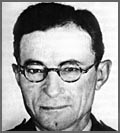
Charles Anderson was born at Cape Town, South Africa, on 12 February 1897. On 13 October 1916 he was commissioned as a lieutenant in the King�s African Rifles and fought with its 3rd Battalion in East Africa against the German-led Askari natives. In addition to being awarded the Military Cross he gained valuable jungle warfare experience. Anderson moved to Australia in 1934, and joined the Citizen Military Forces. He was appointed a captain in the 56th Battalion (Riverina Regiment). He was promoted to major on 26 October and on 1 July 1940 was joined the Australian Imperial Force (AIF) as second-in-command of the 2/19th Battalion.
Anderson was awarded his Victoria Cross during operations against the Japanese in Malaya in the period 18-22 January 1942. In mid-January in the Muar area, the left flank of the allied forces began to crumble when the Japanese Guards Division attacked the inexperienced 45th Indian Brigade. The Guards crossed to the Muar River and advanced south against the hard-pressed British forces. Anderson's 2/19th Battalion, sent from the East, arrived at Bakri on the morning of 18 January to reinforce the Brigade. It soon became engaged with the Japanese who had come in behind the forward Australian battalion, the 2/29th Battalion. At about 10 a.m. on 19 January, the headquarters of the 45th Indian Brigade was bombed, badly injuring the Brigade Commander.
Anderson then took command of the Brigade which had one Indian battalion, at that stage cut off by the enemy, and two other Indian battalions which were in disarray. All had suffered heavy casualties. Anderson waited until the afternoon before ordering the 2/29th Battalion to withdraw into the perimeter, by which time two hundred men of the isolated Indian battalion had reached the Australian lines. During this period, both the 2/19th and 2/29th Battalions were heavily engaged with the Japanese units which had continued to press forward, encircling the Allied force.
On the morning of 20 January the Allied force began a fighting withdrawal towards a vital bridge to the South. The leading company broke through a Japanese blocking force, but the main Australian and Indian force was still hemmed in and vulnerable to air attack. Another company went into the attack with Anderson himself leading the final assault. He personally put two machinegun posts out of action with grenades and shot two Japanese with his pistol.
Further on they encountered another road block and the Japanese, following close behind the Australians and Indians, pressed the rearguard until a counter attack was launched in which the wounded Brigade Commander was killed. Meanwhile Anderson, with the advance guard, organised a three-company attack which put the enemy to flight. That night Anderson learned that the Japanese had fully surrounded his force. On 21 January Anderson's force again encountered the Japanese strongly established in a blocking postion. The Australians attacked, but had gained only a few hundred metres by night fall. Anderson's force now had many wounded and its artillery and mortar ammunition was almost exhausted. Another Allied battalion was ordered to launch a relieving attack that this was delayed and eventually abandoned on 22 January. Early that morning Japanese tanks broke into the perimeter of Anderson's force from its rear, but were stopped by direct artillery gunfire. The isolated force was bombed from the air and shelled by artillery, as it had been throughout its withdrawal. At 9 a.m. Anderson ordered that his vehicles and guns be destroyed and the men withdraw eastwards in small parties. Anderson's force had done all that could reasonably have been expected of it, but their losses were heavy. The 45th Indian Brigade had been decimated, and the two Australian battalions had also suffered heavily. Of the 2/19th Battalion only 271 reached the Allied lines, and only 130 men from the 2/29th Battalion got clear.
On 15 February 1942 Anderson was taken into captivity when British forces in Malaya surrendered. He was released in August 1945 and returned to Australia where his AIF appointment was terminated on 21 December 1945. He was invested with the Victoria Cross by the Governor General at Sydney on 8 January 1947.
Contributed by Australian War Memorial Web Site
 View
View