
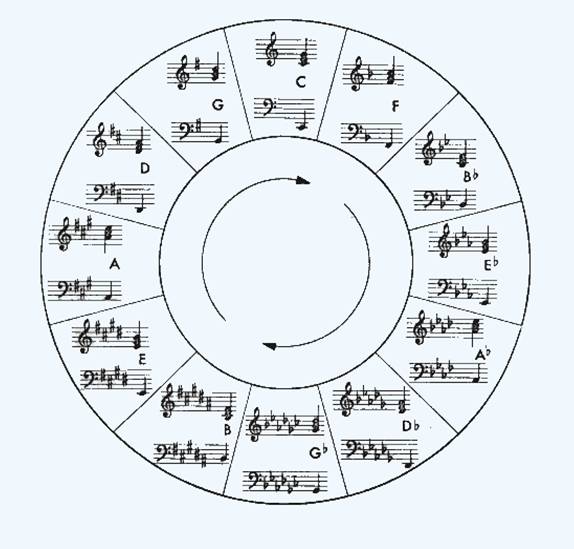
The circle shows the keys and the key�s flats or sharps in sequence so it is easy to memorize both the keys and their flats or sharps.
You will notice that the sequence of flats moving clockwise around the circle is F BEAD G, and the sequence of sharps is BEAD G
The sequence of sharps or flats is read left to right on the staff.
The key of C has no sharps or flats.
The key of F has one flat, B.
The sequence of flats is B, E, A, D, and G.
The sequence begins with the highest of the three black keys and then the higher of the two black keys and continues alternately down the keyboard.
The key is one less than the last flat.
For example: if you have three flats B, E, and A, the key would be E flat which is one less flat than A flat. If you have two flats, B and E, the key is B flat which is one less flat than E flat.
The key of G has one sharp, F.
The sequence of sharps is F, C, G, D, A, and E.
The sequence begins with the lowest of the three black keys and then the lower of the two black keys and continues alternately up the keyboard.
The key is � step above the last sharp.
For example: if you have three sharps F, C, G, the key is A which is � step above G sharp. If you have two sharps F, and C, the key is D which is � step above C sharp.