Iskra Dimitrova home
home
 
 
"Our true necropolises are not any more at the cemeteries, hospitals, wars, or the hecatomb(s); the death is no longer where we would expect it to be - it is not even lethal any more - its necropolises are the vaults and halls of computers, the empty spaces deprived of human sounds - it is a glass coffin in which all of the sterilized recollection of the world is being frozen - only the dead do remember everything..." (Jean Baudrillard)


WC (WONDERFUL CREATURES)

Interactive installation, 1998


CIX Gallery, Skopje, Macedonia,
solo exhibition

Kunsthaus, Nürnberg, Germany
Brown Sugar, Kunst der Gegenwart aus Mazedonien,
curator Menka Karapasoska

The theme of death occurs as a central point all through the works of Iskra Dimitrova as a structuring principle for a whole spectrum of signifying and deeper layers of artistic expression. While elaborating the Doubling motif through the process of dissecting and duplicating, Iskra Dimitrova has created, in course of the past several years, a series of artworks using the body for "recounting the tale" of life and death. In her cryptic setting a speechless persistence was evolving, together with the duplication and evaporation, or the extinction of the sense during the inevitable disintegration of the body.


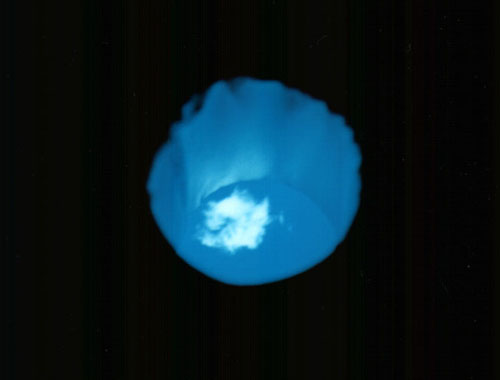
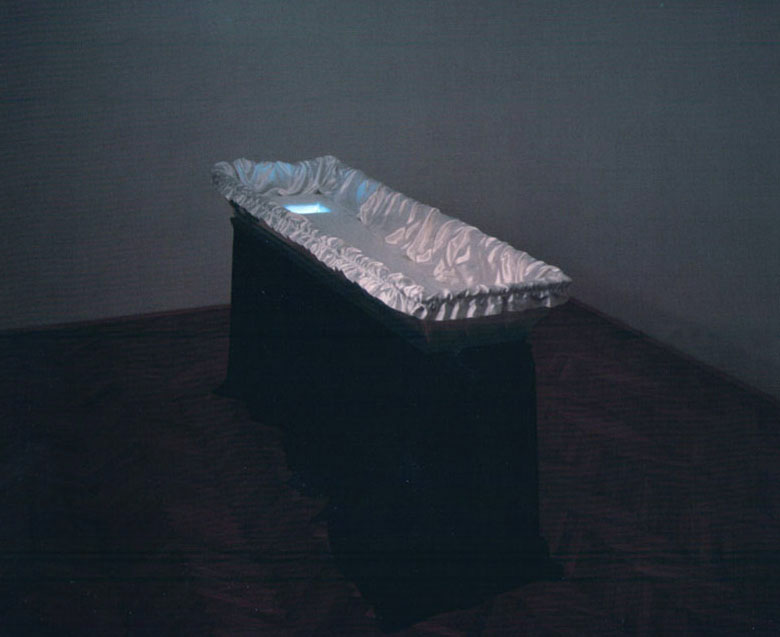
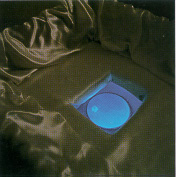
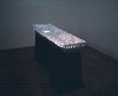
WC (Wonderful Creatures) installation view


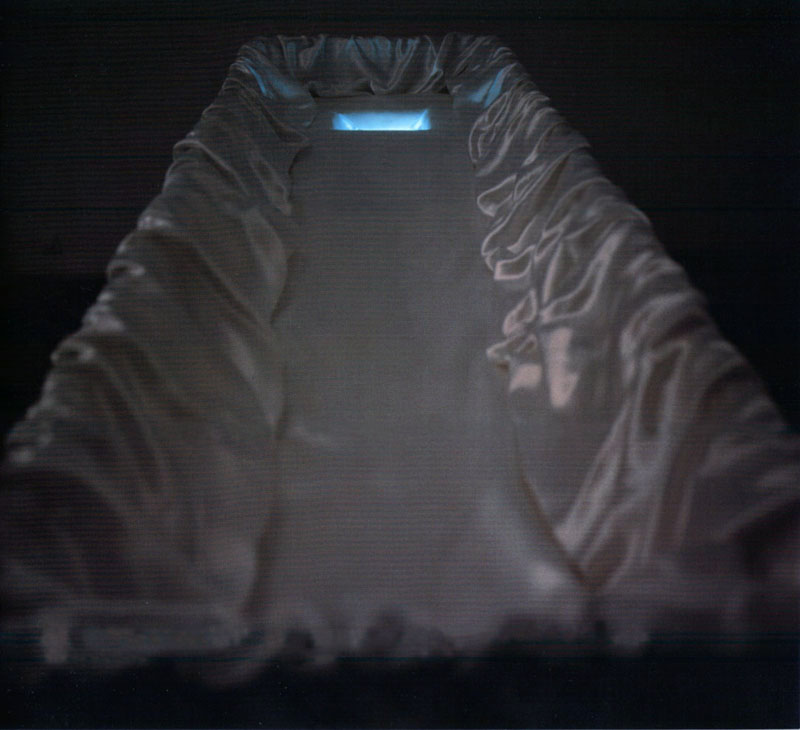
Yet, the body as a scene of expression is being abandoned in her installation Wonderful Creatures, and quite unexpectedly, its place is consigned to the "locution" of the concrete, stripped-down reality. Instead of the body itself, the vacant spot is being taken over by the morbid body of death - the coffin. Cryptic setting and the Doubling on the brink of the existence and nonexistence, once present in the works of Dimitrova, are now "breaking down" on the hard and crude body of the object-coffin. Confronted to this unmitigated reification and decomposition where the subject itself is discernible only by the outlines of the object, the author is suddenly bringing us to a paradoxical situation. Out of the mute body of nonexistence, an amazing light (a vision of the heavenly infinitude) is outpouring, as well as a quiet narrative on "the wonderful creatures ... who, while flying, had their wings shining under the sun".


text Wonderful Creatures


WC (Wonderful Creatures) detail


We are transferred to the regions of memory and dreams, to the delicate folds of fairy tellings, to the subtle lattice of gentle expression. This levitation over maidenly harmonies, within the topicality of the "grandmother's lap" and of the remebrance, rebounds from the morbid voicelessness of the object-coffin. But, this constitutes the topicality of this work - counterpoint, as a play of immeasurable things which is suggesting, following the inevitable rhythm of artistic language, some other layers of adverseness and bisection as well. The heaviness and weightlessness, the dark and the light, the stiff and the fragile, the oblivion and the remembrance, the identification and lossing of one self - these are all pulsating in the unexpressed of the expression.


WC (Wonderful Creatures) detail


Here the death is but a way of having a look at the deep emptiness of our essence, a way to sense the immeasurable sorrow which is not caused by the disappearance of the body, but by the vanishing sense.


Liljana Nedelkovska, In: Iskra Dimitrova, WC (Wonderful Creatures), CIX Gallery, Skopje, 1998 (cat.exh.)


WC (Wonderful Creatures) detail


Materials: coffin, PC computer, sensors, sound, text
The text starts when one comes near the coffin.


back


Wonderful Creatures

Once upon a time there were wonderful flying creatures.
Their wings were fragile like fine gauze. They shimmered and gleamed in the sunlight whenever
they flew. They were admired for their beauty, for the iridescence and brilliance of their color, and for their
long, slender bodies - red, green or blue.

These wonderful creatures were noted for their swift, darting, soaring motion
and for their power of long, sustained flight. They hovered at arm length and then darted away
with the flick of an eye. They could shoot upward or sideways instantly
at the slightest hint of danger, swooping up and down and forth and back.
Each one, in each moment flew differently.

They loved the sun and seemed to disappear almost miraculously whenever the sky became cloudy.
Some believed that these creatures were the spirits of people who had recently died.
They insisted that the creatures be left undisturbed.

Male and female often flew together and sometimes made love while in flight.
The male warmly embraced her while she flew down to the water to gently lay down the little ones.
He often flew with her until they were close to the water, and then released her,
marking time overhead while she dropped to the surface, clasping her again as she rose,
to circle off and away before repeating the performance.

Strangely enough, although they were 'master aerialists' they spent the greater part of their lives in water.
As they grew older they transformed many times. Although they once lived in water
while growing up, when they transformed into adults they were no longer confined
to the vicinity of the water.

They lived only a few days.
back


back


back


back


Photos: Robert Jankuloski, Aleksandar Milev


Contact


© 1999-2000 Iskra Dimitrova
All rights reserved.


Hosted by www.Geocities.ws

1