|
"We
are discontinued beings,
individuals who die lonely
in an incomprehensible adventure,
and yet we feel the yearning
for the lost continuity"
(Bataille)
|
|
Iskra Dimitrova's project, Memento mori*, conceived and carried
out in the 'shelters' of the Museum, is a kind of spatial inscription
of the idea of death. Everything serves this idea: the abandonment
of the exhibition rooms of the Museum; the isolated position
of the space in the subterranean part of the Museum; the stairs
which we must descend; the inaccessibility to outdoor light;
the isolation of sounds; separation, darkness... as if in a
tomb... We are involved in a ritual of "absorption of death"**:
death freed from its instrumental, everyday meaning and raised
to the level of symbolic exchange.
Thanatometamorphosis,
Bridal Chamber and Remains are three situations
of experiencing and coming face to face with death.
I Thanatometamorphosis:
black room with a black body (corpse);
II
Bridal Chamber: white room with a white body (soul);
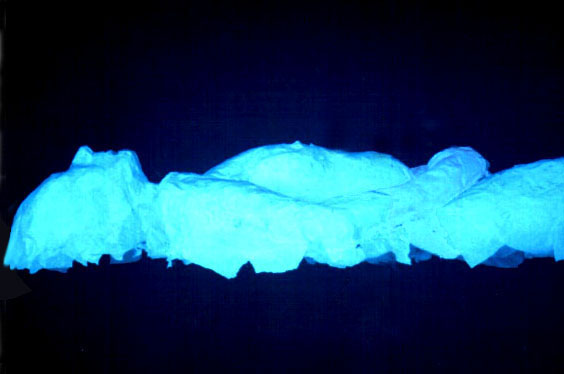
III Remains: white room
with a contorted body (corpse or fetus?).
Despite
its
poetic overtones, despite its references to certain general
paradigmatic and symbolic situations (the symbolism of the circle),
Iskra Dimitrova's cryptosofy gives an odious impression. And
it is precisely here that the paradox of the experience of death
lies, to which the Memento mori environment alludes:
surrounded by death every day, we no longer notice it. "Persecuted
and censored everywhere, death springs from everywhere. This
time no longer as apocalyptic folklore - the kind that could
preoccupy the imagination of certain epochs - but, deprived
of any imaginary substance whatsoever, it turns into the most
banal reality and takes the form of the very principle of
reality that governs our lives."******
"My
death everywhere, my death that dreams"*******
*Remember that you must die, mediaeval carnivals organized with
the purpose of reminding people of the existence of death, to
which Iskra Dimitrova refers.
**Jean Baudrillard, Simbolicka razmena i smrt (L'Echange symbolique
et la mort), Decje novine, Gornji Milanovac, 1991
*** Ibid.
**** Ibid.
back
|
|
II
installation of the project Memento mori
Museum
of Contemporary Art, Skopje, Macedonia, 1997
curator
Liljana Nedelkovska
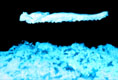
Bridal Chamber
Iskra
Dimitrova: "Eternal is the human yearning for real life, real awareness
only after death."
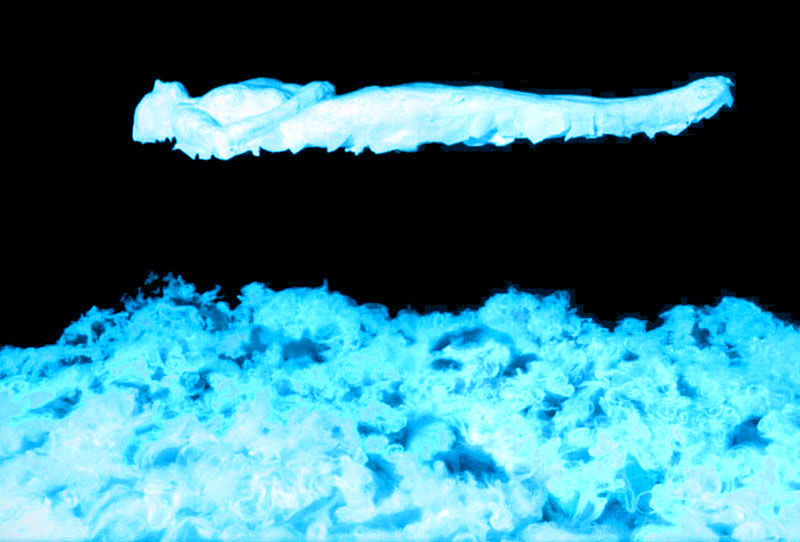
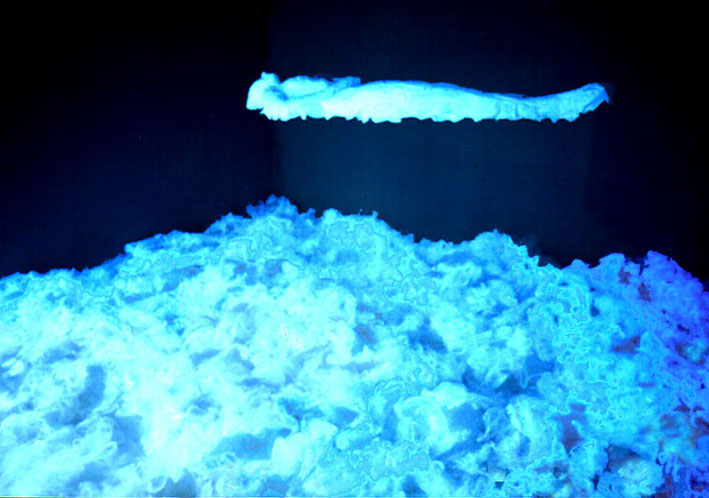
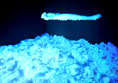
Bridal Chamber*: white room in whose airy, unreal atmosphere
(achieved through the effect of ultraviolet light and the softness and
reflection of malon synthetic wool which fills the lower part of the
room) there
'floats' a white cast.
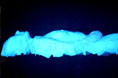
This
cast, with its transparent, weightless state, attracts us
towards the invisible borders of our wish to experience death in a different
way. Our wish to free ourselves from the trauma of death is
as strong as the awareness of its inevitability. Hegel speaks of the
dual feeling of death in Christianity: there is natural death of the
natural body, but at the same time it is "the greatest love"
and "the ultimate renouncement of oneself because of the Other".
Here
"death dies", and "the end turns into sublimity, into
solemnity..."
*Bridal
Chamber, initiation ritual in Gnosticism
Text
by Liljana Nedelkovska, curator at the
Museum of Contemporary Art, Skopje, Macedonia
|