
By: Inuki **Ookami**
With Additional Help From: Tri-Link (On Mandrake and Maidens Trap)
By:
Inuki **Ookami**
With Additional Help From: Tri-Link (On Mandrake and Maidens Trap)
Flowers Plants and Herbs

Angelica - Reputedly Angelica takes its name from the archangel who recommended
its use during the times of plague. It is said to protect against evil spirits
and witchcraft, hence it is also known as 'The Root of the Holy Ghost'. It is
a large biennial herb with glossy green leaves with white flowers from midsummer.
Now used to decorate cakes and trifles. The stems can be used to reduce acidity
and the leaves, which are sweet, can be added to preserves or fruit dishes.
Similar in taste to juniper.

Basil - Used for over 2000 years, it symbolises love. At one time young girls
would place some on their windowsill to indicate they were looking for a suitor.
In Tudor times, small pots of this were given by farmers' wives to visitors
as parting gifts. It is also reputed that any man will fall in love with a woman
from whom he accepts some basil from as a gift. It has large shiny green leaves
and small white flowers. Can be used as snuff to cure headaches.
Beans - Scattering the flowers is thought to placate demons in many countries particularly in the Far East, being associated with death and the spirits of the dead. If one bean in a row should come up white instead of green, an English tradition associates this occurrence with death, and in the south west it was once believed that 3 May was the best time to plant kidney beans to ensure a successful crop.
Broad beans were thought to possess the soul of the dead, and when in flower it was believed that accidents were more likely to happen. If it was a leap year it was thought that the bean would grow upside-down. The shape of the bean was thought to be associated with death and ghosts. Scattering some around the outside of the house would stave of such attentions for 12 months.
Broad beans have also been associated with forecasting the future. A European
belief was that three beans should be prepared in different ways to produce
an outcome and then hidden on Midsummer Eve for the enquirer to find. The untouched
bean indicated wealth, the half-peeled bean indicated a comfortable life, whilst
the third fully peeled bean indicated poverty. The future was revealed by which
bean was found first.
Blackberries - Although thought to be associated with alleviating several illnesses such as whooping cough, boils and rheumatism, t his fruit has over time become associated with the Devil in France and England. In France it was thought that the colour of the fruit resulted from when the Devil spat on it, whilst in England it was thought that picking fruit after 11 October (Olde Michaelmas Day) would bring bad luck as the Devil was believed to have fallen into a thicket and had left a curse on the thorns which had hurt him.
Blossom - It is a commonly held belief that shrubs and trees flowering out of season will bring bad luck, particularly if the flowers of one plant bloom in great numbers when it was thought a hard winter would follow with the community being affected by illness and death. The late flowering of Christmas roses in Wales also indicated imminent sickness and possible death.
Bluebell - This lovely flower is most dangerous. The Scots call it "Deadmen's Bells" because hearing the ring of a Bluebell is to hear your death knell. It is one of the most potent of the faery flowers. A bluebell wood is especially hazardous because of the faery spells and enchantments.
Borage - Supposed to revive the hypochondriac, it is thought borage provided
courage. The Crusaders reputedly drank a mixture of borage and wine before battle
to raise their strengths and spirits. Pink star-shaped flowers on slender green
stems are a pretty sight in the summer and possess a taste and smell very similar
to that of the cucumber. It has been used to treat colds, coughs, bronchitis
and even rheumatism and can help with skin rashes. Lots of vitamin C here.
Bramble Bushes - Creating a natural arch out of any forms of brambles and passing someone who is ill underneath was reputed to cure the affected. Blackheads, rheumatism, boils and whooping cough were also thought to be helped by eating the fruit.
Buttercup - The tradition of children holding buttercups under their chins has been common for many years to find if a yellow glow can be seen. If so, the child likes butter, and the sun will shine.
Cabbage
Thought to be an omen of good luck, particularly if a 'double' is found growing
in the garden (a double being a cabbage that has two shoots from a single root).
Caraway - Using this apparently staves off any prospective burglar when placed
amongst your valued possessions. If the thief did manage to get in the house
apparently the caraway would transfix the person until rescue arrived. For women
worried about their husbands wandering off with other women, placing some in
the pocket would do the trick - same principle as with pigeons - a little in
their food and they'll never want to find another coop.
Carrots - There is some truth in the belief that eating a lot of carrots will improve the eyesight as they contain medicinal salts (although the story of WW2 British RAF pilots being fed on a special diet of carrots is false but typical of the claims made of this vegetable). Eating large quantities of boiled carrots was thought to help asthmatics (by relieving constriction of the bronchial tubes). Also thought to be an aphrodisiac.
Catmint - Believed to chase away nightmares when jelly conserve was made from
the young tops and eaten. Also it was once placed in wine to treat bruises.
It has grey-green leaves and pink, white or lilac flowers which bloom from midsummer.
Viewed with some suspicion as cats are heavily attracted by its aroma - hence
its name.
Chamomile - Said to aid stomach upsets and indigestion, and help those who suffer from insomnia. In Ancient Egypt it was dedicated to the Gods and highly revered for its medicinal qualities and healing powers. The oil is still used and can be used to increase the shine on fair hair. It is an annual with small yellow and white flowers.
Chervil - Served on Holy Thursday as it is said to represent new life and rebirth and was therefore heavily used during Lent. It is also reputed to have been used to heal the blood by having cleansing qualities. Pale green leaves and small white flowers this plant was also used to cleansed the skin.
Chicory - Need the powers of invisibility - here's the plant for you. Perhaps
you'd prefer to open a locked chest - here too chicory could help you but only
on July 25 (St. James's Day). By holding a gold knife and chicory leaves against
the lock, the lock picker would be successful, but only if working in silence
- or death would soon be upon him if a word was spoken. Credited with opening
locks and removing obstacles. Reputedly the early American settlers and prospectors
would carry a piece of this with them for good luck.
Clover - A four leaf clover would bring good luck but also had an added bonus as it was believed it would provide the owner with second sight - the power to see witches and fairies. The three leaf clover has been linked to the Holy Trinity since St. Patrick used it when explaining his doctrine on the subject (although some also believe he used a piece of wood sorrel). In some parts of Britain finding a four-leaf clover also heralds the possibility of meeting your true love on the same day. Enhancing your good luck it is said can be achieved by passing the lucky clover to someone else. Possessing a four leaf clover was also supposed to help those trying to avoid military service. "One leaf for fame, one for wealth, one leaf for a faithful lover, And one leaf to bring glorious health - All are in the four-leaf clover". Four-leaf clovers protect against faeries. It is used to dissolve Glamour in spells cast by faeries or magicians. The Faery Ointment that allows mortals to see through the glamorous appearance of faeries is made from Four-leaf clover. In addition, lay seven grains of wheat upon a Four-leaf clover and you will be able to see the faeries. Another use is to grant wishes. St Patrick used a shamrock. (a very different plant). Most clovers have three leaves, four leaved ones are considered to be lucky, yet five leaf clovers are considered to be bad-luck! How does that work?
Coriander - The Chinese in ancient times believed that one of the powers of this plant was immortality, whilst the Anglo-Saxon's used it as an ingredient in a hand cream to remedy chapped skin. In Peru soap was made from the leaves which are similar to the flat-leafed parsley with small pinkish-white flowers.
Cowslip - Both loved and guarded by faeries. They have the power to find faery gold which is why Cowslip is also called "Culveis Keys", which means key to unlock the way to treasure.
Daffodil - Avoid taking a single flower into the house as it will bring bad luck - always have a bunch to ensure happiness. In Wales finding the first daffodil of Spring is expected to bring more gold than silver to your life and home during the following 12 months.
Daisy - This flower was an essential part of Midsummer celebrations. Whilst it was considered lucky to step on the first daisy of the year, young children were strictly told to avoid it as should it be uprooted the child would grow-up stunted in height. Any young animal that ate it would also come to harm (although in what way it is not known). You can still see young girls occasionally picking daisies and counting the number of petals. By doing so she would be able to find out if her male friend loved her or not by alternating 'he loves me, he loves me not' for each petal pulled out. By grabbing a whole bunch of daisies with the eyes shut the girl could then count how many flowers had been picked. The number reflected how many years she would have to wait before she would marry. Protect against magic because they are a sun symbol. Some believe that dressing children in daisy-chains and coronals will protect them from being taken by the faeries.
Dandelions - In English country folklore this flower is seen as a love omen (although a lot of gardeners also view it as an unwanted weed as it spreads so quickly). If the flower has bloomed and you are left with just the dandelion clock of fluffy seed heads, counting the number of seeds left after you have blown on it will indicate how many years you will have to wait until your wedding day.
Dill - Said to be used heavily in the Middle Ages in witchcraft and magic spells
although it was also known for providing a good night's sleep if taken in tea
just before bedtime. It has fine feathery green leaves and tiny yellow flowers.
It can be used to sweeten the breath.
Fennel - This hardy perennial has feathery leaves and is either bronze or green in colour. It is reputed to promote strength and courage, and also longevity. Snakes were reputed to eat fennel to help them slough their skins and horses could be caught if fed this in gingerbread. In medieval times fennel was hung above doors on Midsummer's Eve to ward off evil spirits. From Midsummer onwards it produces bright yellow flowers and looks very similar to dill. It is an important culinary herb, having an aniseed flavour it is useful for fish or vegetable dishes. It is believed to be useful in treating eye complaints, strengthening sight. Taking an infusion of leaves and seeds is said to relieve tired eyes.
Ferns - Also known as 'Devil Brushes' in England it is believed that hanging
dried ferns in the house will protect all the inhabitants from thunder and lightning
damage. Be careful though because it may rain when the ferns are cut or burnt.
the brackenseed of the plant is said to provide magical qualities if you place
a few in the pocket - invisibility being the most notable. Also be careful when
you go seed collecting because it is believed that treading on a fern will cause
the poor unfortunate traveller to become confused and lose his way. Stomach
ache is supposed to be alleviated by taking some crushed brackenseed taken with
water from a fern growing on a tree.
Feverfew - Growing this around the outside of the house is said to fight off and keep out disease. Also known as 'Flirtwort' and 'Bachelor's Button' it has lacy yellow or green leaves and is highly aromatic with yellow and white flowers in the summer, although bees dislike it. Said to relieve fever if sprigs of the plant are bound to the wrist.
Flowers - To as far back as ancient Egyptian times giving flowers to people has been seen as a good luck token bringing good fortune to all concerned though folklore has it that taking flowers into a house that have bloomed out of season or giving them to a friend will bring bad fortune. When choosing flowers for someone who is ill it is considered wise to think about the associations connected with each flower (white should not be given, whilst red are seen to be a good choice as they denote life, regeneration, blood), and never mix flowers together or place flowers on the bed for a sick person. Picking a flower from a grave and then simply throwing it way is thought to bring bad luck as the place where the flower falls will be haunted.
A German belief though has somewhat happier results. By taking a flower to the table and brushing over your lips after you have drunk some wine then giving this to your lover will secure their love to you forever.
Planting flowers during the period of the new moon is reputed to encourage
good luck and prosperity in all your gardening endeavours.
Forget-Me-Not - Like the Cowslip, the Forget-Me-Not is said to open faery treasure.
Foxglove - The belief in fairies is where this plant received its name from
as the little folk were reputed to wear 'folk's gloves'.
Foxglove - This beautiful flower is one of my personal favorites. It is the source of digitalis, the base of the heart medication, digoxin. The flowers of this plant are worn by faeries as hats or gloves. Foxglove can be deadly if eaten.
Garlic - Considered to have great power being able to keep evil spirits and
forces away from the house, hence the tradition of hanging garlic above windows
and doors. In France garlic is roasted on Midsummer Eve for protection also.
In the Far East it is believed to have the power to bring back lost souls being
heavily used in religious ceremonies. It is also seen to be an effective aphrodisiac.
'Vinegar of the four thieves' was the name given to a drink made from garlic
taken in the 17th-century by thieves and plague victims to prevent infection,
as garlic juice is an antiseptic. Part of the same family as onions, leeks and
shallots. In World War 1 French Army cleaned their wounds with it.
Grass - To see a cat or a dog eating grass to soothe and aid the digestion of food is seen to indicate that rain is on the way so grab your brolly.
Heather - Heather can be found growing wild in many colours but it is the white variety that is considered to be lucky. This belief is thought to be because it was the only type of heather left which was free from bloodstains when the Picts were slaughtered. Scotland of course is famous for heather where similar reasons for white heather being lucky apply. It is said that "heather will never grow over the grave of the clans". A symbol of solitude, Heather is a favored food by faeries who wish to live undisturbed.
Hemp - It was believed that working in hemp fields would bring on sterility,
and women were forbidden from doing so in fear that they would become barren
(although it was still used in marriage divination). Devon folk, UK, traditionally
believed that on Valentine's Day a young girl should walk from the church porch
to the home half-an-hour after midnight if she wanted to see the wraith of her
future husband following behind her. As she went the girl should scatter hemp
seed and look to see the man raking the seed into ground behind her.
Holly, Ivy and Other Greenery - Decorating a house at Yultide with Holly and berries brings good luck because it delights the faeries. Any plant that remained green in the winter was considered to have special powers, so evergreen trees like the holly, fir and pine and other plants like the ivy were often used as religious symbols. Of these, the holly has probably received the most attention. The holly that appears in the well known Christmas carol "The Holly and the Ivy" is most certainly English ivy (Ilex aquifolium). The most common symbols of the holly tree are the sharp points on its leaves that represent the crown of thorns worn on Jesus head and the red berries that represent the blood of Jesus. The ivy in the song is merely mentioned as being inferior to the holly.
The "Sans Day Carol," a traditional Cornish carol, also uses the holly as a symbol and focuses entirely on the different colors of berries found on hollies. As in "The Holly and the Ivy," red berries symbolize Jesus' blood. White berries, found on some holly trees, represent Jesus' purity. Green berries represent the cross Jesus died on. Black berries represent the death of Jesus. Because of the significance of holly it is often used in Christmas wreaths, along with evergreen boughs. The tradition of using holly at Christmas was also brought to North America, and the American holly (I. opaca) is common here.
Another bit of greenery with a long Christmas history is rosemary (Rosmarinus
officianalis). Legend says that when Mary and Joseph, the parents of Jesus,
fled from Bethlehem to Egypt, when Mary stopped beside the road her blue cloak
fell on some rosemary. The flowers were changed from the original white to the
blue we now see on rosemary. Another legend says that Mary washed some of baby
Jesus' clothes in a nearby stream and put them on some rosemary to dry. As a
reward for service the flowers were turned blue and the plant was called rosemary
from then on. Whatever the legend, it became popular in Europe to spread rosemary
on the floor of churches around Christmas and people often spread them on their
floor at home as well.
Honeysuckle - It was believed that a wedding would soon occur if this plant was brought into a house whilst placing the flower in a female's bedroom was reputed to encourage erotic dreams
Hyssop - One of the oldest herbs known and reputed to be used to clean the outside
of sacred buildings, hence it was known as a holy herb (it is also mentioned
in the bible with this connection). Aromatic dark green leaves and can have
pink, white or blue flowers. A strong minty taste and smell. Traditionally believed
to help with chest complaints so was taken to promote perspiration. Also used
for rheumatic pains.
Ivy - The ivy is associated with Bacchus the Roman god and is therefore thought to bring good luck, fun and ecstatic happiness! Growing the plant on the outside walls of a house is believed to be a strong deterrent against misfortune, but if a house plant dies then financial strains may be approaching. If a man places one of ten leaves gathered on 31 October (Halloween) under his pillow it is thought he will dream of his future bride. Women are advised to recite the following once they have collected the leaves "Ivy, ivy, I love you, In my bosom I put you, The first young man who speaks to me, My future husband he shall be". In Shropshire (UK) it was believed that drinking from an ivy cup would cure a child of whooping cough, whilst an alcoholic would be cured of the problem if he drank from a cup made if ivy wood.
Japonica Berries - Also known by English country folk as 'Forbidden Fruit'
as they are believed to have been the original fruit presented to Eve by the
Devil in the Garden of Eden. So eat the jam but beware of the consequences.
Leaf - Oak and Ash leaves are thought to be omens of summer weather. If you need some rain then hope that the ash comes into leaf first; little rain, then hope for the oak. Rain is also thought to be on the way if you hear leaves rustle or see the underneath of the leaf turned upwards. Too many leaves falling before autumn has officially arrived is an ill omen, so too when leaves wither quickly when brought into the house. If you can catch a leaf as it falls you should be lucky enough not to catch a cold during the winter, and if caught between Michaelmas (29 September) and Halloween (31 October) the following year should be a prosperous one.
Leek - Before going into battle the Welsh tradition of rubbing themselves with
the plant was thought to bring extra strength and power to the fighter whilst
providing protection from being wounded.
Lettuce - The Romans believed that the lettuce plant was a powerful aphrodisiac and possessed child-bearing powers. Lots of it was served at feasts and weddings not only for these reasons but probably because it was thought to prevent drunkenness. Whilst in England country folk traditionally believed that planting lots of lettuce in the garden could prevent conception!
Lilac - Reputed to be a flower that normally indicates an ill omen hence the
name 'drowsy-scented flower'. The white varieties were thought to be the worst,
and should not be given to the sick or taken into a house. The only exception
to the rule was the rare five-petalled variety.
Lily - This flower has traditionally been associated with virginity hence the
expression 'pure as a lily'. A widely held belief regarding this was that it
was unlucky to break or damage the plant would threaten happiness, particularly
for a man as this action would bring bad luck to the female members of his family
resulting in their purity being threatened.
Maiden Trap - Also known as The Beauty Plant, Warriors Folly This rare plant
is found in swamps, bogs, humid woods and forests. It spreads eight or nine
foot leaves on the ground in a radiating pattern. It reproduces through airborne
seeds released on capture. The leaves are thin, strong, broad and mimic the
colour of the ground they grow on. They radiate outward from a central taproot.
Unless growing near others of it's kind it produces a flower that resembles
a golden chalice. The plant also emits an odorless, intoxicating chemical. When
something steps near the center the leaves envelope it showing their green undersides.
When a person or animal steps into the center of these plants (usually to reach
for the cup like flowers) the leaves envelope it forming a skintight prison
that is practically unbreakable. Inside the victim is put into a deep sleep.
After one day and night the victim is released to find they have been transformed
into a beautiful maiden. If the transformation occurs to an animal they will
come out wearing clothing similar to their natural skin or coat. Persons caught
retain their memories, yet animals gain the knowledge of how to walk and talk,
but remember little. This plant was created by a powerful sorcerer to guard
his tower against attacks from his enemy's soldiers. The effect is reversible,
but no one is sure how because when the sorcerer died he took the secret with
him. The sap from this plant is quite valuable, as it is used as a makeup, and
teenage boys often challenge each other to pick the flower, which turns into
a strong crystalline substance in a few hours.
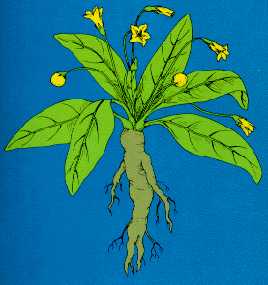
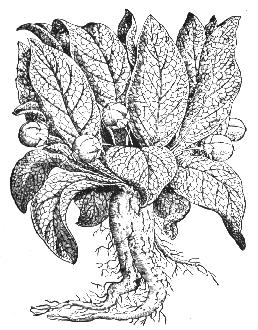
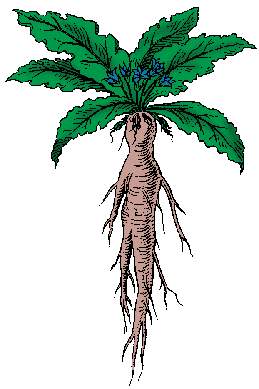
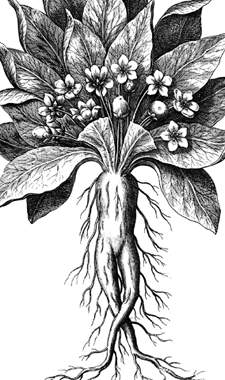
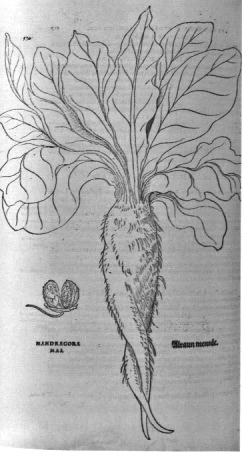
Mandrake (màn´drâk´) - 1.a. A southern European plant
(Mandragora officinarum) having greenish-yellow flowers and a branched root.
This plant was once believed to have magical powers because its root resembles
the human body. b. The root of this plant, which contains the poisonous alkaloid
hyoscyamine. Also
called mandragora. 2.See May apple. - Thought to promote passion (but also sterility).
Once used as an aphrodisiac and also as an anaesthetic hopefully not at the
same time. It was somewhat feared as a plant as it's root which is long and
forked was said to embody an evil demon, and that if it was pulled from the
ground a terrifying shriek would be heard. Anyone hearing the shriek would die.
Hence the custom was developed for dogs to dig up the root by tying the hungry
animal near to the plant and placing some meat near to the plant. The idea was
that the dog would eventually make a grab for the meat uprooting the plant,
and no-one had to witness this. The dog would die when the root was dug up which
theoretically was due the shriek (but could it have been from poison). The plant
is rare in Britain. mandrake [Middle English, alteration (influenced by drake,
dragon). See drake2, of mandragora, from Old English, from Latin mandragorâs,
from Greek. Mandrake, common name for any of a genus of herbs. The species to
which the name is particularly applied has two varieties, vernal and autumnal,
both native to the Mediterranean and Himalayan regions and especially to Greece.
The whole plant has a fetid odor. As late as the Middle Ages, a dose of the
oddly shaped root was sometimes given to patients as a narcotic before surgical
operations. In the United States mayapple is often called mandrake. The mandrake
has traditionally been the object of superstition, largely because of the resemblance
of its forked root to the human figure. Used as an aphrodisiac, the mandrake
was also variously regarded as a charm for pregnancy, for invulnerability, and
for discovering treasure. Scientific classification: Mandrakes constitute the
genus Mandragora, of the family Solanaceae. The species to which the name is
particularly applied is classified as Mandragora officinarum.
Marigolds - In the West country of England these flowers are known as 'The
Drunkards' due their reputation for turning people into alcoholics when the
flowers are picked or even looked at for any length of time. The Welsh traditionally
believed the flower could be used as a weather omen. If the flowers were not
open early in the morning a storm was on the way. Used as a love charm, in wedding
garlands and posies, it was also believed that rubbing the flower head on a
wasp or bee sting would alleviate any pain.
Marjoram - Used as snuff when dried and ground, this plant is said to help
the farmers. If mixed with wild thyme and placed near the milk in a dairy, the
mixture will ensure that it is not turned sour by thunder and lightning. Sweetly
scented it has tiny green leaves and pink flowers.
Marshmallow - This plant was used as the main ingredient, by medieval clergy, in a preparation given to the accused who were to endure an ordeal by fire. Those receiving this treatment were seen as favoured by the clergy for being given this preparation. The sap was used, being smeared quickly over the hands. Reputedly this allowed the accused to hold a red hot iron without being burnt.
Mint - Reputed to be able to heal the pain caused by wasp and bee stings. In Ancient Greece the custom was to perfume all parts of the body with a different scent...mint was used for the arms! It has lilac and cream flowers in the summer and is extremely aromatic wrinkly round leaves. It was also viewed as a symbol of hospitality, so much so that tables were rubbed down with it before the table was prepared.
Mistletoe and Poinsettas- For many centuries this plant has been the base of a range of remedies, so much so that it is also known as 'all-heal'. It is a parasitic plant. When the host or main tree died off in winter it was believed that the mistletoe held the life of the main plant within itself. If found growing on an oak tree this had great significance for the Druid who revered the oak as much as the rowan. the druids viewed the berries of the mistletoe when found on an oak tree as the seminal fluid of the oak-tree god (or spirit). So it was thought that this effect was then an indicator of a charm to induce fertility in action. The mistletoe was cut on the sixth day of the moon with a golden sickle and with full ceremony, which was then divided amongst the people. Fastening the mistletoe to a doorway was thought to ward off all evil, and thunder and lightening. Perhaps the modern custom of kissing under the mistletoe at Christmas is a remnant of this pagan custom. The sprigs of this plant were regarded as a symbol by some of hospitality.
Mistletoe is one of the Christmas traditions that is pagan with no Christian symbolism. It belongs to the Viscaceae or mistletoe family. All members of the family are either parasitic or hemiparasitic. All of the Christmas mistletoes are hemiparasitic, which means they are only partially parasitic. They receive a portion of their nourishment by sinking their roots into the branches or trunk of a a host tree, but they also contain chlorophyll and can make food by photosynthesis. Traditions of kissing under the mistletoe go back to the Greek festival of Saturnalia and kissing under the mistletoe was believed to confer fertility. Many other cultures, including Celts and Scandinavians, considered the mistletoe to have magical powers. Probably lending an aura of mystery to the mistletoe is its method of dispersal. The berries are eaten by birds and the seeds must pass through the intestines of the bird before they will germinate. Some have suggested that this dispersal method led to the name mistletoe which is composed of two Old English words, "mistel" meaning dung and "tan" meaning twig. In actuality, the origin of the word mistel remains a mystery.
The original mistletoe is Viscum album, a European species that parasitizes a number of different tree species. It has the traditional white berries associated with mistletoe and can grow into a moderate sized shrub. It was introduced to California by Luther Burbank and it may occur in other parts of the US as well. The more common mistletoes on the US all belong to the genus Phoradendron. One species, P. tomentosum, is common in Texas and is sold nationally at Christmas time. Other species, like P. villosum which grows on oaks, are important locally. The berries of all the Phoradendron species are also commonly white, but may also be yellowish or even pink.
No Christmas would be complete without the poinsettia (Euphorbia pulcherrima).
As far as Christmas traditions are concerned, the use of poinsettias is a recent
one. They were named after Joel Robert Poinsett, an American ambassador to Mexico
during the first part of the 19th century. He was so impressed with the flowers
on the poinsettias he saw that he sent some home to North Carolina and grew
them in his greenhouse. The brilliant red color of the poinsettia is actually
due to its colorful bracts not its flowers, which are small and uninteresting.
If you look carefully among the bracts you may see the flowers. The red bracts
traditionally represent the star over Bethlehem that led the wise men and are
known as "flowers of the Holy night." Since Poinsett's time many varieties
of poinsettias have been developed with everything from pink to white or even
green bracts.
Nettle - This plant was thought to be heavily used by country folk in medicinal remedies and thought to prevent you being struck by lightning if a small amount was always carried. It was also once believed that you could help a sick relative to recover if you 'grasped the nettle' by the stem and pulled out the root whilst reciting the name of the ill person, or the parents.
Nightshade - A poisonous plant found in Europe. It can be found wild and is
said to have an hallucinogenic effect. Belladonna, a derivative of the plant
was taken by clairvoyants were the aim was to induce second sight. It is also
supposed to have been a principle ingredient for an ointment used by witches
when they wanted to fly. The ointment was rubbed on the body.
Nutmeg - Said be lucky if carried personally to help those unfortunate to suffer with boils or rheumatism.
Nuts - If you are female, have children and have a younger female relative about to be married perhaps you might want to consider taking a bag of hazelnuts to the wedding and presenting it to the bride before she leaves the church, she will be similarly blessed with good fortune so the tradition goes. Today rice has replaced this tradition. If there is a large crop of nuts in your area you can expect an increase in the number of births. To find a nut with two kernels was thought to be lucky: if one of the nuts is eaten and the other is thrown over the left shoulder at the same time as making a wish it should, according to folklore, be granted.
Onion - To hang one in the room was supposed to keep away disease (modern science to some extent does agree with this as if one is cut and left open it will attract germs), whilst sleeping with one under your pillow is supposed to help you dream of your lover to be. Onions could also be used in love in love divination if you are torn between two lovers by carving the name of the person on separate onions and placing them in a warm place. The first to sprout first indicates the most powerful love. Disciplining someone with the cane could fail on two counts if an onion was used according to folklore. Rubbing the onion on the appropriate part of the anatomy would prevent the cane being felt, whilst rubbing the onion on the cane would ensure that the cane would spilt on the first blow.
Orange - A very lucky fruit it seems when exchanged between boys and girls
as it will encourage a love attachment, whilst orange blossom at a wedding was
thought to bring good luck to the happy couple. The orange is also traditionally
attached with fertility.
Pansy - Also called, Heart's Ease, it is beloved by faeries. Oberon, King of the Faeries, is said to have used it in a love potion. Avoid picking these when you're in the middle of enjoying fine weather or the rain will soon return according to tradition.
Parsley - Having chewed on some parsley to sweeten your breath you may then
be shocked to find out that traditionally it was associated with death and disaster.
Bad luck will come your way especially if you cut some for your cooking and
you are in love at the same time, or transplant it, or give it away. The two
varieties now available (curly or flat leafed) are normally used to garnish
a dish, and can grow on your windowsill or in a sunny rich moist soil. Again,
like Rosemary, it is reputed to grow best if the woman of the household is dominant.
It was associated with death by the Ancient Greeks who dedicated it in funeral
rites and scattered it on graves. It was also woven into crowns for victors
of sporting games (and fed to the chariot horses before the races). It is also
believed that babies could be discovered in parsley beds, and that unmarried
girls could put matters to right if they chewed parsley three times a day for
three weeks. When scattered in fishponds it can reputedly heal sick fish too.
The Romans used to line their graves with Parsley to keep the Devil away, and
also to avoid their plants falling into someone else's hands as this was considered
to be like throwing luck away. In Britain it was also once believed that to
sow parsley was to encourage the conception of children so be careful next time
offers you some parsley seeds!
Peach - To place a sprig of orange blossom over your front door would serve to keep evil spirits away according to ancient Chinese folklore.
Peas - Don't be disappointed if you find only one pea in a pea pod next time you're preparing a meal as it symbolises good fortune. Discovering one with nine peas in also allows you the opportunity to make a wish once you have thrown one of the pease over your right shoulder. Good luck.
Pennyroyal - Said, if grown indoors, it will keep fleas and even mosquitoes away. This plant was taken on long sea voyages, in pots, to purify the casks of drinking water. It is a member of the mint family with small mauve flowers and is a low-lying creeping plant with strong aromatic qualities and taste, and said to be used for headaches.
Peony - Placed in the garden this plant reputedly wards off evil spirits and worn as a necklace would help stave off epilepsy, lunacy and nightmares. When children were cutting teeth if the roots were cut and worn the pain would ease (but the root had to be uprooted, like the mandrake, by a dog).
Peppermint - This is still used to catch rats as they strongly dislike the
scent of the oil. The small violet flowers on the end of long leaves are delicate,
and the menthol in the plant can be used in tea, chocolates, toothpaste whilst
also reputed to help with helping those with problems sleeping.
Pine Cones - A means of predicting the weather. When the cone is open the omens
are positive for fine weather, when closed rain is sure to come.
Plants - In England a rural custom is connected with the death of a person
regarding plants. It is reputed that one should whisper the news to their favourite
plants and then tie a piece of black material around them for a few days in
order that they don't wither and die from neglect.
Poppy - A flower of ill omen. Staring into the centre of a poppy it is said can temporarily turn you blind and will cause illness if the flower is brought into a house (perhaps connected with the narcotic qualities of the plant). Since WW1 the plant has become a symbol of remembrance. The tragic loss of so many young men is remembered each Remembrance Day. Each poppy petal laid on a wreath or that is worn as a sign of respect symbolises the death of each soldier that was lost in war.
Primrose - It was believed that a flower blooming in winter or a single flower brought into the house signalled death. If you had less than 13 in the first spring posy the hens on your land would only have as many chickens as primroses in the posy. The Welsh traditionally believed that it is bad luck for a primrose to flower before June. Evil spirits are deterred from hanging around a house if primroses are planted in the garden, and at one time were used as a cure for insomnia Another lovely flowering plant and quite magical. It can allow you to see things that otherwise would be invisible. Eat the Primrose and you will see the faeries. If you touch a faery rock with the correct number of Primroses in a posy, the way to faeryland will be revealed. However if the posy has the wrong number of primroses, the revealed door will lead to doom.
Ragwort and Rye-grass are used by faeries as makeshift horses. "Horse and Hattock" are the magic words to make them fly.
Red Hot Poker - If this plant flowers twice a year it is said that a death will occur in the household.
Rose - A flower of mixed associations. If the petals of a rose are consciously
scattered on the ground it is thought to be unlucky, and if the petals fall
from the plant when it is being held it is said that the person will die. Also
if it flowers in the autumn then it is likely that misfortune will follow the
next year. The Romans decorated the tombs of the dead with roses as it was believed
that this custom would protect the dead from evil spirits. The rose of course
is today seen as a symbol of love and has been used in divination. The wrapping
of a rose in a clean piece of white paper on Midsummer Eve is a divination custom.
It should be kept until Christmas, and then if it has remained intact it should
be worn by a girl in a buttonhole. The first man who admires it is said will
become her husband.
Rosemary - It is believed that this plant grows in abundance where the woman
rules the home but it is probably best to say that the strong flavoured evergreen
shrub is associated with remembrance, with sprigs often being placed in funeral
wreaths or carried at country funerals. It is aromatic and can be found across
Europe and the Mediterranean, with needle-shaped leaves (blue-green, silver
and gold striped varieties). It flowers in either mild winters or late spring
and produces blue, white or pink flowers.
Rushes - A plant said to possess special healing powers. Traditionally viewed as lucky in Britain when found with a green top. It was used as floor covering in churches in Medieval times. Thought to possess protective qualities too.
Sage - Seen as a lucky plant generally. Eating this on nine consecutive mornings was said to relieve the ague but only if you were also fasting so it was believed in southern England. It was also once believed to provide a cure for asthma when the dried leaves were smoked in a pipe whilst fresh leaves rubbed on the gums would clean and strengthen the teeth and gums. The herb comes in many colours and has a spicy fragrance and purplish flowers. Reputed to have many healing properties its botanical name comes from the Latin 'salvere' meaning 'to save'. Used to relieve sore throats, gums, typhoid fever, measles etc...you name it, this plant was believed to have extremely powerful magical qualities that most ailments were treated with it (which were also reputed to work successfully).
Snowdrop - Often seen as an omen of death despite its beauty. Whilst it symbolises
purity, it is said to be unlucky to bring the flower into the house if someone
in the household is ill.
Sow Thistle - Thought to possess strong protective qualities against witchcraft. Wearing a sprig of this in your buttonhole will increase your stamina, and prevent you ever feeling tired. When boiled in water, it is said to be therapeutic for the eyes to relieve soreness.
Spearmint - Reputed to heal chapped hands, this plant has long spikes of lilac
flowers in the summer. 'Mentha' its generic name is derived from ancient Greek
mythology when Mentha was a nymph metamorphosed into the plant we now call mint.
Introduced to America by the Pilgrim Fathers.
St. John's Wort - In order to avoid having the flowers picked it was believed that this plant could move about! Hanging bunches of these flowers though once caught would ward off evil spirits if placed above a door. It is a golden flower and was the emblem of the sun god in pagan times (particularly at Midsummer). Originally known as the 'sun god's flower' the Christians dedicated Midsummer to St. John the Baptist and renamed the plant St. John's Wort. Protects against faeries and faery spells.
Southernwood - Representing fidelity it was often used in country bouquets
for sweethearts and was also known as 'Lad's Love', 'Boy's Love' and 'Old Man'.
Reputed to ward off - evil spirits and infection it was once heavily used as
an antiseptic. It has grey-green feathery leaves with a lemon scent and has
small yellow flowers. once used as a hair tonic for curing baldness. The ointment
was reputed to stimulate beard growth.
Tansy - The name derives from the Greek for 'immortal' perhaps because the flowers last so long, There are two very differing views for this plant as it is thought that (1) when eaten in a salad by women that conception possibilities would be enhanced, or (2) eating the plant would encourage a miscarriage. It is a hardy perennial with aromatic leaves which would explain why Sussex people believed that placing leaves in the shoe would prevent ague. It has clusters of yellow flowers and is commonly known as 'buttons'. Traditionally the juice of the leaves was extracted to flavour puddings and cakes for Easter. During Lent the young leaves were eaten to sweeten body odours caused by the limited food intake. It has a hot, bitter though not unpleasant taste. Horses and goats will not eat it, but sheep and cows are more than happy to tuck in. Most of the recipes for this plant refer back to Elizabethan times but it is now mainly used for decorative purposes.
Tarragon - Just the sort of thing you needed for a bite received from a mad dog it was once believed, and would also help with the stings of venomous bees. The root was also believed to have healing powers and was used for toothache. A perennial herb it has slender aromatic green leaves and produces small white flowers in the summer.
Thyme - The Order of Oddfellows still throw thyme into a grave, hence its continued association with death. Originally cultivated from the Mediterranean this aromatic spreading evergreen produces small mauve flowers in the summer. Its essential oil is highly valued in culinary circles but can also be used for medicinal purposes. The oil has been used to treat rheumatism, leprosy, whooping cough, and in tea to help a fever. Romans prescribed it for relieving depression to lift the spirits, and in the 16-century it was believed to cure sciatica and headaches. Also once used as a disinfectant. This herb can be used in a brew that, once ingested, will enable you to see the faeries. Gather the tops from a hillside where faeries are often seen.
Valerian - Apparently the pied Piper of Hamlyn had a whole pocket full of this when he lured the rats away into the water. Rats and cats are supposedly attracted to the plant too - and yes - it is thought to arouse amorous feelings in humans too.
Vervain - This little plant was used in the Fens, an area known for flooding problems traditionally, to help find drowned bodies as it was believed to help attract eels to the place where the body lay. Reputedly used to staunch Christ's wounds at Calvary it was never gathered without making the sign of the Cross first. Roman soldiers carried this perennial with them into battle for protection. Pale lilac flowers can be seen on sparsely-leafed upright stems. It has a slightly bitter taste and is unscented. It was believed that it possessed magical powers and strong aphrodisiac qualities too. Heavily used in various rites and incantations - it is believed associated with witchcraft and sorcery.
Violet - A flower of ill omen generally. Apparently wearing this around your
neck can prevent drunkenness, but be careful as it is also believed to encourage
fleas to move into the home. Violets originally warned of epidemic or death.
Blooming in the autumn the small dark green leaves and beautiful purple flowers
require shaded moist ground that has been undisturbed for some time to flourish.
Yet if they do bloom in the autumn this is said to be a death omen?
Weeds - It is said that weeds were given to man by God because Adam disobeyed Him in the Garden of Eden, so that no amount of effort will remove them from the earth.
Woodruff - This plant is reputed to have healed cuts and wounds when applied, and also treating liver conditions during the Middle Ages. Heavily used in herbal medicine woodruff was also used to deter insects and mixed with snuff to improve the fragrance. The plant has small white flowers in the summer, is low-lying and has narrow leaves which will stick to almost anything.
Yarrow - Used in spells by witches hence it has many names: the 'Devil's Plaything', the Devil's Nettle' and the 'Bad Man's Plaything'!! It was also reputed to provide the wearer with second sight if the leaves were held over the eyes by people from the Western Isles - if you come from Sweden you might agree after you've finished drinking your umpteenth beer made from this plant as it was often used in the brewing plants! It is a hardy perennial with dark green feathery leaves and clusters of pale lilac or white flowers in the summer, and has a fabulous aroma when crushed. It is said to have been used by Achilles to heal the bleeding wounds of the army, hence its other names: 'Staunchweed', 'Herbe Militaris' and 'Soldier's Woundwort'. Recently it has been used to help the formation of scar tissue rejuvenation.
Fungi
Toadstools - All Toadstools are associated with faeries. They appear suddenly, grow quickly and have odd shapes and colors. However the Toadstool most often associated with faeries is the red Fly Agaric (Amanita Muscaria). The Amanita Muscaria is poisonous and has hallucinogenic properties. In Viking mythology, it was believed to be a gift from the Gods. Red Toadstools (and many other red foods) were taboo to the Celts because they were thought to be the foods of the Gods. Extracts from Fly Agaric induce wild dancing, visions and talking to invisible people. Faeries have claimed other Toadstools as their own and you might recognize some by their names: Yellow Fairy Club, Slender Elf Cap, Dune Pixie-Hood and Dryad's Saddle. Toadstools mark the Faery Ring, the boundary of the faeries' favorite dancing places.
Miscellaneous
Churchyard Mould - Mould from an ancient churchyard is considered valuable in spells. This is actually soil that made, in part, of mouldering bodies. It is also thought to protect against Faeries or spirits.
Spices - Enjoyed high esteem in early kitchens, but the amount of time, travel & trade involved in bringing them to European households meant that for many people, their origins were steeped in mystery. Most varieties of spices were imported by foreign merchants from distant, unknown sources and by the time had reached their final destination had gained the reputation of having mystical, almost occult-like, & barely fathomable properties. Medieval physicists loved any information on spices and were content to believe in even the most fantastic "facts," usually embellishing them with even more incredible details. Even the most common of spices, such as cinnamon, became objects of folklore: "Pliny speketh of canel (cinnamon) and seith of canel and of cassia men tolde fables in old tyme, that is yfounde in briddes nests and specialle in the fenix (phoenix) his nest, and may nought be yfounde but what falleth by his owne wight or is ysmyte down with leded arwes (arrows)."
The Phoenix and its nest -  -
the origin of cinnamon?
-
the origin of cinnamon?
The 16th century English encyclopedist Bartholomaeus de Glanville, known as Bartholomew the Englishman, believed that black pepper was the result of white pepper having been scorched by fire. According to Bartholomew, the peppercorn was the fruit of a tree that grew in a forest on the south slope of the hill Caucasus; this forest was the home of a vicious breed of snakes that had to be driven out by fire in order for the peppercorns to be harvested. This fire transformed white pepper into the wrinkled black variety.
Even by the 13th century the origin of the more common foreign spices remained
a mystery (at least for those not directly involved in their commerce). The
biography Life of Saint Loius, completed in 1309 by Jean, Sire of Joinville
and Seneschal of Champagne, spoke of the Nile River and said "before this
river enters Egypt, the people who usually do such work cast their nets of an
evening into the water and let them lie outspread. When morning comes they find
in their nets such things as are sold by weight and imported into Egypt, as
for instance ginger, rhubabrb, aloes and cinnamon. It is said these things come
from the Earthly Paradise."

Trees
Nearly all trees have some sacred association from ancient times but some are more sacred than others.
The Alder - Is protected by the water spirits. It is said that an Alder can understand human speech and will weep if it hears it is to be cut down.
Amber - Which we now know is the aging resin of several different trees and
shrubs, was of unknown origin to the ancients, who revered it as a great element
in magic and used it often as a talisman.
Because it was found most frequently on the shores of streams, in old lake beds,
or in the sea, it was often thought to be the product of a fish that was called,
appropriately, the amberfish. Others believed it came from seafoam that had
crystallized, or from resin put forth by certain trees. So when the artist of
the Hortus Sanitatis, published in 1491 by Jacob Meydenbach, was required to
portray amber, he cleverly composed all these legends and produced a foaming
ocean in which an amberfish swims under an amber tree growing out of the waters.
The look of doubt expressed in the glance of the fish perhaps says it best.
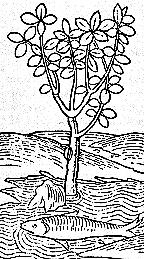
An Amber Tree growing out of the sea, from the Hortus Sanitatis
Apples - Are used as gifts to the faeries. When harvesting apples, leave a few on the tree. These small gifts will ensure a that future harvests are good.
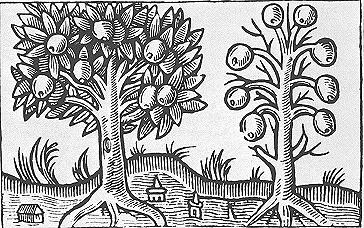
The Apple of Sodom that turns to dust in a man's hand
Apple of Sodom - A gigantic tree which grew in the desolated area that was
once Sodom & Gamorrah. Any traveler of the region foolish enough to pick
one of the apples would have it turn to smoke and ashes in his hand--a sure
sign of God's eternal displeasure with those who would succumb to physical temptation
at the site of His retribution.
The Ash Tree- Is used as protection against faeries and witches in those places where Rowan does not grow. Druids' wands were made of Ash twigs. Witches used Ash to make their witchdolls. Ash also has healing properties. Stand in the shadow of an Ash tree to avoid venoumous snakes and mischievous faeries.
Bay - The leaves of this plant were woven into the laurel wreaths in Ancient
Rome to crown the victors and heroes, but must be slowly dried in the shade
and then sealed in tight containers if they are to be used in cooking. An evergreen
tree with glossy green leaves and small creamy-white flowers which bloom from
midsummer.
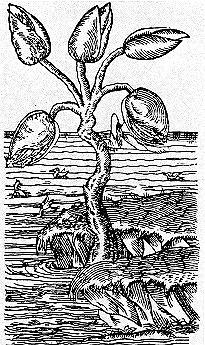
Barnacle Tree- One of the most amazing botanical myths is that of a tree that
had barnacles that opened to reveal geese. The legend of this tree was of great
antiquity, and although Albert Magnus in the 13th century denounced it as false,
the tales of this tree were popular among herbalists up until the 18th century.
William Turner, a 16th century English herbalist accepted the idea, as did John
Gerard in his Herball, or Generall Historie of Plantes, published in 1597, in
which he wrote: "...there is a small llande in Lancashire called the Pile
of Foulders...whereon is found a certaine spume or froth, that in time breedeth
unto certaine shels." These mussel-shaped shells would grow until they
split open, revealing "the legs of the Birde hanging out...til at length
it is all come foorth." The bird would hang by its bill until fully mature,
then would drop into the sea "where it gathereth feathers, and groweth
to a foule, bigger than a Mallard, and lesser than a Goose."
Beech Tree - Is a place for prayer. If one says a prayer while under a Beech tree, the prayer will go straight to heaven.
Birch Tree - Spirit is called "The One with the White Hand." If it touches your head it will leave a white mark and bring on madness; if it touches your heart it will bring death.
Blackthorn - Faeries love to live in thorn trees. If your children are captured by the faeries, make a fire of thorns on the peak of a faery hill and your children will be returned to you.
Christmas Tree - The history of the Christmas tree is controversial. Some Christians either refuse to use a Christmas tree at all or refuse to decorate a tree, because of the pagan origins of Christmas trees. Some refer to a legend about Nimrod, one of the descendents of Noah, in which he decorates a tree with gold and silver as a part of some ritual in honor of the sun God. Others point to the pagan observance of Winter Solstice by various cultural groups. One of these celebrations, called Yule (related to Jol, the month we now call December), which dates as far back as 1200 BC, was regularly observed by the Druids and other Northern European peoples. Tree decorating was one of the many customs of Yule.
In spite of some of the apparent pagan history of the Christmas tree, the origins of the "Christian" Christmas tree may well go back to the introduction of decorated trees in so-called Christian mystery plays, which were a popular teaching tool in the Middle Ages. The first of these trees was probably a fir tree (Abies) and it was decorated with apples. It was referred to as the Paradise tree and represented both the Tree of Life and the Tree of the Knowledge of Good and Evil, the two trees that Adam and Eve had in the Garden of Eden. They were allowed free access to the Tree of Life, but were never to eat of the Tree of the Knowledge of Good and Evil. When they disobeyed God and ate of the latter tree they were expelled from the garden. Gradually, Paradise trees began to show up in churches and homes and became associated with the Christmas celebration. In time, bread, fruit and candles were also put on the tree.
Others date the origin of the Christmas tree to a legend about St. Boniface (AD 772), an early missionary from England to Germany. One day he came upon some men preparing to cut a large oak tree to produce a stake for offering a human sacrifice. St. Boniface felled the tree with one blow and the tree split open revealing a beautiful, young fir tree with its branches pointing to Heaven. He told them it was a holy tree, the Christ Child's tree, and instructed them to take such trees into their homes and surround them with gifts and other decorations to remind them of God.
The first Christmas trees in America were introduced by German and English Immigrants. Because the apples traditionally hung on the trees were too heavy for most trees, glass balls were produced to take their place. A star was often placed on the top of the tree to represent the star over Bethlehem. Over time the decorations have gotten even more elaborate, and now we add tinsel, colored lights, flags, and many other things. Following St. Boniface's advice we also surround them with gifts, symbolizing our love for one another.
Most people use some kind of conifer for a Christmas tree. Firs (Abies) are considered the best, but Douglas firs (Pseudotsuga menziesii) and even pines (Pinus) are used at times. In some areas where conifers are not readily available people may use other trees such as mesquite or even cactus (Cactaceae). Many people today even use artificial trees, which saves the trouble of cutting down a living tree and cleaning up after it has dropped needles on the carpet. Although more expensive in many cases, some people choose to use a live Christmas tree in a pot, which can later be planted in their yard.
Elder - Can sometimes be a witch in tree form. Do not cut the Elder without first asking permission. There are few safe ways for humans to use Elder wood. A garland of Elder hung on the front door will attract demons and burning Elder logs will bring the Devil into the house. Furniture should never be made of Elder, especially not cradles because Elder faeries will pinch the baby black and blue. Elder trees in the yard may uproot themselves after dark to stare through the windows of houses. However Elder will protect faeries from witches and evil spirits during daylight hours. Pregnant women may safely kiss an Elder to ensure that her baby will have good health and good forturne. And Elder tree is a good place to seek shelter in a storm; it will never be struck by lightning because it is said to be the tree from which Christ's cross was made.
Hazle Nut - The Ancient Celts believed the Hazel Nut to be the receptacle of knowledge. In England it is a symbol of fertility.
Oak Trees - Are often homes to faeries and are otherwise considered magical and powerful. The Oak is considered potent and believed to have the powers of peace and protection. It was worshipped by Druids and Norsemen. The Celts made it a symbol of hospitality.
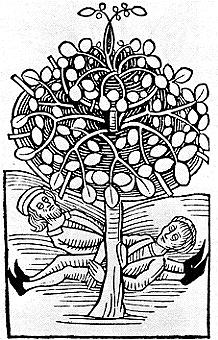
Antiaris toxicaria, the fabled Bausor Tree of narcotic fumes
Poison Tree- The first voyagers to Malay returned with grisly tales of a poisonous
tree growing on the islands near Cathay, which was called the Bohun Upas--the
tree of poisons. To the medieval traveler this tree was to be shunned, as it
produced narcotic and toxic fumes which killed plants and animals for miles
around. If one were to fall asleep in the shade of this tree, he would never
awaken. Malaysians supposedly executed prisoners by tying them to the trunk
of this great tree. By the 15th c. the tales of this tree had grown fantastic,
and highly stylized drawings of the Bohun Upas were in some of the first printed
books. The legend itself was probably based on the Bausor Tree (Antiaris toxicaria),
which produces a poisonous latex used by natives on arrow tips.
Rowan (Mountain Ash) - offers the best protection against faery enchantments and witchcraft. Ancient Druids built fires of Rowan wood to call forth spirits who would then answer questions when Rowan berries were spread on the newly flayed hides of bulls.
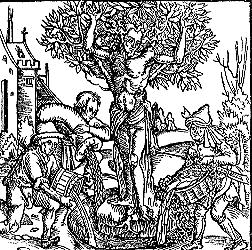
A human Tree of Life
Tree of Life - The identification of this tree varied among cultures and time
periods. To the Druids, the tree of life was the Oak, due to its age and the
fact that it was the host for mistletoe, their most sacred plant. To the ancient
Hebrews, it was the Cedar, which provided wood and a delicate, precious oil.
The Assyrians depicted the tree of life as a Date tree, and since they artificially
pollinated their date trees to produce a greater amount of fruit, to them it
was not only a source of food but a symbol of conception. Also, the fruit provided
a date wine which was used as a libation to the gods.
Biblically, the tree of life is the Sycamore, which appears often in the Scriptures.
To most, this suggests the western Sycamore, the Plant tree (Platanus). However,
the ancient Egyptians also regarded the Sycamore as their sacred "tree
of life," and so the idea that this is the Platanus Sycamore must be questioned,
as that species is not indigenous to the Nile Valley. In reality, the Sycamore
of the Bible was the wild Fig tree, dedicated to fertility, joy, and the afterlife.
The fig tree has a leaf very similar to that of a mulberry tree, and over the
years the two Greek words for fig and mulberry (sycos and moros) united to form
the name Sycamore. No "real" Sycamore was ever a tree of life.
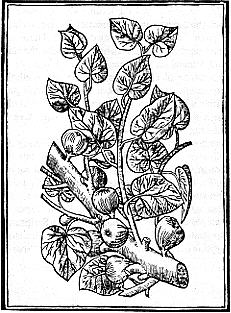
Ficus sycamorus, the Sycamore of the Bible, which is in reality a fig tree.
Willow Trees - are said to uproot themselves at night and mutter while stalking solitary travelers.
Zieba Tree- And finally, no study of fabulous plants would be complete without
mention of the Zieba tree, a huge, shingle-barked growth that supported in its
lower branches a nest of bare bosomed men & women. Like all those who choose
to believe in the tales of these incredible plants, the humans reposing in the
Zieba tree spend their days sitting exalted in fantasy, contemplating in wonder
all things seen and unseen.
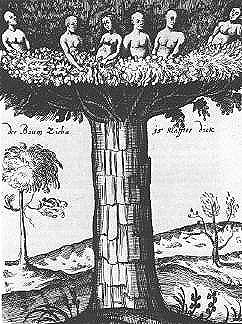
The Zieba Tree
Back to Information
Back to World of Night (WoN) Site