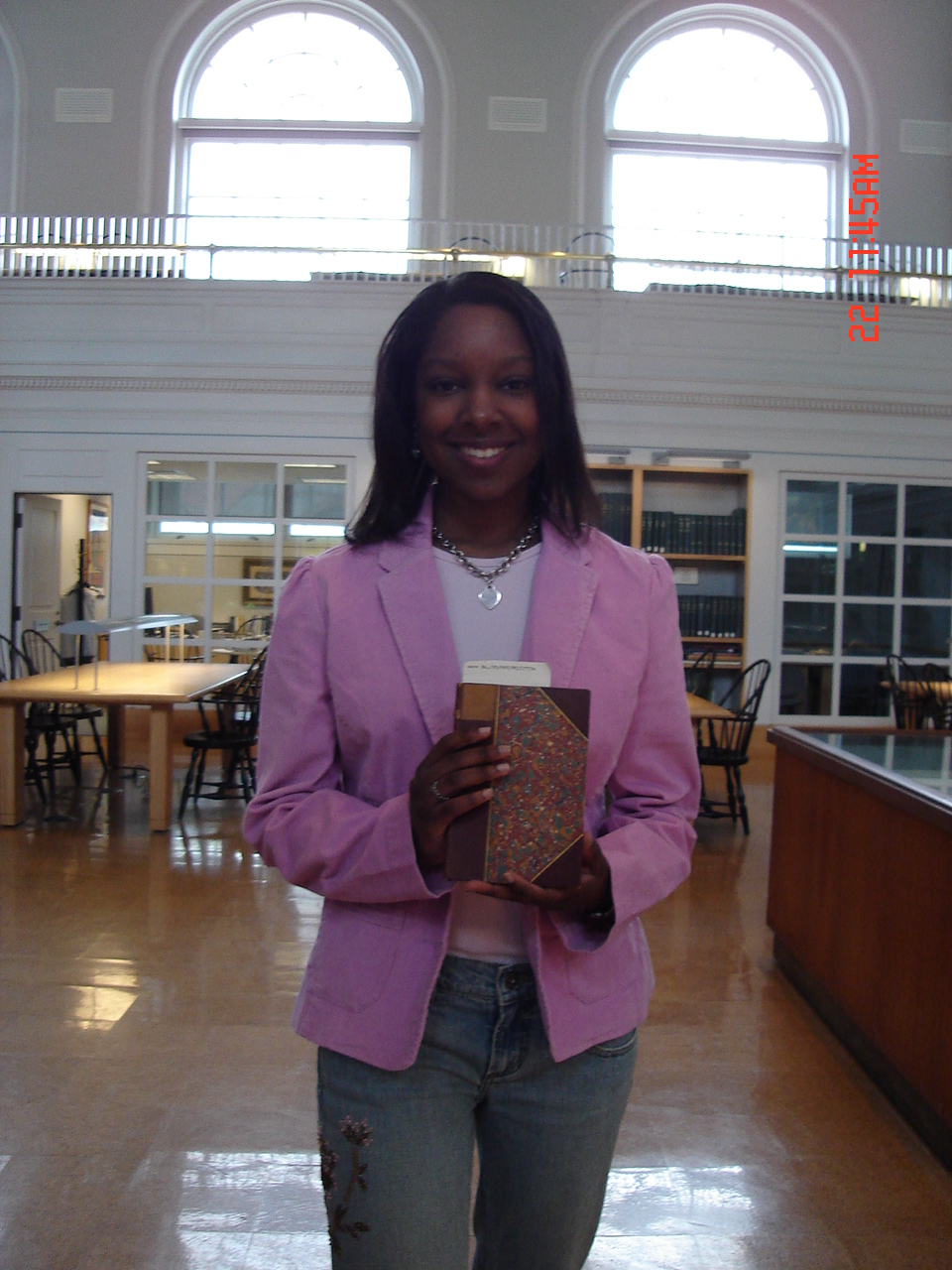
| Featured Writer Shannon J. Prince Shannon J. Prince is a creative writing major and junior at Dartmouth College. In addition to writing, she is an activist for indigenous and African issues, a ceramics maker, and a travel addict. She has been published in The Green Muse, Damn Good Writing, Haggard and Halloo, Houston Literary Review, Words on Paper, Bewildering Stories, The Quarterly Review of Bewildering Stories (the top third of their published stories), The Smoking Poet, Muscadine Lines, Ragad, Prick of the Spindle, International Zeitschrift, Conceit Magazine, Snow Monkey, Paradigm, Words Myth, Sorrowland Press, Ginosko, Mastadon Dentist, Ascent Aspirations, Poetic Diversity, Lost Beat Poetry, First Voices, Ugly Accent and Trillium. She also won Dartmouth's Thomas Ralston Prize for creative writing. |
 |
| THE AUTUMN MERMAID
SHANNON J. PRINCE I was born in autumn When life is hostile To restraining anything That would prefer to fly On high, vermillion leaves Dove away from their branches And higher The laundry of angels Fluttered away from the lines I listened for the mating whistle of the buck And rose to meet that wild waiting love Under the incomprehensible gentleness of his gaze The humanity in me shattered into a thousand golden leaves I was born in autumn When leaves are weighted down with becoming Chrysalises can barely flutter in the wind they are so heavy with metamorphosis The tree reckless enough to reveal Drops his charlatan green cloak And the wonder of his truth Leaves him ruby and gold If you are born in autumn When the branches� burn coalescent Convert to monarch wings And rocket down When the sucrose leaves are aware, where they land, the earth will become fecund You will always be enamored with that descent All extraneous but beauty and birth So when the river was morning-lit and autumn cold I leapt into the liquid autumn gold The autumn mermaid Intrigued by the journey under MUTILATION SHANNON J.PRINCE We are losing tongues we are killing their mouths we destroy the people who know the stories we are losing pink and the soil is too poisoned for more melons and we cannot see past the smoke to pink stars we are losing soft places on the body everything is muscle and teeth and nails and blood we are losing the ability to know the difference between sweet and sour we reach for grenades like they are mangoes we are losing tongues which are better than eyes and more talented than hands we can no longer apologize, forgive, sing, speak, pray eat, nurture, we grow thin voiceless we more than die we disappear and take the world falling with us LOVE POEM SHANNON J. PRINCE All of the witches I have ever known Have been discrete about both their aerodynamic capabilities And their wanderlust Don�t be quick as them to restrain your desire I want this to be a love poem We are gamblers and our dice are made of fire The only way not to be consumed Is to fling them away without circumspection or prudence If you try to restrain your longing, your longing will devour you And I really want this to be a love poem Once upon a time can be either The chilly dewy morning at autumn�s beginning Or the summer night still warmed by an invisible sun Far, far away Is a flexible destination Can either mean in a patch of hemlock trees Or next to a field of pansies Love stories are possible almost anywhere Love songs can be synthesized from bird music or white noise Join me, join me, right away I really want this to be a love poem QUEEN SHANNON J. PRINCE My family isn�t haughty, but quietly pleased because underneath all of our bones and blood are tiny kernels of magic. We are a people as much descendent from red dirt and centuries-old pine trees as we are from our human ancestors. We come from not only a great love, but a great story, so in us is more than the kisses, the genes, the sperm, the nighttime whispers. We owe our existence also to the wood nymphs and starry nights. The Bible says babies are special because they were created in love, but we are different because we come from love and a fairy tale. My great-grandmother was Queen Esther Cecile. You�d think a name like that would mean that her mom loved her. I mean, whenever I hear of little girl named Gisele or Solange, I think her mom must have really loved her. Not this mom. She just pulled some royal title out of the past, and mixing it with the delicate Cecile on a whim, bestowed the name on a baby she left with her mother and disappeared somewhere into the expanse of magnolias and longhorns like a phantom. So the life of this old woman, my great-great-great grandmother, became intertwined with that of a tiny living piece of onyx, a child so dark and pretty everyone who saw her was stunned by her �seal� skin. So instead of being a Queen of the sultry Texan days, she was changed into a sea creature she had never seen. Ignoring her humorous tongue, artistic ability, and maternal heart, she like Nefertari,* Sleeping Beauty, and Belle was named solely for her looks. She was called Seal. On the opposite end of the spectrum from Snow White, she was in the same kettle of fish. The woods were torture for each of them, and in the place of their true mothers were witches. Trees never looked like magical African baobabs, or Biblical sycamores, or romantic plumerias to either of them. Snow White�s mother sent her into the jungle to be slaughtered like an animal seen by tourists on a safari. Thank God the pygmies saved her. As for Mamo Seal, in the forest she was beaten constantly for fifteen years until her body bore ridges like the stitching on a baseball. But she didn�t despair like a star-crossed mermaid turned to foam on the sea, for wedged among the terror, the sorceresses, the blood, and the orchards are men who lose their horses and hear you singing, or give a pig�s heart to your mom in exchange for your own, or are hunting squirrel according to their tribal traditions, and see in the middle of the pine an ancient Toltec statue of a maiden. Surrounded by lizards and crowned by birdsong, the statue moves and the man praises his God, in whatever language it is he speaks, because now the galaxy has all of its songs and the rainbow has been completed. Papa was eighteen years old when he fell in love with fifteen-year-old Seal. He proposed to her, but she felt she was still a child and didn�t want to get married yet. So for the next three years, Papa never looked at another girl as he waited for Seal to mature. And as soon as she was eighteen, they were married � a marriage that lasted seventy-one years until my great-grandmother�s death. They loved on all of the levels. Their longtime companionship didn�t replace the crushes they had had on each other. They always acted more like boyfriend and girlfriend than husband and wife. Seal was Queen again. For instance, if she wanted something, though it lay a few inches from her but was across the room from Papa, she�d call to him to get it, and he�d silently do it, peacefully, like out of all the things he did � preaching, driving the school bus, raising crops and kids, that�s the thing he was most meant to do, take care of her. She wasn�t bossing him around; she was just receiving the care she had wanted for so long. Queen Esther loved children, and Papa was willing to let her have as many as she wanted. He didn�t know she�d take him up on that offer nine times, but he kept his word. She used to ask each one of them what they wanted for breakfast in the morning, and then cook nine different things. And no skimping; one would get biscuits made from scratch, the next jelly she made herself, the next pancakes, again from scratch. There was no way her babies were going to hurt like she did. They were all so in love with each other. I remember when she was near ninety and in the hospital, a nurse noticed that the bed looked a little lumpy. It turned out a couple of her senior citizen daughters had sneaked into bed with her, and although it was against regulations, they convinced the nurse to let them stay. Happily ever after can be amazing. I know. I�ve seen it. When Papa and Seal looked at each other, it seemed as if they were gazing from the underside of silk, in bliss so lustrous it made their spirits wax with silver like intangible moons. Their love was sun and they were the Sahara, soaking the heat and light in day after day. Their souls lay in each other. They were L. Queen Papa Esther C. Cecile, one being cast in separate bodies so that their unity could be appreciated � one kernel of magic. *Named Most Beautiful Among Women DEAR SHANNON SHANNON J. PRINCE Back then, children were only aware of four careers, and they rose black like totems against the distant horizon. Supposing youth ever did wane and, improbably, we did morph into adults someday, the only things we thought of being were policemen, firemen, doctors, or lawyers. I, myself, liked the first two options. You know, normal school boy fantasies. Most people in Hearne, Texas were farmers, but my family lived in the urban area of the town. My dad worked at a gravel pit until I was nine, when he passed away. What I remember of him is pleasant. But my mom stayed at home with my sister and me. It was just the three of us. My older two brothers and sister were grown and on their own, so my mother, sister, and I existed in an isosceles type equilibrium. My mother seemed ideal to me as a boy, like some incarnation of justice always making sure we knew right from wrong. My sister was more someone to play alongside of than with, she, interested in dolls and I preferring trucks, hoops, or hunting, yet still the two of us were close. I started school at six, and I loved it. Knowledge wasn�t really something I had to keep tilling and poking and prodding around for to obtain. It opened itself up to me like a treasure chest with a rusted lock, dousing me with imaginary numbers, obelisks, kingdoms, codes, runes, poems, obscure words, treaties, promises, and dreams. I loved math, literature, and history. I read on my own when I could spare the hours, but back then we were always trying to get something to expand and grow � a garden, an animal, something that in future seasons colored gilt or jade could be eaten, could give us life. I was valedictorian of my senior class. Don�t ask me what I spoke about. I don�t even remember. There are ten million words, memories, moments I would give you willingly if I could place them in the right order, summon them to the surface of my mind, but age can hide eras and seconds under leaves, lock them in gardens, shut them up in closets, bind them to the shadows. I was drafted after high school to aid the U.S. in our fight against Korea, although, fortunately, I was able to stay here. I met your grandmother while in the army. I took her to her high school prom when my buddy, whom she had invited, couldn�t get leave. I thought I�d do him a favor. He promised me the girl was pretty � and wow. She was beautiful, but she was also kind, and she knew exactly what she wanted from life. I felt that the two of us could locate the labyrinths within each other and follow the winding corridors to that wild place which is the heart. Times when I was granted leave from the military to take Almeta, my Be Bop, out on dates were wonderful. The rest of my days as a soldier weren�t as lovely. I tried to serve my country valiantly, but I hated taking orders. After my compulsory two years I didn�t sign up for more. With Almeta as my wife, I headed to Houston to go to Texas Southern University. Two years in the army had earned me four years of college tuition. My life seemed to be divided. Unlike my classmates, I was a married homeowner. In a little while I was also a father. I worked two jobs, but I also had homework. On campus, I majored in tailoring, later electronics, enjoying classes and college life. At home, I tried to find time to be with my wife, and my newborn daughter, Diane, whose birth had made me so content. After three and a half years of college with only thirty hours left to go, the government told me my college tuition money had run out. Again, the duplicity of my life struck me. As a young husband and first time father I had a great home life, yet my hopes for a college degree had ended. You see, I have had a happy life but an extremely hard one nonetheless. I felt blessed to have had six healthy kids, but I always wanted to provide for them and my wife a little more than I have been able. I didn�t have a favorite out of the six, and I didn�t have many rules to follow. I only insisted that they study hard so that life would not be so difficult. I had to work most of the time, but whenever I had a few moments to play with my kids I treasured them. Even now, I love being with my grandkids � not participating in any particular activity with you or for any special reason, but merely because I like the aura your children�s children give you when you are near them. I admire their accomplishments and delight in their differences, respecting them all as individuals. One of the most difficult things in my life has been racism. I hated segregation, and sometimes I wouldn�t adhere to it. At work, I drank from the white water fountain, brandishing a knife at any one who didn�t like the sight of it. It broke my heart when both Kennedy and Martin Luther King Jr. died, because I thought that blacks may never attain civil rights. We have, to a certain extent, but the roots of the civil rights movement have nurtured all types of fruits. As foul a thing as segregation was, when it was around there had to be black business owners because blacks weren�t welcome as clients in so many white businesses. Blacks had no choice about either being entrepreneurs or supporting other black entrepreneurs. Now that blacks can patronize any establishment, black entrepreneurship has decreased, converting racial segregation into economic segregation. While my generation focused on attaining civil rights, younger generations should work on attaining education and encouraging people of all races to support black entrepreneurship. I have had so many years and seen so many wonders. I have seen a nation morph and a man walk on the moon � although at first I doubted my eyes. I believe in a Supreme Being that we cannot see. I don�t go to church because I do not like the tenets of denominations and the claims of pastors, yet I am loyal to God. Perhaps I cannot give you all of my stories because so many have been bitter. I didn�t consciously suppress them, but the mind is a survivor which out of necessity hides darkness. Yet despite the thorns that have been cruelly placed in so many lives, I assure you, Granddaughter, there is a better world somewhere. Search for its light, listen for its noise, gather it in your arms and help it to hatch. Wherever you see hope or hear rumor of this new world, hasten to it. Tend it. I have spent my life helping it to dawn. Now, Granddaughter, I pass this sacred duty on to you. READ AN INTERVIEW WITH MS. PRINCE BY PURCHASING A COPY OF THE JOURNAL. SPRING 2008 |