 |
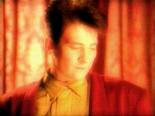
| The torch and twanger on her smokin' new CD, her punk persona and her old pal Ellen by Randee Dawn It's pop culture quiz time, and k.d. lang is ready. She leans forward intently in her New York hotel suite, wearing a cool, white linen suit that makes her look more like a lanky Tom Wolfe than the woman responsible for some of music's most intriguing sounds over the past decade. And now for the question: Just who is k.d. lang? A smile crosses her face. "Some people think I'm a militant vegetarian. Some people think I'm a militant lesbian. Some people think I'm boring. Some people think I'm fantastic," she says. "They're probably all right, all at the same time." First and foremost, the shape-shifting lang is a musician--a country-punk from Canada turned pop-torch chanteuse. Blessed with a rich, warm voice, she's equally at home wrapping herself around pre-rock classics like Cole Porter's "So In Love," an anguished duet of "Crying" with Roy Orbison or the Patsy Cline-esque "Pulling Back the Reins." But this self-labeled big-boned gal is more than a singer. Her entire life has become an eye-catching performance, and she steps comfortably into roles as an openly lesbian artist, animal-rights spokeswoman, and even a Vanity Fair cover girl (receiving a seductive shave from Cindy Crawford, no less). Now, the chameleon adds another layer of coloring with Drag. An eclectic mix of covers and originals loosely based around the topic of smoking, the new disc takes lang from the familiar to the unexplored--in other words, a typical outing from a most atypical artist. You don't smoke, do you? No. So why base an album on smoking? I find cigarette smoking very interesting. It's a historical symbol. It used to be very glamorous and chic--a sophisticated, elitist thing to do. Then in the '50s, it became kind of rebellious, and now it's gotten to the point where even bad guys can't smoke in movies. It's gone from being touted as almost medicinal to being the Antichrist. I'm interested in it as a visual stimulant--and because it's in the consciousness of North Americans so heavily. I wanted to document musically where we are with it now, and I tried very hard to present an album that represented the complete spectrum--not necessarily pro or con, just one that gives the whole perspective and doesn't make a judgment. Have you gotten flak from antismoking advocates? Not that I know of. But to me, it's the same as a writer writing a piece or a photographer doing a retrospective on the topic. This is the history of smoking, from the glam shots to the people dying of lung cancer. It's an artistic perspective, not a judgment or a promotional thing. The album also seems to be, on another level, about addictions in general. Well, addiction is definitely a part of it. The album branches off into the more addictive aspect of it, the human need. Why do you suppose people become addicted? I think there are an infinite number of reasons, but a lot of it has to do with love deprivation, masking emotional weaknesses or hurt. There's also the chemical thing, which I can't even begin to understand. But a lot of it has to do with filling some emotional gap. What are you addicted to? No substances. I guess I must be addicted to creativity or applause. It keeps me going. Even though I want to quit sometimes, I end up making another record. Have you put serious thought into quitting? I'd like to take a break, and I really was expecting to take a long break after the last album [1996's All You Can Eat], but then this one popped up into my head. And you can't deny inspiration; you have to go with it while it's there, or it's kind of bad karma. Are you a fan of the songs you picked for Drag? Sure. The originals, or certain versions of them, have to move me. I have to be in love with a song in order to sing it. And that was the priority in picking the songs and then getting the balance for the theme of the record. Critics of cover versions often say nothing was wrong with the originals to begin with. I've even said that. But the thing is, when you interpret it's not about ignoring the original. It's not about changing it entirely. It's not about competing with it. It's about superimposing yourself onto it and adding your perspectives--adding your love to the song, and making it a bigger thing. In a way like traditional storytelling, or passing it on. What draws you to the songs you do? My voice kind of legislates what I do. It sounds like it's from the '40s or '50s or '60s. I would sound terrible singing Alanis Morissette, so I end up kind of singing other stuff. But I'm a kind of alternative artist conceptually, so it's about trying to fulfill all the parts of my artistic personality. When did you realize you needed to let your sound legislate how you were going to sing? I guess pretty early. Country was a way for me to incorporate punk, and country was a good way for me to sing, because country puts the vocalist up front. The melodies are still beautiful because they have a roots-oriented structure. It suits my voice, but it also let me be really energetic. Rock is a harsher, more abusive sound on the voice, and that doesn't really suit my style. But country did, and that's one of the reasons I did country-punk. The success of Ingenue in 1992 really vaulted you into a much bigger spotlight. How did you deal with that? I was into it while it was happening, and then, you know, just like any other drug, there's a down. Fame is a constant state of readjustment, 'cause there's no formula, no textbook on how it's going to be. Nobody prepares you for the up, and no one prepares you for the down. You get all excited, and then it's over and you have to wait until the next one comes out. It's a constant roller coaster. Do you feel under pressure to reproduce that momentum? I did. I have to say I don't now. I'm quite happy not putting that pressure on myself. And, of course, there are different kinds of pressure. There's pressure to raise my goals as a vocalist and a singer. But to me, it's very important that I set those standards, that they're not externally set. Did you decide to go back to what worked before--cover versions that downplayed the sexual ambiguities--before All You Can Eat had a disappointing run on the charts? I think it was sheer boredom of sexual specifics that made me move away from it. God, do you know how many times I've answered lesbian questions in the last five years? More than a few, I'm sure. Absolutely. But there is something there. You can't help but react to your last record, because every record is part of a long chain. It's my life and my path, so, of course, I was affected by All You Can Eat. It was a very important transitional record for me. But, historically, I've always made an alternative record, then a ballad record, then an alternative record, then a ballad, from Angel with a Lariat to Shadowland to Absolute Torch and Twang to Ingenue. Does discussion of your music often get buried by your outspokenness about lesbianism, animal rights and vegetarianism? I think it's the nature of the pop media. They want to see what makes you tick, and I speak openly and honestly about things that make me tick. I would hope it wouldn't overshadow the music in the long run. It's a struggle to have a career of longevity in the first place, so I do what I can just to keep my integrity and have a clear vision of who I am. Part of that is being honest about myself. It's kind of changing now, in that I don't really have much more I can talk about. So, I guess people are settling down on my music now. You once said you don't read anything other than the dictionary and the phone book. Oh, well, the phone book was basically a joke, but I really don't read at all. Why? I just haven't gotten to it. There are things people don't do--I'm sure a ballet instructor would ask, "You've never danced? Why don't you dance?" It's something I probably will get into when I slow down, but I've been so busy listening and observing in other ways. Reading is just something I'll get around to doing eventually. You were on Ellen the night she came out. Are we any better off for it? I think so. And I think more than anything, Ellen is better off for it. That was my sole purpose in being on the show--to support my friend. And I think anything that pushes the envelope of consciousness is a positive thing. It will never be quite as closeted as it was before, because of Ellen. But just to be really clear, I think there have been a lot of people before Ellen, and there will be a lot of people after Ellen, and everyone that's ever come out has added to paving the way. It's a long, long, road yet. |
|
 |
 |
| e! interview |
 |