 |
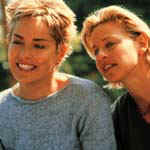
| Five Questions With... If These Walls Could Talk 2's Ellen DeGeneres By Frank Lovece Writer-director Anne Heche, your significant other, has said it took months to convince you to do the movie's lovemaking scene, and how nervous you were right up to the moment of filming. No body doubles were used. So what was your experience doing a sex scene with Sharon Stone? "We'd met before. And [in rehearsal, during an improvisation exercise] we had to tell our story of how [our characters] met, and it really established their relationships with each other. So [when time came to film], there was music playing on the set and it was really just Sharon and me and the cameraman. Anne wasn't even in the room � she was outside the room on a headset talking to the camera guy. No one [else] was on the set, everyone was gone. So it was just, like, candles lit around the bed and it was dark and there was music, so it was really a great atmosphere to just completely kinda forget about everything." Was there ever any thought about having Anne co-star in the segment with you? "Never. Never. We're too smart for that now. We've learned our lesson, I hope. We'll still make mistakes, but we would've been slammed for that. First of all, we already have exposed so much of ourselves, y'know, consciously or not. And we don't mind being photographed, we don't mind saying we're proud of our relationship � we're proud of our love, and we're not gonna hide who we are. But it did get to a point where people are starting to see so much of us that for us to show what they'd think would be our relationship, even though it's not, it's a movie. They'll think that's how they live, that's their house, that's how they make love, that's how they kiss. And just because Sharon happens to resemble her now because [they both have similarly spiky] short blond hair, it's not like if Sharon were to have passed that we would've gone, 'Who else has short blond hair?' " The movie takes place in three very distinct eras for women generally, lesbian or not. When did you realize you were gay, and did you find the film's middle segment, "1972," about a young college woman coming to grips with her sexuality, an accurate reflection of your own experience or those of people you know? "I really was in complete denial of my sexuality. I was boy-crazy all my life. I had a different boyfriend every week. I couldn't imagine getting married, because I thought I got tired of people so fast. My first experience with a girl, I was in high school. I was a senior, '76. A friend of mine told me she was in love with me � it was her idea. I had a boyfriend. Actually, she had a boyfriend, too. We'd make out in the bathroom, get back in the car, go on our double date � and we did love our boyfriends. She married the guy she was with! I was gonna marry the guy that I was with, too. But then I ended up moving back to [my home state of] Louisiana. And I still dated guys, and then met another girl, and I still thought it was OK, that it was just her, and then I went back to guys again. And then I realized I was having a lot more feelings when I was with girls than with guys. So then I went to my first gay bar in New Orleans, and it was exactly like that scene [in the segment "1972," with Michelle Williams] walking into a gay bar and thinking it was weird to see two girls dancing together." Has the atmosphere changed much since that era, in terms of wider acceptance and visibility to the rest of society? "It's changed tremendously, but what's really sad is that in order to socialize you have to go to bars. That's the only place where you're surrounded by people and can touch another person of the same sex and feel like you fit in and people aren't going to stare at you. And that's not the best environment. We're making some forward movement, but you don't drive down the street and see a billboard with two women laughing, smoking a cigarette or one offering the other one a candy bar. It's always a man and a woman � usually a white man and a woman. You rarely see people of color and you very rarely see two people of the same sex advertising anything at all. Ikea and Volkswagen � but that's brand-new. Some [advertisements], you can see where they started to go that way and then 'saved it' at the end with a voice-over." It does seem to have changed, as you say, but there have been several high-profile murders of gay people just for their being gay. And you've got people like Dr. Laura Schlessinger, the radio talk-show host who's referred to being gay as "deviant" and "a biological error." "A 'biological deviant' � that's what I am. And she uses religion to justify it. What is she a doctor of? It's gotta be something that did not educate her in this point of view. [Note: Schlessinger, 53, holds a Ph.D. in physiology, but is not a physician or a psychiatrist.] The scary thing is, she's getting her own TV show � and [syndicator] Paramount wouldn't dare give a white supremacist a show, somebody who's gonna talk that way about black people or Jews." |
 |
| 5 questions with ellen |