HISTORY OF THE HOLY SHROUD OF TURIN
Probably the 7th April 30, or perhaps the 3rd April 33
Crucifixion of Jesus
~ 57
Ma'nu VI inherits the throne of Edessa. Return to paganism, and persecution of the Christians
~ 326
Helena, mother of the Roman emperor Constantine the Great, (born at Trier in 265, died at Nicomedia in 327), goes to Palestine to find the relics of Jesus. She is reported to have discovered the nails of the Passion, the Cross, and the tunic that she donates to the town of Trier. The narrative of her quest, is written by Eusebius of Caesarea (265-340) in his book 'Ecclesiastical History'
525
Flooding of the Daisan, a tributary of the Euphrates, floods the city of Edessa. This flood is mentioned in the writings of Procopeus of Caesarea. In the course of the reconstruction work at Edessa, a cloth is discovered which had been hidden above one of the gates of the town. It shows the face of a man The emperor Justinian of Constantinople orders the cathedral of Sainte Sophie at Edessa built as a home for this image
594
Evagrius Scholasticus, writes his ecclesiastical history in which he mentions the image of Edessa as "created by God, and not produced by the hands of man". He dates this discovery at 544 AD
632 - 642
Invasion of the middle east by Arabs. Edessa is taken in 639. Christianity is tolerated. The Cathedral of Saint Sophie is preserved, as well as the image of Edessa
673 - 677
First siege of Constantinople by the Arabs
~ 692
In Constantinople, Justinian II mints a coin with the effigy of Christ Pantocrator
718
Second siege of Constantinople. At the same time the Muslims invade the south of Spain, and the Sudarium is carried to Oviedo in the Kingdom of Asturias (Northern Spain) for safe keeping
723 - 842
Acts of violence by the Byzantian and Muslim iconoclasts
~ 800
Irene, the Empress of Constantinople, gives to Charlemagne, the tunic of Christ. Charlemagne gives this for safe keeping to his daughter Theodrade, a nun at the Abbey of Argenteuil. It is hidden and would be rediscovered in 1156
943 - 944
Siege of Edessa by the Emperor of Byzantium. The image of Edessa is given to him in exchange for his lifting the siege, together with the payment of a large sum of money, and the liberation of Muslim prisoners
The Mandylion, the name given by the Byzantians to the image of Edessa, leaves for Samosate and then Constantinople
964
The Mandylion arrives at Constantinople in August. It will be conserved in the Pharos Chapel, in the Boucoleon Palace
1146
The Turks take Edessa. The Cathedral of Sainte Sophie is destroyed.
~ 1150
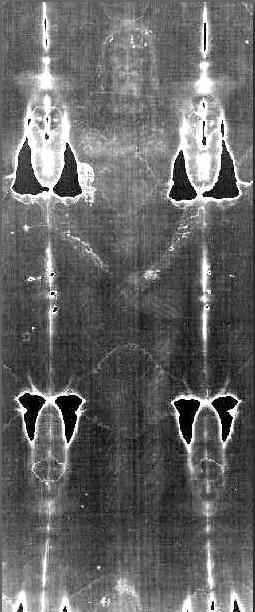
Writing of the Codex Pray, which contains several miniatures (small paintings) representing the Passion. One of them shows the holy women coming to the tomb after the resurrection. On it can be seen a representation of the abandoned Shroud with marks corresponding to the first set of burn marks that can be seen today on the Shroud of Turin.
1156
Discovery, in the Church of the Monastery of the Benedictines at Argenteuil, of a tunic stained with blood. This tunic known under the name of Holy Tunic of Argenteuil could well be the seamless tunic that Christ wore at his Crucifixion, and which the Roman soldiers drew lots for. In effect the blood stains are in a pattern relatively similar to that of the stains appearing on the Shroud, and the blood group of these stains is the same as that of the Shroud A+.
1196
Rediscovered in the Cathedral at Trier (Treves), in old burial chamber, a tunic known as the Holy Tunic of Treves which was said to have been given to the town in the year 325AD by Saint Helena, mother of the Roman emperor Constantine the Great. It may be the outer garment worn by Christ
1204
The capture and sacking of Constantinople by the Francs of the fourth Crusade. The 12th April, the disappearance of the Mandylion.
~ 1205
The Holy Shroud is probably at Athens
1248
The Crown of Thorns is transferred to the Holy Chapel, that Saint Louis had built for it
~ 1350
First display of the Holy Shroud at Lirey (Champagne, France)
1353
The knight, Chevalier Geoffrey I de Charny, obtains from the French King, Jean le Bon, a grant to found the Collegiate Church at Lirey
1354
The Holy Shroud is entrusted to the Collegiate Church at Lirey
1353
Pope Innocent IV grants indulgences to pilgrims visiting the Collegiate at Lirey
1356
Battle of Poitiers in France -- French fight against the English, Welsh and Gascons at Nouaille wood. Sept 18th, attempt at negotiations between 11 nobles, (5 were English, whilst the 6 French included the archbishop of Sens and Geoffrey de Charny). Geofrey de Charny proposed a solution, a duel between 100 of the best knights on each side, an echo of the famous battle of the Thirty in Brittany in 1351, but the Duke of Warwick rejected this. The next day, Geoffrey I de Charny was killed on the field of battle. He was the bearer of the French standard, the oriflamme, and was killed defending the French King. His body was later transferred to Paris. (see, Edward, by Barber, 1978. pp 137-148). Geoffrey's widow, Jeanne de Vergy, petitions the King and the subsidies are continued in favour of her son Geoffrey II de Charny
1356
The Bishop of Troyes (Champagne, France), Henri de Poitiers, sends a letter of congratulations to Geoffrey II de Charny, on the 28th May.
1357
Twelve Bishops allow indulgences for pilgrims visiting Lirey
1389
Geoffroy II de Charny petitions the Pope to be allowed to put the Shroud on show. He obtains permission
1389
Pierre d'Arcis, Bishop of Troyes, writes a memorandum stating that the Shroud of Lirey is a fake (a painting). He asks that it not be displayed any more.
1390
Clement VII, The first Pope in Avignon (this was during the the Great Schism), orders Pierre d'Arcis to silence, under pain of excommunication.
1398
Death of Geoffroy II de Charny, on the 22 May.
1400
The daughter of Geoffrey II de Charny, Marguerite de Charny, marries Jean de Beaufremont who will be killed at the battle of Azincourt in 1415. In 1418 Marguerite de Charny marries again, to Humbert de Villersexel, seigneur de Saint Hippolyte sur le Doubs.
1418
The Shroud is given to Humbert de Villersexel by the Canons of Lirey. It will be conserved in the chateau de Monfort, near Montbard, then transferred to Saint Hippolyte sur le Doubs, in the Chapelle des Buessarts.
1438
Death of Humbert de Villersexel ; the canons of Lirey want to recover the Shroud. Marguarite de Charny refuses. The case is carried before the parliament of Dole (May 1443), then to the Court of Besancon (July 1447). Both decide in favour of Marguarite de Charny. The canons refuse to accept this judgment, and ask for the excommunication of Marguarite de Charny. In 1459 they abandon their claim in return for financial compensation. The quarrel had lasted 21 years !
1449
Holy Shroud is displayed at Chimay (Principality of Liege)
1452
Holy Shroud is displayed at the Chateau de Germolles (near Macon)
1453
The Holy Shroud is transferred to Duke Louis de Savoie by Marguerite de Charny, and moved to Chambery
1494
The Holy Shroud is exhibited at Vercelli on Good Friday
1503
Great display in Bourg-en-Bresse
1506
Holy Chapel of the Holy Shroud in Chambery, and creation of a liturgic Festival of the Shroud on the 4 May by Pope Jules II
1509
Marguerite of Austria donates a new silver reliquary, that the Shroud will be kept in
1516
Francois I comes to Chambery 15 June 1516 to venerate the Shroud after the Victory of Marignan (1515)
1532
Fire in the Holy Chapel at Chambery during the night of 3 to 4 December ; The Holy Shroud is damaged by the fire, and by the water used to fight the fire.
1534
Authentication of the Shroud after being repaired by the Clarisses of Chambery
1535
War of Charles V against Francois I who invades Savoie. The Holy Shroud is transferred to Vercelli (Piedmont), and displayed at Turin on the 4th May
1536
The Shroud is exhibited in Milan
1537
The Shroud is exhibited in Nice where it stays until 1543
1549
The Shroud is kept in treasury of the Cathedral Saint Eusebio at Vercelli
1553
French troops sack Vercelli 18th Nov. The Shroud is saved by a canon who hides it in his house
1561
The Shroud rests briefly at Annecy, then is returned to the Holy Chapel at Chambery
1578
14th of September : the Holy Shroud arrives to stay permanently in Turin. It is venerated by , among others, Saint Charles Borromee (1578), Saint Francois de Sales (1613), Sainte Jeanne de Chantal (1639), Pius VII (1804), etc.
1670
The Congregation of Indulgences accords a full indulgence to all who make a pilgrimage to the Holy Shroud "for the meditation on the Passion, and in particular on the death and entombment of Christ
1694
The Holy Shroud enters the Chapelle Royale of the Cathedral of Turin (1 June), and is stored in the sanctuary designed specially by Guarino Guarini, where it is still to be found. It is fixed on a new black lining made by the Bienheureux Sebastian Valfre who also added several patches where the repairs by the Clarisses had been insufficient
1868
Princess Clotilde of Savoie, sews a new lining of red silk onto the back of the Shroud
1898
First photo of the Holy Shroud by Secundo Pia and the discovery that the Shroud is a photo negative.
1902
Publication of the first scientific study "The Shroud of Christ" by Paul Vignon.
A professor of comparative anatomy at the Sorbonne, Yves Delage, an agnostic, concludes that the Shroud is authentic
1931
The photographer Giuseppe Enrie takes new photos (of excellent quality) of the Shroud
1935
Publication by Doctor Pierre Barbet of "The Five Wounds of Christ", then, in 1949, "The Passion according to a Surgeon"
1969
A commission of scientific experts is authorised to examine the Shroud. New photos are taken by Giovanni-Battista Judica-Cordiglia, this time in colour, and under the illumination of a Wood lamp.
1972
1st Oct : Criminal attempt by an arsonist to burn the Shroud. The Shroud is spared.
1973
Samples from the Shroud are taken by Max Frei in an attempt to study the pollens, and by other scientists to study the blood stains
1978
Scientific study by STURP
1983
The Holy Shroud is bequeathed to the Pope by the Royal Family of Savoie
1988
Carbon 14 dating indicates that the Shroud dates between 1260 et 1390.
1989
Scientific Symposium of Paris, and Creation of CIELT ; Major faults in the Carbon 14 dating process are revealed
1993
Scientific Symposium of Rome ; confirmation by the scientific community of the Shroud's authenticity
1997
Criminal fire at the Chapelle Royale de Turin ; The Shroud 'miraculously' escapes destruction
1997
Scientific Symposium of Nice : Confirmation that the formation of the image on the Turin Shroud is not the work of man