|
|
Multi-Phase Images:
Lenticular Technology Advances Fine Arts
By Ray Zone
On September 25, 1902, inventor Frederic Ives filed an
historic patent application describing the “Parallax Stereogram and
Process of Making Same.” It was the first practical method of producing a
stereoscopic image that could be seen in 3-D without a viewing aid of any kind.
In other words, it was an “auto-stereoscopic” image. Ives described
a process in which a “composite image,” consisting of left and right-eye
pictures, was viewed “through a screen of alternate opaque and
transparent lines, so adjusted as to give a stereoscopic effect by the parallax
of binocular vision.”
This lenticular stereogram could also be used to
display a two-step animated image and by 1910 a series of “Photo-change”
postcards were on the market displaying pictures in which a woman’s face
would transform into that of a flower. Other applications for lenticular
imaging were made from 1920 onwards which included stereoscopic motion
pictures, magazine covers and record jackets. But, up to the invention of
desktop publishing and the proliferation of the home computer (about 1995),
lenticular imaging techniques remained the proprietary and private preserve of
just a few closed-mouth individuals and companies. Even the lenticular sheets
which lay over the vertically interlaced composite images were practically
impossible to come by.
All that has changed now. Computer software to
vertically interlace two or more images together as well as lenticular sheets
in different sizes and with varying lpi (lines per inch) are
freely available. There is even an online discussion group which shares
information about the technology and resources for materials at: [email protected]
(send an email with “subscribe” in subject box and email body to
join).
 Heather Lowe is a Los Angeles artist who is creating
work for this relatively new platform for the fine arts. Initially, Lowe began
a few years ago by creating stereographic paintings. To do this, of course, she
had to make two paintings that were different only with respect to horizontal
parallax, a left eye and right eye image. These were usually side-by-side
images on a single canvas. The gallery patrons would use a plastic lorgnette
viewer to see the paintings in 3-D. Or, some of those adept at the technique
could use “binocular freevision” to see the images without any
viewing aid. This technique is similar to that used a few years ago to see the
hidden 3-D image imbedded in the Magic Eye posters that were popular at the
time.
Heather Lowe is a Los Angeles artist who is creating
work for this relatively new platform for the fine arts. Initially, Lowe began
a few years ago by creating stereographic paintings. To do this, of course, she
had to make two paintings that were different only with respect to horizontal
parallax, a left eye and right eye image. These were usually side-by-side
images on a single canvas. The gallery patrons would use a plastic lorgnette
viewer to see the paintings in 3-D. Or, some of those adept at the technique
could use “binocular freevision” to see the images without any
viewing aid. This technique is similar to that used a few years ago to see the
hidden 3-D image imbedded in the Magic Eye posters that were popular at the
time.
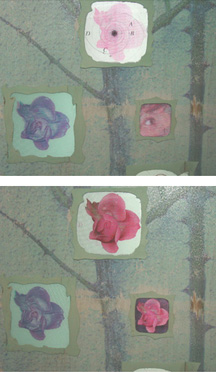
Now, Lowe has incorporated animation as well as 3-D
into her lenticular art works. The multi-phase composites are frequently
created in multiples of more than two images. With the work titled Rose
Lowe has painted very subtle differences between the two views. Slight
horizontal head movements on the part of the onlooker will elicit these changes
in the image.
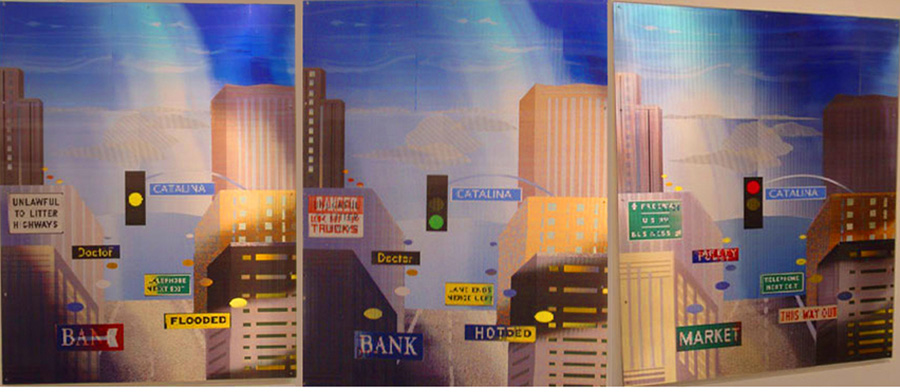
A cityscape called Night and Day on Catalina Street,
a 22” by 28” lenticular on board, uses three views with mysterious
changes in signage and a traffic light changing from yellow to green to red.
This work clarifies in an inventive fashion the artistic potential of the
multi-phase image. Now, the artist who makes paintings for a wall can also be a
filmmaker or a “motion-graphic” artist. The palette for artistic
expression is expanded and a new visual grammar can be created.
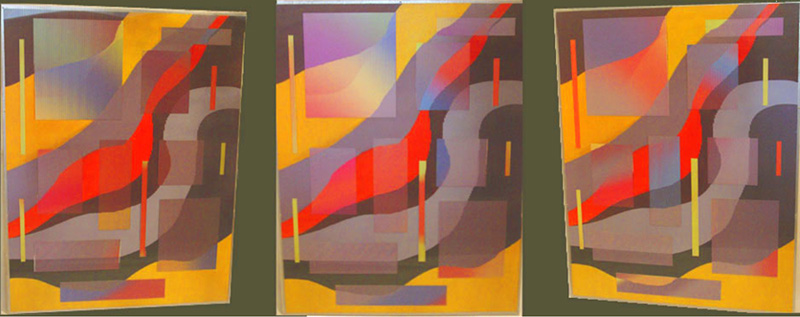
Multi-phase art works can use intricate spectral
changes to extend the vocabulary of abstract expressionism as with Lowe’s
22” by 28” lenticular and acrylic painting collage on board titled Pieces.
Or, bolder chromatic explorations with complementary colors melding are
possible as with Lowe’s lenticular titled Walls 2.
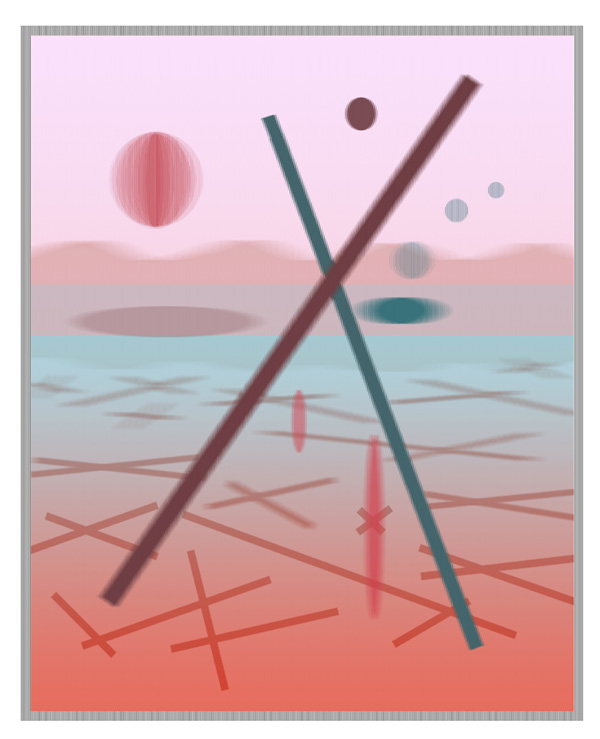
Lowe’s multi-image explorations elicit scrutiny
for their subtle transformations. With minute changes occurring in such works
as X Marks the Spot, an 8" by 10" lenticular, the viewer is
summoned to look within the painting at a quietly luminous space in which
simple shapes present themselves. These poised and beautiful abstracts,
enunciated with pleasing secondary and tertiary colors, announce a new world of
imaging for fine artists.
Heather Lowe may speak softly in this new multi-phase language.
But her work invites repeated viewing and the onlooker will return with delight
to these transformative emblems of color, movement and space.
Ray Zone has
been writing about the fine arts and 3-D for over two decades. His website,
viewable in red/blue 3-D is at: www.ray3dzone.com.
Ray can be contacted at: [email protected]