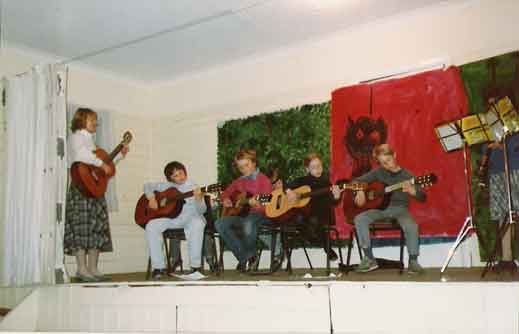
Hasaan was born in Sydney's North Shore in 1974 and spent the first 11 years of his life living in the quiet suburb of Lindfield, surrounded by bushland.
The son of two teachers, he was encouraged to spend much of his leisure time in educational activities. He enjoyed reading at an early age and listened to more complicated music such as John Coltrane, George Benson, Dionne Warwick and Frank Zappa.
He began playing guitar at the age of six and was terrified of playing chords - preferring to pluck melodies that he taught himself by ear.
In 1983, Hasaan left Lindfield Demonstration School to attend North Sydney Demonstration School where he co-developed the schoolyard game of "Fumbles" in which the players throw a tennis ball against a wall and try to catch it "on the full". Those who "fumble" the ball must run to the wall and touch it before they are hit by the ball thrown at them by opposing players, in which case they are "out". The game became very popular in North Sydney and soon spread to other schools in the Northern Suburbs. It is still being played today, although many schools banned the game in the 1990s because it involves "branding" (throwing a ball directly at another person with the intention of striking the body).
|
Hasaan and his mother moved to Wollomombi, NSW in 1986 where he attended Chandler Public School. During this time, Hasaan began to perform in public with the guitar, often amusing the audience with a selection of strange facial expressions while he played. in 1987, his mother remarried to the security chief at the University of New England (UNE) and they lived in "The Lodge", a special residence in the centre of the campus surrounded by a wildlife sanctuary for deer and wallabies. Hasaan attended Duval High School and started playing saxophone in the school band. He also learned trombone and drums during this time. |
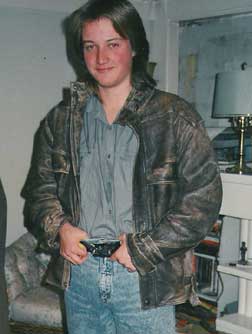
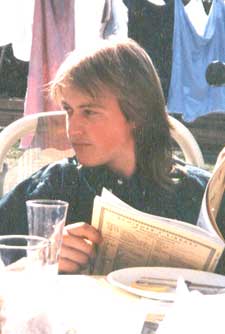
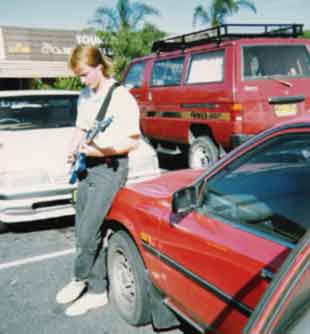
In 1990, he went to live with his father in Mannering Park in the NSW Central Coast, where he attended Northlakes High School in nearby San Remo. Here he joined the local rock band "Black Dragon" playing saxophone and guitar. His biggest musical influences at the time were Huey Lewis and the News and Johnny Diesel and the Injectors. He toured with the school choir and performed several completely improvised guitar solos on stage using backing music he had recorded in his bedroom.
 |
 |
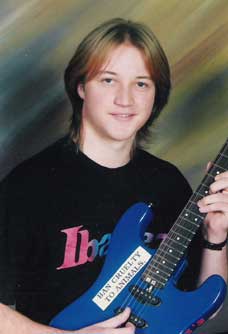 |
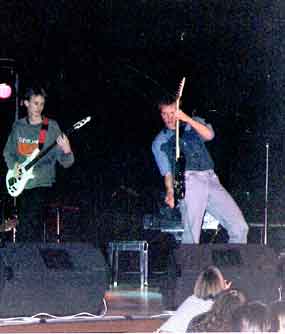
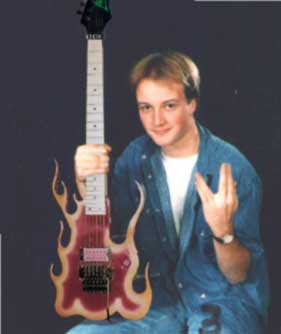
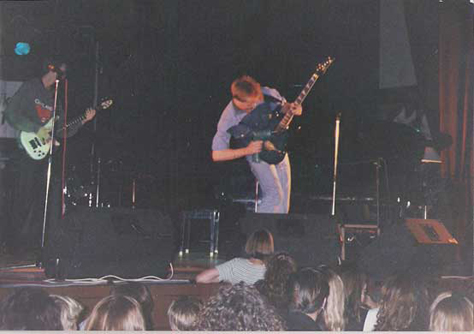
He also played baritone saxophone with the Gorokan High School band although he was never a student at that school. His saxophone tutors included Dianne Gardiner and Andrew "Jock" Robinson. He learned the Dexter Gordon version of "The Shadow of Your Smile" note for note, completely by ear and this became his party peice. Hasaan bought a second hand Ibanez RG550 and had it stripped down, carved into the shape of a flame and repainted. He joined a comedic rock band fronted by talented percussionist Chris Young that was callled "Smutty Crud" and participated in a "Battle of the Bands" competition in which Hasaan played guitar and sang lead vocals. The group performed several difficult instrumentals by Frank Zappa and also "Montana" in which Hasaan sang the impossible polyrythmic vocal parts doubled on guitar. During the performance, Hasaan's old Marshall JCM900 amplifier set fire to a black curtain and a member of the audience jumped onto the stage with an extinguisher while Hasaan kept soloing with the "inferno" behind him. This incident was captured in a photograph and the image of (what appeared to be) a burning amplifier and flame-shaped guitar contributed to Hasaan's reputation as a "wild rock kid".
 |
 |
 |
| Hasaan moved to Port Macquarie in 1992 and spent the last two years of high school at Westport Technology High, where he founded the band "Beg, Borrow & Steel". Hasaan originally saw an advertisement for a "Battle of the Bands" competition and decided that he wanted to enter. The problem was that he had only just arrived in town and had not even started school yet. In the first week of school, he went straight to the music room and started auditioning fellow students to form a band with less than four weeks until the competition. He was unable to find a bass player and the first heat of the competition was performed with no bass at all. For the finals, Hasaan managed to convince a Year 12 student to play bass on a keyboard synthesiser to fill out the sound and "Beg, Borrow & Steel" won the competition playing a mixture of original songs written by Hasaan and several classics by Stevie Ray Vaughan. ("Couldn't Stand the Weather" and "Scuttlebuttin") | 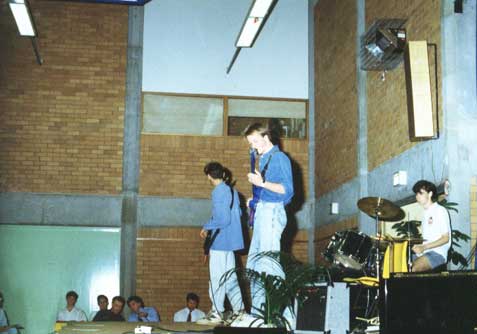 |
 |
Hasaan sold his tenor saxophone in 1993 and purchased what is now known as "#1", an Ibanez EX-370 guitar with gold hardware and a flame-maple top. The guitar was modified immediately after purchase with DiMarzio PAF PRO pickups. "Beg, Borrow & Steel" became well known in the Hastings area and received plenty of work. Hasaan began teaching guitar in a local music shop in addition to presenting a radio program on a local station that featured guitar music. He used his earnings to buy more and more guitars, favouring Ibanez JEM777 models with their distinctive monkey grips and elaborate paintwork. Hasaan's main influence at this time was Steve Vai who designed and endorsed the JEM. Hasaan performed at the opening night of the new Port Macquarie RSL and also competed in the 1993 KFC/NRTV Student of the Year Awards where he won the "Entertainer of the Year" title. He stunned the audience by playing his guitar with a Makita cordless electric drill in the middle of his solo. |
After completing Year 12, Hasaan found that his focus on music had left him with very poor results in his HSC. He moved back to Sydney to find work but found it very difficult to join established working bands. His elaborate and flashy style was incompatible with the acid-funk style that was popular in most live music venues at the time (1994). He worked night shift in a service station for a year, cleaning toilets and passing the time writing science fiction stories through the night. He eventually moved to another station where he worked evening shifts, became assistant manager and eventually station manager. Although he had worked hard to reach the apex of his job, he was still working in a service station. He dreamed of a more satisfying life. It was during this time that Hasaan became a Muslim. The details of this can be found elsewhere on the site. However, the conversion was not particularly significant at the beginning since he began as a "closet" Muslim. |
 |
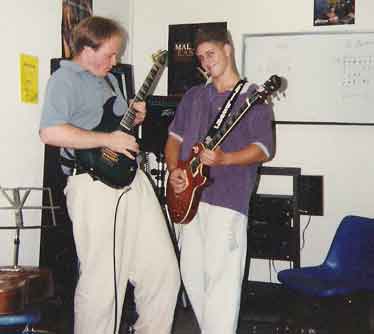 |
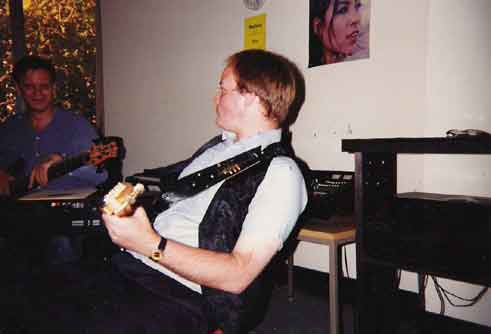
He was sponsored by his uncle to attend the Australian Institute of Music, where he studied under George Golla and Jeremy Sawkins. After spending hours in the practice booths and jazz workshops at AIM, Hasaan made some good contacts and began attracting attention for his playing again. At this time, he had a large collection of electric and acoustic guitars, and had invested in a Roland GR-30 guitar synthesiser, which gave him so many options with the instrument: he could play piano parts, horn section parts, exotic instruments such as the sitar and also string section parts. |
Hasaan played in several bands at this time and also recorded guitar parts on the albums of some of his friends from AIM. With the money earned from recording contracts, Hasaan was able to afford more and more guitars, eventually increasing his collection to nearly 20 instruments and also purchased several thousand compact discs. However, Hasaan found that the music industry was not all he had hoped it to be. It had been a childhood dream to play guitar for a living, and now that he had accomplished that goal, he found that it gave little satisfaction. He decided to enroll in university as a mature age student and study to be a teacher, to follow in his mother's footsteps. |
 |
While at university, Hasaan lived alone in his mother's holiday house in the Blue Mountains. The quiet and solitude helped him to focus on Islamic studies using the internet. He taught himself to pray and began to search for authentic hadiths so that he could begin to incorporate the sunnah of the prophet Muhummad (upon whom be peace) into his life.
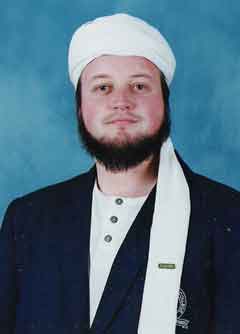
| In 2001, Hasaan began to grow a beard and began wearing Muslim clothing such as a kufi. Instantly, he began to attract attention from people around him and for the first time he felt like he was no longer part of mainstream society. Although painful, he managed to adjust and actually began to dress in such a way that he drew a LOT of attention. He began to wear a turban and a long flowing jilbab and coloured his beard jet black. He realised that whenever he did good deeds or displayed good manners, the image of Islam would be improved. This became his method of dawah: "display good manners to everybody and make sure everybody knows you are a Muslim". | 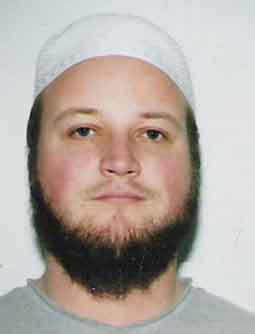 |
 |
After September 11th, he encountered a great deal of hostility because of his Islamic dress. Many Muslims urged him to shave the beard and wear "normal" clothes again but he stubbornly refused. He wrote many articles for university publications about the root causes of terrorism and the emergence of Islamophobia, as well as writing regularly to respond to inflammatory articles by the Daily Telegraph. Most of his letters were published although many of them were heavily edited before they were printed. Hasaan angrily wrote on one occasion "Please republish my letters with the name of the person who has edited them, since the final versions are more representative of his work than mine..."
In 2002, Hasaan began working unqualified as a high school music teacher at King Abdul Aziz Islamic College in Rooty Hill NSW. (Now called the Australian Islamic College of Sydney). He left at the end of the year to return to his studies in 2003 and taught part time at Ashraful Madaaris High School in Minto. (again as the music teacher). He developed a special music program for both schools in which he tried to reconcile the differing views on music education of the Muslim community and the NSW Board of Studies. The BOS repeatedly rejected his view that Music education should be very limited in Muslim schools, while Hasaan has repeated challenged the view stated in the syllabaus rationale that "Music is an important element in every culture in the world..." stating that music is considered to be forbidden by the majority of Islamic scholars, and that many Muslims do not want to have music in their lives.
 |
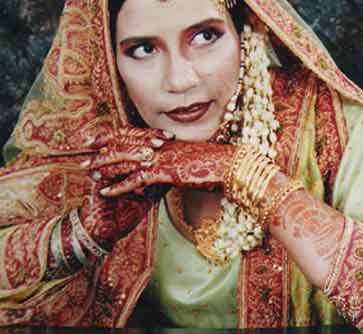 |
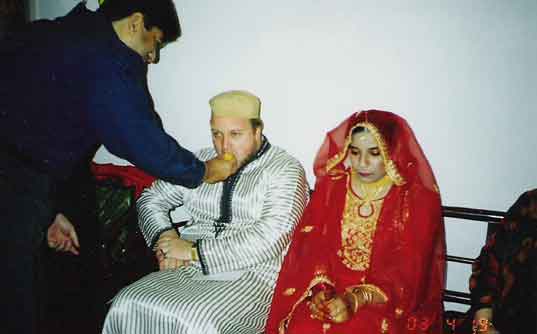
Hasaan married Nikhat Khan from Pakistan in April, 2003. Nikhat was an IT manager in the Bank Of America in Karachi, and has a double-masters degree in chemistry from the University of Karachi. They have two children.
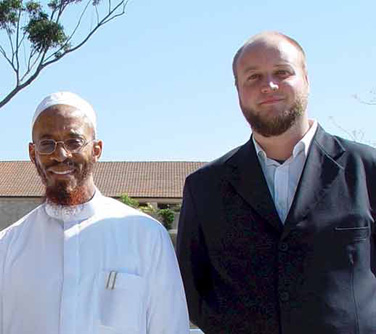
Hasaan attended the lecture presentation "Our Beginning, Our End" by Shaykh Khalid Yasin at the Whitlam Centre in Liverpool. The lecture had a profound impact and he received a copy of the "Purpose of Life" CD at the end of the lecture, which he listened to over and over. He was very impressed by Khalid Yasin's style of dawah and obtained all the recordings that he could of lectures he had given in Australia. He began transcribing them, word for word so that he could share them with others. He attended a Friday sermon by Khalid Yasin at Minto Mosque in late 2003 in which Khalid described his intentions to establish an Islamic television channel in Australia. Hasaan was convinced that such a project would have a positive influence on the non-Muslims of Australia and more importantly, the Muslim youth of Australia who would have an alternative to the current television choices.
 |
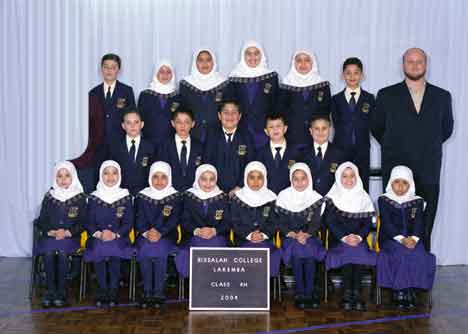 |
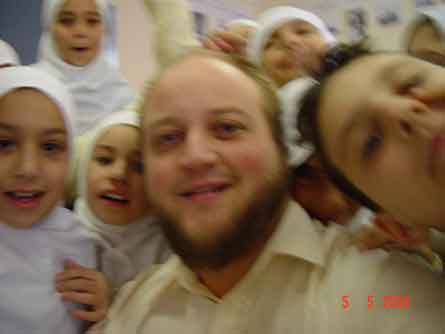
In 2004, Hasaan was a full time primary school teacher at Rissalah College in Lakemba, NSW, and regards the deputy principal Mrs Hajr Toefy as his mentor and one of his greatest pedagogical influences as a teacher.
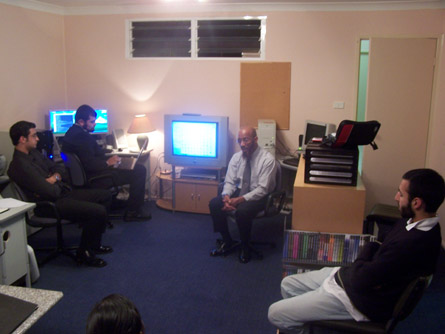
In 2005, Hasaan was astonished when Khalid Yasin moved into his street. He went immediately to help him move into his home and they established a working relationship straight away. Hasaan prayed fajr with Khalid every morning and then helped him to set up what would become the office for the Islamic Broadcast Corporation. Hasaan accompanied Khalid Yasin on many tours around Australia and appealed to large audiences (in his capacity as the spokesman) to donate money to the project by placing money in an envelope that was on their chairs. The envelope identified the charity as the Islamic Television Trust, registered in the UK.
Despite the efforts of Hasaan and others who had joined Khalid Yasin to support the project, very little interest was shown by the Muslim community and the fundrasing lectures were poorly attended. Khalid's erratic behaviour did little to improve the project's image and several outrageous public statements about friendship between Muslims and non-Muslims doomed the Islamic Broadcast Corporation to an early demise.
 |
 |
Hasaan left IBC in August 2005 and refused to be interviewed by commercial television and radio media about the failed enterprise.
In 2006, Hasaan returned to Rooty Hill to teach at the Australian Islamic College of Sydney and has been there since.
Hasaan now battles with a weight problem, having reached 140kg and is experiencing other health problems such as chronic pain in his feet and knees and chronic sleep disorders.