SCREEN MAGAZINE, DECEMBER 4, 1998
As Good As It Gets
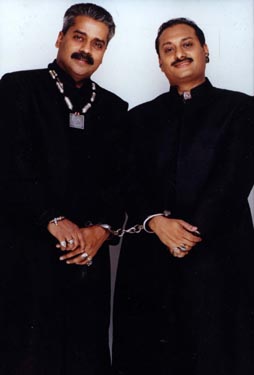 Leslie Lewis and Hariharan,
collectively known as Colonial Cousins, are back with the follow-up to their
eponymous first set. Called The Way We Do It, the album is both a continuation,
and the beginning of a new journey for the band. In a free-wheeling chat
with Sandeep Belagaje,
Lezz and Hari display as much finesse
with words as they do with their music.
Leslie Lewis and Hariharan,
collectively known as Colonial Cousins, are back with the follow-up to their
eponymous first set. Called The Way We Do It, the album is both a continuation,
and the beginning of a new journey for the band. In a free-wheeling chat
with Sandeep Belagaje,
Lezz and Hari display as much finesse
with words as they do with their music.
SB:
First of all congratulations on a great new album. The on thing that stuck
me about was how seamless the album was, and how it defied narrow linguistic
and stylistic boundaries.
Lezz: That's because you are listening to the music and not to the lyrics. You don't think what language you are listening to.
Hari: Up until now a lot of people are making a straight connection, and that's a good thing.
Lezz: The album is not about compliments. It's not about English grooves or Indian structure.
Hari: It's about Indians writing English lyrics. Take the boatman's song, for instance.
Lezz: It's about being Indian. If they can sing about New York why can't we sing about Matunga.
SB: In fact somebody just has. Mantra have taken Waltzing Matilda and turned it into Waltzing Matunga. And it works.
Lezz: The Indianness is the way we are, just as the Englishness is the way they are. This album is about Indian today. It's about the way we speak. We often say Chalo yaar, let's go. We don't make a conscious effort at speaking like this, it is just the way we speak.
Hari: Somebody in Chennai would perhaps mix his local tongue with English to get the local equivalent of that. The point is that, this is just the way we are. And that's reflected in our music.
SB: Is it really sick talking about your music, boring perhaps?
Hari: I wouldn't say we are bored, it is just that we feel that we are very incompetent in expressing ourselves through words. What we have had to say we have already said through our music.
Lezz: It is an impossible task to describe music. It is an experience, a multi-sensory experience. There is only that much that you can describe your music in English, and that gets tiresome...
Hari: And it's not like
we don't feel good talking to people. But it gets tedious when you have
 to talk
to seven people a day all asking you the same set of questions, or just
variations of the same. Its like I have gone through this before. It's like
deja vu.
to talk
to seven people a day all asking you the same set of questions, or just
variations of the same. Its like I have gone through this before. It's like
deja vu.
Lezz: It's not our job, baba,...
Hari: This is not something we do everyday. And, the thing is that we don't take ourselves or our music that seriously. Theek hai, jitna aata hai utna kar lete hain. We have confidence in what we do, and since music comes to us effortlessly, we don't have to toil at that; what toil has to be done has been done. Dus ghanta riyaaz karna, barah ghante riyaaz karna, all that's behind us. Right now we are experiencing life and enjoying the fruits of our hard work. And I would like to think that our music has grown...
SB: Perhaps your experiencing life is also refelcted in your music.
Hari: Perhaps. But the fact is that music has to effortless, it has to come from within, it has to be organic, it has to be subconscious, it has to be like breathing, it has to be a part of you.
Lezz: From a larger perspective, it has to become second instinct. It's like when I pick up a guitar, I don't think about the way I place my fingers on the strings to play G Major. I just pick up a guitar and play G Major. Music has to be done that way, sub-conscious.
Hari: That part comes to you only when you train and train hard. Training makes you deliver what you can think up. Your mind is there and your voice is there with it, your mind and your voice are in one sync. That's what training does to you. Otherwise, there will be a delay, which isn't music.
SB: The thing that strikes one about your music is the excellent blending of Carnatic and western music. What is it about Carnatic music that makes it so suited for fusion?
Hari: Carnatic music is more structured than Hindustani music, and in a lot of ways it is like western classical music. Carnatic has a lot of fixed compositions, its grammar is very strong and it is laya oriented, while Hindustani is more melodic. Also, Carnatic is more funky, and like Lezz says, it is the original funk music.
Lezz: That's why when U. Srinivas plays the mandolin on The Way We Do It, it sounds very funky. The Amercicans call it techno-funk. But it is Carnatic, this is our basic music. We have experimented, but not to much. A lot of what you hear on the album is pure classical music. It what adds mood to the song.
SB: Experimented like taking the tanpura and making it a lead instrument...
Lezz: That was because the song on which it is used had a spiritual feel to it. Lady is a spiritual experience. It has got the soul of India coming through, it reeks of India. And we don't mean poverty, or snake-charmers, or vermillion or whatever. It is spiritual, not religious, and it is a love song to boot. At the end of the day we are singing I love you, will you be there?. We are singing it like a ghazal.
Hari: Ghazal mein wohi baat hai na. Mehbooba to bachcha bhi ho sakti hai, woh khuda bhi ho sakta hain. Wohi cheez hai na yahan pe. What are we talking about in Lady on this album, and to a certain extent on Krishna on the first album is about spirituality.. Saying Rama, Krishna, Allah or Jesus is not religious. It's a vibe.
Lezz: It's the mood that you create, it's the space that you put yourself into. It's all of that. Both of us are spiritual guys because without it we cannot get music. We feel there is a hand above us, and we create music through a power we can experience but cannot see and define. And that's exactly what our music is. It is an experience, our experience.
Hari: Who could have thought
that two South Indian guys could come together and make music that make sense
to a lot of people. I mean, here I have seventeen albums behind me, and Lezz
has many jingles and albums behind him. So, what is this magic that brings
us together and drives us together? Lezz sounds different on his solo albums,
like I do on mine.
But there is a definite vibe when we are together.
SB: Did that vibe happen at the very first meeting or was it something that grew over time?
Lezz: The spark happened at the first meeting, but as we started working together we realised that we have such similar tastes in life. Be it music or clothes or just about anything else, we have similar tastes. We end up buying the same things.
SB: Like happy soul-mates, perhaps?
Lezz: Yeah, maybe. It's like when we go shopping we end up buying identical things. It all started with the black sherwanis you see on the cover and video of our first album. Independently, Hari went to Anjasan and bought the black sherwani because he thought he would look good in it. Also independently, my wife told me that she had seen some good stuff at Anjasan, and why do I end up buying but a black sherwani. So, when we appeared on the video wearing sherwanis we were dressed in clothes that we both liked. And, it came naturally to us.
Hari: Our tastes are similar. It's not just a question of clothes and cars. It's also music. We also like the same kind of music, it's not what kind of music. It's that we both like good music. We have the same aesthetic values. When I hear something good I can tell how Lezz will react to it.
 SB: That must make your
musical communication that much easier?
SB: That must make your
musical communication that much easier?
Hari: We don't talk about it ...
Lezz: ... it is seamless, that's why we are able to create good fusion music. In the studio, Hari is apt to sing something which triggers something inside me, and I add something to it, which Hari then adds something else to, and it goes so on and so forth until we feel that this is it; this is as good as it can get.
Hari: We have been recording for so many years that we can instinctly tell when a song is done. It's like `this is it, don't push it. It cannot get any better'. We realise that there has to be an effort to achieve a higher a aesthetic plane, but it shouldn't be forced.
Lezz: When we start recording we have the basic structure of a song planned out in our minds. We know how it will begin and how it will end, what we need to do is to get to that end through the best means possible.
SB: You've had a lot of big names come and work with on this album. How did communications with those guys work out?
Hari: We've been very lucky because at some point in time (the people we worked with) had been exposed to our music and communication wasn't difficult. U. Srinivas was very good to work with; Birju Maharaj doesn't do albums like these very easily. For them to come out and say `yes' to working with us is a big compliment, indeed.
Lezz: In fact they wanted to work with us just as much as we wanted to work with them. What this tells us is that we are on the right track musically. We aren't on some vague, experimental musical path. They must have felt that there was some grounding to our music, which is why they agreed to work with us; free of cost in most cases.
SB: As a producer, when did you get interested in fusion music?
Lezz: Even when I was poducing advertisement jingles, I was pondering on how to take Indian styles and internationalise them. So by the time I met Hari I had a fair idea of the sound of what we wanted to do and where we wanted to go. There was no trial-and-error, that had already been done years ago. This helped us work with the foreign crew on the album. We were sure that we could tell them what to do even if they didn't instinctively feel their way through a certain piece of music.
SB: Did you have to hold hands a lot?
Hari: Not really. The thing is that every musician is creative by himself, and knows where a certain piece is going musically. It is only in areas that they couldn't cope with that we stepped in.
Lezz: We weren't worried that much about them going out of mark because we had done our home work. And it made no sense to hold hands a lot. That would have meant that such creative minds as Andy Marvel (Diane King's producer and Celine Dion's song writer), Andy Whitmore (producer for Peter Andre and Terence Trent D'Arby), Keith Le Blanc (drummer for Peter Gabriel and Tina Turner) weren't bringing in any of their experience into the album. That wasn't our intention. We were there to make the best use of their talent within the structure we had designed.
SB: Given the wealth of national and international music talent on the album, do you guys feel that this album could break through internationally?
Lezz: It better do that. Musically this is a breakthrough; it better be commercially, as well. This is the first time that an Indian band has a product that can stand in the international mainstream pop market and compete. We may be called a fusion band because we have to be classified as something, but what we do is popular music. We don't make avant garde music that is critically acclaimed but nobody ever buys. We would like to believe that we make music that people will go out and buy.
Hari: It's like Gloria Estefan's music. What she does is Latino music with dance sensibilities all packaged as pop music. What we do is Indian music with dance music to be sold as pop music.
Lezz: Our music is also different from other sub-continental efforts by the likes of Nusrat Fateh Ali Khan to the extent that we aren't being billed under the world music category. Our music isn't being called ethnic music. That means we have a chance of breaking into the mainstream market.
Hari: What also gives us hope is that there is no other band quite like us out there in the market today. We hope to fight (the Whites) on their terms.
Lezz: Essentially, what we are saying is, `hey, you have heard a lot of world music. Now listen to the way we do it', which is why the album is called The Way We Do It.
SB: Both of you are busy solo artists, as well. How difficult is it switching to a solo role after a combo-album such as this.
Hari: Not very difficult, actually. When I record a pure ghazal album, or sing a film song, I know my target audience is different, and I'm addressing a different set of musical sensibilities. One is tempted to be a little "different" musically, but music companies aren't always that open to experiments.
Lezz: I did try something different when I recorded Haseena. I tried to bring in a softer sound to a pop album. Some people liked it, but many didn't. The idea is that you try to be creative. Of course, we get to be fully vent our creative frustrations when we work on a Colonial Cousins album.