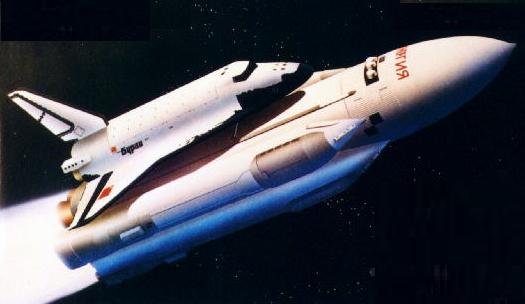
Not many know that the Russians have a space shuttle themselves called the Buran (Wind). The Russians use one giant rocket called Energiya which is the largest and most powerful rocket in the world, a real monster of a booster. Energiya-Buran Reusable Space System (MKS) can lift a staggering 100 tons. It stands 60 meters tall and produces a thrust of 4000 tons. With the shuttle Buran attached it can still lift 30 tons, this is 5 tons more than the American shuttle can with it's 25 tons capacity. Two unmanned launches were made both of which were done automatically by computers. The rocket is currently not in use because of lack of funding, but when the Russian space program was still going strong they had planned to use the Energiya to boost a new space station into orbit the Mir-2 consisting of several modules each weighing 100 tons.
The main differences between Buran and the American Shuttle are:
- Automatic landing of Buran; The Shuttle needs a crew to land;
- The Energiya-Buran shuttle system is a fully reusable, which includes the four side 'Zenit' boosters and the main 'Energiya' core super booster. The U.S shuttle, on the other hand, is only semi reusable;
- The Buran is powered solely by liquid fuel, whereas the U.S. Shutlle uses a combination of both the fuels. Solid Rocket Boosters are used during initial take off, SRB's are inherently very dangerous, which is nothing more than a controlled explosion;
- Absence of main rocket engines in Buran. The main engines are placed on a central block of ENERGIYA rocket which is capable of launching a 120 ton payload against 30 tons of Space Shuttle;
- High lift-drag ratio of Buran is 6.5 against 5.5 of Space Shuttle;
- Buran returns 20 tonns of payloads against 15 tonns for Space Shuttle from orbit to Earth;
- The cutting lay-out pattern of thermo protection tiles of Buran are optimal and the longitudinal slits of tile-belts are orthogonal to the flow line. Sharp angles of tiles are absent. The tile-belts of the Buran fuselage and fin have an optimal position.