Prelude
Tamil Nadu has a rich history in the cooperative banking sector, dating back to the early 1900s. The Cooperative Movement in India, established through the Cooperative Societies Act of 1904, has played a crucial role in the country's economy, particularly in agriculture and rural development. This act was a result of recommendations made by a committee led by Mr. Frederick Nicholson, an ICS officer of the Madras Presidency.
The Tamil Nadu State Co-operative Bank Ltd. (TNSC) was initially an urban cooperative bank founded in 1905. Over the years, it has evolved into the Tamil Nadu State Apex Co-Operative Bank Ltd., serving as an apex body that standardizes procedures within the cooperative banking system. The bank provides training to ensure uniformity in operations.
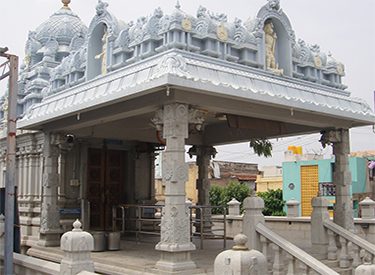
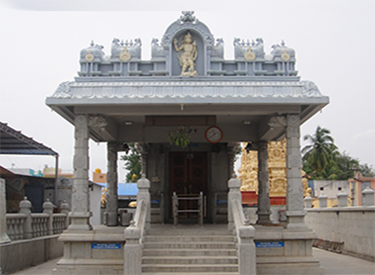
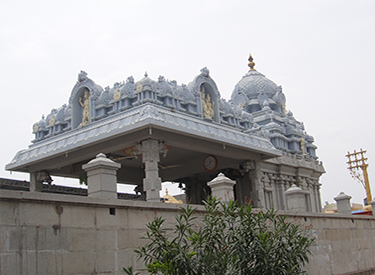
The complex is comprised of a large four-story building that faces north towards Luz Church Road, a double-story building located near the second entrance, and the temple dedicated to Sri Hanuman, both of which face east.
With this background in mind, now enter the TNSC Alwarpet branch, which is popular among the Hanumath devotees.
Memories shared by Sri gk kaushik
![Alwarpet Anjaneyar Temple [Bank Anjaneyar],Luz church Road,Mylapore](images/alwarpet1.jpg "Alwarpet Anjaneyar Temple [Bank Anjaneyar],Luz church Road,Mylapore") There was a palacious bungalow in place of the present four-storied building, which had come up during the mid-sixties. The new building was inaugurated on 13th April 1968 [Tamil New Year's day!] by Kalaigner Karunanidhi, the then PWD Minister. We can see a slab to this effect in the new building.
There was a palacious bungalow in place of the present four-storied building, which had come up during the mid-sixties. The new building was inaugurated on 13th April 1968 [Tamil New Year's day!] by Kalaigner Karunanidhi, the then PWD Minister. We can see a slab to this effect in the new building.
I have cherished memories of my brother or I accompanying our father to the bank in the early 1960s. Our father would withdraw cash, which we were responsible for carrying home, before he continued to T Nagar. During that time, the bank operated out of a building facing east near the only entrance then. The tall bank counters were adorned with brass bars that gleamed like gold, and the cash counter was heavily guarded with additional brass bars.
I vividly remember observing numerous people entering a bungalow nearby and inquired about it to my father. He explained that it was a training center for bank employees from various parts of the state. Sadly, the building was demolished a year or two later. During that time, as one approaches the complex, one can notice massive gates and windows, dismantled from the other building, that are staged and barricaded, while the bank continues to operate as usual from the building near the entrance.
ASC Bank, from whom this building was purchased by TNBC Bank, could not have constructed such a bungalow, nor would it have installed the idol of Sri Anjaneya atop the building. Prior to ASC Bank, the bungalow must have been owned by somebody who is devoted to Sri Anjaneya.
One Sunday morning, I was on my way to the Teachers Training College grounds at Saidapet to watch a cricket match played by the YMCC team, which included my elder brother. The route for me is through Alwarpet, and as I approached the bank building, I noticed a crowd gathered around the guard. He was animatedly recounting his nightly encounters with a monkey, claiming it was the same one each time. The guard, named Sanjeevi, believed that Sri Anjaneya resides nearby. Intrigued by the guard's story, I listened for a while before continuing the trip to Saidapet.
Unfortunately, after losing my father in 1966, I had not visited the place. However, before relocating to Delhi in 1971, I had heard that a shrine dedicated to Sri Anjaneya had been established within the complex.
I understand that the bungalow I mentioned in the preceding paragraph had a stucco figure of Sri Anjaneya made of mortar perched on top of the building. I had not noticed the same at that time. A photo of the bungalow showing Sri Anjaneya is said to be present in the Bank office. Moreover, the official site https://alwarpetanjaneyar.com/ acknowledges the same.
Recently, I was reading memories of Sri Indukanth Ragade, an Urban water management expert and environmentalist, about the bungalow, 'The Retreat', where he spent his childhood. This charming bungalow was located at the end of Kennedy Street off Luz Chearch Road. While recalling all the bungalows on Luz Cherch Road, he had mentioned: "My memory fails in recollecting the owner of the huge adjacent plot where the Madras State Apex Co-operative Bank and the M.Ct.M. School are now located." On this, the official site mentions that the bungalow was purchased from the Andhra State Co-operative Bank during the year 1963. The identity of the original owners remains unknown, with Sri Anjaneya positioned atop the building.
Yes. I had seen the bungalow 'The Retreat' in the end 1950s. My classmate Sri Sathya Vasu, son of our Maths teacher, and Sri Krishnamoorthi were living in the houses in Kannedy Street facing the lengthy compound wall of the bungalow. We go to Alwarpet through Oliver Road, hence I do not know of the bungalows on the Luz Church Road.
Conclusion
Andhra State Co-operative Bank, from whom this building was purchased by TNBC Bank, could not have constructed such a bungalow, nor would it have installed the idol of Sri Anjaneya atop the building. Prior to ASC Bank, the bungalow must have been owned by somebody who is devoted to Sri Anjaneya. Sri Anjaneya, moved by the devotion of that devotee, must have chosen to stay back in the premises. Perhaps this is why He revealed His presence through Sri Sanjeevi, the guard at that time.
In an unusual decision, the management of the Bank chose to permit the establishment of a temple within their premises. It is even more unusual to bear the cost of construction as well as the maintenance cost of conducting daily pooja.
Can there be any other explanation other than that it has happened because of His will to bless us all?
I salute Thee to give me inspiration, magnanimity, and Santhi.
Anjaneyar Aalaya Trust
183, Lus Church Road, Mylapore, Chennai-600 004
Pin : 600 004
e-mail: [email protected]
Working Hours of Temple : 6 AM to 10.00 AM & 5 PM to 9 PM