History
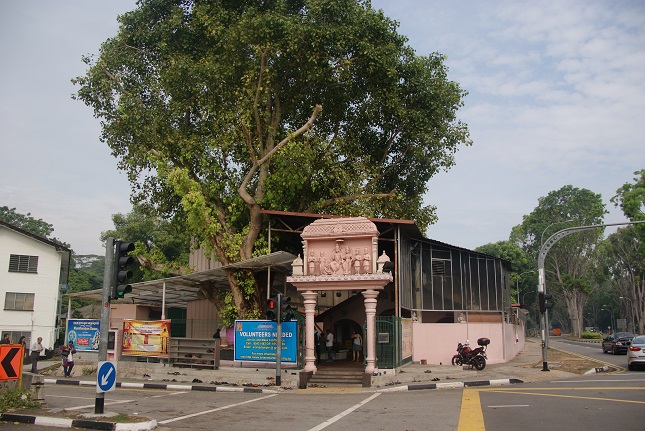
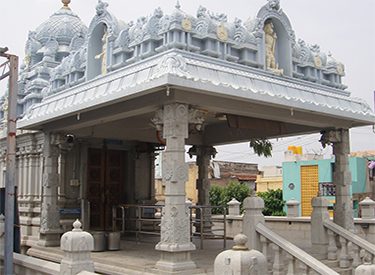
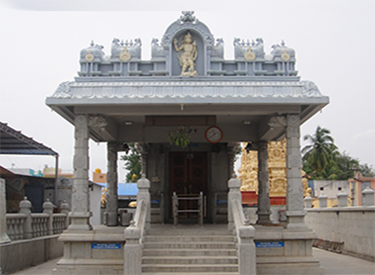
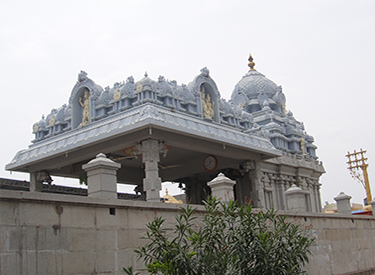
Like others of its era, this temple is secluded behind a perimeter wall decorated with mythical elements, with a devotional hall and recessed sanctuary. From the outside, it appears as a towering, multi-tier main gateway adorned with mythical figures and religious symbols. The ornate gateway is topped by a symbolic barrel roof-like structure.
The temple is auspiciously situated — it faces east, overlooks the sea and guards the village. These three factors are the most important determinants in the ‘Vasthu Shastra’ of a temple. The favourable location of the temple also received great praise from experts in Temple Science and Architecture from Madurai, South India.
Spiritual centre
Following its post-war construction, the temple’s initial patronage was from the Hindu workers of the Royal Air Force. As more public housing estates developed in the east, its congregation has likewise increased. In fact, the Sree Ramar Temple at Changi has since become a spiritual centre for Singaporeans in the eastern part of Singapore.
 The temple hosts many annual religious activities like Rama Navami and Hanuman Jayanti, both grand occasions; and the Navarathiri
Festival and Chandi Homams. Additionally, devotees are invited to participate in the villaku pooja, held on the first Sunday of each month.
The temple hosts many annual religious activities like Rama Navami and Hanuman Jayanti, both grand occasions; and the Navarathiri
Festival and Chandi Homams. Additionally, devotees are invited to participate in the villaku pooja, held on the first Sunday of each month.
Uniqueness
Interestingly, the temple is also visited by non-Hindu believers. To cater to their needs, idols of the Lord Buddha and Guan Yin (Goddess of Mercy) were set up in the temple.
One of a kind
The temple is notable as being the only temple of its kind in South East Asia dedicated to Hindu god Rama.
Vaishnavitism and Saivitism
Although it is a Vaishnavite (followers of Vaishnavism, considers Vishnu as the Supreme Lord) temple, Saivite (followers of Shaivism, one of the largest sects that believe Shiva is the supreme god) deities can also be found in the temple. This allows Hindus to complete their rituals at the temple after conducting post-funeral rites at the seaside.
This unique setup is the result of three other Hindu temples being amalgamated with Sree Ramar Temple: Sri Manmatha Karunaya Eswarar Temple, Sri Muthu Mariamman Temple and Sri Palani Aandavar Shrine.
Sri Hanuman
 Sri Hanuman is seen in the main garbhagraha along with Sri Rama, Sri Sita and Sri Lakshmana. He is seen in the kneeled posture on
right side of Sri Rama.
Sri Hanuman is seen in the main garbhagraha along with Sri Rama, Sri Sita and Sri Lakshmana. He is seen in the kneeled posture on
right side of Sri Rama.
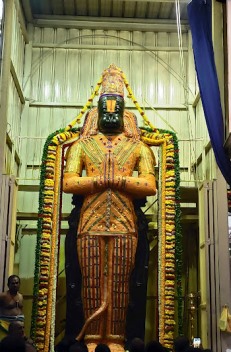
In February 2004, the temple administration decided to erect an Anjaneya statue. After that, a 21 feet tall statue of Anjaneyar was carved under the supervision of Tamil Nadu Stapati [sculptor] Mr. Krishnamurthy and established in the year 2005.
For this there is a separate sannidhi for Sri Hanuman was established. Sri Hanuman of this temple is known by the name "Sri Viswarooa Sri Anjaneya". The imposing magnificient Sri Hanuman in "anjali hasta" posture is seen offering salutations to Sri Rama. He attracts attention of all devotees alike. During Sri Hanumanth Jayanthi large devotees turnup to see the abhishekam [anointing] of murthi.
Note from author: I had been to the temple fifteen years back when on an assignment to that country. The information given here is from the Singapore Government website.
I salute Thee to give me inspiration, magnanimity, and Santhi.
Sree Ramar Temple,
51 Changi Village Road,
Singapore – 509908
Phone : (65) 6543 1463 & Fax: (65) 6542 6593
e-mail : [email protected]
Working Hours of Temple : 6 AM to 12 PM
Evening Working Hours : 5.30 PM to 9.00 PM