Home
Genetics
Genetic
Crosses
History
Glossary
Puzzles
About
this site
Site
map
WebQuest
|
Individuals and team players
Whereas some of our
traits are controlled by just one pair of alleles, the majority of our
visible traits are controlled by two or more pairs.
How
can we tell?
-
Traits controlled by
one pair of alleles tend to show "either/or
variation".
That is, you either see one phenotype or another.
-
This is also
called discrete
or discontinuous variation.
Examples: Human
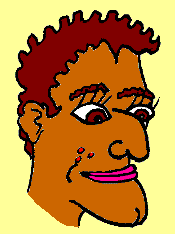 |
If you pass the mouse arrow over Dom here, you will see his dominant
traits turn into recessive traits. |
Examples: Other species
-
Hairless cat or
furry cat. (To read about cat genetics go to Cat World.)
-
Tall
growing or dwarf pea plant
-
Round pea seeds or
wrinkled pea seeds
-
For a list of 7
contrasting traits in garden peas go to Pink
Monkey.
- "Silvering" of horse
coat colour. (For other genes affecting horse coat colour go to table 2.
-
Traits controlled by
several pairs of alleles at different places on the chromosomes show a
range in the phenotype from one extreme
to another.
-
This is
called continuous
variation.
-
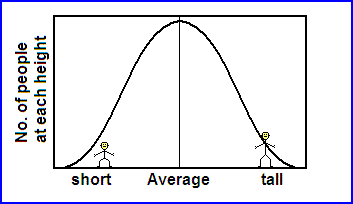
Most of the
individuals in a population are near the average phenotype with only a
few individuals at each extreme.
-
A good example of
this is height in humans. There are a few very tall people and a few
very short people, but the majority are in between and most are around
average.
- If you graph the
heights of a large group of people, the graph usually has a bell shaped
curve. This is typical for traits
controlled by several genes.
-
Skin colour in
humans is also controlled by a number
of genes, but it is common for some populations of people to all be the
same colour - e.g. black, white or brown. However, in places
where there has been mixing between these populations, there is a whole
range of shades.
Other
sources of variation
Not all variation
between
individuals
is caused by different genes or alleles. Some of the other factors that
affect phenotype include:
-
Effects of the
environment such as wind damage to trees or sunburn in humans.
-
Other physical
effects that cause harm or injury such as scars cause by fights or
accidents.
-
Nutrition - different
nutrients or foods being taken in. Lack of food or nutrients can cause
deficiency diseases such as yellow leaves in plants or stunted growth
in animals. Chemicals taken in by a pregnant mother can cause changes
to her growing child that result in birth defects.
-
Diseases can cause
short-term or long-term changes to appearance and functioning of
organisms. For example chicken pox causes spots when you have it but
may leave permanent pock marks if you scratch too much.
-
Deliberate changes
made by people. For example using hair dye to change hair colour, or
docking the tails or horns of sheep or cattle.
Phenocopies
If
a plant or animal has a phenotype that appears to be caused by genes
but is actually caused by something environmental, it is said to be a
phenocopy. Examples include:
- A shrub may grow along
the ground (= be prostrate) because it has genes for that growth form,
but in an area of strong winds, shrubs that have the genes for upright
growth may show a phenocopy of prostrate plants.
-
Some cattle are
naturally "polled" = don't grow horns, but people often dock
horns of cattle, so make a phenocopy.
- Some people have
naturally blonde hair while others dye theirs and so are a phenocopy.
Pedigree
Diagrams
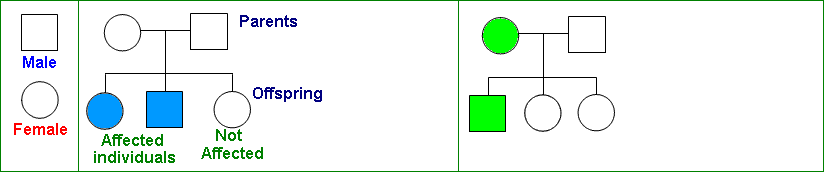
A
pedigree diagram shows a family tree in which the inheritance of a
certain characteristic is followed through two or more generations.
It
is common to symbolise females using circles and males with
squares. Individuals with the trait under study are shown
with shaded shapes. (Put the
mouse arrow
on the diagram below for more information)
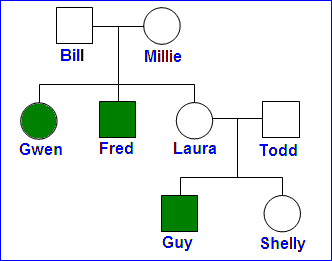
Example:
For the trait of being shortsighted in humans.
Gwen,
Fred and Guy are shortsighted. (Put
the mouse arrow
on the diagram below to
see genotypes).
-
If
N is the allele for normal sight and n
is the allele for
shortsighted, we know for sure that Gwen,
Fred and Guy are all homozygous recessive (nn)
as they have the
trait.
-
We also know that
Bill and Millie, and Laura and Todd must
be heterozygous. They have normal vision but they must have
had
hidden alleles that they passed on to some of their offspring.
- Shelly has normal
vision but she might have received a recessive allele from either
parent. Her genotype could be NN or Nn. We can use N- to
show that we don't know the other allele.
|
 A site for
learning
about basic genetics
A site for
learning
about basic genetics