
Enrico Fermi
Enrico Fermi was born in Rome on 29th September, 1901, the son of Alberto Fermi, a Chief Inspector of the Ministry of Communications, and Ida de Gattis. He attended a local grammar school, and his early aptitude for mathematics and physics was recognized and encouraged by his father's colleagues, among them A. Amidei. In 1918, he won a fellowship of the Scuola Normale Superiore of Pisa. He spent four years at the University of Pisa, gaining his doctor's degree in physics in 1922, with Professor Puccianti.
Soon afterwards, in 1923, he was awarded a scholarship from the Italian Government and spent some months with Professor Max Born in G�ttingen. With a Rockefeller Fellowship, in 1924, he moved to Leyden to work with P. Ehrenfest, and later that same year he returned to Italy to occupy for two years (1924-1926) the post of Lecturer in Mathematical Physics and Mechanics at the University of Florence.
In 1926, Fermi discovered the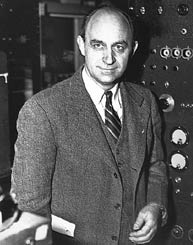 statistical laws, nowadays known as the �Fermi statistics�, governing the particles subject to Pauli's exclusion principle (now referred to as �fermions�, in contrast with �bosons� which obey the Bose-Einstein statistics).
In 1927, Fermi was elected Professor of Theoretical Physics at the University of Rome (a post which he retained until 1938, when he - immediately after the receipt of the Nobel Prize - emigrated to America, primarily to escape Mussolini's fascist dictatorship).
During the early years of his career in Rome he occupied himself with electrodynamic problems and with theoretical investigations on various spectroscopic phenomena. But a capital turning-point came when he directed his attention from the outer electrons towards the atomic nucleus itself. In 1934, he evolved the �-decay theory, coalescing previous work on radiation theory with Pauli's idea of the neutrino. Following the discovery by Curie and Joliot of artificial radioactivity (1934), he demonstrated that nuclear transformation occurs in almost every element subjected to neutron bombardment. This work resulted in the discovery of slow neutrons that same year, leading to the discovery of nuclear fission and the production of elements lying beyond what was until then the Periodic Table.
In 1938, Fermi was without doubt the greatest expert on neutrons, and he continued his work on this topic on his arrival in the United States, where he was soon appointed Professor of Physics at Columbia University, N.Y. (1939-1942).
Upon the discovery of fission, by Hahn and Strassmann early in 1939, he immediately saw the possibility of emission of secondary neutrons and of a chain reaction. He proceeded to work with tremendous enthusiasm, and directed a classical series of experiments which ultimately led to the atomic pile and the first controlled nuclear chain reaction. This took place in Chicago on December 2, 1942 - on a volleyball field situated beneath Chicago's stadium. He subsequently played an important part in solving the problems connected with the development of the first atomic bomb (He was one of the leaders of the team of physicists on the Manhattan Project for the development of nuclear energy and the atomic bomb.)
In 1944, Fermi became American citizen, and at the end of the war (1946) he accepted a professorship at the Institute for Nuclear Studies of the University of Chicago, a position which he held until his untimely death in 1954. There he turned his attention to high-energy physics, and led investigations into the pion-nucleon interaction.
During the last years of his life Fermi occupied himself with the problem of the mysterious origin of cosmic rays, thereby developing a theory, according to which a universal magnetic field - acting as a giant accelerator - would account for the fantastic energies present in the cosmic ray particles.
Professor Fermi was the author of numerous papers both in theoretical and experimental physics. His most important contributions were:
"Sulla quantizzazione del gas perfetto monoatomico", Rend. Accad. Naz. Lincei, 1935 (also in Z. Phys., 1936), concerning the foundations of the statistics of the electronic gas and of the gases made of particles that obey the Pauli Principle.
Several papers published in Rend. Accad. Naz. Lincei, 1927-28, deal with the statistical model of the atom (Thomas-Fermi atom model) and give a semiquantitative method for the calculation of atomic properties. A resum� of this work was published by Fermi in the volume: Quantentheorie und Chemie, edited by H. Falkenhagen, Leipzig, 1928.
"Uber die magnetischen Momente der AtomKerne", Z. Phys., 1930, is a quantitative theory of the hyperfine structures of spectrum lines. The magnetic moments of some nuclei are deduced therefrom.
"Tentativo di una teoria dei raggi �", Ricerca Scientifica, 1933 (also Z. Phys., 1934) proposes a theory of the emission of �-rays, based on the hypothesis, first proposed by Pauli, of the existence of the neutrino.
The Nobel Prize for Physics was awarded to Fermi for his work on the artificial radioactivity produced by neutrons, and for nuclear reactions brought about by slow neutrons. The first paper on this subject "Radioattivit� indotta dal bombardamento di neutroni" was published by him in Ricerca Scientifica, 1934. All the work is collected in the following papers by himself and various collaborators: "Artificial radioactivity produced by neutron bombardment", Proc. Roy. Soc., 1934 and 1935; "On the absorption and diffusion of slow neutrons", Phys. Rev., 1936. The theoretical problems connected with the neutron are discussed by Fermi in the paper "Sul moto dei neutroni lenti", Ricerca Scientfica, 1936.
His Collected Papers are being published by a Committee under the Chairmanship of his friend and former pupil, Professor E. Segr� (Nobel Prize winner 1959, with O. Chamberlain, for the discovery of the antiproton).
Fermi was member of several academies and learned societies in Italy and abroad (he was early in his career, in 1929, chosen among the first 30 members of the Royal Academy of Italy).
As lecturer he was always in great demand (he has also given several courses at the University of Michigan, Ann Arbor; and Stanford University, Calif.). He was the first recipient of a special award of $50,000 - which now bears his name - for work on the atom.
Professor Fermi married Laura Capon in 1928. They had one son Giulio and one daughter Nella. His favourite pastimes were walking, mountaineering, and winter sports.
He died in Chicago on 29th November, 1954.
From Nobel Lectures, Physics 1922-1941.
(Source : http://www.nobel.se/physics/laureates/1938/fermi-bio.html)
Enrico Fermi
If the 19th century was the century of
chemistry, the 20th was the century of physics. The
burgeoning science supported such transforming
applications as medical imaging, nuclear reactors,
atom and hydrogen bombs, radio and television,
transistors, computers and lasers. Physical knowledge
increased so rapidly after 1900 that theory and
experiment soon divided into separate specialties.
Enrico Fermi, a supremely self-assured Italian
American born in Rome in 1901, was the last great
physicist to bridge the gap. His theory of beta decay
introduced the last of the four basic forces known in
nature (gravity, electromagnetism and, operating
within the nucleus of the atom, the strong force and
Fermi's "weak force"). He also co-invented and
designed the first man-made nuclear reactor, starting
it up in a historic secret experiment at the
University of Chicago on Dec. 2, 1942. In the famous
code that an administrator used to report the success
of the experiment by open phone to Washington, Fermi
was "the Italian navigator" who had "landed in the new
world."
He had personally landed in the new world four years
earlier, with a newly minted Nobel Prize gold medal in
his pocket, pre-eminent among a distillation of
outstanding scientists who immigrated to the U.S. in
the 1930s to escape anti-Semitic persecution in
Hitler's Germany and Mussolini's Italy--in Fermi's
case, of his Jewish wife Laura.
A dark, compact man with mischievous gray-blue eyes,
Fermi was the son of a civil servant, an administrator
with the Italian national railroad. He discovered
physics at 14, when he was left bereft by the death of
his cherished older brother Giulio during minor throat
surgery. Einstein characterized his own commitment to
science as a flight from the I and the we to the it.
Physics may have offered Enrico more consolatory
certitudes than religion. Browsing through the
bookstalls in Rome's Campo dei Fiori, the grieving boy
found two antique volumes of elementary physics,
carried them home and read them through, sometimes
correcting the mathematics. Later, he told his older
sister Maria that he had not even noticed they were
written in Latin.
He progressed so quickly, guided by an engineer who
was a family friend, that his competition essay for
university admission was judged worthy of a doctoral
examination. By 1920 he was teaching his teachers at
the University of Pisa; he worked out his first theory
of permanent value to physics while still an
undergraduate. His only setback was a period of
postdoctoral study in Germany in 1923 among such
talents as Wolfgang Pauli and Werner Heisenberg, when
his gifts went unrecognized. He disliked pretension,
preferring simplicity and concreteness, and the
philosophic German style may have repelled him. "Not a
philosopher," the American theorist J. Robert
Oppenheimer later sketched him. "Passion for clarity.
He was simply unable to let things be foggy. Since
they always are, this kept him pretty active." He won
appointment as professor of theoretical physics at the
University of Rome at 25 and quickly assembled a small
group of first-class young talents for his
self-appointed task of reviving Italian physics.
Judging him infallible, they nicknamed him "the Pope."
The Pope and his team almost found nuclear fission in
1934 in the course of experiments in which, looking
for radioactive transformations, they systematically
bombarded one element after another with the newly
discovered neutron. They missed by the thickness of
the sheet of foil in which they wrapped their uranium
sample; the foil blocked the fission fragments that
their instruments would otherwise have recorded. It
was a blessing in disguise. If fission had come to
light in the mid-1930s, while the democracies still
slept, Nazi Germany would have won a long lead toward
building an atom bomb. In compensation, Fermi made the
most important discovery of his life, that slowing
neutrons by passing them through a light-element
"moderator" such as paraffin increased their
effectiveness, a finding that would allow releasing
nuclear energy in a reactor.
If Hitler had not hounded Jewish scientists out of
Europe, the Anglo-American atom bomb program sparked
by the discovery of fission late in 1938 would have
found itself shorthanded. Most Allied physicists had
already been put to work developing radar and the
proximity fuse, inventions of more immediate value.
Fermi and his fellow emigres--Hungarians Leo Szilard,
Eugene Wigner, John von Neumann and Edward Teller,
German Hans Bethe--formed the heart of the bomb squad.
In 1939, still officially enemy aliens, Fermi and
Szilard co-invented the nuclear reactor at Columbia
University, sketching out a three-dimensional lattice
of uranium slugs dropped into holes in black, greasy
blocks of graphite moderator, with sliding
neutron-absorbing cadmium control rods to regulate the
chain reaction. Fermi, still mastering English, dubbed
this elegantly simple machine a "pile."
The work moved to the University of Chicago when the
Manhattan Project consolidated its operations there,
culminating in the assembly of the first full-scale
pile, CP-1, on a doubles squash court under the stands
of the university football field in late 1942. Built
up in layers inside wooden framing, it took the shape
of a doorknob the size of a two-car garage--a
flattened graphite ellipsoid 25 ft. wide and 20 ft.
high, weighing nearly 100 tons. Dec. 2 dawned to
below-zero cold. That morning the State Department
announced that 2 million Jews had perished in Europe
and 5 million more were in danger; American boys and
Japanese were dying at Guadalcanal. It was cold inside
the squash court, and the crowd of scientists who
assembled on the balcony kept on their overcoats.
Fermi proceeded imperturbably through the experiment,
confident of the estimates he had charted with his
pocket slide rule. At 11:30 a.m., as was his custom,
he stopped for lunch. The pile went critical in
midafternoon with the full withdrawal of the control
rods, and Fermi allowed himself a grin. He had proved
the science of a chain reaction in uranium; from then
on, building a bomb was mere engineering. He shut the
pile down after 28 minutes of operation. Wigner had
thought to buy a celebratory fiasco of Chianti, which
supplied a toast. "For some time we had known that we
were about to unlock a giant," Wigner would write.
"Still, we could not escape an eerie feeling when we
knew we had actually done it."
From that first small pile grew production reactors
that bred plutonium for the first atom bombs. Moving
to Los Alamos in 1944, Fermi was on hand in the New
Mexican desert for the first test of the brutal new
weapon in July 1945. He estimated its explosive yield
with a characteristically simple experiment, dropping
scraps of paper in the predawn stillness and again
when the blast wind arrived and comparing their
displacement.
Fermi died prematurely of stomach cancer in Chicago in
1954. He had argued against U.S. development of the
hydrogen bomb when that project was debated in 1949,
calling it "a weapon which in practical effect is
almost one of genocide." His counsel went unheeded,
and the U.S.-Soviet arms race that ensued put the
world at mortal risk. But the discovery of how to
release nuclear energy, in which he played so crucial
a part, had long-term beneficial results: the
development of an essentially unlimited new source of
energy and the forestalling, perhaps permanently, of
world-scale war.
BORN Sept. 29, 1901, Rome
1926 Develops Fermi-Dirac statistics
1932 Writes key paper on beta decay
1934 Discovers slow neutrons
1938 Awarded Nobel Prize for Physics
1939 Escapes Europe and moves to the U.S.
1942 Achieves man-made nuclear chain reaction
1949 Argues against development of the H-bomb
1954 Dies in Chicago
What is a Fermi Question?
A Fermi question requires estimation of physical
quantities to arrive at an answer.
Throughout his work, Fermi was legendary for being
able to figure out things in his head, using
information that initially seems too meager for a
quantitative result. He used a process of "zeroing in"
on problems by saying that the value in question was
certainly larger than one number and less than some
other amount. He would proceed through a problem in
that fashion and, in the end, have a quantified answer
within identified limits.
In a Fermi question, the goal is to get an answer to
an order of magnitude (typically a power of ten) by
making reasonable assumptions about the situation, not
necessarily relying upon definite knowledge for an
"exact" answer.
A Fermi question is posed with limited information
given.
How many water balloons would it take to fill the
school gymnasium?
How many piano tuners are there in New York City?
What is the mass in kilograms of the student body in
your school?
A Fermi question requires that students ask many more
questions.
How big is a water balloon?
What are the approximate dimensitons dimensions of the
gym?
What measurment must be estimated using the dimensions
of the gym?
... and the list goes on.
A Fermi question demands communication.
A Fermi question utilizes estimation.
A Fermi question emphasizes process rather than "the"
answer.
Example 1:
HOW MANY PIANO TUNERS ARE IN NEW YORK CITY?
How might one figure out such a thing?? Surely the
number of piano tuners in some way depends on the
number of pianos. The number of pianos must connect in
some way to the number of people in the area.
Approximately how many people are in New York City?
10,000,000
Does every individual own a piano?
No
Would it be reasonable to assert that "individuals
don't tend to own pianos; families do?
Yes.
About how many families are there in a city of 10
million people?
Perhaps there are 2,000,000 families in NYC.
Does every family own a piano?
No.
Perhaps one out of every five does.
That would mean there are about 400,000 pianos in NYC.
How many piano tuners are needed for 400,000 pianos?
Some people never get around to tuning their piano;
some people tune their piano every month. If we assume
that "on the average" every piano gets tuned once a
year, then there are 400,000 "piano tunings" every
year.
How many piano tunings can one piano tuner do?
Let's assume that the average piano tuner can tune
four pianos a day. Also assume that there are 200
working days per year. That means that every tuner can
tune about 800 pianos per year.
How many piano tuners are needed in NYC?
The number of tuners is approximately 400,000/800 or
500 piano tuners.
Try it yourself.
Use different assumptions for various factors. It is
unlikely that you can justify an answer greater than a
factor of 10 or smaller than a factor of 10 from the
number originally obtained; that is to say, there are
probably not more than 5000 tuners and surely no less
than 50. Thus the answer obtained is good to within an
"order of magnitude".
Example 2:
HOW MANY JELLY BEANS FILL A ONE-LITER BOTTLE?
As with any Fermi question, there are multiple
directions from which the problem can be approached.
Solution 1 illustrates a more algorithmic approach;
solution 2 is more intuitive. In both solutions, it is
understood that one liter is equal to 1000 cubic
centimeters.
Solution 1
What is the approximate size a jelly bean?
An examination of a jelly bean reveals that is
approximately the size of a small cylinder that
measures about 2 cm long by about 1.5 cm in diameter.
Do jelly beans "completely fill the liter bottle"?
The irregular shape of jelly beans result in them not
being tightly packet; approximately 80% of the volume
of the bottle is filled
The number of jelly beans is the occupied volume of
the jar divided by the volume of a single jelly bean
Number of beans = (Occupied Volume of Jar)/(Volume of
1 Bean)
The volume of one jelly bean is approximated by the
volume of a small cylincer 2 cm long and 1.5 cm in
diameter
Volume of 1 Jelly Bean = h(pi)(d/2)^2 = 2cm x 3
(1.5cm/2)^2 = 27/8 cubic centimers
Thus the approximate number of beans in the jar is
Number of beans = (.80 x 1000 cubic centimeters)/(27/8
cubic centimeters) = approx 240 jelly beans
Have your students try it out with jelly beans and a
liter bottle or jar. If you don't have a liter jar,
use a quart jar (.95 liter)
Solution 2
Have your students construct or visualize a paper cube
that measures 1 cubic inch.
How many jelly beans will fit in the cube?
Approximately 4
How many cubic inches are there in 1 liter?
1 inch = approx 2.54 centimeters. Therefore 1 cubic
inch = approx. 16 cubic centimeters
1000 cubic centimeters/16 cubic centimeters = approx
62 cubic inches in one liter.
How many jelly beans are there in the one liter
container?
62 x 4 = approximately 248 jellybeans