
Akio Morita
Almost exactly five years ago, Akio Morita--Mr. Sony--fell to the ground during a game of tennis. The co-founder and chairman of the board had suffered a stroke. He has since been in a wheelchair. This is particularly sad, as Morita had never been able to sit still and relax. At 72, he was playing tennis at 7 a.m. each Tuesday. I know this well because I would practice on the court next to him. My tennis, however, was very different from his. I played with an instructor, and if I was tired, I would just take a break. Not him. He challenged everybody, including young athletes.
This was in keeping with a man who created one of the first global corporations. He saw long before his contemporaries that a shrinking world could present enormous opportunities for a company that could think beyond its own borders, both physically and psychologically. And he pursued that strategy with his relentless brand of energy in every market, particularly the U.S. It is notable that this year, according to a Harris survey, Sony is rated the No. 1 brand name by American consumers, ahead of Coca-Cola and General Electric.
The best 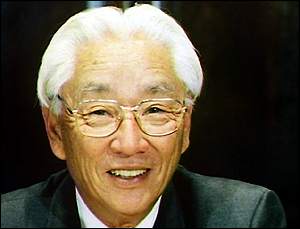 way to describe Morita's extraordinary drive is to scan his schedule for the two-month period immediately preceding his stroke. He took trips from his home base in Tokyo to New Jersey, Washington, Chicago, San Francisco, Los Angeles, San Antonio, Dallas, Britain, Barcelona and Paris. During that time he met with Queen Elizabeth II, General Electric chief Jack Welch, future French President Jacques Chirac, Isaac Stern and many other politicians, bureaucrats and business associates. He attended two concerts and a movie; took four trips within Japan; appeared at eight receptions; played nine rounds of golf; was guest of honor at a wedding ceremony; and went to work as usual for 17 days at Sony headquarters. Morita's schedule had been decided on more than a year in advance. Whenever there was a small opening, Morita would immediately and strategically fill it by arranging a meeting with someone he wanted to become acquainted with or catch up with. Unlike so many executives who remove themselves from the rest of the corporate pyramid, he was always in the middle of the action.
Morita had been groomed since the third grade to become the successor of a 14-generation family business: a prominent sake-brewing company in Nagoya. In true entrepreneurial spirit, however, he traded this life of comfort and privilege for the uncertainties of a start-up, called Tokyo Telecommunications Engineering, Inc., in the rubble of postwar Japan.
From the outset, Morita's marketing concept was brand-name identification and brand responsibility: that the name would instantly communicate high product quality. This is a marketing concept widely used by companies today. But at that time most companies in Japan were producing under somebody else's brand name. Pentax, for example, was making products for Honeywell, Ricoh for Savin and Sanyo for Sears.
Complementing Morita's unusual focus on brand identity were the talents of his co-founder, Masaru Ibuka, the engineering and product-design force behind Sony's inventions. The combination worked well. The two sought to provide the best available technology and quality to the consumer. One of Sony's first products was a transistor radio, produced in 1955. While the transistor was developed by Bell Labs and produced by Western Electric, it was Sony that first used it for a small pocket radio, in 1957, creating a new market in the bargain.
The radio's success led to more firsts in transistorized products, such as an 8-in. television and a videotape recorder. Sony's technological achievements in product design, production and marketing helped change the image of MADE IN JAPAN from a notion of cheap imitations to one associated with superior quality. In Morita's own words, they made Sony the Cadillac of electronics.
The creation of the name Sony highlights Morita's intuition and determination to communicate globally. He wanted a name recognizable everywhere: creative, Roman letters, short and catchy. Morita and Ibuka pored over dictionaries and found the word sonus, which in Latin means sound. In addition, the word sonny was part of the pop vernacular in America at the time, and they thought it suggested a company made up of young people with abundant energy. The combination of the two formed Sony.
Sony's globalization began in the U.S., where Morita moved his entire family in 1963. In that way he would understand Americans, their market, customs and regulations, thereby increasing the chance of his company's success. It was a brilliant decision. Not many businessmen in those days possessed such a passionate and determined business vision. In the U.S., Morita settled into a large Fifth Avenue apartment in Manhattan. He built a solid and valuable network by continually socializing and giving parties during the week, a habit he maintained throughout his career.
Morita was a workaholic, but he was also a playaholic. He followed art and music, and was a sports fanatic. In his 60s he took up wind surfing and scuba diving and started skiing to ensure good exercise through the winter. He loved to water-ski and even crafted a water-resistant microphone on a handle, connected by a wire on the ski rope to a speaker on the boat so he could relay instructions to his wife Yoshiko. He was so proud of this invention. To simply have a good time, he would invent and perfect such a product.
The Walkman is just such an invention. Morita watched as his children and their friends played music from morning until night. He noticed people listening to music in their cars and carrying large stereos to the beach and the park. Sony's engineering department was generally opposed to the concept of a tape player without a recording function (it would be added later), but Morita would not be denied. He insisted on a product that sounded like a high-quality car stereo yet was portable and allowed the user to listen while doing something else--thus the name Walkman.
Sony America considered that bad English and changed it to Soundabout for the U.S., Freestyle for Sweden and Stowaway for Britain. Morita was leery of using a different name for each country, and when sales were less than rewarding, he changed the name universally to Sony Walkman. Subsequently, the Walkman was a worldwide hit that is now featured in major dictionaries.
The man who put Sony on the global radar had a nationalist side that was both contradictory and complementary. This you can sense in reading his best seller, "Made in Japan," as well as in talking to him. When I would complain about the ambivalence, he'd grin and say, "Ohmae-san, it is the generation gap." A navy veteran, he returned from service to a Japanese economy that had been destroyed by the war, so for a long time he maintained a Japan-first frame of mind. His initial intentions were simply to make a contribution toward rebuilding his country from the ashes of the war.
But he eventually adopted a more international point of view and, in the 1960s, began to speak of issues, such as encouraging free trade by reducing tariffs and other barriers, that many Japanese businessmen had been reluctant to discuss for decades. He represented, very vocally, the business community of Japan, a country that had during the 1970s become the No. 2 economy in the world and could no longer be ignored by the major economic players. Some controversy resulted when he was listed as co-author of a book in 1989--"The Japan That Can Say No"--that suggested that other countries stop complaining about Japanese imports and get to work improving their own corporations. His real opinions were somewhat misrepresented by the publisher: he had intended the consensus-oriented Japanese to see that in other countries disagreement and debate were not insulting and that Japanese could argue with their business partners abroad without destroying their friendship.
But as Sony grew internationally, Morita expanded his vision. Now it was "Think globally, act locally"--that is, have a common value system that transcends national objectives; serve international customers, shareholders and employees, regardless of the origin of the company. I liked his reference to the phrase in a business context so much that I used it in my book "The Borderless World" to describe a company that is in the final stage of globalization.
In 1993, Morita was asked by Gaishi Hiraiwa, then chairman of Keidanren, to be his successor. Keidanren is the most prestigious business association in Japan, and all CEOs in Japan would like to hold an important position in the organization. Until this time, Morita had never really been accepted by the Japanese establishment as Sony was a relatively small company and didn't come from the traditional strong houses of steelmaking, public utilities and heavy industry. In the Japanese economic circle, becoming chairman of Keidanren is likened to the succession of the Emperor. As it turned out, the day of Morita's stroke, Nov. 30, 1993, was the day the succession announcement was to have taken place.
This would have been a wonderful thing for Japan in 1993, a time when the country was about to collapse into sustained recession. Morita had already been thinking about reforming Japan, and he organized discussion groups of politicians, business people and bureaucrats to talk about what would be needed. People say that Japan's current economic situation might have been very different if someone like Morita had been in a position to speak on behalf of the entrepreneurs and the dynamics of business--as opposed to begging the government to rescue industry after industry. I also believe this is the case. The great tragedy is that Japan does not have another like him.
Morita achieved more than most could imagine in one lifetime. If he had been able to read the paper reporting Sony as the No. 1 consumer brand in the U.S., he would have smiled from his beachside mansion in Oahu and said, "Of course! I told you so! After all, Sony was made in the U.S.A.!"
(Source : www.time.com)
Sony Co-Founder Akio Morita Dies
Innovator Built Industry Giant
By John Burgess
Washington Post Staff Writer
Monday, October 4, 1999; Page A01
Akio Morita, co-founder of Sony Corp. and principal matchmaker in the world's love affair with consumer electronics, died yesterday of pneumonia in Tokyo at the age of 78.
In 1946, with $500 in capital, Sony began life in a Tokyo building that still bore the scorches of wartime fires. Over the next half-century, Mr. Morita and Sony helped hook the planet on one new electronic product after another -- the tape recorder, the transistor radio, the VCR, the Walkman, the compact disc.
Before Sony came on the scene, consumer electronics meant large, expensive units with wooden cabinets in affluent homes. Drawing on new technology and marketing concepts, Mr. Morita helped create "personal electronics," with products falling in price, weight and size even as they rose in capability.
Along the way, Mr. Morita's company created tens of thousands of jobs at home in the wake of the World War II defeat and helped turn the words "Made in Japan" into a symbol of unsurpassable quality. "I consider him one of the people who brought Japan back from where it was in the '40s and created a new industrial concept," said Henry A. Kissinger, who first met Mr. Morita in the 1970s during a visit to Japan as secretary of state.
As Sony blossomed into a giant with plants and billboards around the world -- its sales rang up at $57 billion in the past fiscal year -- the ebullient Mr. Morita functioned variously as product conceiver, business strategist and chief salesman. He rarely seemed more animated than when demonstrating a new product.
He was proud to dream up things that people had no idea they wanted. "Our plan is to lead the public with new products rather than ask them what kind of products they want," he wrote in "Made in Japan," a 1986 autobiography. "The public does not know what is possible, but we do."
Garrulous and fluent in English, he traveled abroad extensively and counted as friends such people as the late conductor Leonard Bernstein and Katharine Graham, chairman of the executive committee of The Washington Post Co.; U.S. ambassadors were guests at his home in Tokyo.
Sporting hair that turned silver early in life and was parted down the middle in the style of a prewar Tokyo dandy, he became arguably the best-known Japanese in the world after the emperor. Turning heads on streets and trade show floors, he put a glamorous face on the normally drab and anonymous business leadership of his country.
Mr. Morita had his share of failures over the years -- his Beta video system lost a world contest against the rival VHS. But his company nonetheless achieved almost universal recognition, creating a class of consumer who wouldn't buy an electronic product unless it had the name Sony on it.
In addition to leading in products, Mr. Morita often led the way for his Japanese competitors in setting business strategy. Sony was an early leader in putting manufacturing plants abroad and naming foreigners to important executive positions.
Mr. Morita often spoke of "global localization," said Peter G. Peterson, chairman of the investment bank Blackstone Group and a former commerce secretary. That meant becoming intimately involved in local economies all over the world, building plants and getting to know local people and business leaders.
"He could not only dream very big dreams -- he could make them happen," Peterson said.
Mr. Morita was born Jan. 26, 1921, into a wealthy family that owned a sake-brewing business in the industrial city of Nagoya. He knew sound-reproduction gadgets from an early age: His mother often listened to Western classical music on a hand-cranked Victrola, and a local shopkeeper would send over new records when they arrived. The young Mr. Morita became an obsessive electronics hobbyist, neglecting his schoolwork to build a crude phonograph and radio.
He studied physics in college, and at the time of Japan's surrender to the World War II allies in 1945 he was a newly commissioned lieutenant in the Japanese navy, researching heat-seeking weapons.
Demobilized along with millions of other young men, he went to Tokyo in 1946, with a "temporary" reprieve from his father on a pledge to take over the family sake business. In the city, he and a civilian engineer he had met in the navy, Masaru Ibuka, founded a company that went by the unwieldy name of Tokyo Telecommunications Engineering Corp.
It initially produced components and radio upgrade kits, while grander projects were planned. The first major product was Japan's first tape recorder, released in 1950. But what forever put the company on the map was a product that changed how hundreds of millions of people got music and news, the transistor radio.
The transistor, the basic component of electronic miniaturization, had been invented in 1947 at Bell Laboratories in New Jersey. Initially it went in small quantities into telephone switching equipment and hearing aids. But Mr. Morita saw mass potential. He went to New York in 1953 and licensed rights to the technology.
The miniature radio that resulted was not the first -- a U.S. company put one out a few months earlier. But it was Sony that ran with the idea and persuaded people to buy it and subsequent models that became ever smaller.
Staying in cheap hotels and eating at the automat, Mr. Morita tramped around electronics shops in New York City with a sample $29.95 radio, trying to convince proprietors that Americans would want something small in a society where bigness was the usual gauge of quality.
Determined to build a world name for his company, he rejected what would have been a huge order from Bulova Co., because it wanted the radios to be sold bearing its brand name. Rarely a failure as a salesman, Mr. Morita returned home with extensive orders for radios that were sold under its manufacturer's name.
As the company grew, Mr. Morita and other executives decided it needed a better name. They came up with Sony, drawn from the Latin root sonus for sound and the slang "sonny boy," by which they meant the young and innovative men who staffed the company, according to his autobiography.
Mr. Morita moved his family to New York for 15 months in the early 1960s as he was setting up Sony Corporation of America, the U.S. division that eventually got the company's products into just about every electronics store in the country. Early on, Mr. Morita and his collaborators decided that their products would not be discount items, but would be high quality and premium-priced.
Sony developed the first transistorized television in 1960 and the Trinitron color TV system in 1968. It led the way in home video, putting out the Betamax system in 1975. Though Beta was overtaken by VHS, Sony's early promotion of video technology was crucial to creating the mass market that eventually made it affordable for most American households.
Before 1979, no one thought there was a market for a portable device that would play tapes through a headset but not record. That year, after Mr. Morita had put his engineers to work, Sony came out with the Walkman, and within a few years it and knockoffs from other companies were standard equipment of the electronics age, existing in the hundreds of millions.
"I do not believe that any amount of market research could have told us that the Sony Walkman would be successful," Mr. Morita wrote.
Sony also co-developed the compact disc technology that came onto the market in the early 1980s and remains a nearly universal home music standard.
Sony had heavy sales in video studio equipment but has been less successful in the computer market. It negotiated deals to manufacture Apple Computer Inc.'s Macintosh computers, and it puts out high-end laptops of its own, but few people associate the name Sony with computers or the Internet.
Efforts to establish mass markets for the Minidisc music format likewise fizzled. Perhaps the most publicized of Sony's troubles followed its 1989 purchase of the legendary Hollywood film studio Columbia Pictures. In 1994, poor performance at the studio knocked $3 billion off Sony's profits.
During the 1980s and early '90s, the high points of Japan's stature in the world economy, Mr. Morita became known as a critic of U.S. business practices, faulting executives for huge compensation packages and excessive use of lawyers. He also criticized the Japanese system as too closed and stodgy and not paying out enough in dividends to investors.
With a conservative Japanese politician, he co-authored a controversial book titled "A Japan That Can Say No." Appearing in 1989, it argued that Japan, under intense criticism internationally as a closed market, should speak up for itself more forcefully. To American critics the book seemed a manifesto of a new Japanese nationalism. It had been written for the Japanese-language market and friends later said that Mr. Morita was surprised that it was publicized so widely outside his country.
In any case, with his direct style and his ease with foreigners Mr. Morita was more commonly seen by his own people as an internationalist, perhaps too much of one. "He fought a long time to be accepted in the Japanese Establishment," said Clyde Prestowitz, president of the Economic Strategy Institute and a former U.S. trade negotiator.
In Kissinger's view, Mr. Morita was at ease in the world but he was also "a proud Japanese." He criticized the United States, but "did it from a posture of friendship."
In 1993, at the age of 72, he won an honor that few Japanese business leaders ever achieve. He was picked as the next chairman of Keidanren, the organization that represents the biggest corporate names of Japan. However, on the very day that the appointment was to be announced, he suffered a serious stroke on a tennis court.
He stepped down from Sony's helm the following year and lived much of the rest of his life in Hawaii, spending long periods in rehabilitation therapy.
He is survived by his wife, Yoshiko, two sons and a daughter.