Pipewellgate Wesleyan Methodist Society and Sabbath School & High Level Road
Early meetings of the Methodists in this area were
carried out in the long room of an inn west of where
the High Level Bridge was later constructed and prior
to the construction of the Pipewellgate chapel. The
chapel and premises - a shop and tenements were erected
in 1823 - 200 yards west of the later site of the High
Level Bridge, and were capable of seating 165 people,
mainly on backless forms. A stone set into the wall of
the building was inscribed "WESLEYAN CHAPEL 1823".
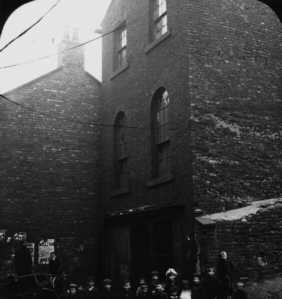
The earliest Trustees of Pipewellgate are not known
although they were men associated with the High Street
Chapel. It is not until 1852 that a list of them is
provided in the Circuit Schedule book covering that
year. The names are all men associated with other
chapels and who appear frequently within other
histories:
William Brown, John Kimpster, John A Denton, Robert Horsley,
Andrew Penman, John Smailes, Robert Stokoe, George Fergusson,
John Cooper Dobinson, John Leitch, James Snowball, Benjamin Idle,
George Furnace, Abraham Pescod, John Jackson, Thomas Smith,
Joseph Kimpster, William Kimpster, Cuthbert Nicholson, Silas Kent & George Holmes
Amongst the best information we have available
concerning this Society, is the Sabbath School records
which commence in 1848. A Sabbath School was first
established in the ancient manor of Pipewellgate in
1789 by Baptists from the Newcastle Tuthill Stairs
congregation. When the Wesleyans opened their chapel
in 1823, the Baptists handed over the care of their
school to them so there was a good foundation right
from the start.
As in nearby Hillgate, but perhaps to a far greater
degree, Pipewellgate was a treacherous place to live.
Reports at the time show that up to 20 people could be
found living in each room of the tennemented buildings
- males, females and children and often annimals (e.g.
pigs) altogether. Sanitary arrangements were almost
non-existent with only three privies for over 2,000
inhabitants. Amongst the living quarters could be found
181 tripe dressing shops and 31 slaughter houses whose
blood and offal flowed freely through the streets. All
forms of low life dwelt in Pipewellgate where
alcoholism, theft and prostitution were a common way of
life and the dimly-lit streets presented a sight that
no respectable person would dare enter.
But the Wesleyans did enter and opened a chapel and
schoolroom that provided a little of God's Light into
an otherwise living hell. The children were keen at
their studies and eager to expand their knowledge - a
fact that was, eventually, passed on to some of their
parents. Some of the older children went on to become
members of the Wesleyan Connexion and to better
themselves far beyond the imaginations of their
guardians or contemporaries. In 1842 the chapel was
holding adult evening classes with 60 people attending.
Ages ranged from 16 to 55 years of age with the
majority being men.
In 1848, average attendance at the school was 74 per
week with more (approx. 100) attending in the afternoon.
In addition to "Stephenson's Lessons" - a plan of
readings over a number of weeks, an Alphabet Box was
procured to teach the infants the basics of reading and
writing. For many of the children, this was the only
education they would receive.
Until 1848, the Pipewellgate Sabbath School stood alone
as the only educational establishment in the area but
it was noted in the Minutes that the Roman Catholics
had opened a Sabbath and Day School in the
neighbourhood which had a very large attendance.
This may have been due to the high numbers of immigrant
Irish families who lived in the area. The establishment
of this Day School worried the Wesleyans. Whilst children
attending the RC School were occupied every day, those
at the Wesleyan school were "running about the
streets during the week unlearning what we have taught
them and learning much that is bad".
Despite the terrible living conditions, 1849 brought no
deaths to the school of thirteen classes. It was noted
that 26 boys and 25 girls were able to read the
Testament - remarkable in that all had learned to read
in one year within the school's hallowed walls. Senior
Boys who excelled in good conduct were "promoted" to
help keep order in the Alphabet Class with excellent
results.
By 1853, 50 children were attending a Day School
elsewhere whilst the Cholera epidemic that year
resulted in very poor attendance, particularly at the
school anniversary on 18th September. It is noted that
many children in the area succumbed to the disease and
particular note is made of two scholars (both un-named)
- a girl who was "but a babe" and a boy. The boy had
attended the school for many years though it was
observed had not acknowledged Jesus in that time.
Not until moments before his death did his mother -
who knew nothing of religion - summon the teacher who
prayed with the lad and into his passing.
It would appear from the Minutes of the School and
other sources that the chapel itself was not prospering
as well as the school. The premises were well cared
for receiving regular cleaning and redecoration but in
1853 a number of pews were removed from the chapel as
"unnecessary" and moved to the school.
Following the Great Fire of 1854, a handful of children
who had attended the Church Walk School transferred to
Pipewellgate but the chapel premises were being offered
for sale. The sale took some time to complete and it
was not until 27th March 1856 that they were bought by
Byron John Proctor, a JP and ex-Mayor of the Borough
and owner of the Pipewellgate Glue Works, for �410,
whilst a new chapel at High Level Road was being built.
The Pipewellgate chapel paid annual rent to Mr. Proctor
though there were many problems associated with this arrangement.
In 1860, the renting of the premises came to an end and
the school moved to new premises on High Level Road
(though this was often also called Pipewellgate).
In 1862, there were 10 members of this chapel meeting
mostly on weekday evenings. By 1912, the Church of
England was holding services in Pipewellgate old chapel. The
building was removed during the general slum clearance
of the 1930s.
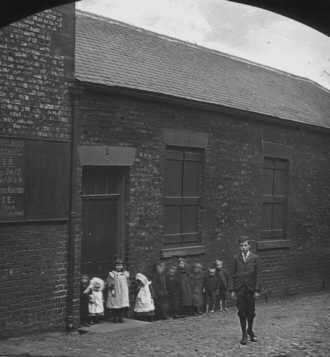
Following the opening of the new chapel, Jonathan
Fairless was added to the list of Trustees. The chapel
had a membership of around 30. In 1883, the Sunday
School was led by a Miss Chinnery. In 1872 the chapel
was leased temporarily as a Board School - there being
no other schools in the Pipewellgate area. This proved
a worthwhile venture for the Education Authorities and
later in 1894, when the chapel closed, the premises
were converted into a school and it is by this that the
only surviving photograph of the premises are shown.
The chapel closed on 1st March 1894 with Benjamin Idle,
one of the Trustees, resigning on that day. Most of
the remaining members transferred to High West Street
Chapel though six it would appear either went elsewhere
or ceased to meet. The property was retained within a
Trust until about 1913 when it was sold to the
Education Authority. The buildings were demolished in the late 1930s and
the site was converted into a car park in the 1960s though it was still evident
where the building had stood. In 2003, the site was totally cleared in readiness for
the construction of "luxury" apartments on the Rabbit Banks site.
 to return to the main menu.