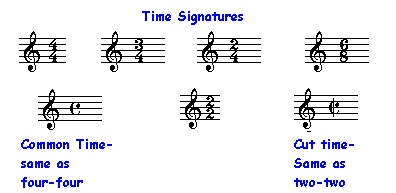
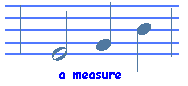
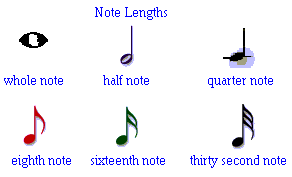
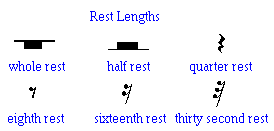
Pictures of everything are at the bottom of the page!!!
Measures
Q: What is a measure?
A: Measures are divisions in the music. Each measure consists of, depending on the time signature, anywhere from one to eight or more beats. At the end of each measure, the composer adds a bar line so musicians know that the measure is over and the next one is starting.
Time Signatures
Q: So, what is a time signature anyway?
A: A time signature is a number at the beginning of the music that gives some basic information about the measures in that particular piece. It is written like a fraction, except without the fraction bar between the two numbers.
Q: What do all those numbers mean?
A: The top number refers to the number of beats in each measure, and the bottom number tells you what kind of note gets one beat. So if the top number was four, there would be four beats in each measure, if it was three there would be three beats, etc. If there was a four on the bottom, a quarter note would get one beat, if there was a two, a half note gets one beat, if there was an eight, an eighth note gets one beat, etc.
Note Lengths
Q: So, how do I know how long to hold the note?
A: Well, this depends on the type of note and the note length that gets one beat, which can be found in the time signature. In a time signature with a four on the bottom, a quarter note gets one beat. This means that a half note gets two beats (because it is twice as long as a quarter note) and a whole note gets four. So then, an eighth note would get one-half of a beat, a sixteenth note one-fourth, and a thirty-second note one-eighth. If there is a number other than four on the bottom of the time signature, the length of the note or rest changes according to the new number. (So if the bottom number was two, a half note would get one beat, a whole note two, a quarter note one-half, etc.)
Q: What does the dot after a note mean?
A: The dot adds half of the value to the note. So, for example, a dotted half note would get two beats for the half note, plus half of that value, or one extra beat, for the dot. This means that the total length of a dotted half note is three beats. By the same rule, a dotted quarter note gets 1and 1/2 beats (one for the note and one-half for the dot) and a dotted eighth note gets three-quarters of a beat.
Rest Lengths
Q: How do I know how long to rest?
A: The length of each different kind of rest corresponds to a type of note. For example, if a quarter note gets one beat according to the time signature, then a quarter rest also gets one beat. Check out the rest picture at the bottom of the page.
Rhythm
Q: How do I count rhythm?
A: For each rhythm, there is a simple way to write down how that ryhthm is counted. For example, take a piece in four-four time. This means that there are four beats in the measure. A quarter note is counted by writing the number of the beat it occurs on directly below the quarter note. If a note lasts for more than one beat, place the numbers of all the beats below the note, then connect the numbers with dashes between them. For eighth notes, put the number of the beat under eighth notes that occur on the beat and "+" under the ones that occur on offbeats. Sixteenth notes can be counted by writing "(#)e+a" underneath each sixteenth in the group. Again, if the bottom number of the time signature is not four, the system will have to be adjusted based on the new lengths of the notes.
Did You Know?
If there is a number on the top of your music, like "MM=96," this is called a metronome marking. It refers to the number of beats per minute in the tempo. If you have a metronome, the metronome will help you to keep a steady beat at the correct tempo. If you do not have a metronome, click here to go to a list of flute stores where you can buy one.