
To play a major scale, start on the note it is named for, then go up and down the scale in the key signature.
Example: F major scale starts on F, and the key signature is one flat (Bb). So, the
scale is F, G, A, Bb, C, D, E, F, E, D, C, Bb, A, G, F.
Q: How do I figure out the key signature of a major scale?
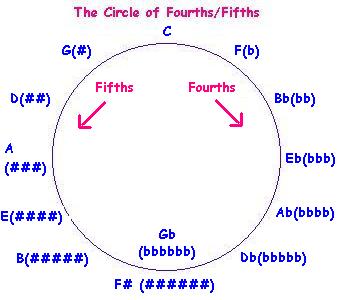
A: By refering to the circle of fourths/fifths, which is the reference guide for all
scales. It shows the scales in a circle, by key signatures. The circle gets its name
because to move around the circle clockwise, you are moving in intervals of a fourth,
and if you go counter-clockwise, you are moving in intervals of a fifth. This is a picture
of the circle:
Order of Sharps: F, C, G, D, A, E, B*****
Q: Why does it work this way? Why do the scales have the key signatures that they do?
A: A scale is a pattern of half and whole steps. In order for the scale to be major, it has
a special pattern of half and whole steps that all major scales share. This pattern is:
whole step, whole step, half step, whole step, whole step, whole step, half step. So, in
a C Major scale, the notes naturally fall into this pattern and no accidentals are needed:
a whole step between C and D, a whole step between D and E, a half step between E
and F, a whole step between F and G, a whole step between G and A, a whole step
between A and B, and a half step between B and C. In the other scales, the accidentals
are needed in order to make the scale fit the pattern.
Minor Scales
To play a minor scale, you need to know the relative major and the pattern for the type of minor scale you want to play.
Q: You mean there's more than one type of minor scale?
A: Yes, there are three different minor scale forms, called natural, harmonic, and
melodic.
Q: What about relative majors? What are those?
A: Every minor scale has a relative major. This means that when playing a minor scale,
you will start on the note the scale is named for just like a major scale, but you use the
key signature of the relative major. To figure out a minor scale's relative major, just
count up three half steps from the name of the minor scale. Example: To find the key
signature of a minor, count 3 half steps up from a (A#/Bb, B, C) to get C, the relative
major.
Q: Great, so how do I actually play the scales?
A: First, figure out the relative major of the scale. Again, let's say that you wanted to
play an a minor scale, you would count 3 half steps up from a and get C, the relative
major. The key signature of C major is no sharps or flats, so this is the key signature
you will use for a minor. Now, there are three forms of minor scales, and each form has
a formula to use:
1) Natural minor: Play the scale, starting on the note it is named for, in the key
signature of the relative major.
2) Harmonic minor: Play a natural minor scale, but raise the seventh note one half
step going up and coming down.
3) Melodic minor: Play a natural minor scale, but raise the sixth and seventh notes
going up. Play natural form when coming down.
Q: Isn't there another way to figure out the minor scales?
A: Yes, this is the one that doesn't use relative majors. To play an a minor scale, play
an A major scale but flat the third, sixth, and seventh notes. For harmonic minor, flat
the third and sixth notes and raise the seventh note. For melodic minor, flat the third
note going up, and flat notes 3, 6, and 7 coming down.
Q: So, does it matter which method I use?
A: No, use the one that is easier for you, but make sure you understand the relative
major method because this is how major scales are constructed.
Q: Do I really have to learn all three forms of minor scale?
A: Natural form is very important because it is the basis for all three forms. Harmonic
form is the form that music in a minor key signature is usually based on, so if you see a
minor scale in your music, chances are good it will be harmonic. Melodic minor scales
are the hardest, so often the judges of competitions will ask for this form.
Did you know?
~ When writing about scales, major scales are usually wirtten with capital letters and
minor scales are usually written with lower case letters.
~ Every minor scale also has a parallel major; this just means the major scale that is
named with the same note (ie C major and c minor).
