Open or Closed Holes
Open hole flutes have holes in the keys that you put your fingers on to play, while closed hole flutes do not have these holes. The biggest advantage of having an open-hole flute is that the tone is much better. The holes in the keys also promote good hand position, but these flutes can be harder to play at first because the hand position must be totally correct in order to play one. In general, student flutes have closed holes and intermediate flutes and upward have open holes. Note: Open-hole flutes are also called French flutes, and Closed-hole flutes are also called Plateau flutes.
Foot Joint
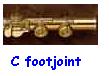
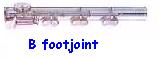
C footjoints have three keys on them (the E-flat key and 2 more), while B footjoints have 1 extra key (for a total of 4 keys). This key opens an extra hole in the very end of the flute. The extra key makes the flute longer and heavier, but extends the range of the instrument down to low B, and makes some high notes easier to play. The B footjoint generally comes on more expensive flutes, intermediate models and upward.
In line or Offset G
On some flutes, the G key and Ab lever are lined up with the rest of the keys, but some flutes have these keys slightly off-centered. The offset G is designed for people who have smaller hands and can prevent tension in the left hand. The in line G is the traditional flute design. The placement of the G key does not have any effect on the sound, so its placement is a matter of personal preference.
Key Arms
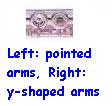
The little pieces of metal that connect the keys to the body tube of the flute can either be y-shaped or pointed. The y-shaped arms connect to the edge of the key and are standard on beginner and low-end intermediate flutes. The pointed (French) arms connect to the keys that the fingers don't press down on in the middle of the key and are standard on high-end intermediate flutes and up. The y arms are stronger, and these flutes will not have key leaks as often. The French pointed arms can not be put on a flute on an assembly line; they must be done by hand. This makes the key placements more exact (and the flute more expensive).
Springs and Mechanism
Mechanism is all the keys, springs, and little tubes that can be found near the middle of the flute, the parts that make the flute play notes when the keys are pressed down. In general, student flutes have a more durable mechanism and thicker springs, which make the keys a little harder to press down and a little slower to respond. More advanced instruments will have less durable mechanisms and thinner springs (ie white gold instead of nickel silver) to make the keys easier to push down and quicker to respond. These flutes must be cared for a little more to make sure that the mechanism and springs are not bent when putting the instrument together and taking it apart, and should not be held by the keys.
Split E (High E Facilitator)
There are several different mechanisms designed to make the troublesome high E natural easier to play. They include the split E mechanism for offset-G flutes, the clutch key used to turn the split E mechanism on and off, and the donut, a little donut-shaped disk in the G hole. These features are nice on an intermediate or advanced flute, but high E can be played well without them.
Gizmo Key
This is an extra lever on the foot joint of B-foot flutes that can be pressed down to play high C (the one on five ledger lines). High C can be played without the gizmo key, but it does make that note much easier to play. This key is not a requirement for a flute, but it is a nice bonus if your flute has one.
Metal Selection
In general, the more solid silver and the less silver plated a flute has, the better it will sound. The biggest impact on the sound comes from the material that the headjoint is made of, so a lower-cost, almost as good alternative to a solid silver flute would be a silver headjoint and silver plated flute. Some very advanced flutes are also made of other metals, like gold or platinum. The best thing to do to choose a metal is a blindfolded playing test, to decide which combination of metals you like best.
Embouchure Plate Metal
On some flutes, the metal of the embouchure plate does not match the metal of the rest of the flute (ie gold plate on silver flute). Contrary to what most salespeople will tell you, this does not effect the tone of the instrument in any way. The only reason to get a different metal for the embouchure plate, other than the look, would be if you have allergic reactions to the metal of your instrument (ie black chin).
Riser
This is where the embochure plate connects to the headjoint. It is usually made out of the same material as the headjoint, but in some advanced flutes it might be made out of a better material. This should increase the tone of the instrument to some degree.
Back to Instruments