
Breathing for Flute Players
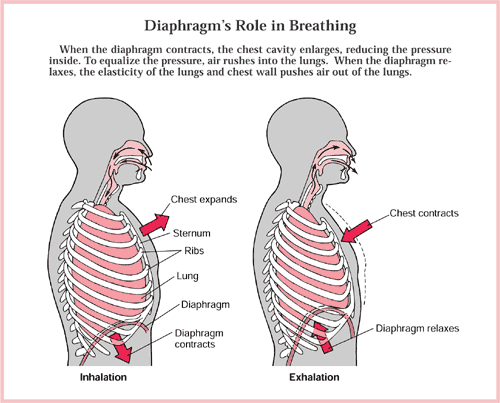
So, breathing is really easy, right? It's something you do all the time without thinking about it, but actually, breathing while playing the flute is different than normal breathing. When playing a wind instrument, you need to use more air and make the air move much faster than when you are breating normally. Specifically for the flute, we have to use a lot of air because the flute embouchure does not offer much air resistance, but the air does not have to move as fast as it does for some of the other instruments. Flute breathing starts at the diaphragm, the muscles just below the bottom of your lungs that move when you pretend to pant like a dog. These are also the muscles that (involuntarily) control your breathing, and cause you to get the hiccups (which are really just spasms of the diaphragm muscles). Anyway, in a normal breath you take in air from the top of your lungs and you expand slightly upward. In a flute breath you want to take in air from the bottom of your lungs and gradually fill them to the top. You will actually feel your lungs expanding outward, rather than upward. Try putting your hands just above your hips. If you are taking deep diaphragmatic breaths you should be able to feel expansion in front, sides, and back when you breathe. It is important to take a deep breath from the diaphragm whenever you play.
Breath Support
Once you've got the air, the rest is easy, right? Wrong! The muscles in the abdomen need to push the air back out of the lungs. Most of the pressure should come from the muscles below the belly button which push in and upwards towards the lungs. Constant pressure must be applied from these muscles; this is called breath support. Good breath support is very important to flute playing because it really affects your tone and intonation. The muscles should be tense, but not tight, and should move towards the lungs as your air supply begins to run low. If these muscles aren't moving when you exhale, you are not breathing correctly. Contrary to popular belief, the muscles used in breath support are NOT the diaphragm muscles, instead, they are the abdominal muscles (the same muscles you use to do sit-ups). The diaphragm should be relaxed when you exhale. And one more thing: breath support should start AFTER you form your embouchure, right before you start to play a note.
What About the Throat?
The most important thing about the throat in flute playing is that it remains open at all times. A great way to make sure your throat is open is to open your mouth really wide, like you are yawning. You should feel a similar open sensation in your throat when playing. Make sure that you don't close your throat when you close your mouth, though. It is also important that you don't close your throat when tonguing; practice starting and ending notes without the tongue to make sure that this is not the case. An open throat will give you much better tone, and it is impossible to use vibrato correctly if your throat is closed. By the same token, you should never stop your airstream from the throat (it should be stopped with the tongue or the abdomen only). Breath support and vibrato should not come from the throat either; they both come from the diaphragm/abdomen and, to a limited degree, the trachea (windpipe).
A Really Good Analogy
Are you really confused now? If so, I read a great analogy for breathing in my favorite book about the subject (see the "Learn More" section, below). The author compared breathing on the flute to a manual tire pump, like the kind you would use for a bike tire. When you pull up on the handle, air rushes into the pump. This is like breathing in; the diaphragm muscles are pulled down (involuntarily) and the air rushes into the lungs to equalize the pressure. In order to get the air back out of the pump, you have to push down on the handle. This is like the breath support you must use when exhaling air into the flute. Like the handle of the pump, the muscles in the stomach should move to compress the air out of the lungs.
Top Ten Breathing Exercises
1) The first exercise is for deep breaths from the diaphragm. Lay on your back on the floor and put a heavy book on your stomach. Take a deep breath in. Your stomach should expand outward/upward so that the book is raised into the air. Exhale and watch the book lower back down.
2) Sit in a chair and bend over at the waist so your legs and back form about a 45 degree angle. Take a deep breath for four slow counts and then breathe out for four slow counts. Then breathe in for three and out for four, etc.
3) Sit the same as in # 1. Take a deep breath for as long as you need to. Then, start a stopwatch and slowly exhale. Make a hissing noise ("sssss") as you exhale. Time yourself to see how long you can go before you run out of air.
4) Sit the same as in #1. Take one count to quickly breathe in and quickly breathe out on the next count. Repete for a total of about 25 breaths. Then, take one deep breath. Pant in and out quickly, saying "ha." Make sure your throat is open throughout.
5) For this exercise you need your flute. Take a deep breath for as long as you need to. Then play a low A on your flute for as long as you can. Time with a stopwatch. This is similar to #2.
6) This is a way to test that your throat is not closed when you play. Take a deep breath and hold it. Put your flute up like you are going to play. Then breathe in and out small breaths through your nose. If you can do this, your throat is not closed.
7) Another exercise for opening the throat. For this one, you will need a piece of hollow pipe with diameter approximately the size of a quarter. Put the end of the tube in your mouth and close your lips around it like a straw. Breathe in and out, taking deep breaths from the diaphragm and making sure to keep your throat open.
8) This exercise is for breath support. You need a long, thin piece of cloth like a scarf or cloth belt. Tie the belt loosely around you just above the waist. Take a deep breath, making sure that you can feel expansion against the belt in the front, sides, and back. Hold the breath for a few seconds, then slowly exhale, maintaining enough breath pressure that the belt will not fall down.
9) Also for breath support. Take a deep breath and completely relax your abdominal muscles. Begin to sustain a note on your flute. Count slowly to ten, gradually increasing abdominal pressure/breath support. Then fluxuate pressure by relaxing and tightening the abdominal muscles ten times. Finally, count to ten while gradually relaxing the abdominal muscles. You will probably notice that as the pressre drops, the pitch goes flat and the tone loses its energy.
10) Play long tones, starting and stopping the tone with air (not tongue). Concentrate on keeping the throat open and supporting the tone with good breath pressure.
Dizziness
Most flute players experience some dizziness when they first start playing, especially when playing for long periods of time. In addition, practicing breathing can sometimes make you dizzy. If you ever feel dizzy, faint, lightheaded, etc. when practicing, stop playing and sit down. Take a break for a few minutes and just breathe normally. By practicing breathing and always breathing correctly when you play, you can minimize the amount of dizziness you will experience.
Still Having Problems?
It is impossible to breathe correctly if your posture is bad. Click here to go to my posture page.
This awesome picture came from www.merck.com:

Breathing for Musicians by Scott A. Nelson, DMA (Edited by Bill Still). Reinhardt and Still Publishers, VA, 1999