





The film Text copyright (c) Filmverdict 2006-present. Any film titles and artwork used are copyright of their respective owners.
Apocalypse Now
(1979/2001)
Reviewer: Rich
Version: Collector's Edition - The Complete Dossier
Number of discs: 2
Helicopters circle. The jungle bursts into flames. "The End". The start of a masterpiece.
The beginning of Apocalypse Now is instantly recognisable now, but, as Coppola admits in his commentary here, was actually created somewhat by accident. The dreamlike montage was constructed out of discarded shots and the scene depicting a drunk Captain Willard (an actually drunk Martin Sheen) in a Saigon hotel room was not actually planned to be in the film. But add The Doors and some seminal sound design - Apocalypse Now pioneered the now-standard 5.1 surround sound system, never better utilised than with the opening sound effect of the swirling helicopter - and an iconic opening was born. It's for more than just show, however: the disorienting effect succinctly encapsulates Willard's fatigued mental state, and provides the first evidence that this is not going to be just another war film.
Francis Ford Coppola's 5-years-in-the-making follow up to the certified "Best Sequel Ever", The Godfather Part II, carried with it all the negative hype of a potential disaster. The budget had spiralled massively out of control; the Philippines shoot had dragged on and on for sixteen months, as opposed to the originally scheduled six weeks(!); the star suffered a mid-shoot heart attack, prompting Coppola's legendary "he's not dead until I say he's dead!" outburst; and the director was reportedly close to suicide. Over a million feet of film was shot, or roughly two hundred hours, which was part of the reason that the post-production alone took three years. Eventually, the negative buzz became so overwhelming that Coppola took it to Cannes in unfinished form to prove the doubters wrong. The rest, as they say, is history.
Regardless of its classic status, it must be said that Apocalypse Now certainly divided initial audiences, and still does to this day. It is completely unlike any war film before or since, depicting the chaos of the Vietnam conflict with a hint of surrealism and a definite off-kilter perspective. Coppola's aim was to show how war corrupts a man, and as his characters sail down the river everything gradually becomes more and more bizarre and unexpected, culminating in Marlon Brando's rambling (yet mesmerising) extended cameo. The genius of the film is that it pulls the viewer along on this journey; you feel like another passenger on the boat. Perhaps it is not as authentic an experience as, say, Platoon, but no other film captures so well the psychological effects of warfare and conveys them so completely to the viewer. No-one has ever accused Coppola of being unambitious, and if some of his (more recent) efforts have failed, at least commercially speaking, Apocalypse Now represents the height of his creative career.
In 2001 Coppola chose to go back and reinsert excised scenes to make the Redux version, which is closer to the film he originally showed at Cannes over two decades before. The added scenes, totalling 40 minutes or so (bringing the total running time to over 3 hours), proved to be controversial. None of them impact the plot, instead just taking the form of added vignettes on this episodic journey. The added French Plantation sequence bore most of the criticism, and it's easy to see why: it brings the narrative to a complete screeching halt for 15 minutes while new characters spout heavy-handed background information. A new scene in which Brando's Colonel Kurtz reads Time Magazine articles to the imprisoned Willard dents the mysteriousness of the character by showing him in full daylight, countering the oppressive shadow-drenched darkness of his other scenes. Nevertheless, while an ungainly beast, Apocalypse Now Redux remains a triumph. Such needless detours would never work in another film, but in the context of Coppola's insane endeavour they seem oddly fitting, only adding to its uniquely foreboding atmosphere.
The extras
The production of Apocalypse Now was so tortuous that it would make a fabulous film by itself - which of course it did, in the famous documentary Hearts of Darkness. That it's not included here (due to rights issues) does render this so-called "Complete Dossier" rather less than complete, but it's the only really noteworthy omission in what is a substantial DVD package.
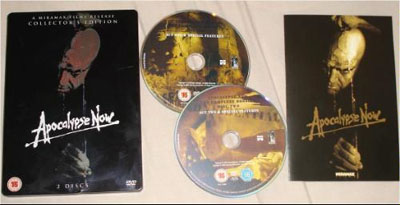
Both versions are included, split over the two DVDs. You select which version to watch first, then the main menu appears corresponding to the version chosen. Picture quality is outstanding, particularly the extraordinarily deep blacks (a benefit of the dye-printing process used for Redux's release, as detailed on the extras). Sound, as you would expect from a film with so much emphasis on that department, is also exemplary. Presentation, therefore, gets an A+. On a side note, while the R1 version came in a box designed to look literally like a dossier, here we get a steelbook with a minimalist but effective design showing Marlon Brando's mysterious shadowy form. Inside is a leaflet detailing the special features.
The extras occupy the space that is left on both discs. Both versions are accompanied by a Coppola commentary (the same commentary, just cleverly extended if you're watching Redux), and each version features a different 4-minute introduction by the director. As proven by Coppola's Godfather commentaries, he's an extremely entertaining talker, divulging anecdotes and reflections at a good rate, making this one of the best commentaries out there. Disc 1 features an extensive selection of deleted scenes, all with very poor picture quality but very interesting nonetheless. One of them, which runs for 15 minutes, basically just consists of Marlon Brando reading the entire poem "The Hollow Men" by T.S. Eliot, which is slightly excessive, but many will simply lap up any extra footage of the great man. A particularly intriguing scene shows the ultimate fate of Dennis Hopper's photojournalist; perhaps a surprising omission from the final film (and not reinserted for Redux). Two short featurettes on the birth of 5.1 sound and a look at the helicopter flyover in the opening scene round out the disc.
The bulk of Disc 2's extras consist of a fascinating three-part documentary on the film's post-production, clocking in at about 45 minutes in total. Further featurettes look at the film's colour palette, the creation of the Redux version and some brief reminiscences from some of the cast. There's also the option on both discs to turn on a "Redux Marker", which indicates what scenes have been added while watching Redux.
The summary
It could be argued that Apocalypse Now finished off Coppola as a filmmaker as it's his last truly great work. Nevertheless it concluded a decade the likes of which few, if any, other directors have ever experienced. Masterful.




Agree? Disagree? Say so in the Guestbook!