






The film Text copyright (c) Filmverdict 2006-present. Any film titles and artwork used are copyright of their respective owners.
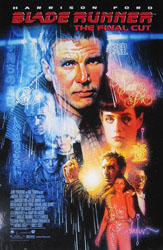
Blade Runner is in some ways comparable to Citizen Kane. That in itself is quite an assertion - indeed it is rare for any film to deserve mentioning in the same sentence as the official greatest American film of all time (that's according to the American Film Institute; it's not a personal favourite). That is not to say that Blade Runner resembles Orson Welles' venerated feature debut, other than the fact that both films represented a giant leap forward in terms of mise-en-scène. Kane is famous for its innovative camera set-ups, but in Blade Runner's case it's what the camera looks at that distinguishes it. Director Ridley Scott, in only his third film, created the most seamless and convincing dystopia that has ever been depicted on screen, including since the advent of CGI. Scott was no doubt helped immensely by the myriad production designers, set dressers and "Visual Futurist" (a rather unique credit) Syd Mead, but it was the initial vision of the then-young British advertising veteran that brought this unparalleled world to the screen.
The look of Blade Runner has received so much attention that it has obscured the other delights the film has to offer, and the criticism that it received in some quarters that it is all look and no substance is unfounded. The film's focus on the visuals is entirely in keeping with its central themes: Blade Runner is all about looking, seeing and whether we should believe what our eyes show us. The irony is that much of the grungy metropolis that we see is indeed an illusion, brought about by a combination of matte paintings and stunning pre-digital effects. Eye imagery is everywhere - the first image of something that appears organic is an extreme close-up of an eye, but our initial assumption that it belongs to a human being is rapidly debunked as we discover it belongs to a malicious replicant (a super-advanced robot who looks absolutely human, presenting the film's main moral quandary). This is the first of four encountered in the story, all of whom Harrison Ford's blade runner Deckard - a cop, or bounty hunter, who tracks and kills replicants - is charged to destroy.
Ford's performance here is underrated, even by the actor himself, who grumbled during the filming that he felt more like set decoration and who demonstrated his dislike of the film for many years by refusing to talk about it in interviews. (He has since come round to its charms somewhat.) Rutger Hauer is chilling as the replicants' leader Roy Batty, and the most quoted piece of dialogue from the film is a wonderful bit of nonsense - what are C-beams glittering off the shoulder of Orion? - written by the actor himself that in an indefinable way manages to be extremely moving. Scott furthers the emphasis on eyes in this "final cut", by adding a subtle golden reflection occasionally to the pupils of the replicants, a touch that is slightly overused but muted enough to be insignificant. In other respects, too, the changes are extremely minor; certain effects shots are touched up, lip synching fixed, and so on. Scott hasn't gone George Lucas on us.
The main reason that this new version fully deserves its existence is its miraculous digital restoration. There are not enough superlatives to describe how good the film looks, and sounds, projecting in crystal digital clarity with the Dolby surround speakers being exercised by the ambient noises and Vangelis' magical electronic noodling. It is essential to be fully absorbed in the environment of 2019 Los Angeles to gain most enjoyment out of the film, and there is no better way than to watch this new cut in a state-of-the-art cinema. (When released for the home market in a couple of weeks' time it will be a rather large incentive to upgrade to HD.) The emphasis in Blade Runner is clearly on atmosphere rather than plot or characters, and the few flaws that it does have - the pace slackens at times, for instance, particularly in the second half before the Deckard/Batty showdown - are rendered irrelevant by the unbeatable level of immersion that the film achieves.
Certainly it is a difficult film to watch in some respects. It is perhaps the most visually dense film ever shot, and does not reveal all its treasures in one viewing; it even requires multiple viewings simply to notice everything in the frame. The fact that it was a commercial flop at first is no surprise. Such movies that are so ahead of their time, that arrive and suddenly redefine the what it is possible to accomplish in cinema - Citizen Kane included - often only find their audiences years after their initial release. Now, however, Blade Runner stands shoulder-to-shoulder with 2001: A Space Odyssey at the summit of serious science fiction film.
The summary
You probably know whether or not you like Blade Runner by now. For anyone who does, or is still curious, seek this new version out. Ridley Scott's magnum opus has never been better.


Blade Runner: The Final Cut is being shown at the following UK cinemas:
Ritzy in Brixton
Cameo in Edinburgh
Picturehouse in Cambridge
Picturehouse in Liverpool
Tyneside in Newcastle
Agree? Disagree? Say so in the Guestbook!