







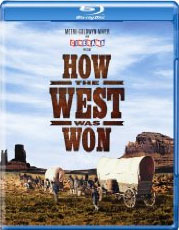
The film Text copyright (c) Filmverdict 2006-present. Any film titles and artwork used are copyright of their respective owners.
The Western genre is quite possibly the most appropriate platform for epic films. By their very definition, grand blockbusters are impressive in scale and length but How the West Was Won surpasses the boundaries of conventional tent-pole cinema even further, leaving traditional marquee fare in the shade. Firstly, and most noticeably, the Cinerama curving widescreen method, which works by simultaneously projecting images from three synchronized 35 mm projectors onto a huge, deeply-curved screen, subtending 146 degrees of arc, is the process of choice. Unfortunately this leaves miniscule lines where the frames have been joined, but this is only a minor complaint about such a unique cinematic invention which returns such breath-taking results. One only has to witness the first glimpse of James Stewart in the opening moments of the film to see how magnificently nature is captured. Even though Ultra Panavision 70 was used for trickier shots such as the impressive raft sequence, Cinerama is used predominantly and is a welcome innovation - the sensation of watching Lawrence of Arabia for the first time is duplicated.
Furthermore, How the West Was Won takes the idea of an ensemble cast and epitomises 'star-studded'. With irrefutably the greatest roll call in cinema history, the cast includes: the aforementioned James Stewart, Henry Fonda, John Wayne, Gregory Peck, Eli Wallach, Karl Malden, George Peppard, Richard Windmark, Walter Brennan, Carroll Baker, Lee J. Cobb, a young Harry Dean Stanton, an uncredited Lee Van Cleef, and Spencer Tracy as narrator. The stardust also sprawls over to the visionaries behind the action with three directors - John Ford, Henry Hathaway and George Marshall - helming their own individual segments of the 162 minutes. Indeed, a film which spans fifty years, four generations of the same family, and an incredible journey from New York State to the Pacific Ocean warrants such an illustrious inventory of cultural icons and character actors, and teamwork is the basis of success here.
Despite the credentials of such a piece, slight problems occur which result in How the West Was Won being remembered as a classic, not due to outstanding quality but rather the sheer gargantuousness of the work. By covering fur trappers, settlers, the Civil War, ranchers, railroads and outlaws, the range of the epochs explored is sometimes too overwhelming to comprehend and paradoxically comes off as overly simplistic on occasions where too much information is crammed into too few screen minutes. With contemporary directors such as Steven Soderbergh and Quentin Tarantino splitting some of their films into two parts, one can't help but feel the Cinerama executives should have blown up each volume of the feature and released them in a series, especially on such an important, almost educational, historical subject. Obviously that idea would destroy the aura surrounding the film regarding star power but sometimes, as the old cliché goes, too many cooks spoil the broth and the star wattage on show is taken for granted by the audience because it's impossible to appreciate so many heavyweights in one film, even though everyone does a sterling job.
The film is littered with positives however which deems the shapelessness excusable. Alfred Newman's original score is a sensation, a pleasuring answer to the classical music featured in the Overture and Intermission. Newman manages to evoke the grandeur of mountains and rivers with aplomb, the tense energy of the truly great runaway train shootout, the boisterous buffalo stampede and battle sequences, and the quasi-desperation of the Gold Rush. The epilogue, which shows tremendous shots of famous landmarks of Los Angeles and San Francisco such as the Golden Gate Bridge, are even assisted by Newman's aptitude - an epic score for the epic film. Another plus is the quality of acting with no visible signs of Ocean's Twelve syndrome here. The stars allow each other to shine with no jockeying for positions in the pecking order or particular parts (even John Wayne drives from the backseat) and, thankfully, the fourth wall stays intact.
The picture and sound
Disc One contains the superb widescreen transfer but Disc Two will be the destination for aficionados. The restored SmileBox Curved Screen Simulation takes the viewer back to what the film would have looked like on a Cinerama screen and the results are astonishing. In 1080p and with 5.1 surround sound, Warner Bros. have created an excellent novelty which is one of the best Blu-ray, possibly even film, experiences presently available. The picture quality is sensational on a large television, even if the conjoined lines cannot be helped, and the lack of (hardly) any grain or video noise is astounding. A petty technicality across both discs is the lack of quality in the audio department. The dialogue is poorly balanced in comparison to the rousing score which leads to frustrating moments where spoken words are struggling to be heard amidst the loud music track.
The extras
Only two dramatic films were ever made utilising Cinerama because of the drawbacks involving the sheer width of the lens for both directors and actors, and factors such as this are discussed in the in-depth 96-minute Cinerama documentary on Disc One entitled "This is Cinerama", an extensive look at the filmmaking process by key figures. An audio commentary featuring filmmaker David Strohmeier, Director of Cinerama, Inc. John Sittig, film historian Rudy Behlmer, music historian Jon Burlingame and stuntman Loren James is a great experience with Behlmer in particular exercising his interesting trivia muscles. A theatrical trailer rounds off the package, which isn't as detailed as a Gone With the Wind four-disc DVD Special Edition, say, by any stretch, but not much more can or needs to be said. One has to remember that How the West Was Won was a revolutionary film in many ways but it isn't exactly a gem for critics like Citizen Kane or The Godfather. A dedicated 'Making Of' would have been a welcome addition however, as the Cinerama documentary is almost solely concerned with shooting utilising the ultra-rare method and distributing the finished films rather than exploring this one in particular.
The summary
It's unsurprising to see How the West Was Won selected for preservation in the United States National Film Registry by the Library of Congress as being "culturally, historically, or aesthetically significant" as it ticks every box. A unique joy which is more nostalgic historical curiosity than anything else.



Agree? Disagree? Say so in the Guestbook!