|
Storytelling
(*2001) -R-
Exclusive Review including
comments from writer/director Todd Solodnz
Release Date: January
25--Limited, NY & LA. February 8--More Theaters
Written and Directed by:
Todd Solodnz
Starring: Selma
Blair, Leo Fitzpatrick, Robert Wisdom, Paul Giamotti, John Goodman, Julie
Hagerty, Mark Webber, Lupe Ontiveros, Conan O'Brien
December 10, 2001
Welcome to Todd Solodnz's
Take on Political Correctness
By Judd Taylor
During a Q&A session at the second screening of Todd Solodnz's new
film at the New York Film Festival this year, Solodnz said that he likes
to take the clichés and stereotypes of the perfect family he saw
while watching TV sitcoms while growing up and twist and distort them into
something new. We got a glimmer of this in his second feature Welcome
to the Dollhouse (a lesser known film, Fear, Anxiety and Depression,
was his first) with young Dawn Wiener's dysfunctional family. Happiness
brought it full fledge with the Maplewood family, and the father's sick
fetish. Now comes Solodnz's fourth film and what will be his most
largely distributed film, Storytelling.
Storytelling contains two separate segments titled "Fiction" and
"Nonfiction." They basically sum up the state of entertainment today.
"Fiction" centers around Vi, a creative writing student, Marcus, her cerebral
palsy inflicted (ex) boyfriend and Mr. Scott, her black creative writing
professor. Solodnz's dark comedy is ever apparent as he finds humor
in Marcus and the way his classmates suck up to him. In this room
full of students squabbling to be politically correct, Professor Scott
is the only one who speaks the truth.
This truth telling draws Vi to him, and a sick sadistic sex fantasy pursues.
Whose fantasy is it, and did it really happen? Vi learns a lesson
in writing fiction: the more truth to it, the better it is.
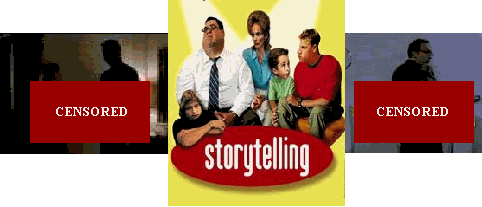
During the scene in this segment, which is to become the infamous sex scene,
a giant red box censors our two characters. Solodnz noted during
the Q&A that the MPAA had a problem with this scene for the R rating,
but he had an ingenious loophole in his contract. If there was ever
anything objectionable in the film, he could bleep it, for sound, or blotch
it, for visuals. Apparently the studio who okayed the contract didn't
actually think he'd put a large box in the middle of the screen to block
out the objectionable item.
Solodnz said he took it a step further and made it red, to symbolize communist
Russia, almost like an in-your-face to the ridiculous standards of the
MPAA. The film premiered at the Cannes Film Festival without the
red box, and I believe the European version doesn't contain it either.
Solodnz said, "I always thought there'd be an American version, and a version
for everywhere else." Lucky for him, the red box works for the film,
because it comments on what can and can't be said in fiction, as well as
makes a valid statement.
In the second segment, "Nonfiction," Toby Oxman ("Pig Vomit" star Paul
Giamotti from Private Parts) is an awful documentary filmmaker who
fears he's exploiting his subject, but all the while continues in the perverse
exploitation. "Nonfiction" takes Sam Mendes's American Beauty
family one step further, and Solodnz even takes a jab at Mendes.
At one point, Toby talks nonsense while we see some trash fly in the wind,
a spoof of a scene in Beauty.
According to Solodnz, Mendes made a comment about how Happiness
was very condescending to its characters. Solodnz answered him back
in this film.
"Nonfiction" ends very tragically, yet Solodnz's dark humor shines again
as death results in laughter. Someone in the audience questioned
such a dark ending and Solodnz responded, "I do see my movies as comedies,
but they're very sad ones. I can't please everyone."
One of the reasons the last part works so well is that he holds a scene
for a good minute and we think something is going to happen, but then we
cut away. Solodonz knows how to manipulate the audience.
Even the casting does this. John Goodman and Julie Hagerty, two people
I couldn't see together before this film, play the perfect family on the
outside, distraught on the inside, to a tee. Hagerty's flimsiness
and Goodman's sternness compliment each other.
Anyone who writes should see Storytelling. Todd Solodnz shows
us once again his unconditional uncompromising attitude toward subjects
no one else will take on. He's distanced himself from his Woody Allen
Fear,
Anxiety and Depression days and continues to make thought provoking
original dark comedies.
Alternative Recommendations:
Happiness, Welcome to the Dollhouse (both d: Solodnz), Private Parts (s:
Giamotti), The Big Lebowski (s: Goodman), American Beauty, Your Friends
and Neighbors
-Viewed Sunday, September
30, 2001 at the New York Film Festival
*Since Storytelling
premiered at the New York Film Festival, it qualifies for the 2001 Fidelio
Film Awards.
Nominated for
3 Fidelio
Film Awards
| Best Comedic Feature |
Best Original Screenplay
Todd Solodnz |
Best Actress
Selma Blair |
|

|
|