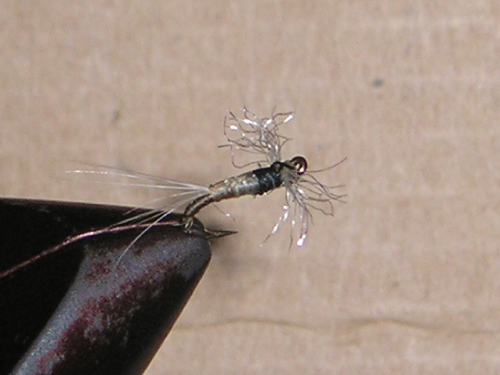
Once again, not a fly I can claim to have invented, I've just adapted one of Malcolm Greenhalgh's patterns for a red spinner and made it a little smaller and changed the colour. Works nicely though!
The real key to this fly is the material. GSP (Gel Spun Polypropylene) is an extremely light, man-made fibre which floats extremely well. It's available in a variety of thicknesses, under several brand names and a fairly wide range of colours (you know that weird, waxy feeling stuff that was in the middle of the last batch of mylar tubing you bought? GSP!) Apparently it doesn't take to being dyed all that well and some colours simply aren't available.
The following image is a caenis spent spinner.
I will be tying more soon and hope to get a better photo's, including a fly called a 'white ptarmigan' which imitates the caenis nymph.
GSP Caenis Spinner Ingredients:
Hook: Size 20 to 24 up-eyed dry fly hook Silk: 14/0 white/cream Wings: Fine, white, GSP filaments Tails: GSP from wing Underbody: GSP from wing Body: as tying silk Thorax: 14/0 black/chestnut tying silk Rib: Special - see instructions.
NB - morning Caenis are generally smaller and have a darker thorax than afternoon/evening Caenis, hence the range of hooks sizes and colour for the thorax.
Looks like a scary amount of stuff to fit onto a small hook eh? Actually it's quite easy, especially with such fine thread, as most of the ingredients are actually the same bit of material just lashed to the hook or left loose depending on what it's representing.
The core of any fly is always the first bed of silk, on such small hooks it's worth keeping it as fine as possible so allow the bobbin to 'unwind' the silk a little so it behaves a little more like a floss than a silk. Gordon Griffiths 14/0 does this particularly well.
Next tie in the GSP - this is where you need to experiment a bit to get proportions right - too much GSP and the fly will look very fat, too little and the wings won't support the weight of the fly in the surface film. It also depends on which brand of GSP you're using, so I'm not going to try and quote you an amount to use. The photo should give you an idea of proportion though.
Tie in the GSP as you would tie in a post for a parachute fly, with the tag end tapering away towards the bend of the hook, covered with touching turns of your tying silk to secure it to the hook. Don't use very hard wraps or the GSP loses some of it's buoyancy. A good way to acheive the correct taper is to tie in a longer than needed bundle of GSP fibres, hold this in your left hand behind the bend of the hook and using sharp scissors trim the bundle with a single cut at an angle to the shank of the hook - NOTE: Remember to keep a half dozen fibres un-cut as Caenis have very long tails for their body length and these fibres will make the tails. They actually have three, but fish can't count and six means the fly can be damaged a little without losing any effectiveness.
Once you've trimmed the GSP to the required taper, bind it to the hook using semi-soft wraps. If the wraps are too hard it will force the GSP round the hook shank and look very odd. Once you've reached the beginning of the bend spin the bobbin to tighten the thread as much as possible and wind back to the post in open wraps - this is the special rib mentioned in the ingredients, it's surprising how well it stands out in fact.
Take the thread past the post and tie it off at the eye with a couple of whip finishes, one over the top of the other. You can remove the white/cream thread and tie in the black/chestnut thread behind the post to form the thorax at this point. Separate the wing post into two equal amounts, pulling them down from their vertical position above the shank so they stick out to the sides of the fly - make tight, hard, figure of eight wraps over the thorax area with the black/chestnut thread to secure the new positioning of the wings and to form the thorax - whip finish ahead of the wings but leaving the head formed of the white silk visible.
The final step is probably the trickiest. Using a fine needle to carry some varnish, coat the thorax and allow to dry before removing from the vice.
The result is a virtually unsinkable fly in still water. The only snags I've come across with them, tend more to be with the hooks straightening out while playing fish - I'd recommend you use as light a rod as you can for such small, fine wire hooks.
Lastly, any Caenis hatch tends to be prolific compared to the other hatches on the water, but they don't last all that long. Begin fishing the spinner patterns as soon as you realise the fish have turned onto Caenis as the whole hatch will probably last no more than about an hour.