| 2003 Icebreaker Galesville USA; 1st, 2nd and 10th |
| Document data |
| Related links |
| By : Various Created : 1 may 2003 Last updated : 1 may 2003 Classification : general publication Copyright : restricted freeware |
| Created by : Projectgroup, 01 may 2003 |
| Go back to website F16 HP class |
 |
|
| Three setups raced in opening race |
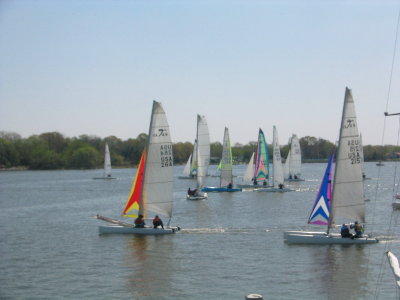
| Last sunday, 27th april 2003, at Galesville USA one could see three setups of fast 16 foot catamarans race eachother and other high performance cats in the Icebreaker medium distance race. In a fleet of 20 catamarans, we witnessed a Taipan 4.9 - F16 (#264) take first place overall, a standard Taipan 4.9 (#215) take 2nd place overall and a singlehanded Taipan cat/uni rigged take 10th place overall. In the picture above you can see Taipan #264 of Chip Zenke and Lee Mullins just getting a head start over the Taipan #215 of Christopher Lord and Jim Boyer. These two crews would later claim both 1st places in both the spinnaker and non-spinnaker scoring classes as well as take both the 1st and 2nd places in the overall of the combined fleet. |
| From the results page at : http://www.berean.org/sc15/racerslt.html I gethered the following story : The Icebreaker race is the first race in CRAC's distance racing series and is described as a medium distance bouy race. It is held on the Cheasapeak bay in eastern USA near Washington D.C. It was held on Sunday 27th of april and some 20 catamarans of different make registered. During the race the windstrength was recorded to be between 10 and 15 knots. The fleet consisted of : 4 - I-20�s ; 1 - F18 HT ; 3 Taipan 4.9�s ; 3 N6.0�s ; 2 A-cats ; 5 H20�s ; 1 N5.5 and 1 nacra 5.8. 18 catamarans finished after taking between 2 to 3 hours to finish the course. One catamaran did not finish and one other was disqualified. 7 catamarans sailed with a spinnaker, 9 without and we saw 4 singlehanded sailors without spis. This was a pretty High Performance fleet considering the fact that the average Portsmouth rating of the fleet was 64.0 with the fastest boats having a rating of 59,2 and the slowest 70.3. Typical Hobie 16, Nacra 5.0 and Prindle 16 ratings are of course around 77. The course required the crews to complete 5 laps around the bouys. The boat taking the line-honours (elasped time) was the I-20 of Bobby Noll and John McLaughlin. They completed the course in 2 hours, 9 minutes and 30 seconds. The last boat, a Hobie 20, finished in 3 hours, 6 minutes and 12 seconds. However the Top 10 of the fleet all finished within 12 minutes of the lead I-20. In a fleet of 20 boats this meant that halve of the fleet finished within that timespan of only 12 minutes. Pretty close finishing considering that they had just spend and average time of 2 hours and 15 minutes on the course. One expects this to happen in a race lasting only a hour or 45 minutes, not in a race lasting over 2 hours in normal 10 to 15 knots winds. From the race data it looks like the boats on elapsed time positions 3 to 7 fought hard with each other all the way to the finish line. These 5 boats saw pretty close actual racing on the water. Two I-20�s, one N6.0, an A-cat and one Formula 16 - Taipan 4.9 finished all in less than a minute of eachother; An I-20 was leading the pack but the smallest boat of the group, a Formula 16, gave good chase and even edged out a win over the one of the bigger boats in the fleet, a Nacra 6.0 with a big NA rig featuiring a modified square top main. The two were seperated by a mere 2 seconds on the finish line. The A-cat in this group was giving all a good �hurry up� by finishing only 12 secs later. All this after only 2 hours and 17 minutes of racing. This result would propel the smallest boat of the fleet (Formula 16) to pass all other boats on handicap and take first place overall. The lead I-20 crew came in seven and a halve minutes ealier but was still some 14 minutes short of effectively defending their claim on first place overall when the handicaps calculations were made. Even if the Taipan 4.9 - F16 PN rating for 2003 had been made the same as that of the Formula 18 class then Chip and Lee would have still corrected out over the four crews on big boats finishing ahead of them. Therefor This win was not a giveaway due to a very soft Portsmouth handicap rating. Even if the race would have been raced under the Texel or ISAF systems then the Taipan F16 would have still corrected out over the boats finishing ahead of her. A very convincing win by Skipper Chip Zenke and crew Lee Mullins. In the elapsed time part of the race we saw much closer racing. There we saw 20 footers battling it out with a 18 and 16 footers on elapsed time. With the emphasis on �elapsed time� as in "first over the line wins, no handicap calculations". A little further back we saw another 16 footer battling it out with two Hobie 20�s and right behind them we saw a singlehanded Nacra 5.5 finishing at exactly the same time as the 3rd Hobie 20. All were without spinnakers and they were only 13 minutes behind the first finisher. With this Robert Schnabel sailed his nacra 5.5 uni, the second slowest rated boat in the fleet, to a convincing 3rd spot overall on handicap. The 16 foot Taipan 4.9 just ahead, sailed by Jim Boyer and Christopher Lord, eventually took 2nd place overall on handicap. At place 14 and 15 on the elasped time list we see another 16 footer, singlehanded this time, and a 20 footer competing to out do the other. This ended with the smaller of the two building up a lead of some 4 minutes at the time of finishing. Not bad against a Nacra 6.0 with a big North American rig. Surely this mixing of 16, 18 and 20 footer will give rise to very interesting changes of overall positions when assembling the results based on handicap ratings. This handicapped result shows two 16 footers taking first and second postions and two 18 foot singlehanders taking 3rd and 4th places. The first 20 footers are found at place 5 to 8 and the doublehanded uni-rigged 18 footer is found at position 9. The Top 10 is then completed by a singlehanded 16 footer. Two 20 footers have been pushed out the handicapped top 10 list ; one by a 16 foot singlehander and one by a 18 foot singlehander. The solo sailors Robert Schnabel and Constantine Cerementis have put themselves on the map this way. Although Brian Blackford achieved the greater honour of finishing in the top 10 of both the elapsed as handicapped listings The remaining 7 boats stayed in the top 10 but exchanged places were the smaller boats were fortunate to exchange their high placings for even higher ones. The final top 5 on handicap showed the following crews : Handicapped time difference -1- Chip Zenke and Lee Mullins on a Formula 16 - Taipan 4.9 0:00:00 -2- Christopher Lord and Jim Boyer on a standard Taipan 4.9 0:01:16 -3- Robert Schnabel singlehanding on a Nacra 5.5 uni. 0:02:23 -4- Brian Blackford singlehanding on a A-class 0:05:42 -5- David Nees and Cheri Niedleman on a Hobie 20 0:11:38 The top 5 finishers on elasped time are Elapsed time -1- Bobby Noll and John McLaughlin on a I-20 2:09:30 -2- Doug Kirby and Jeff LoSapio on a Javelin 2 ; F18HT 2:13:01 -3- Rob lancaster and Roger Holmes on a I-20 2:16:19 -4- Eric Euler and James Rawlings on a I-20 2:16:49 -5- Chip Zenke and Lee Mullins on a Formula 16 - Taipan 4.9 2:17:02 From reading the handicapped time results it is clear that the smaller boat crews have sailed very well in relation to their Portsmouth ratings. The first big boat crew in the top 5, a Hobie 20, is a good 11 minutes short in �furfilling their rating� and taking 1st place in the handicapped results. In contrast, the 18 and 16 foooters in the top 4 are only seperated by a good 5 minutes on handicapped time. The first boat over the line, an I-20, is a shy 14 minutes short of taking the lead in the handicapped results. This is more than what was separating the first 11 finishers at the finish line in real time, this being 60 % of the fleet. So when looking at crew ability, to the extend as it can be assumed to be filtered out by the handicap ratings, we can conclude that this day belonged to the crews who opted to go small or solo. Wouter |
| First analysis of what happened at Icebreaker 2003 |
| Chip Zenke / Lee Mulins (Taipan 4.9 - F16) and Christopher Lord / Jim Boyer (Taipan 4.9) |
 |