
Created : 25 july 2001
Last updated : 25 oktober 2001
Classification : Comparative analysis
Copyright : Restricted freeware
Status : Being rewritten. Still have to be checked for grammer
Comments : This is a preliminairy analysis and no garantees are giving with respect to the validity of the info presented.


2,30 mtr.
13,95 sq. mtr
8,83 mtr.
12,90 sq. mtr.
0,0 sq. mtr.
75 kg
75 kg
150 kg
Width
Mainsail area
Mainsail luff
Rated main area
Genaker size
Weight
Weight crew
Total weight
Width
Mainsail area
Mainsail luff
Rated main area
Genaker size
Weight
Weight crew
Total weight
2,5 mtr.
14,50 sq. mtr
8,30 mtr.
13,00 sq. mtr.
17,5 sq. mtr.
95 kg
75 kg
170 kg
2,6 mtr.
13,68 sq. mtr
8,15 mtr.
12,31 sq. mtr.
155 kg
75 kg
17 sq. mtr.
230 kg
Width
Mainsail area
Mainsail luff
Rated main area
Weight
Weight crew
Genaker size
Total weight
2,55 mtr.
14,91 sq. mtr
8,03 mtr.
13,07 sq. mtr.
147 kg
75 kg
17,4 sq. mtr.
222 kg
Width
Mainsail area
Mainsail luff
Rated main area
Weight
Weight crew
Genaker size
Total weight
The values given for the non F16 HP boats except A-cats are all fixed, because they are either true one-design classes. However the values given for the A-cat F16HP represent just one possible implementation of both the rules. Still the important values of both classes won't change. Only the sailarea's and sail luff lengths may differ from implementation to implemenation; The Texel handicap of the F16HP will remain unaltered; the one of the A-cat will most likely still be rounded of to 96.
It needs to be said however that the highest ranking A-cat under the Texel system has a rating of only 98. This due to the fact that it's base values were not measured to be the same as the limits allow by the A-cat rule. I choose to use the maximum allow values in order to arrive at a conservative comparison of the F16HP 1-up performance with respect to the A-cat class.
The values given for the actual sail areas and luff lengths of the F16HP represent a setup that is expected to be a general optimum for the Formula 16 HP class. It gives the values encountered on a craft which is fitted with a mainsail that has a higher aspect ratio than a F18 mainsail and a lower ratio than that of the A-cat but is nevertheless fitted on a equally high mast of 9 mtr.. The mainsail luff is "just" 8,3 mtr. so the boom is positioned high above the trampoline. These aspects improve handlebility while retaining good light air performance and getting a normal sized crew of 75 kg's easily trapped in the stronger winds. The F16 HP is not intended to be a "youth boat" as some might call it solely based on it's length. (without disrespect to youth classes or other 16 ft classes in general)
The values given for both the Inter-17 and Hobie FX-one are copied from the Texel measurements. The measurements of the Inter-17 are more or less confirmed by the ISAF measurements, those of the Hobie FX-one differ somewhat from the ISAF ones. And both systems measured different values than were supplied by the builders. I took the most beneficial values that were still trustworthy and decided that I would use the weights that were measured without the genaker packages.Remember that 5 kg's weight of the genaker package IS included in the 95 kg's total weight of the F16HP. So I assume the packages of the I-17 and Hobie FX-one to be weightless. Once again to make sure that a carefull comparison is made with respect to the other solo boats.
The F16 HP board dimensions, needed to calculate the ISAF handicap rating, are inspired by the Stealth R design which did so well in the UK 2001 beach catamaran championship. Taipans and Bim 16's boards are slightly smaller in area and are of a lower aspect ratio too. So the values used can be assumed to be at the maximum dimensions.
Anyways, It will be clear that we allowed extra performance to the A-cat, Inter-17 and Hobie FX-one designs whill we keep the F16 HP values strikt to the limits as layed down in the rules. This will result in a cautious comparison between the different classes and the F16HP 1-up.
* wetted surface area determines the total amount of hull drag at low speeds, meaning in light winds.
* that prismatic ratio determined by (displacement / length) determines the total amount of hull drag at
high speeds, which are only reached in heavy air. Ofcourse a sizeable contribution of the wetted
surface area is now neglected, however this approach will favour the longer boats and therefor give a
carefull estimate of F16HP actual high speed drag.
* both boats have equally tall, sophisticated and optimized sail rigs, with the same level of control.
* both boats can transform the full sail power potential into thrust without capsizing or pitchpoling.
* both boats have similar hull shapes to such a degree that the small differences that exist can be
neglected.
* Both crews weight 75 kg's and are equally tall. In general, both crews are the same in every respect.
Measured ratios
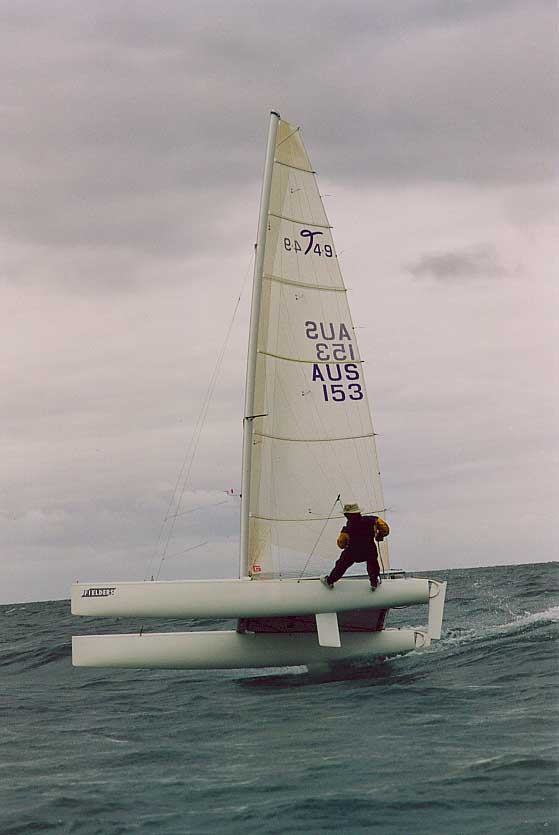
Total Weight F16HP / A-cat = (75+95) / (75+75) = 1,1333 = 113 %
Length hulls F16HP / A-cat = 5 / 5,49 = 0,9107 = 91 %
Width platform F16HP / A-cat = 2,5 / 2,30 = 1,0870 = 109 %
Mast leverage (mast heights) F16HP / A-cat = about 100 % in this F16HP implementation
Mainsail area F16HP / A-cat = 14,50 / 13,95 = 1,0394 = 104 %
Rated mainsail area F16HP / A-cat = 13,00 / 12,90 = 1,0078 = 101 %
Luff lengths F16HP / A-cat = 8,3 / 8,83 = 0,9400 = 94 %
Mainsail aspect ratio F16HP / A-cat = ((8,3)^2 / 14,50) / ((8,83)^2 / 13,95) = 0,8500 = 85 %
Genaker area F16HP / A-cat = 17,5 / 0 = uncomparable
Genaker luff (hoist height) F16HP / A-cat = about (7,50 / 0) = uncomparable
Genaker aspect ratio F16HP / A-cat = ((7,50)^2 / 17,5) / ((0)^2 / 0) = uncomparable
Calculated Ratios
Wetted surface area est. F16HP / A-cat = sq.rt. (Ratio weight * Ratio length) = 1,0141 = 101 %
Prismatic drag ratio est. F16HP / A-cat = Ratio weight / Ratio Length = 1,2418 = 124 %
Sailpower no genaker est. F16HP / A-cat = Ratio mainsail = 104 %
Sailpower genaker est. F16HP / A-cat = (main+0,05*genaker)/main = about (13+0,9)/13 = 107 %
Max. righting moments crew (75 * (2,5 + 1) + 100 * 2,5 *0,5) / (75 (2,3 + 1) + 75 * 2,3 * 0,5) =
= 387,5 kgm / 333,75 kgm = 1,1610 = 116 %
Performance Ratios
(light to medium air performance)
Sailpower to wetted surf. upwind F16HP / A-cat = 104 % / 101 % = 1,0297 = 103 %
Sailpower to wetted surf. downwind F16HP / A-cat = 107 % / 101 % = 1,0594 = 106 %
(medium to heavy air performance)
Sailpower to prism. drag upwind F16HP / A-cat = 104 % / 124 % = 0,8387 = 84 %
Sailpower to prism. drag downwind F16HP / A-cat = 107 % / 124 % = 0,8629 = 86 %
(indicator ability to keep rig under full power)
Max.Righting to heeling moment upwind F16HP / A-cat= 116 % / (104 %*100%)=1,1154=112 %
Max.Righting to heeling moment downwind F16HP / A-cat= 116 % / (107 %*100%)=1,0841=109 %
(indicator heavy air performance when limited by ability to hold down platform)
Modified sailpower to prism. drag upwind F16HP / A-cat = 112 % * 84 % = 94 %
Modified sailpower to prism. drag downwind F16HP / A-cat = 109 % * 86 % = 93 %
Accelleration (sailpower to weight) upwind F16HP / A-cat = 104 % / 113 % = 92 %
Accelleration (sailpower to weight) downwind F16HP / A-cat = 107 % / 113 % = 95 %
What strikes me first is the small difference in wetted surface area. The A-cat is 25 kg's lighter than the F16HP but it only has a mere 1 % less wetted surface which indicates equality when we assume a margin of error of 2 %. The culprit is ofcourse the fact that the A-cat hulls are longer. When looking at the ratio for sailarea we see that this ratio is substantially bigger than to the wetted surface ratio. The mast are eaually height and the sail shape will be about the same so too so this would suggest at least performance equallity around the course and maybe a slight advantage downwind in the lighter wind conditions. This is also indicated by the performance ratios for light air conditions (sailpower to wetted surface drag).
In medium to heavy air the situation changes, the A-cat will bank heavily on his far better hull finess ratio to give him a higher topspeed and he will have a definate advantage despite the fact that the wetted surfaces are nearly equal. In the heavy stuff the F16 HP regains some performance relative to the A-cat due to the fact that the A-cat is sooner overpowered than the F16 HP. This is reflected in the modified ratios of sailpower to prismatic drag. This righting limit cuts the A-cat advantage (at least) in halve.
It must be remembered however that we neglected the influenceof wetted surface completely at high speeds. This is done to arrive at a carefull comparison. A more daring comparison could be that both drag types contribute equally at high speeds, a condition that is certainly met under medium wind conditions. This results in a new drag ratio of (101 % + 124 %) / 2 = 113 %, which in turn would produce high speed performanc ratios of 92 % upwind and 95 % downwind and modified Performance ratios of 103 % upwind and 104 % downwind respectively (last includes genaker, when without than 103 %). This would favour the F16 HP again. It must be underlined that the methode to include the genaker was very mild indeed. We assumed it's positive effect would be comparable to adding 0,875 sq. mtr. = 5 % to the a-cat mainsail. However, it is far more likely that the total sailpower is in increased by 50 %. Anyway we set out to do a very conservative comparison.
It would be save to conclude that the A-cat will have it's biggest advantage in the medium windstrengths and that this advantage can very well be very limited to a 3 % or less. The genaker could well tip the balance decisively in favour of the F16 HP in these conditions, especially in distance races. In light air and the really heavy stuff the numbers suggest that both classes are equal.
One thing is for sure the A-cat sailor does not have much margin and this situation is reflected in the fact that both Texel and ISAF handicap systems officially rate the F16 HP 1-up equally to the A-cat.
It will be clear that the F16HP 1-up both in genaker or genakerless mode are capable of giving the A-cats a true race in several sailing conditions. Not bad for the F16HP which can be disrespectfully called "just" a 2-up boat that can also be raced solo !
Measured ratios
Total Weight F16HP / I-17 = (75+95) / (75+155) = 0,7391 = 73 %
Length hulls F16HP / I-17 = 5 / 5,24 = 0,9542 = 95 %
Width platform F16HP / I-17 = 2,5 / 2,60 = 0,9615 = 96 %
Mast leverage (mast heights) F16HP / I-17 = about 9 / 8,5 = 106 % in this F16HP implementation
Mainsail area F16HP / I-17 = 14,50 / 13,68 = 1,0599 = 106 %
Rated mainsail area F16HP / I-17 = 13,00 / 12,31 = 1,0561 = 106 %
Luff lengths F16HP / I-17 = 8,3 / 8,15 = 1,0184 = 94 %
Mainsail aspect ratio F16HP / I-17 = ((8,3)^2 / 14,50) / ((8,15)^2 / 13,68) = 0,9785 = 98 %
Genaker area F16HP / I-17 = 17,5 / 17 = 1,0294 = 103 %
Genaker luff (hoist height) F16HP / I-17 = about 100 %
Genaker aspect ratio F16HP / I-17 = ((7,50)^2 / 17,5) / ((7,5)^2 / 17) = 0,9714 = 97 %
Calculated Ratios
Wetted surface area est. F16HP / I-17 = sq.rt. (Ratio weight * Ratio length) = 0,8398 = 84 %
Prismatic drag ratio est. F16HP / I-17 = Ratio weight / Ratio Length = 0,7746 = 78 %
Sailpower no genaker est. F16HP / I-17 = Ratio mainsail = 106 %
Sailpower genaker est. F16HP / I-17 = (1 * main + 2 * genaker) / 3= 104 %
Max. righting moments crew (75 * (2,5 + 1) + 100 * 2,5 *0,5) / (75 (2,6 + 1) + 155 * 2,6 * 0,5) =
= 387,5 kgm / 471,5 kgm = 0,8218 = 82 %
Performance Ratios
(light to medium air performance)
Sailpower to wetted surf. upwind F16HP / I-17 = 106 % / 84 % = 1,2619 = 126 %
Sailpower to wetted surf. downwind F16HP / I-17 = 104 % / 84 % = 1,2381 = 124 %
(medium to heavy air performance)
Sailpower to prism. drag upwind F16HP / I-17 = 106 % / 78 % = 1,3590 = 136 %
Sailpower to prism. drag downwind F16HP / I-17 = 104 % / 78 % = 1,3333 = 133 %
(indicator ability to keep rig under full power)
Max.Righting to heeling moment upwind F16HP / I-17= 82 % / (106 %*106%)=0,7298=73 %
Max.Righting to heeling moment downwind F16HP / I-17= 82 % / (104 %*106%)=0,7438=74 %
(indicator heavy air performance when limited by ability to hold down platform)
Modified sailpower to prism. drag upwind F16HP / I-17 = 73 % * 136 % = 99 %
Modified sailpower to prism. drag downwind F16HP / I-17 = 74 % * 133 % = 98 %
Accelleration (sailpower to weight) upwind F16HP / I-17 = 106 % / 73 % = 145 %
Accelleration (sailpower to weight) downwind F16HP / I-17 = 104 % / 73 % = 142 %
What strikes me first is the fact that the measured ratio's are all around 100 % (equality) with the exception of the overall weight. Another striking aspect is the fact that, even with the very conservative approach we have taken with respect to high speed drag, that the high speed drag estimate of the F16 HP is even less than the wetted surface (low speed) drag of the longer hulled I-17. Ratios of 78 % and 84 % respectively. This eventually lead to power to drag ratios of such that the speed advantage come out at about sq. rt. (130 %) = 114 % which is reflected in the Texel and ISAF handicap ratios of about 112 %.
These numbers are indicative of a F16HP performance that is superior to that of the I-17 in light winds and which becomes more superior with increasing wind.
At teh end of the medium wind conditions the situation changes. In the stronger winds the effect that hold the a-cat back with respect to the F16 HP is now limiting the F16 HP with respect to the I-17. The sailforce of the F16 HP in higher winds is limited by it's capability to hold down the craft. In the extreme case this leads to equal performance in the really heavy stuff and could well lead to a situation where the I-17 has a better sailpower to drag ratio. That is when we assume the high speed drag to be comprised of 50 % wetted surface drag and 50 % prismatic drag again as we did in the comparison to the A-cat. Ofcourse the higher masted and lighter I-17 R which is used in the USA benefits alot less from this reversal of fortune. There the F16 HP to I-17R righting ratio can be expected to be around 85 % and the sailarea and mast height around 100 % resulting in a righting to heeling ratio of 85 %. This in turn results in a modified sailpower to prismatic drag ratio of about 115% which leads to a speed advantage of the F16HP to I-17 R of sq. rt.(115%) = 107 %. Less than the handicap numbers but still considerable.
So the full situation now is that the F16 HP 1-up completely and progressively outperforms the I-17 in the light to medium conditions. And just before the moment where more downhaul isn't possible anymore on the F16HP, the I-17 will reverse the trend and start to climb back with the promise that equal performance is achievable at the really strong winds. However this point could well be found passed 25 knots or windforce 6 and higher. It is save to say however that the I-17 will have a definate handicap advantage in this windrange. Remarkable at the same time is that the same 1-up F16 HP (without jib) sailed with a crew of two in turn completely outperforms the I-17 in this windrange on both handicap and elapsed time, hence the claim that a this F16HP setup (not part of the class rules) is a handicap killer. Apparently both single handers suffer alot at higher windspeeds.
When it comes done to accelleration, the I-17 can forget it. Any tacking or jibing duel will be won by the F16 HP unless the F16 HP crew falls of the back of the boat. The last is not just a wild claim, it has really happened. Later the skipper described the accelleration of his (1-up) F16 HP implementation under genaker as an unbelievable strong sensation of accelleration.
Measured ratios
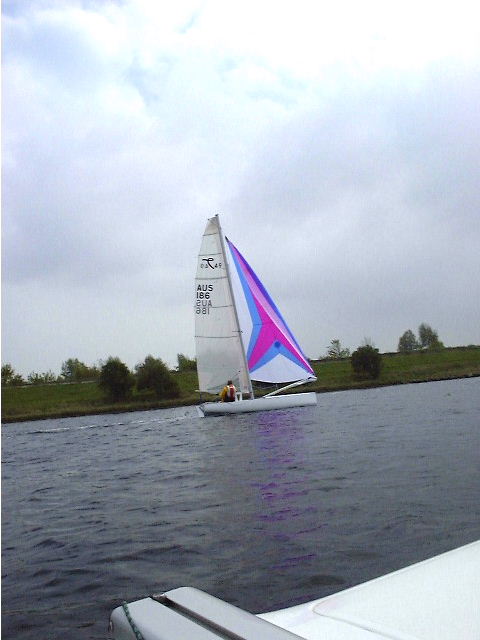
Total Weight F16HP / FX-one = (75+95) / (75+147) = 0,7727 = 77 %
Length hulls F16HP / FX-one = 5 / 5,23 = 0,9560 = 96 %
Width platform F16HP / FX-one = 2,5 / 2,55 = 0,9804 = 98 %
Mast leverage (mast heights) F16HP / FX-one = about 9 / 8,5 = 106 % in this F16HP implementation
Mainsail area F16HP / FX-one = 14,50 / 14,91 = 0,9725 = 97 %
Rated mainsail area F16HP / FX-one = 13,00 / 13,07 = 0,9946 = 99 %
Luff lengths F16HP / FX-one = 8,3 / 8,03 = 1,0336 = 103 %
Mainsail aspect ratio F16HP / FX-one = ((8,3)^2 / 14,50) / ((8,03)^2 / 14,91)=1,0986=110 %
Genaker area F16HP / FX-one = 17,5 / 17,4 = 1,0057 = 100 %
Genaker luff (hoist height) F16HP / FX-one = about 100 %
Genaker aspect ratio F16HP / FX-one = ((7,50)^2 / 17,5) / ((7,5)^2 / 17,4) = 0,9943 = 99 %
Calculated Ratios
Wetted surface area est. F16HP / FX-one = sq.rt. (Ratio weight * Ratio length) = 0,8595 = 86 %
Prismatic drag ratio est. F16HP / FX-one = Ratio weight / Ratio Length = 0,8083 = 81 %
Sailpower no genaker est. F16HP / FX-one = Ratio rated mainsail = 99 %
Sailpower genaker est. F16HP / FX-one = (1 * main + 2 * genaker) / 3= 100 %
Max. righting moments crew (75 * (2,5 + 1) + 100 * 2,5 *0,5) / (75 (2,55 + 1) + 147 * 2,55 * 0,5) =
= 387,5 kgm / 453,7 kgm = 0,8541 = 85 %
Performance Ratios
(light to medium air performance)
Sailpower to wetted surf. upwind F16HP / FX-one = 99 % / 86 % = 1,1512 = 115 %
Sailpower to wetted surf. downwind F16HP / FX-one = 100 % / 86 % = 1,1163 = 112 %
(medium to heavy air performance)
Sailpower to prism. drag upwind F16HP / FX-one = 99 % / 81 % = 1,2222 = 122 %
Sailpower to prism. drag downwind F16HP / FX-one = 100 % / 81 % = 1,2346 = 123 %
(indicator ability to keep rig under full power)
Max.Righting to heeling moment upwind F16HP / FX-one =85 % / (99 %*106%)=0,8100=81 %
Max.Righting to heeling moment downwind F16HP / FX-one =85 % / (100 %*106%)=0,8019=80 %
(indicator heavy air performance when limited by ability to hold down platform)
Modified sailpower to prism. drag upwind F16HP / FX-one = 81 % * 122 % = 98 %
Modified sailpower to prism. drag downwind F16HP / FX-one = 80 % * 123 % = 98 %
Accelleration (sailpower to weight) upwind F16HP / FX-one = 99 % / 77 % = 129 %
Accelleration (sailpower to weight) downwind F16HP / FX-one = 100 % / 77 % = 130 %
Once again the measured ratio's are all around 100 % (equality) with the exception of the overall weight; as they were when comparing the F16HP 1-up to the I-17. Much of the analysis will therefor hold true for the FX-one too.Once again we see that, even with the very conservative approach we have taken with respect to high speed drag, that the high speed drag ratio estimate is even less than the wetted surface ratio (low speed) despite the fact that the FX-one has longer hulls. Ratios of 81 % and 86 % respectively. This eventually leads to power to drag ratios of such a magnitude that the speed advantage comes out at about sq. rt. (118 %) = 109 % which is reflected in the Texel and ISAF handicap ratios of about 109 %.
These numbers are indicative of a F16HP performance that is superior to that of the I-17 in light winds and which becomes more superior with increasing wind.
At the end of the medium wind conditions the situation once again changes. In the stronger winds the effect that hold back the A-cat with respect to the F16 HP is now limiting the F16 HP with respect to the FX-one. The sailforce of the F16 HP in strong winds is limited by it's capability to hold down the craft. In the extreme case this leads to equal performance in the really heavy stuff and could lead to a situation where the FX-one has a better sailpower to drag ratio. That is when we assume the high speed drag to be comprised of 50 % wetted surface drag and 50 % prismatic drag again as we did in the comparison to the A-cat.
So the full situation now is that the F16 HP 1-up completely and progressively outperforms the FX-one in the light to medium conditions. And just before the moment where more downhaul isn't possible anymore on the F16HP, the FX-one will reverse the trend and start to climb back with the promise that equal performance is achievable at the really strong winds. However this point could well be found passed 25 knots or windforce 6 and higher. It is save to say however that the FX-one will have a definate handicap advantage in this windrange. Remarkable at the same time is that the same 1-up F16 HP (without jib) sailed with a crew of two in turn completely outperforms the FX-one in this windrange on both handicap and elapsed time, hence the claim that a this F16HP setup (not part of the class rules) is a handicap killer. Apparently both single handers suffer alot at higher windspeeds.
When it comes done to accelleration, also the FX-one can forget it. Any tacking or jibing duel will be won by the F16 HP unless the F16 HP crew falls of the back of the boat. The last is not just a wild claim, it has really happened. Later the skipper described the accelleration of his (1-up) F16 HP implementation under genaker as an unbelievable strong sensation of accelleration.
From this comparison it also follows that the FX-one does a little better than the I-17, when looking at these ratios. Ofcourse the FX-one hull is very much different in shape then that of the I-17 and it has been unproven yet which one of the two is the better hull shape for a platform of the dimension that both these boats have. Ofcourse, the A-cat after which the FX-one and Fox were modelled was superior but the Fox have been unable to beat the I-20 on a regular basis. So which lead will the FX-one follow ?
Remarkable is that going even lighter doesn't really help the F16 HT 1-ups, it allready has enough potential to play with the big boy which is called A-cat. The others just don't stand a change on elapsed time (ofcourse on handicap it is a different story as is the intend of handicap ratings). With a genaker the F16HP is unbeatable on long race courses and there it will be in direct competition with the potentially fastest of them all; the new M18 by Marstrom. M18 probably wins due to a 8 % better power to wetted surface ratio in light air and a longer waterline in medium to heavy air. But then again it should at least do that at more than more than twice the cost, 1,1 times the length and 1,5 times the width.
So if anything the new F16 HP as a solo craft comes in on the solo sailing hitlists at number 3 (after M18 and A-cat) with a bullit.