
Created : 23 September 2001
Last updated : 8 October 2002
Classification : general publication
Copyright : restricted shareware
Status : Being created, temporary
Comments : These proposed rules are the result of the evaluation discussions as they are now. The final version may be very different

For the construction, all materials and all methodes of construction are allowed when these
do not imply an unacceptable increase in risk of bodily harm or imply the operation of
an unsafe craft. The F16 HP authority shall be the judge of this and the F16 HP authority
decision shall be binding.
In case of doubt, the intention of the rule makers which is referred to as the spirit of the rule, shall take precedence over the letter of the rule. Read section B �The F16 HP class organisation rules� for more on this.
The maximum overall length measured on the hulls is 5.00 mtr. (= 16,4 ft.)
The maximum overall beam is 2.50 mtr. (= 8,2 ft.)
Wings are allowed and the equivilant overall beam is than determined by measuring the overall width including only one fully extended wing. If the platform has removable wings than one wing is removed before measuring.
The minimum weight of the boat ready to sail, excluding non permanently fixed wings, is fixed at :
Singlehanded mode (cat rigged with gennaker) : 104,0 kg. (= 230 pounds)
Doublehanded mode (sloop rigged with gennaker) : 107,0 kg. (= 236 pounds)
The distance between de top of the main beam and the base of the mast section is referred to as the �mast foot height�.
The mast foot height shall not be more than 0,075 mtr.
The distance between the base of the mast section and the highest point of the perpendicular projection of the hoisted mainsail on the mast is referred to as the �mainsail hoist height�.
The mainsail hoist height shall not be more than 8,50 mtr.
The part of the mast section with attached fittings that is farther away from the base of the mast section than the mainsail hoist height is referred to as the �mast crane section�
The mast crane section shall not be taller than 0,075 mtr. and have no other function than to hoist and fix the mainsail to its mainsail hoist height.
The circumference of the mast section shall not be more than 0,500 mtr.
Each hull shall carry at least 75 liters of flotation, either by solid closed cell foam, air bags or sealed air compartments in hulls, and have at least one inspection hatch.
The platform shall be equipped with a pair of rudders and, if fitted, a pair
of daggerboards or centerboards.
All performance calculations, such as in handicap ratings, shall be performed as
if a platform has dagger- or centreboards, this dispite the fact that a particular design
may not have either of them.
It is not permitted to adjust while racing : the rake of the mast, the
tension of the standing rigging, the angle or length of the spreaders,
the position and height of the gennaker boom other
than that by one or two turn buckles appropriately blockable.
Each boat must be equiped with a suitable righting system allowing
the boat to be righted by the crew without outside assistance
with respect to all the sailing conditions that can be encountered.
A particular boat and crew combination may only participate in a
race or sailing event when the crew sailing the boat is considered
to be able to right the boat unaided by the F16 HP authority or
the acting authority when the first is absent.
Crews may be asked to demonstrate their ability to right their boat by
the F16 HP authority.
There will be no other restrictions on crew weight apart from the rule that the
weight must be sufficient to right the boat unaided and at all times and under all encountered racing conditions.
The length of the gennaker boom shall not be more than 3,5 mtr.
When the fixed end of the gennaker boom is located in front of the vertical passing through the leading edge of an unrotated mast, than the distance between the fixing point and the leading edge of the mast is considered to be part of the gennaker boom.
Contrary to ISAF rule 64.2 it is allowed to fix the genaker boom to the forward beam.
The genaker boom shall be fixed and sit approximately on the longitudinal centreline of the boat.
The sail plan in the doublehanded configuration comprises a
mainsail, a jib and a gennaker.
The sail plan in the singlehanded configuration comprises a
mainsail with a gennaker.
It is allowed to race with fewer sails than the sails named per configuration
The sails are allowed to be made of any material and shall fit
in a bag of normal dimensions.
Only "soft sails" are allowed and the F16 HP authority shall be
the judge of this and the F16 HP authority decision shall be binding.
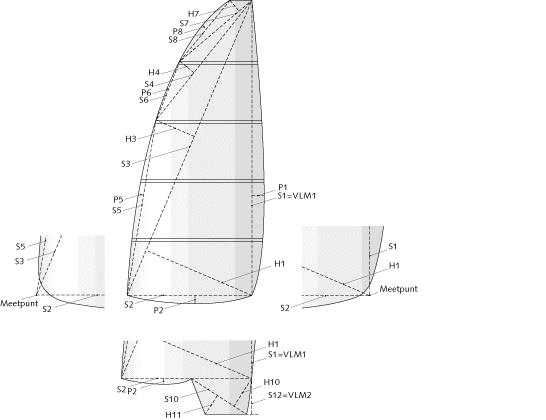
A mainsail is considered to be compliant when its rated sailarea is not more than 13,00 sq. mtr. which means that a mainsail design is considered compliant when :
EITHER
The mainsail used falls within the maximum limits of one of the three �Mast & mainsail area ; mainsail luff length� combinations given in the following table :
Combination code 1 2 3
Maximum mast & mainsail area 14,60 sq.mtr. 14,85 sq. mtr. 15,10 sq. mtr.
Maximum mainsail luff length 8,22 sq.mtr 8,00 sq. mtr. 7,81 sq. mtr.
Resulting rated mainsail area 13,00 sq. mtr. 13,00 sq. mtr. 13,00 sq. mtr.
OR
The mainsail satisfies the following rule :
The maximum allowed actual mainsail area for a particular design shall be that mainsail area that
when put in the following formulae results in the value, called rated mainsail area, that is
equal or less than 13,00 sq. mtr. :
Mast & mainsail area * aspect related effectiveness =< 13,00 sq. mtr.
Where :
Mast & mainsail area = (actual mainsail area + � * mast area)
Mast area is calculated by multiplying the luff length of the mainsail with the
circumference of the mast.
Aspect related effectiveness = (40,1+18,31*AS-2,016*AS^2+0,07472*AS^3) * 0,01
AS = measure of aspect ratio = (mainsail luff length)^2 / actual mast and mainsail area
Mainsail luff length is defined as : the distance measured alongside the mast from the highest
point of a normally hoisted sail towards the lowest point reached when the downhaul is used.
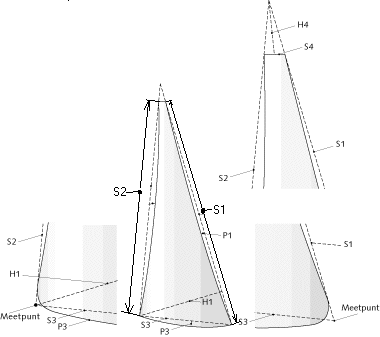
The leech shall not be convex.
The rated sail area of the jib and the mainsail combined shall not be more than 16,50 sq .mtr. which means that a jib design is considered to be compliant when :
EITHER
The jib used falls within the maximum limits of one of the �jib area & projected jib luff length� combinations given in the following table :
Combination code 4 5 6
Maximum jib area 3,65 sq.mtr. 3,70 sq. mtr. 3,75 sq. mtr.
Maximum projected jib lufflength 5,48 mtr. 4,95 mtr. 4,71 sq. mtr.
Resulting rated jib area 3,50 sq. mtr 3,50 sq. mtr. 3,50 sq. mtr.
Resulting combined rated sail area 16,50 sq.mtr 16,50 sq. mtr. 16,50 sq.mtr.
OR
The jib used satisfies the following rule :
The maximum allowed actual jib sail area for a particular design shall be that jib area that when put in the following formulae results in the value, called rated jib sail area, that is equal or less than (16,50 sq. mtr. � the rated area of the mainsail)
actual jib sail area *(aspect related effectiveness) =< 16,50 sq. mtr. � rated mainsailarea
Where :
Aspect related effectiveness = (40,1+18,31*AS-2,016*AS^2+0,07472*AS^3) * 0,01
AS = measure of aspect ratio = (vertical projection of jib sail luff)^2 / (jib sail area)
Vertical projection of jib sail luff is defined as : the distance between the horizontals on the
mast taken from the highest point of the jib towards the lowest point on either the luff or
leech. It will be measured alongside the mast.
The maximum distance measured from the top of the mean beam to the heighest theoretical
point to which a gennaker sail could be hoisted is referred to as Gennaker Hoist Height.
Gennaker Hoist Height shall not be more than 7,50 mtr.
The distance to a mast tang may be used for the Gennaker Hoist Height measurement when no part of the gennaker can be hoisted past the distance measured.
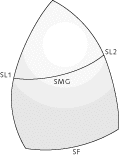
The gennaker must satisfy the following two shape and size conditions :
SMG > 75% * SF
Gennaker sail area = SF * (SL1+SL2) / 4 + (SMG-SF/2) * (SL1+SL2) / 3 =< 17,50 sq. mtr.
Where :
* SMG is the width at mid-height, which shall be taken between the mid
point of the luff and the mid point of the leech.
* SF is the length of the foot measured around the edge of the sail
between the lowest points of the luff and the leech ;
* SL1 is the length of the luff of the sail, from the highest point of
the sail, to the lowest point of the sail on the luff ;
* SL2 is the length of the leech of the sail measured along the edge of
the sail, from the highest point of the sail, to the lowest point of the sail
on the leech.
The maximum allowed jib area for a particular design which is grandfathered is that jib area
that satisfies the following two conditions :
-1- 2,50 sq. mtr. =< rated jib area =< 4,25 sq. mtr
-2- The resulting rating number must be equal to or "slower"
than the rating number of the F18 class when using
the F16 HP officially designated handicap calculation system
which is the ISAF handicap system.
The via ISAF calculated rating number for a grandfathered design may therefor not be lower than 1,01.
When a grandfathered boat falls outside this rule than it can only be grandfathered in by a F16HP authority degree after they have consulted the F16HP class.
All non-true-F16HP or non-foundation boats are placed in, and only allowed to race in, the "Open F16 HP" fleet of which the true F16 HP's and foundation boats are a (full compliant) sub class.