
Created : 12 april 2002
Last updated : 13 march 2003
Classification : general publication
Copyright : restricted shareware
Status : Draft version december 2001 displayed. Update with results of 2002 Taipan nationals soon.
Comments : Update pending

The Influence of Crew Weight on Sailing Performance in Taipan Catamarans
by
Elliot Tonkes (Taipan # 074)
Draft: December 2001
Elliot is affiliated to the Department of Mathematics at the University of Queensland in Australia. This draft version is based on the Taipan 4.9 Australian Nationals 2000 / 2001. Elliot is currently looking to update this paper with the results of the Taipan 4.9 Australian Nationals 2001 / 2002. By expanding the set of data points this way, Elliot expects to increase accuracy. Click to see the used datapoints (results and parameters).
The Formula 16 HP class feels that this analysis is an important part in determining wether to implement a weight equalization system or not. Currently no such system is used in the Formula 16 HP class.
In order to arrive at a dependable basis for such a decision, a similar analysis must be made for boats equipped with asymmetic spinnakers which as the F16 HP's. It may be very possible that the spinnakers go a long way to equal out the performance on the legs downwind which typically are the legs where the inequality is the biggest.
But for now the analysis for sloop rigged One-design Taipan 4.9's
This paper considers the influence of crew weight on the performance of Taipan catamarans based on results at the 2000/2001 national championships. Intuitively we expect that light crews will perform better in lighter wind conditions, while heavier crews will achieve superior results in heavier winds.
The statistical results in this paper are based on a collection of data from the Taipan national titles 2000/2001. We restrict the analysis to the 4.9m Taipan sloop fleet, which consisted of 33 boats, and we have finishing times for 10 races in a range of windstrengths. Crew weights were gathered on the final day of the regatta (thanks to Angus Elliott). The data is listed as an appendix at the end of this document.
A uniform course was sailed for each race, being close to an upwind/downwind course.
The boat masses varied from 102 to 111 kg. Crew mass varied from 113 kg to 165 kg. Total combined boat/crew mass varied from to 216 to 268 kg.
Finishing times for races depended on windstrength. In the third race with the lightest winds, the median finishing time was around 81 minutes. In the 10th race with fresh winds, the median finishing time was around 33 minutes.
Moderate amounts of data are missing as boats withdrew or were disqualified.
Initial Approach
A naive approach may be firstly to scatter plot mass against a measure of performance (for example, normalised finishing times) and perform a regression. Intuitively, we would expect that in light wind, a small mass gives better performance (positive correlation), and in heavy wind, a small mass gives worse performance (negative correlation).
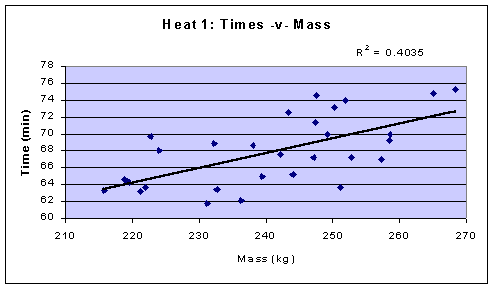
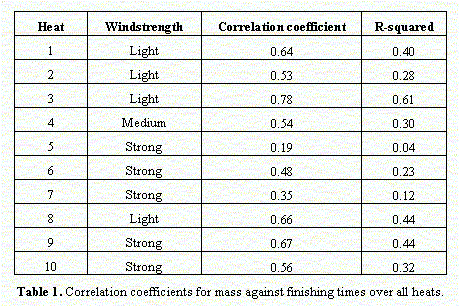
For the first heat (in light winds), we have the following representative scatterplot which tends to support our conclusion with an R-squared value of 40 % (statistically significant). However, This pattern holds for all of the heats. It indicates that boats with lighter weights performed better than boats with heavier weights in every heat of the national titles (all windstrengths).
The purpose of this study is to determine, on average, does the performance of a given boat vary with windstrength because of its mass.
Better Statistical Analysis
A better statistical analysis will utilise the extra information that the same boat competed in various windstrengths. This can be used to generate relative performance, rather than the absolute (unmatched) results above.
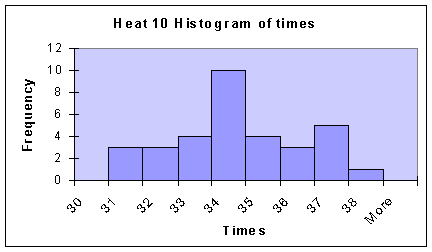
We firstly argue that finishing times should be normally distributed. A yacht race can be considered as a long sequence of decisions (for example, to tack or not to tack, or to go to shore or out to sea). If each of these decisions gives a crew a slight advantage or hindrance, then the summation of these decisions determines the final position. By a further leap, if the decisions are all assumed to have a similar influence, then the central limit theorem dictates that the final performances will be normally distributed. Plotting the histogram of finishing times for (say) the tenth heat seems to support this conclusion as the `bell-shaped curve' (Gaussian distribution) seems apparent.
We now derive a measure of relative performance. Let
P = T(m) - T
S(t)
where T(m) is the mean time and S(t) is the standard deviation in finishing times. Then P is a standard normal variable, meaning that the average performance is 0 (negative P means below average performance, positive P means above average performance). If P>1, then the performance is in the top 15%.
The 10 races are divided into light and strong windstrengths. Heats 1, 2, 3 and 8 were light wind races. Heats 5, 6, 7, 9 and 10 were all strong wind races. Race 4 was neither, so these results have been discarded. Boats which did not have a listed total weight, or boats which did not compete in both light and heavy races were dropped from the model. A single nuisance point was identified as the outlying result by boat 161 in heat 6. This data point was dropped from the analysis as an anomoly.
For each boat, we determine performance P in each heat. Next, the mean performance taken over all light heats P(l), and the mean over all strong heats, P(s) is found. We expect that P(s)>P(l) for heavy crews, while we expect P(l)>P(s) for light crews. The plot below shows P(s)-P(l) against total mass. It shows that there is a weak relationship in the direction expected. In other words, heavier boats have a slightly better relative performance in heavier winds.
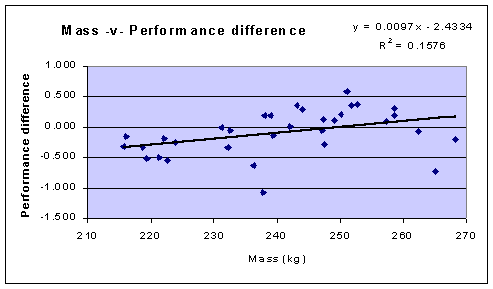
The coefficient to the regression test has a p-value of 0.022 meaning that at the 95% confidence level we deduce that there is (only just) a significant relationship between boat performance across windstrengths based on the mass of the boat.
The plot shows that at around 250 kg, the boat is not biased to light or heavy conditions.
If we remove the obvious anomoly points
� yacht 161 at (237.7, -1.065)
� yacht 012 at (265.1, -0.721)
then it indicates that 242 kg is the weight which favours neither light nor heavy conditions.
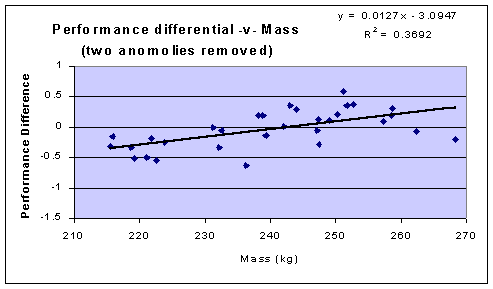
We have found that the boat/crew mass has a statistically significant impact on relative boat performance across windstrengths. As intuitively expected, in stronger winds, a heavier crew/boat performs relatively better. The analysis did not calculate the extent of improvement with windstrength since there were relatively few races for the analysis.
The regression suggests that the combined weight of craft and crew (red.) of around 240 kg is the weight which yields most consistent performance across all windstrengths for the Taipan 4.9 One-design catamaran class.
As stated the Taipan 4.9 One-design class is found (preliminairy) to have a optimal combined weight of 240 kg's or 530 lbs. This value is produced using the 2000/ 2001 Taipan 4.9 Nationals data. This result may be subject to slight change with the extention of the dataset with the 2002 Nationals data.
With respect to the F16 HP class it can be argued that the use of a spinnaker will affect this result in some extend. But mostly it is expected to impact on the spread of competitive weight, it probably shifts the emphasis more to handling and less to overall weight. In this way it could potentially widen the competitive scope.
However , when the impact of a spi is assumed to impact more or less the same on all boats we can extrapolate this result for the Taipan 4.9 class to the F16HP class. As a matter of fact the Taipan class is very comparable to the F16 HP design.
So under this assumption we can conclude that the Formula 16 HP class will have an :
Optimal crew weight F16 HP = optimal overall weight - min boat weight = 240 - 100 = 140 kg's
Which is 530 - 220 = 310 lbs for our Americans friends and about 22 stone for our English friends
This overall weight places the Taipan 4.9 One-design class as well as the Formula 16 HP class in the ideal range for male-female mixed crews. And with a competitive spread of weight around this weight the classes are also very well suited to parent-teenager and light to medium male-male teams.