| Formula 16 Introduction |
| Document data |
| By : various Created : 24 may 2001 Last updated : 14 januari 2004 Copyright : Restricted shareware Status : Branches in 5 continents |
| Related links |
 |
| Introduction |
| The Formula 18 (F18) class is well known to most beach catamaran sailors. And it's bigger brother, the Formula 20 (F20) class is evenly well known. Back in 2000, it was rumoured that a F16 class was also being formed. The same rumour had it that some difficulties had arisen and that these had delayed its introduction. Later it became clear that that rumour was just that, a rumour. However, we made our start-up in may 2001 and are the only Formula 16 class to ever have drawn up a rule set. By now it is well understood by all that the Formula classes have largely replaced the various Single Manufacture One Design classes. With the introduction of the Formula 16 class the concept of handicap racing will be replaced as well as the Formula 16 boats can race A-cats and F18's on elapsed time, not on handicap. First over the line wins. Simple, effective and fun. |
| The setup of the Formula 16 class |
| The target group of the Formula 16 class is a combination of doublehanded and singlehanded sailors. The class aims for the lighter and medium weight crews and especially the mixed crews that typically fall into this weight range. A singlehanded sailor that occasionally or regulary takes somebody along fall right into the target group of the formula 16 as well. Official Formula 16 class racing is devided into two sub groups, one doublehanded and one singlehanded setup. Both use a spinnaker. The difference between both setups is found in flying a jib or not. For recreational sailing or open class (handicapped) racing, three more setups can be added.: doublehanded or singlehanded sailing without a spinnaker and singlehanding a sloop rigged F16 without a spinnaker but with a selftacking jib. The versatility of the class will be evident. When a crew cancels at the last moment then a sailor can just take off the jib and attend the event in singlehanded mode. When a crew is found at the last moment then switching to the doublehanded setup is a matter of minutes. Many more scenario�s can be thought up. The Formula 16 class box rule regulates then all. The Formula 16 boxrule only limits those dimensions that have an impact on performance and leaves the rest open to personal preference. Gear can be acquired from all suppliers as long as it conforms to the general limits as specified in the Formula 16 rules. Compliance is checked when acquiring a class certificate and at events. |
| Our current world presence |
| Current Formula 16 local branches : Australia Netherlands (Benelux) South Africa South East Asia (Thailand and Malaysia) United Kingdom United States East United Stated West Go to our contact persons list if you want to contact your local Formula 16 branch Current F16 designs and supporting builders (alfabetical order) : Blade F16 (By Dynautic ; the results of the experiments of the founders of F16) Stealth F16 (By Stealth Marine : launched in Januari 2002) Taipan F16 (By AHPC : A fully optimized to F16 specs version of the proven Taipan 4.9) Grandfathered (alfabetical order) Spitfire (By Swell catamarans; an Yves Loday and Reg White company) Taipan 4.9 (By AHPC) |
 |
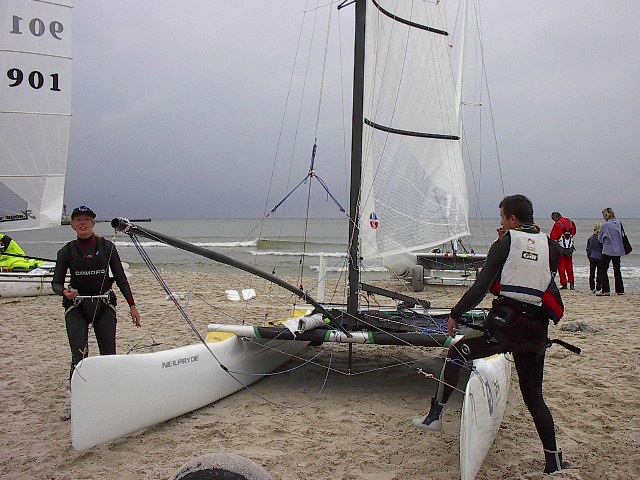
| Formula 16 class, fast gennaker sailing on a lightweight 5 mtr. platform |
 |
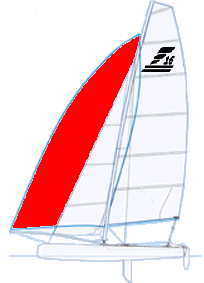
| Mixed crew sailing is an important target group of the Formula 16 class |
 |
|
| Created by : Wouter Hijink, 24 may 2001 |
| Early 2001 a small group of sailors felt the Formula 18/20 and the A-cat classes left a part of the sailor community wanting. A need was felt for a design that could be sailed effectively in both modes, singlehanded and doublehanded. Some expressed a concern that an affordable entry into modern spinnaker sailing was missing. Others felt that the existing Formulas could be improved upon. An often heard area of improvement was weight. However lightweight classes were created before and went without much of an impact. This time something special had to be achieved to make the newly born Formula 16 class a stayer. At the time a group of catamaran sailors from the USA, Australia and the Europe were already experimenting on their own with F16 alike setups. These sailors saw the common ground and joined forces in order to work out the international F16 Formula framework and build up the class. Thus, in the spring of 2001 the F16 class was born and the first draft ruleset was made public in july 2001. The "special character" to make the class a stayer was found some months later. It was discoverd that the F16's were capable of performing on a level with the A-cats and F18's in respectively the singlehanded and doublehanded setup. F16�s could race both of them without the need for handicap calculations. Also the two setups of the F16�s can race eachother on a first in wins as they are that close in overall performance. More information about the various aspects of the class and the class rules can be found at : |
| The Beginning |
| The Formula 16 class is building a class that sees competitive sailing on the water and a open relax feel on the beach afterwards. We also seek cooperation between the Formula 16 class and other the formula classes. The Formula 16 class does not believe that the creation of many seperate and mutual exclusive sailing groups is the path to full sailing enjoyment or even improvement of personal sailing skills. The Formula 16 class also strives to make the F16 racing scene bigger than just racing against other F16's. Formula 16 is both an open class (handicap) racer as well as a class racer. And recreational sailing is also considered an important part of the F16 sailing. Afterall, we all start out as recreational sailors before we become racing crews and it is what we still do on lazy friday afternoons.These three scenes complement eachother fully and none interferes with the full exploitation of another. The Formula 16 class aims at helping crews see beyond the self limiting conviction that the chance on succes is somehow significantly linked to the type or age of a boat. This policy is based on the realisation that even in one-design classes the difference between the winner and the last finisher is at least 40 % of the elapsed time, while the differences between Formula boats of different age, condition or make is measurend in a few % at maximum; well maintained boats differ less. |
| The Spirit of the Formula 16 class |
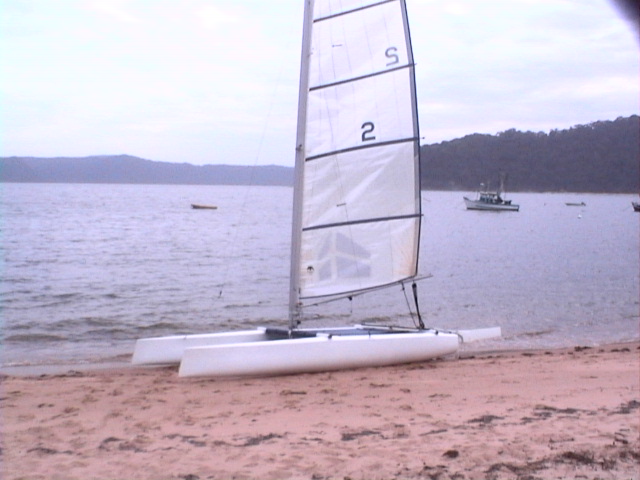 |
| Recreational sailing ? Just put up the mainsail on your F16 and be sailing within minutes. |
|