
Created : 22 june 2001
Last updated : 8 may 2005
Classification : general publication
Copyright : restricted shareware
Status : Finished, valid from may 2005
Comments : Based on the 2002 rules as accepted by 85 % majority vote with simplifications and grammar corrections

1.1.1 In case of doubt, the intention of the rule makers, which is referred to as the spirit of the rule, shall take precedence over the letter of the rule.
1.1.2 For construction, all materials and methods are allowed when these do not imply either an unacceptable risk of bodily harm or the operation of an unseaworthy craft.
1.1.3 It is the responsibility of both designer and builder of a catamaran that is intended to be sailed within the Formula 16 class to contact the Formula 16 Class Autority and request that their design, or modification of an existing design, be checked and found to be in compliance with the Formula 16 rules before publicising their product as a "Formula 16" or "Formula 16 compliant".
1.1.4 It is the responsibility of competitors to ensure their craft are safe and seaworthy.
1.1.5 When the Formula 16 Class Authority feels that a designer, builder, competitor or craft is failing to comply with the Formula 16 rules then the Class Authority may take appropriate action to restrict, or even prevent, the use of the craft or the participation of the competitor.
1.2.1 The maximum overall length measured on the hulls is 5.00 mtr. (= 16,4 ft.)
1.2.2 The maximum overall beam measured on the platform is 2.50 mtr. (= 8,2 ft.)
1.2.3 Wings may be carried as long as the equivalent overall beam when measured over the platform and one fully extended wing is 2,50 mtr. or less.
1.2.4 The hulls, beams and trampoline shall not be permanently fixed to one-another. The Formula 16 Class authority may demand that these items be disassembled, but only at a time when doing so does not directly affect the fairness of racing.
The minimum weight of the boat ready to sail, excluding non permanently fitted wings, is fixed at :
1.3.1 Singlehanded mode (cat rigged with gennaker) : 104,0 kg. (= 230 pounds)
1.3.2 Doublehanded mode (sloop rigged with gennaker) : 107,0 kg. (= 236 pounds)
1.4.1 The distance between the top of the main beam and the base of the mast section is referred to as the �mast foot height�.
The mast foot height shall not be more than 0,075 mtr.
1.4.2 The distance between the base of the mast section and the highest point of the perpendicular projection of the hoisted mainsail on the mast is referred to as the �mainsail hoist height�.
The mainsail hoist height shall not be more than 8,50 mtr.
1.4.3 The part of the mast section with attached fittings that is farther from the base of the mast section than the mainsail hoist height is referred to as the �mast crane section�.
The mast crane section shall not be taller than 0,075 mtr. and have no other function than to hoist and fix the mainsail to its mainsail hoist height.
1.4.4 The distance, at right angles to the mast axis, measured around and back to the same point is referred to as the "mast circumference".
The circumference of the mast section shall not be more than 0,500 mtr.
1.4.5 The weight that is measured at the mainsail hoist height of a mast lying perfectly horinzontal with its base supported at the bottom edge of the mast section is referred to as the "mast tip weight".
The minimum mast tip weight of a fully fitted mast, excluding standing rigging, is
set at 6.00 kg for reasons of seaworthyness and to garantee fair racing.
1.5.1 Each hull shall have at least one inspection hatch.
1.5.2 Each hull shall carry at least 50 liters of flotation, which may be provided by solid closed cell foam, solid blocks of compacted foam granulate, air bags or sealed air compartments.
1.6.1 The platform shall be equipped with a pair of rudders.
1.6.2 In addition to the rudders, the platform may also be equipped with a pair
of daggerboards or centerboards.
1.6.2 All performance calculations, such as in handicap ratings, shall be performed as
if a platform has daggerboards or centreboards, even though a particular design
may have neither of them.
1.7.1 It is not permitted to adjust the following items while racing : the rake of the mast, the tension of the standing rigging, the angle or length of the spreaders or the position and height of the gennaker boom.
1.7.2 It is permitted to adjust the diamond wire tension while racing or to adjust the items named under 1.7.1 between the races.
1.8.1 It is the responsibility of the crew to ensure that the boat is equipped with a righting system
that will enable the crew to right the boat without outside assistance.
1.8.2 The Formula 16 Class Authority may demand that a crew demonstrate their ability to right their boat, but only at a time when doing so does not directly affect the fairness of racing.
1.9.1 There will be no other restrictions on crew weight apart from the requirement that the crew
weight must be sufficient to right the boat unaided under all encountered sailing conditions.
1.10.1 The length of the gennaker boom shall not be more than 3,50 mtr.
1.10.2 When the aft end of the gennaker boom is located in front of the vertical passing through the leading edge of an unrotated mast, than the distance between the fixing point and the leading edge of the mast is considered to be part of the gennaker boom.
1.10.3 In contrast to ISAF rule 64.2, the gennaker boom may be fixed to the forward beam.
1.10.4 The gennaker boom shall be fixed and sit approximately on the longitudinal centreline of the boat.
1.11.1 The sail plan in the doublehanded configuration comprises a mainsail, a jib and a gennaker.
1.11.2 The sail plan in the singlehanded configuration comprises a mainsail and a gennaker.
1.11.3 Racing with fewer sails than those named for each configuration is permitted.
1.11.4 Only "soft sails" are allowed and it must be possible to store these in a bag of normal dimensions. The Formula 16 Class Authority shall be the judge of what qualifies as a "soft sail" and its decision shall be binding.
1.11.5 (redundant and thus removed)
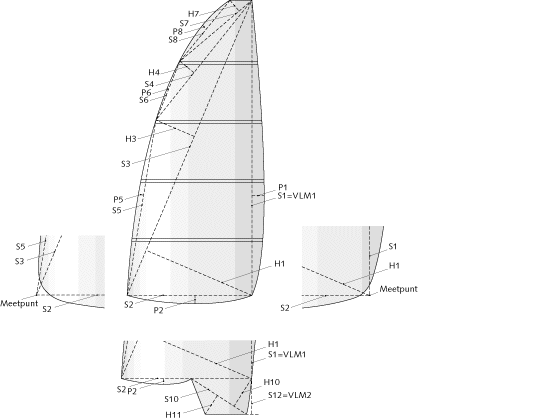
1.12.1 The Mast & mainsail area may not be larger than 15 sq. mtr.
1.12.2 The Mainsail luff length may not be longer than 8.1 mtr (= 8100 mm).
Where :
Mast & mainsail area = (mainsail area + � * mast area)
Mainsail area = all of the mainsail surface area that is outside of the mast while sailing.
Mast area = mainsail luff length multiplied by the circumference of the mast.
Mainsail luff length is defined as : the distance measured alongside the (straight) mast from the
highest point of a normally hoisted mainsail towards the lowest point reached
when the downhaul is used.
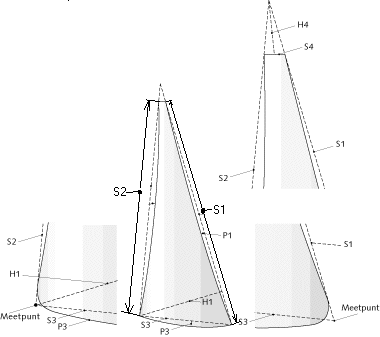
1.13.1 (Revoked by vote per 10 July 2004) : original rule read : "The leech shall not be convex."
1.13.2 The jib sail area may not be larger than 3.7 sq. mtr.
1.13.3 Neither the luff nor the leech of the jib sail may be longer than 6 mtr (= 6000 mm).
1.14.1 The maximum distance measured from the top of the main beam to the highest theoretical
point to which a gennaker sail can be hoisted is referred to as the "gennaker hoist height".
The gennaker hoist height shall not be more than 7,50 mtr.
1.14.2 The distance from the top of the main beam to a mast gate may be used for the "gennaker hoist height" measurement when no part of the gennaker can be hoisted past the distance measured.
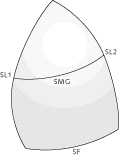
1.14.3 The gennaker must satisfy the following two shape and size conditions :
SMG > 75% * SF (shape condition)
Max. Gennaker area = SF * (SL1+SL2) / 4 + (SMG-SF/2) * (SL1+SL2) / 3 = 17,5 sq. mtr.
Where :
* SMG is the width at mid-height, which shall be taken between the mid
point of the luff and the mid point of the leech.
* SF is the length of the foot of the sail measured around the edge of
the sail, between the lowest points of the luff and the leech.
* SL1 is the length of the luff of the sail measured along the edge of
the sail, from the highest point of the sail, to the lowest point of the sail
on the luff.
* SL2 is the length of the leech of the sail measured along the edge of
the sail, from the highest point of the sail, to the lowest point of the sail
on the leech.