
Created : 25 april 2003
Last updated : 10 april 2004
Classification : General overview
Copyright : Restricted Shareware
Status : Continiously updated
Comments : Just added the mpg video files. these are 2 to 3.5 MB per file

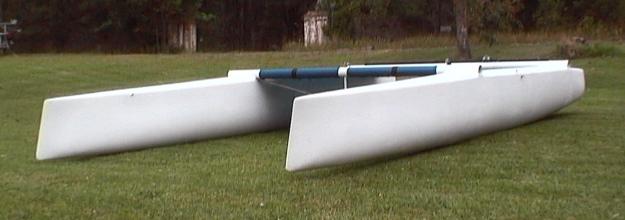

shape technology coupled with some innovations of our own. Innovations that adapt the modern advances in fast sailboat design to the specifics of a lightweight 5 mtr (16,4 foot) platform. But also innovations that will enable amateur builders to produce a timber hull shape that up till now could only be achieved when building in glass. Thus a timber-epoxy hull builder can achieve an as good as identical hull shape to the glass version of the Blade. Identical hull shape means identical performance characteristics. This feature that was assumed to be lost with the more complex buoyancy distributions of modern hull designs which up till now could not be achieved when building a hull from timber. An added benefit of the design.
In addition, the new buoyancy distribution will significantly increase dive resistance and improve dive recovery. This is the result of concentrating buoyancy very low in the hulls and the narrowing of the deck. Together these will allow the platform to be driven very hard on both a beam reach as well as off the wind under an asymmetric spinnaker. This lesson was learned on an earlier platform.
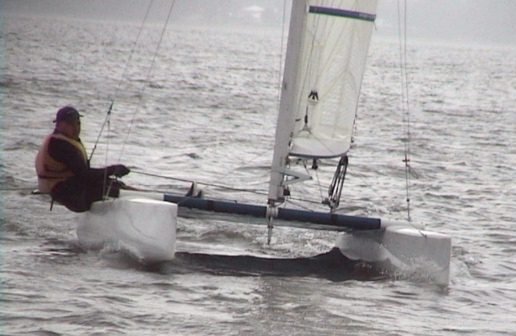
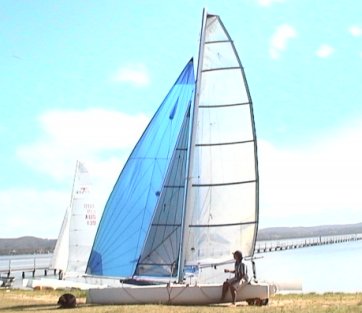
The platform width will of course be the full 2,5 mtr. to make full use of all the available power from a rig that rivals the efficient aspect ratios of those used in the Formula 18, Tornado and Formula 20 classes.
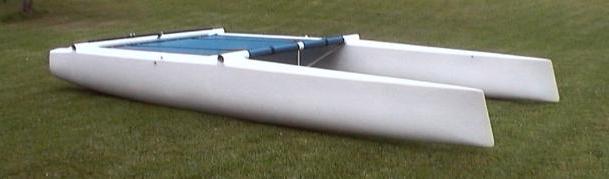
Is the Blade a wave piercer?
Answer-
In my view all catamarans are wave piecers, especially the modern designs of which the Blade is one. So in answer to your question, yes, the Blade is a wave piercer.
Possibly a better question would be :"how does the Blade hull differ from traditional catamaran hull designs ?"
Answer-
In the Blade design we have sought to minimize the response to passing waves while simultaniously improving its dive resistance. However, we have not sought to minimize the response to passing waves by reducing the hull volume in both the bow and sterns. Simply reducing volume at these extremities is counter productive. We have seen such experiments in other classes over the years and each time the outcome did not seem to work out. It either reduced the platform�s weight carrying capability or the remaining bulb of volume under the main beam made the boat rock like a child�s rocking horse. We have paid special attention to the overall distribution of volume (bouyancy) and particularly to the destribution of it in the vertical plane of the hulls. This difference to more traditional hull shapes has resulted in a hull shape that is both less sensitive to passing waves as more resistant to diving.
On that subject when comparing designs it is analogous to two different ways of pressing a bottle filled with air under the water. The hulls of older designs are like the bottle that is partially submerged neck down. While the Blade is like a bottle that is partially submerged with its base down. The drive in the sails combined with the hull's drag attempts to make the platform rotate around its center of buoyancy. When this happens each hull type exhibits different characteristics .
First and most noticeable is that it is easier to further depress the bottle that has its neck down. The same is true for the older, more traditional, hulls and this is especially so at its bows.
The second is that when the older, more traditional, hulls are depressed into a bow down attitude that the drag significantly increases as the angle at the bow entry increases. This entry is bigger higher up as the reserved buoyancy is located there. This increase in drag also increases the hulls inclination to rotate pressing the bows down further and before we know it we have a boat with an built in positive feedback loop that is trying to make it flip over its bows. Also the bulk of the reserve bouyancy kicks in relatively late and only at a significant bow down attitude. It is our view that both this positive feedback loop and delayed counterforce is typical of the more traditional hulls.
By putting the bottle upside down so to speak we have made sure that the impact of the counterforce is immediate and that response to passing waves is minimized by reducing the reserved volume above the waterline while keeping the overall bouyancy the same.
Also the shape of the Blade�s hull minimizes the positive feedback by ensuring the bow is depressed far less and when it is depressed it presents and even sharper angle at te entry to the water thus minimizing any increase in drag. This all means the Blade can take the drive from the sails and convert that to increased forward motion more effectively than older designs.

Does the Blade lift its bows out of the water like some of the other attempts at this type of hull shape.
Answer-
We are expecting this only to happen when tacking. We have paid careful attention to both the position of the bow and angle of the keel to the waters surface to minimize drag particularly when sailing upwind. Waterline length is important here en therefor we have placed the keel line of the bow into the water.
Question-4-
The Blade does not appear to cut the deck away as aggressively as the others as well, why is that ?
Answer-
Given the hull is only 16ft long we have paid special attention to both freeboard in the hull and beam clearance. What we have come up with is a platform that can not only carry heavier crew weights but also provide enough freeboard and stability that young children will be able to crew in the stronger conditions and still feel safe. We believe that we will have managed this in a hull shape that will have even lower drag.
Question-5-
From what you have said it appears that the Blade, and especially its hull shape, was designed independently from others and specifically from a 16 ft perspective.
Answer-
I would consider that a fair statement.
The prototype will be sailing in only a couple of weeks we should be able to very quickly guage the success of our objectives
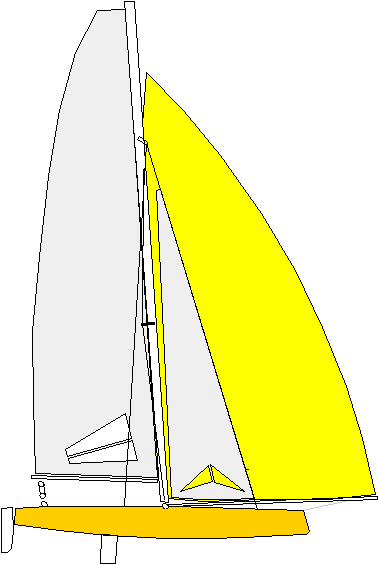
We have both sailed the platform independently of eachother and are actually pretty pleased with the results so far.
I just had the chance to take the Blade for a test sail.
I was a little bit anxious with it being so new and untested. It took no time for me to relax.
It sails & feels like a boat with a much longer waterline length.
When going up wind the boat points and climbs in height without loosing speed.
When tacking WOW ! seems like no loss of speed. Tacks on itself very quickly and
scary when you dont expect it to be that quick.
When its time to reach or go wild no problem being so boyant in the nose, so you can push,
and should you bury the nose (very hard to do) either bear away or de power and out it
pops and the ride goes on.
My only concern is the rudders. They are just too short and don't have enough in the water
if you lift the transom. The designers tell me they already have longer rudders in the making.
The centreboards seem fine with minimal sideways drift.
The boat does not seem to want to sit still so holding it on a start line may be a bit of work,
but then again the boat is designed to be sailed, and enjoyed, so I did.
My thanks to the designers for the opportunity.
Went sailing today in 15-18 knots wind with gusts and a 2-2.5 metre swell.
The Blade doesn't seem to acknowledge the swell when you get it moving.
It climbs and decends with ease and always feels powered up.
An interested sailor wanted go on it so he came out with me.
All up we would have had nearly 180kg of crew weight on the boat.
The Blade did not seem to take much notice of the extra crew weight and she
trimmed and sailed pretty much as it would with half that crew weight on board.
This is another objective of the design that seems to have worked out.
(post has been edited to show only the comments dealing with the Blade F16 performance)
Post 1
Hi my name is Tony Jenkins. ... I predominantly sail my boat one up. Some Australians may remember my vocal opposition to the introduction of spinnakers to our class. ....To be honest, as a single handed sailor, I haven't seen anything to change my mind of this. That is until the Forster regatta back in October. It was there that two pesky Mosquitoes with spis blew our single handed fleet away. And it looked all too easy.
So after umming and arring for a couple of months I decided to go ahead and order my spinnaker.
But in the mean time I have been collecting the materials needed to build my self a new boat. ...
Which brings me to the Blade. I was fortunate to be invited to Blade debut. I sailed on it and against it all day. It was there and then, that I decided that this is the boat I'm going to build. That process started last Monday. Four sheets of ply are now scarfed. ... I will keep you informed how my project is coming along.
Regards TJ
Post 2
Hi folks.
It seems the Blade has generated a bit of interest.
I would like to point out at the start, that I have no financial interest in the Blade.
It has been designed right here in Australia.
The plans will be $250 aus, and will be available late January. (I managed to buy the draft set)
My interests in builing a Blade are,
1)I'm looking forward to sailing a boat that I built my self,
2) and I think it will give me an edge, certinally in the mixed fleets that I'm currently sailing in, and hopefuly against other F16s a little later.
My goal is to have a hybrid sailing by February. ... And then, hopefully have a fully compliant F16 by the start of next season.I hope this has answerd some of your questions.
Regards Tony Jenkins.