
The Moveable Mother Goose & The Wonderful Wizard of Oz
Where do I start? Both of these books are amazing. I have seen pop-up books, but never the caliber and intricate detail of Robert Sabuda's pop-up books. You would think that one pop-up detail per page would be quite enough, but that doesn't seem to satisfy Sabuda. Most every page has an impressive pop-up figure, and then along the sides or bottom of the page, he has miniature pop-up pages with more pop-up features. He doesn't seem to know where to quit, and that's to the reader and viewer's advantage and delight.
Color & Illustrations
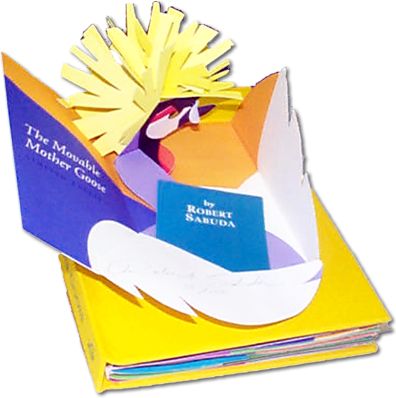
The colors in the Moveable Mother Goose are brighter, with more use of primary and secondary colors. The patterns use solid, two-dimensional colors, similar to cartoon or Disney characters. In a few of the pop-up figures, Sabuda uses a shiny silver patterned paper in some of the large figures and even in tiny details such as the peacock feathers. This is very labor intensive to print and paste such intricate details.
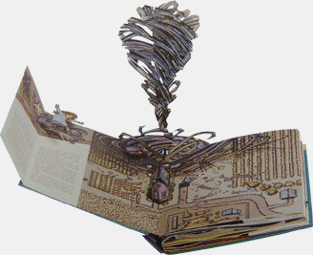
The colors in the Wizard of Oz use more muted colors at the beginning of the story as seen above with the tornado page, such as tans, grays, browns, and rusts. The illustrations are more three-dimensional, using various shades of the same color and contrasting colors to shadow and create depth. Then when Dorothy's house falls down in the middle of Oz, the colors get brighter, although still following the more detailed, three-dimensional process. The yellow brick road is a shiny gold foil with a brick pattern imprinted on it. The red poppies literally pop off the page. The Emerald City and the hot air balloon are made of a beautiful iridescent green foil-covered paper. The look of the artwork follows the style of W.W. Denslow, who originally illustrated the Wizard of Oz.
Movement
The nature of pop-up books is movement-- something leaps off the page towards you as the page is opened. The Moveable Mother Goose is aptly named-- every Mother Goose Rhyme has movement: the spider pestering Miss Muffet comes out of a bowl, Little Bo Peep's sheep raises its huge head to greet you, a peacock opens its beautiful tail, the Knave of Hearts is running away, the mouse runs up and down the clock, Jack jumps over a candlestick, Jack Sprat's wife chows down on cupcakes, and 24 blackbirds fly out of a pie, not including all the little side pages of poems and pop-ups.
The Wizard of Oz book takes the prize, though. The tornado not only stands up, but it twists and twirls on the way up. Dorothy and Toto are thrown off the bed (a little side note pop-up), her house appears on the next page, along with trees and Munchkins, and the Wicked Witch of the East's silver slippers (this follows the original story) are actually sticking out under the house. The Scarecrow, Tin Woodman, and the Lion all pop up in their respective side pages, along with the large pop-ups of the beautiful red poppies, and the magnificent Emerald City, complete with a pocket containing removeable green spectacles for the reader to put on and see everything in green. The witch's castle is very detailed, including flying monkeys coming out of every window; and a side page shows movement of the witch melting after Dorothy pours the water on her. The other amazing pop-up in the book is the hot air balloon, which is literally suspended in air above the two pages. Sabuda has rigged two little wood sticks that stand up with a string suspended between them to hold the balloon suspended above the page. That is amazing.
Stories
Sabuda has taken two well known titles and added his magic touch of pop-up illustrations. Mother Goose is made up of many old children's verses that have been popular and well-loved for years. I noticed that Sabuda used animals and insects as his characters (with the exception of the Knave of Hearts) instead of using humans in his illustrations. Each poem tells a story of its own.
The Wonderful Wizard of Oz is a single story, although told in a shorter version of L. Frank Baum's original text.There are some differences than the movie version of Oz, such as the silver shoes versus the ruby slippers, the Tin Woodman versus the Tinman, and the additional people called Quadlings and Winkies. The ending is also different, too, than the popular version in that Dorothy doesn't say "There's no place like home," then wakes up in her bedroom, like it was a dream. Dorothy tells the slippers, "Take me back to Aunt Em," and the slippers do just that.
I would highly recommend both books to readers, as well as the other pop-up books Sabuda has created. They are simply amazing.
Baum, Frank L. 2000. The wonderful wizard of Oz. Illustrated by Robert Sabuda. New York: Simon & Schuster. ISBN 0689817517.
Sabuda, Robert. 1999. The movable Mother Goose. New York: Simon & Schuster. ISBN 0689811926.
Illustrations:
The tornado in The Wonderful Wizard of Oz accessed at http://www.pop-upbook.com.tx/pic/use-p002.gif

Movable Mother Goose accessed at http://www.library.unt.edu/rarebooks/exhibits/popup2/images/mother.gif
Home