
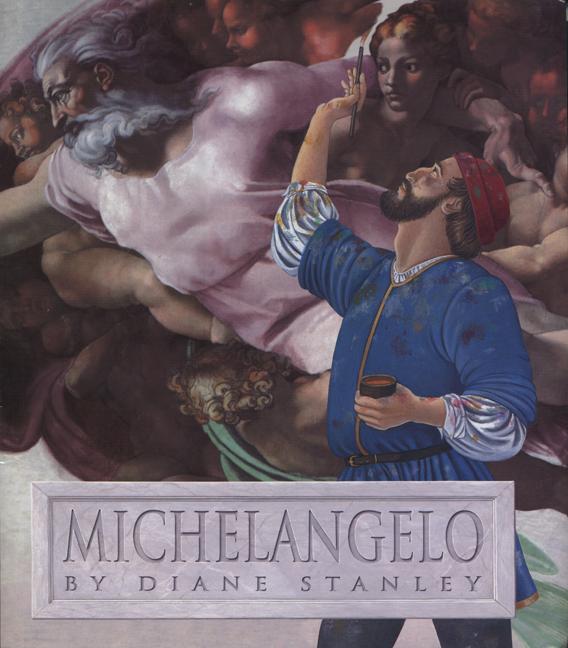
Michelangelo
By Diane Stanley
HarperCollins Publishers
London, England
2000
ISBN 0-688-15086-1
Ages 9-12
Michelangelo grew up in the age of the Renaissance, or Europe's rebirth of discovering the great achievements of their ancient past. This awakening of learning and creativity lasted for about two hundred years from the 14th to the 16th centuries. It began in Italy, and the heart of Renaissance was in Florence, Michelangelo's hometown. Florence was also the home of other artists of the caliber of Michelangelo: Giotto, Donatello, Botticelli, and Leonardo da Vinci. I wonder what was in the water? I do know that creativity and talent begets and inspires further creativity and talent. Artisans learn from each other; they compete with each other, and so on. It was interesting to learn, too, that three of the other four boys living with Michelangelo in the Medici palace also rose to positions of great power: two became the pope, and one governed the republic of Florence.
Michelangelo displayed some of the typical behavior patterns of a genius - he was obsessed with his work, he was a perfectionist, he liked to work alone, he wasn't too good with relationships and teamwork, and he lived his passion - art - which continued throughout his lifetime. Most of us do not experience that kind of lifelong dedication to one's craft; some of us blaze brightly for a while, than fizzle out. That did not happen to Michelangelo. His art defined his life and who he was, and it has lasted for centuries.
The book even gives an interesting mini-history/geography lesson about Italy. It was not a unified country until 1870. Up until then it was a peninsula divided into separate independent, self-governing states, Florence being one of them. Stanley made a beautiful map illustration showing early Italy during the time of Michelangelo's life.
Stanley's pictures have an old world look about them, and she is consistent showing Michelangelo's distorted nose throughout the book, which was caused by a punch from a fellow artist in Michelangelo's younger years.
As an artist, it would be a little daunting to take on the task of illustrating a picture book about any great artist, especially someone like Michelangelo, but Diane Stanley didn't shy away from it. She says that she prepared the illustrations using watercolors, colored pencil, and gouache on watercolor paper. The images of Michelangelo's art (paintings and sculptures) were manipulated on the computer and super-imposed on or under her own illustrations of the book. That was her salvation-- to use Michelangelo's own artwork to help illustrate a picture book about him.