
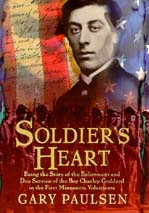
By Gary Paulsen
New York: Delacorte Press
1998
ISBN 0-385-32498-7
Ages 9-12
This historical novel is part fiction, but there actually was a Charley Goddard who joined the army of the North and survived a number of battles. Paulsen has taken the facts of a true story and added dialogue, realistic situations, and difficulties affecting soldiers in battle as well as the tough times of waiting between the battles. Paulsen pulls no punches-- the battle scenes are graphic and gruesome and difficult to read about. Even the soldiers' time of waiting between battles is painful when it talks of men dying from dysentery and other diseases, fighting starvation, and the bitter cold. The subject matter seems harsh for 9-12 year olds, but it rings true, and definitely doesn't glorify or gloss over the harshness of war.
I usually don't critique a book according to grammar rules while I'm reading it unless something really obvious jumps out at me. Paulsen has written the story primarily in third person, but from Charley's perspective and his thoughts. He uses quotation marks with the dialogue, and italicizes Charley's thoughts, which makes the story seem like it's in first person. I did find some inconsistencies where Charley's first person thoughts are not italicized, but it did not distract from the story. I won't divulge the ending, but the last chapter was a bit unclear until the epilogue is read.
The book is a quick read-- 106 pages, but not one I would ordinarily pick up to read. I appreciate the veracity in its pages, though, and based on the words in the book's dedication:
Dedicated to Mike Magee-- friend, sailor, and one who understands..., it sounded as if the author knew of what he wrote about in this book.