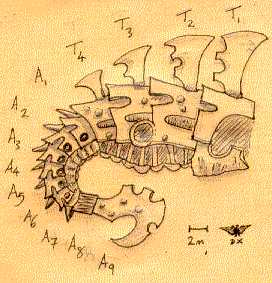
Transverse view of Thorax and Abdomen, legs removed
The Tyranid Biotitan Heirophant
Information regarding their combat effectiveness is widely available, but very little has been compiled concerning their biology.
A largely undamaged specimen was obtained from Hediste IV, prior to the second wave of tyranid invaders. A detailed analysis has been impossible due to accelerated decomposition of the bioconstruct, but an initial autopsy has been completed.
Appearance
The colours of the 'biotitans' result from pigmentation within both the osteoplacs (boney plates) and sclerites (chitinous plates). Nearly every colour has been observed, and it is believed that these denote both a brood and hive association.
Sclerites
The structure of the sclerites is remarkably similar to Terran arthropods, consisting of a biopolymer with extensive cross-links. The chemical structure is identical to that of other tyranid constructs analysed. The overall structure is not, however, one solid mass. Rather, a large number of smaller sections on the order of one to two metres in diameter are held together via tendons and muscles to create the plate. These units funtion much like the mesh armour used by Eldar infantry, 'tensing' when subjected to a stress a dissipating much of the force.
The sclerites cover most of the heirphant's surface, including the head and weapon systems. It seems to be a poor conductor of heat, hence the large pores along the thorax and legs. Further thermoregulation is carried out by the 'fins' on the dorsal surface of thorax segments 1-4 (T 1-4 on the diagram), which are porous and highly vasculated.
Osteoplacs
These form the secondary armour of the constructs, overlying the sclerites and providing substantial protection and often covered in spines and ridges. Although they look fearsome, their primary function is defensive - strengthening the plates and resisting crushing attacks by an enemy.
Extensive connections exist between the osteoplacs and deeper tissues, supplying oxygen and nutrients to the plates, and allowing the passage of smaller symbionts. Clusters of lysozoonts are found around these connections. Consisting almost entirely of an enzyme-filled sac these symbionts can rapidly digest the links, resulting in the shedding of the plate. The loss of several plates was documented on Julio VI when melta bombs were dropped onto a heirophant. Damage to the construct was thus minimised, and new plates began regrowing within 5 minutes.
Lesser damage results in the rupturing of small pockets within the plates. These contain osteozoonts, which rapidly form a boney 'scab' over the wound.
Viscera
The organs of the heirophant are perhaps the most startling discovery. The digestive system is much reduced, consisting of an atrophied fore gut, several large storage sacs, and a large heptopancreas. Sections of the gut have become isolated, and allow the transportation of smaller tyranid broods. It is hypothesised that the heirophant is 'fed' by other symbionts on an energy-rich food, which can be rapidly broken down in the gut. This presumably occurs prior to a battle, and may have implications for prolonged campaigns.
The muscles surround an extensive network of veins. Intimately associated with these are large growths rich in oxygen-scavenging proteins, similar to haemoglobins and cyanoglobins found in Terran animals. These store oxygen at high pressure, and allow the high metabolic activity witnessed in these constructs.
A second function put forward for the major scleritic pores is gas exchange. These pores are richly supplied with vessels, and covered in a protein-rich liquid 'filter' to exclude pathogens and toxins. A number of hearts and circulatory systems are distributed throughout the construct, presumably to conter the massive stresses associated with one single system.
Further Work
Several lines of investigation have yet to be pursued, including the posibility that higly-pigmented sclerites may be involved in oxygenic-photosynthesis. Such a function would remove carbon dioxide whilst providing oxygen and basic energy supplies for the construct. However, owing to the loss of important research personnel and the corruption of the sample specimen, further work has been postponed.

