|
|
| PLACES OF INTEREST IN MALTA |
|
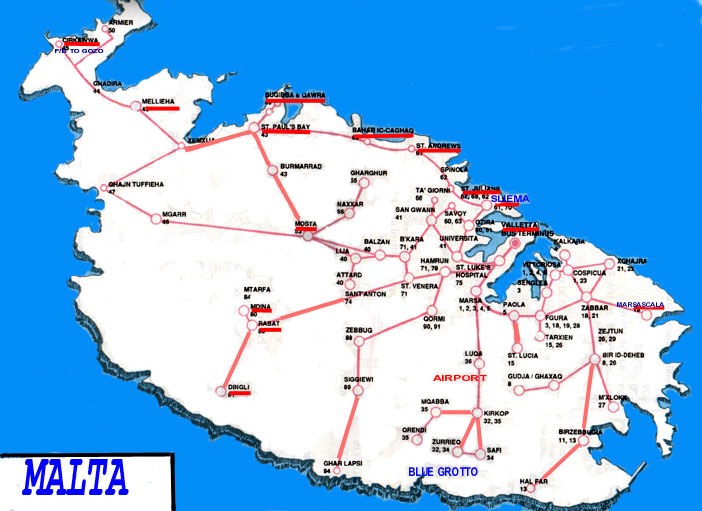
VALLETTA Founded by Grand Master Jean Parisot de la Valette, and built on a grid pattern as designed by Francesco Laparelli in 1566, Valletta is Malta's capital and serves as the islands' main hub of social, cultural, economic and administrative activities. The whole town has been identified as a UNESCO World Heritage site, and contains numerous monuments that should not be missed. St John's Co-Cathedral is certainly Malta's most important and artistic historical monument, built by the Knights of the Order of St John as their conventual church in 1573-1578. From within the Cathedral one can gain access to the Oratory which the Knights built for their novices. This was constructed in 1602 and was later to be embellished by Caravaggio's painting The Beheading of St Jobn. St John's CoCathedral Museum is reached via the Oratory. It contains an interesting exhibitor of Flemish tapestries, church vestments as well as other objets d'art. Open daily except Sundays. Said to be the oldest church in Valletta, Our Lady of Victory Church was rebuilt in its baroque architectural style in the mid-18thcentury. It was built with its back to St James Cavalier and was dedicated to the Virgin Mother as a child - II-Bambina. As the feast is celebrated on September 8, the same date that the Knights emerged victorious from the Great Siege laid by the Ottomans in 1565, it is known as our Lady of Victory Church. StPaul'sShipwreck Church (open daily) is considered to be the most important church in Valletta after St John's CoCathedral. This church celebrates the feast of St Paul's Shipwreck on February 10. The wooden statue of St Paul which is carried in procession is the work of the 17th-century sculptor Melchiorre GA. One can also see a silver monstrance with a bone relic of St Paul, as well as the silver column brought from Rome in 1960. The GrandMaster's Palace, built as the official residence of the Grand Master of the Knights of St john, later served as the British Governor's residence and administrative offices. Today the Palace houses Parliament and also serves as the office of the President of Malta. One may visit the State Rooms, open daily except Sundays. The Palace Armoury may also be visited daily. The Auberges Of the many ornate facades in Valletta, perhaps the most imposing is that of the Auberge de Castille. This was one of the many communal residences built for the Knights in Valletta. The building was commissioned by Grand Master Manoel Pinto de Fonseca and designed by Andrea Belli. Today this fine building serves as the Office of the Prime Minister of Malta. The Auberge d'Italie, situated in the upper part of Merchants Street and in front of another notable building, Palazzo Parisio, has a fine facade designed by Romano Carapecchia. The bust in bronze on the facade portrays Grand Master Gregorio Carafa. The Auberge de Baviere, built for the Bavarian knights, overlooks Marsamxett Harbour and is currently used by the Ministry for Housing. Housed inside the Auberge de Provence in Republic Street is the National Museum of Archaeology (open daily), containing numerous megalithic architectural elements as well as a display of prehistoric art objects that were found during excavations at various archaeological sites in Malta and Gozo. The National Museum of Fine Arts, originally built as a residence for one of the higher dignitaries of the Order of St John, today houses a rich collection of art, especially paintings, dating from the 13th century until the present. Among the more famous painters represented are Guido Reni, Favray and Matthias Stomer, together with the largest collection of works by Mattia Preti. Open daily. The War Museum (open daily) is situated within the precincts of Fort St Elmo. The small museum is packed with a vast hoard of militaria from the entire British period. There is also a pictorial documentary of the Second World War. Among the exhibits is the George Cross. The Manoel Theatre was built in 1731 and is one of the oldest to be found in Europe. It is a small but quaint theatre that provides ever-changing entertainment by the performing arts. Adjacent to it is a small museum, open Mondays to Saturdays. St James Cavalier, originally built for war, has been totally renovated from inside and opened to the public in September 2000 as a Centre for Creativity - the primary arts centre where Maltese contemporary art in all its forms may be presented. It is the intention of this centre to establish itself as a catalyst for all forms of artistic expression. Open daily. Fort St Elmo, situated at the tip of Valletta, has for centuries defended the two harbours. Its heroic defence can best be documented in the Great Siege of 1565 as well as in World War II. Open Saturdays afternoon and Sundays all day. On certain Sundays special historical re-enactments related to the fort's history are held. The National Library is situated behind Republic Square's cafeterias. The Bibliotbeca holds a vast collection of books and documents from the Knights' period. Built in the late 18th century, it is frequented daily by researchers of history. Open Mondays to Saturdays. The old building of the Sacra Infermeria served as the hospital of the Knights, but was also used by the British as a military hospital. The building with its numerous halls and corridors is nowadays used as the Mediterranean Conference Centre, exhibition hall and theatre. The Malta Experience is a multi-visual show highlighting Malta's 7,000-year-old history. The show is screened in one of the halls of the Mediterranean Conference Centre. The entrance is situated on top of the bastions. Open daily. The Great Siege of Malta Show, situated beneath the National Library, is a spectacular walk-through experience that recounts in diorama form the story of the Knights from their origin in Jerusalem until their glorious 268 years in Malta. The World War II Siege Memorial, situated right below the Lower Barrakka Garden, takes the shape of a Greek round temple in which a bell hangs, and a catafalque perched on the fortification walls of Valletta. Upper Barrakka Garden, overlooking Grand Harbour, this garden was designed as a place of recreation for the Italian knights. It has numerous monuments dedicated to British and Maltese personalities. Lower Barrakka Garden is another green oasis in the capital that affords a different splendid view of Grand Harbour. A cenotaph in the form of a Greek temple commemorates the death of Alexander Ball, Britain's first Commissioner and Governor in Malta in 1800. Hastings Garden, situated on the left of Valletta's main fortifications, it provides a panoramic view of Marsamxett Harbour and the northern side of the island. MDINA The town served as Malta's ancient capital from Roman times until the arrival of the Knights of St John in Malta in 1530. It derives its name from the Arab period (870-1224). Today its architecture reflects especially the baroque period and may be admired by all those who really want to experience Malta's past. The small town has a tiny population of some 300. More than private residences, the most conspicuous buildings are the numerous palaces, churches and museums. The magnificent Cathedral was built by Lorenzo Gafa in 1702 after the older one was damaged by an earthquake in 1693. It is dedicated to the Conversion of St Paul but celebrates the feast of St Peter and St Paul on June 29 under the title of Glmnarja. Open Mondays to Saturdays. On the right of the Cathedral is the Cathedral Museum, built in the 18th century as a seminary for priests. Among; the mainly-ecclesiastical exhibits there are works of art from mediaeval to more recent times. Noteworthy among these is the collection of etchings by Durer as well as paintings by numerous other 17th-and 18thccntury artists. Open daily. Also impressive in its architecture is the Magisterial Palace or Vilhena Palace, situated right behind the main gate of Mdina. The old palace currently houses the Natural History Museum. Open daily. The Norman House or Palazzo Falzon is so called because of its Sicilian style of Norman architecture. The palazzino houses an interesting collection of antique furniture. Open Mondays to Fridays. RABAT Adjacent to Mdina, this suburban town with its mostly-narrow winding streets is full of old houses, churches and convents. Just outside Mdina's fortification walls and on the periphery of Rabat is the Roman Villa with its small museum. The fine mosaic floor and the smaller mosaics displayed on its walls date back to the 1st century AD. Beneath St Paul's parish church is the small cave and chapel known as St Paul's Grotto. It is believed that St Paul was held prisoner here when shipwrecked in Malta in AD 60. St Paul's Catacombs and St Agatha's Catacombs are the largest of several hundred other catacombs that were found all over the Maltese archipelago. Situated in St Agatha Street and dating back to the 4th7th centuries AD, both catacombs consist of a series of very narrow corridors flanked by walls with hundreds of rock-cut tombs. Dingli Clifs are found outside the village of Dingli. The cliffs mark the highest point of the island - some 230 metres above sea level. From the edge of these cliffs one may enjoy a panoramic view of the terraced fields below as well as a view of the island of Filfla, lying some 5 km off the coast. From this point the view inland will reach the northern side of the island. Buskett Garden lies a few hundred metres from Dingli Cliffs. Overlooking the garden is Verdala Castle, built by Grand Master Hughes Loubenx de Verdalle in the late 16th century. It now serves as the summer residence for Malta's President and his guests. San Anton Palace and Garden serves as a green oasis in the middle of the built-up Attard/Balzan area. The palace served as the residence of Antoine de Paule, who later became a Grand Master. The palace also served as the residence of the British Governors. MOSTA The Rotunda at Mosta is one of the most conspicuous churches in Malta. It may be seen emerging from among the other buildings of Mosta from miles away. The church, in the form of the Pantheon in Rome, was designed by George Grognet De Vasse and constructed in 1833-1860. During World War II this church miraculously survived an aerial attack when a bomb pierced the dome and ricocheted inside the church without exploding. COTTONERA The Three Cities - Birgu, Bormla, L-Isla All three towns are situated within the Grand Harbour area and inside the 5 km of fortification walls known as the Cottonera Lines. The towns are also alternatively known as Vittoriosa, Cospicua and Senglea. Vittoriosa (Birgu) is the oldest of the three and was Malta's maritime town. Here one can visit the Maritime Museum and the Inquisitor's Palace, as well as admire various interesting old buildings, notably the first auberges of the Knights. At its tip is Fort St Angelo, which since mediaeval times until World War II saw many sea battles take place around its shores. The fort became the first seat of the Order of St John when it took up residence in Malta. The British Royal Navy adopted Fort St Angelo as its naval headquarters in the Mediterranean. Senglea (L-Isla) is the peninsular town that like Birgu faces Valletta. It was built by Grand Master Claude de la Sengle in 1555. At its tip is a small garden, Gnien il-Gardjola, with a stupendous view of Grand Harbour. A sentry post displays the eye, ear and crane bird as symbols of watchfulness. Cospicua (Bormla) is the youngest town, yet it grew fast in commercial importance due to the development of the shiprepair yards in the 19th century. The feast of the Immaculate Conception, which is celebrated by the parishioners on December 8, is also a public holiday. TARXIEN The Hypogeum is an underground burial place that was used in prehistoric times and contemporarily with the Maltese megalithic temples. Open daily. The Neolithic Temples are among the most refined prehistoric temples that still maintain a good representation of prehistoric art in the form of bas reliefs, sculpture and pottery. Open daily. GbarDalam Prehistoric Cave is situated outside the town of Birzebbuga. To reach the cave from the road one first enters a museum housing a vast collection of skeletal remains of elephants, hippopotami and deer which were found inside the cave and which abounded in Malta during the Glacial Periods. Ghar Hasan is situated right on the edge of a sheer cliff in the vicinity of Birzebbuga's Free Port. According to legend a Turk called Hasan abducted a Maltese girl and kept her inside the cave. When discovered by the locals he preferred to kill the girl and commit suicide rather than be captured, so he hurled himself and the girl into the sea below. Marsaxlokk is Malta's main fishing village situated in the southeastern harbour of the island (hence its name). This fishing village has the largest fishing fleet of luzzu boats. On Sundays a sizeable street market is open throughout the day. Just as famous as the one in Capri, but larger and more beautiful, Malta's Blue Grotto is situated below the cliffs of Wied iz-Zurrieq. Boat trips are held regularly from the small bay (weather permitting). The turquoise blue colour of the seabed can best be appreciated in the morning light. Hagar Qim and Mnajdra Temples are among the most impressive of the prehistoric sites and are situated a few scores of metres away from the southern cliffs of Malta, in the proximity of the Blue Grotto. SLIEMA, ST JULIAN'S and PACEVILLE This area is the pleasure centre of Malta. There are hotels, restaurants, cafes, bars, discos, cinemas, a bowling centre, a casino in a fairytale palace as well as Bay Street, a family entertainment complex. It is a lively part of Malta all the year round, but particularly in summer. BUGIBBA, QAWRA, ST PAUL'S BAY These are essentially summer resorts, although many people live there all the year round. There are hotels and restaurants. flats as well as fun places where you can have an enjoyable night out. Almost everywhere you wander in this part of Malta, there is the Mediterranean Sea ready to seduce you. SANDY BEACHES These are largely concentrated in the northwest of Malta. Among the most popular are Ghajn Tuffieha, Mellieba Bay, Golden Bay, Paradise Bay and Armier Bay. |