
Introduction and Setup Time Reduction Theory
Introduction
Setup time reduction (STR) is an integral piece of the Just in Time production system. STR allows companies to implement the other JIT elements. A major key to implementation of JIT is inventory reduction. Inventory reduction requires a company to produce in smaller lot sizes. As the lot size is reduced, long production runs evaporate and industry is left with short production runs. These short production runs, in turn, demand more setups, thus the necessity of reducing the amount of time spent on setups.
Smaller lot sizes are just the first benefit of STR. STR also makes for better setups, full production is attained quicker (there is less of a ramp rate, as the company is fully prepared prior to starting production). Quality is improved, workers are empowered, lead time is reduced, the list of benefits is long.
STR takes on particular importance in the custom injection molding industry. The custom injection molding industry sells machine time. When a molding machine is not producing, the company loses money. Changing a molding machine typically takes approximately 2 hours.
History of Company
Technimark, as a whole, is a typical custom injection molding company. The company is 15 years old and has three separate, distinct divisions. The first division, called Diversified Products, produces a variety of injection molded parts for the business machine, power tool, point of purchase display and telecommunications industries. The division has three manufacturing plants, each plant focused on a particular size of machine.
The second division, referred to as Specialty Products, creates products solely for the textile and furniture industries. This division's products are owned and/or licensed by Technimark directly.
The third division, and focus of this discussion, is the Packaging Products Division. The only product coming out of this plant is makeup compacts of different styles and sizes. The division molds, decorates and assembles these products. The decoration and assembly processes add a tremendous level of complication to the task of setups. A prototypical changeover for this division uses approximately 6 hours (down from 12 hours in the past). These 6 hours were deemed excessive, if we could reduce the number to 3 hours, the company would save approximately $1500.00 per changeover.
Theory of Setup Time Reduction
Two standard methods exist for setup time reduction. Shigeo Shingo advocates a method called Single Minute Exchange of Dies (SMED) and Edward Hay favors a similar method. The basics of the Shingo method involve organizing the setup, removing internal elements and eliminating adjustments. Hay's method calls for externalizing internal methods where possible, reducing internal elements, eliminating problems and making fewer adjustments.
A further look into Shingo's methods reveal that SMED consists of 8 techniques and 4 stages. The 8 steps are: (1) separate internal from external setup operations, (2) convert internal to external setup, (3) standardized function, not shape, (4) use functional clamps (or eliminate fasteners altogether, (5) use intermediate jigs, (6) adopt parallel operations, (7) eliminate adjustments and (8) mechanization.
Technique 1 - Separate Internal from External Setup Operations
Internal setup operations are those that can only be done when the machine is shut down and not running. External operations can be accomplished while the machine is running. By simply identifying and separating these activities, 30 to 50 percent improvement can be attained (Shingo, 1989, p. 48).
Technique 2 - Convert Internal to External Setup
Determine the internal steps that do not have to be done while the machine is stopped. Start completing these tasks while the machine is still running. A very powerful and useful step in STR. For example, in injection molding a typical internal operation is to clear the water lines during a changeover. This operation could be converted to an external operation for a tremendous time savings.
Technique 3 - Standardize Function, Not Shape
"Function standardization requires only uniformity in the parts necessary for setup operations." (Shingo, 1989, p. 48) Another example from injection molding is the cooling hoses for a mold. These are typically different, by standardizing on size and function, time is reduced.
Technique 4 - Use Functional Clamps (or Eliminate Fasteners)
Injection molds are typically attached to the molding machine via clamps with bolts. A much faster method is to use a standard hydraulic clamp system to hold the mold in place. There are dozens of other examples of functional fasteners.
Technique 5 - Use Intermediate Jigs
Technique 6 - Adopt Parallel Operations
By using multiple personnel changing different aspects of the setup at the same time has a positive effect on setup time. For example, while one person is changing the mold, someone else can change the material.
Technique 7 - Eliminate Adjustments
After actual, physical changes, machines must be "processed." These process adjustments account for tremendous amounts of setup time. Eliminating (or at least limiting) these adjustments can reduce setup time by up to 75%.
Technique 8 - Mechanization
This technique should be the last step taken, as it often involves tremendous investments. Mechanization typically involves automating the changeovers.
Original Setup Time Reduction
This phase occurred about 3 years ago. These methods reduced the setup time from 12 hours to 6 hours.
Methods - Phase I
After reviewing the operations in Technimark's Packaging Products Division, a decision was reached to start work on reducing the overall setup time in the plant. At this point, the division was starting a product redesign project that would, over the course of three years, involve the majority of the products made by the division. The opportunity to design molds with quick change in mind could not be overlooked.
Part requirements prevented high cavitation molds prior to the development of new design and tool construction technologies. As the redesign phase started taking hold, a concept to do higher cavitation molds became available. Thus, 16 cavity molds were constructed for all of the new products. By standardizing on one mold size and, basically, one product, the setup of the molds was simplified. This standardization took about 3 years to accomplish, after which the setup time had been reduced to about 6 hours.
Setup Time "Kaizen" Team (KaiT)
Kaizen Theory
Kaizen, roughly translated, means continuous improvement. It is the philosophy and action of making small, incremental improvements a part of the everyday life of all members of an organization. It takes management commitment, time and money to be successful.
A popular style of Kaizen is to hold "Kaizen Events." Kaizen events involve a limited period of time (usually one week) and a limited number of resources (typically very low cost) to "reengineer" a system or process. These events are very effective for assembly type operations, where there are many operations. For systemic type development, "events" are not as useful due to the time and resource constraints.
Technimark's Packaging Products Division operates in a steady state condition, thus demanding systemic type improvements. It was felt by the management of this division that a Kaizen event would not be able to contribute all of the needed improvements, thus a new Kaizen method was developed, the Kaizen Team (KaiT - pronounced as kite).
KaiTs accomplish three things: (1) the specific project assigned (in this case, setup time reduction), (2) employee empowerment and (3) ownership. Specific elements are added to the team experience to realize these goals. The details of the KaiT that reviewed STR will be covered below. But the general experience is similar for all KaiTs.
The KaiT is chartered for a period of one year. The KaiT is formed in a 3-4 day Kaizen event. During the event, the team is trained in the particular area of responsibility. Part of the training is the establishment of the goals of the project. The goals of the KaiT are not established by management. The team itself determines the acceptable goals (with senior management approval, which is always given).
After training, the team reviews the current methods and develops a list of recommendations to improve the system. The team implements these improvements during their one week Kaizen event if possible. If the team cannot implement the improvement, then the KaiT maintains a list of these recommendations.
At the end of the Kaizen event, the team presents all of its recommendations (even those that were implemented)to the management team. Every member of the KaiT must participate in the presentation and managers are free to ask questions. The presentation develops the unity of the KaiT with the management team by allowing the KaiT to assign its "unimplemented " suggestions to individual managers. As the KaiT assigns suggestions to managers, it also assigns one of the KaiT members to work with the manager. The manager executes their respective assignments. Typically, every manager on the management team is assigned an improvement.
After the one week event, the team meets periodically (usually once per month) to review progress. Should the KaiT determine that the management team is slipping, then the KaiT will meet on an accelerated schedule to further critique the progress toward the goal.
After one year, the goal is reviewed in detail by the KaiT and the management team as a unit. If the project methods become part of the culture, then the KaiT is permanently disbanded. However, should the culture not be improved, the KaiT must assemble a new team, train them and push them to continue the improvements.
To assure employee empowerment, employees are added from all possible disciplines within the company. For example, a KaiT to improve material handling would employ not only the materials people, but also hourly employees, engineers, etc. Employees empowerment is critically important for the KaiT to perform well. It is hoped, that over time, the KaiTs will promote an overall feeling of empowerment for all employees.
Setup Time Reduction Kaizen Team
The STR KaiT started work on October 20, 1997. They were trained using the handouts contained in Appendix A of this report. The keys were to cover the reasoning for a Kaizen Team and also the basics of STR. They are still operating today. Their next scheduled meeting is December 19, 1997 to review the progress. This team was allowed 3 days for planning and could only spend $1000.00 during their Kaizen event.
The team observed several changeovers and they developed a matrix of changeovers. They found four types of changeovers, with different potential items to be changed.
Type of Changeover
|
|
|
| |
Observations (O) and Recommendations ( R)
Material Changes (applies to all types of changes except Robot)
O - Team leaders had to search in the warehouse for new material
R - Create specific staging area for new materials & locate
prior to change (complete)
O - During changes Team leaders had to drain a full hopper
R - Communicate better to night shifts to "pull" wands
& let material run down (complete)
O - Often one person had to do the material changes
R - Require that at least 2 people do a material change (complete)
O - The material change was in the way of moving the automation table in or out
R - Drain hoppers and clean loaders while the machine is running
(complete)
O - It took over an hour to drain and clean a large hopper
R - Replace large hopper with "one shot" mini hoppers
(capital money of $400,000 approved to complete this project in
1998, benefits more than just quick change)
Mold Changes
O - The mold change was waiting on forklift from material change
R - Purchase a motorized pallet jack for team leaders (ordered)
O - Mold hanger had to search for special knockouts
R - Purchased 10 bins to stay with molds holding knockouts, switches,
etc. (complete)
O - Mold hanger had to stand under the mold to remove / replace water pipes which had to be done to each mold, each time it was moved
R - Use shorter pipes (1" long) and put short legs on mold
(2") (KaiT came back later and suggested using a piece of
4" X 4" lumber to avert putting legs on molds, complete)
O - There was no mold spray on the setup cart
R - Developed a check list (in appendix B) for tools required
prior to change (complete)
O - Wasted time blowing out water lines while mold was still in press
R - Purchased a vacuum to suck out the water once mold was in
tool shop (complete)
O - Used a tape measure to square the mold
R - Purchased a magnetic level to square the mold quicker (complete)
O - Mold hanger had to shift eye bolts from old mold to the new mold
R - Purchased additional eyebolts for staging molds (complete)
O - New molds had to be retrieved from the green rack while machines were down
R - Stage new molds at the machine prior to shut down (complete)
Robot Changes
O - Brought out the wrong robot heads first and had to search for correct ones
R - Stage all accessory equipment prior to starting the change
(complete)
O - People to work on robot not present at start of changeover
R - Implement checklist of people required to start changeover
(complete)
O - Took 25 - 30 minutes to set positions on old robots
R - Replace old robots with Sepros (pending)
Assembly Table Changes
O - Had to borrow casters from table in the warehouse
R - Purchased new casters (complete)
O - Changed out conveyors then had to adjust
R - Standardize the type and size of conveyors (in process, complete
by Jan. 1, 1999)
O - New table had a valve that was sticking and needed to be replaced
R - Save extra bases and covers then cycle table the day before
changeover (complete)
O - Often new table is missing parts when installed
R - Enforce rule that tables do not get stripped while in storage
(complete, ongoing)
O - Machines stopped at 6:45, changeover scheduled at 7:00
R - Better communication (PIT team concept) (complete)
O - New table and conveyors were brought from the shop with machines down
R - Stage table, conveyors and all equipment at the machines being
changed (complete)
O - Assembly tables had to be jacked up to be set on casters
R - Mount casters and jacks to tables (complete)
O - It took a "technical" person to hook up air and electrical on table
R - Standardize plugs (air manifolds) so anyone can hook up (complete)
Presentation
The KaiT presented its observations and recommendations at a lunch meeting with the management team. It also presented its expenditures (total of $1080, slightly over budget, but acceptable with a 10% contingency) and its keys to success, which the management team felt was extremely important and exciting.
Keys to success:
(1) Leadership is necessary because without it this program
has very little chance of success. We ask (and know) that the
management team will support this effort through helping to implement
and enforce the mostly procedural changes outlined above.
(2) Communication of the proposed changes is going to be
very important because EVERYONE in Plant 4 will be affected. We
feel that the Pit Crew Meetings are very important because it
got everyone involved in the change on the "same sheet of
music." Plant meetings are important, again because everyone
is involved, the front office (how changes are reported) to the
team members (doing color changes) and everyone in the middle.
(3) Accurate Documentation is required because without
an accurate yardstick how do we measure progress? The team's suggestion
is that we use 3 check off sheets(copies in Appendix B): (1) Tools
- all tools required on the change over cart prior to starting,
(2) Equipment - verifying that all equipment is staged and has
been inspected & (3) Personnel - the change over should not
start before certain people are here and ready. Our suggestion
is that these sheets be compiled by the Pit Crew Chief, reviewed
by the Plant Manager then kept by the Business Unit Manager. Once
the changeover is complete, the Pit Crew Chief will fill out the
Production Log to assure proper reporting.
(4) Individual Involvement, everyone who works in Plant
4 is a part of the changeover "system." It is crucial
for them to understand and be invested or the system will not
be a success.
(5) Follow-up will be done in 30 days by the team. The
focus of this initial follow-up will be to check on implementation.
Additional follow-ups will occur once per month with results being
the focus. We anticipate that there will be a substantial downward
trend in the time it takes Plant 4 to do changes.
Results
This team's results are shown in the final results shown below…they are impressive. Summary of the results - setup time reduced from an average of 5.4 hours to 0.5 hours.
Final Results
The final results from all of the setup time reduction programs in Technimark's Packaging Products Division are not finalized. The KaiT is ongoing over the course of the next year. It will meet at least once per month to determine the progress, along with coming up with new ideas to implement. This is one of the strengths of the KaiT program.
However, the total interim results are very heartening.
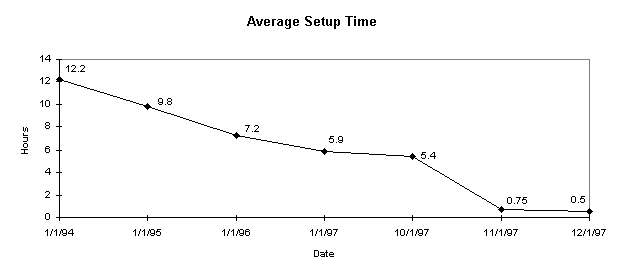
As the chart shows, we are currently at an average of 0.5 hours for changeovers. This is an average of all changeovers performed in the Packaging Products Division. Some of the changes are simple (i.e. color changes only), others are complex (i.e. 2 molds, 2 colors and an automation table). The fastest changeover to date of the simple variety has been 8 minutes, 12 seconds. The fastest of the complex type is 47 minutes, 15 seconds.
These improvements have led to the division being tremendously more profitable. Our profitability on changeover days has grown by 13.7% and overall profitability has been improved by 2.3%. Both of these are obviously directly due to the improvement in changeover time. In addition, our major customer has announced that they are reducing their raw material inventory to one week (down from three weeks). Since we carry no finished goods inventory, their raw materials are our total inventory. We have agreed to the reduction in inventory, due to our increased ability to perform changeovers.
Finally, the biggest benefit that we have seen to date is in the empowerment of our hourly employees. These people are finally able to see that we care about their suggestions and ideas. They now participate fully in all KaiT meetings (we have eliminated the fear factor). Those that are not on one of our KaiTs are all clamoring to be included on the next one. By including these people, the company is benefiting tremendously.
The Future
What does the future hold? The first thing that we have done is to roll out the KaiT idea to our other divisions. Each of the other two divisions have formed a KaiT and are starting to see benefit from them. The Diversified Products group has a KaiT that is involved with reducing employee turnover. The Specialty Products group's KaiT is looking at their preventive maintenance programs.
As for the Packaging Products Division, our second KaiT is operational. This team is attacking our material handling systems. The success of the first team strengthens the chances of the second team for success. The material handling system shows signs of being tougher to have the spectacular results shown by the STR team, the area is much less well defined, but the costs are significant.
As for STR itself, the methods developed have been implemented across the entire company. Our Diversified Products group has shown a tremendous improvement. Their average setup time is down from 3 hours to 13 minutes, 15 seconds (as of December 1, 1997). They do not have the complicated setups of the Packaging Products group.
Finally, for the STR KaiT, the next year will be exciting as they
continue to change the culture of the Packaging Products Division.
Unbeknownst to them, a reward system is being set up to reward
the most productive KaiT during a year. This team stands a good
chance of being the first award winner.

| Return to Sending Page |
|
| Duane A. Floyd's QA & IE Lab |
| Quick Links To | Duane's Major Pages | ||
 |
 |
 |
 |
| Home | Professional | Humanities | Books |
Page is © 1998 by Duane A. Floyd
