The Lucio's
Phenomenon.
El Fenómeno de Lucio
Data-Medicos
Dermagic/Express No. 2-(94)
03 Mayo 2.000 03 May 2.000
EDITORIAL
ESPAÑOL
================
Hola
amigos de la red. DERMAGIC de nuevo con ustedes, el tema de hoy: EL FENÓMENO
DE LUCIO.
La semana pasada vi una paciente de 14 años en mi consulta
privada, era una adolescente con una LEPRA. EL FENÓMENO DE LUCIO
llamado también ERITEMA NECROTIZANTE es uno de los tipos de reacción
leprosa (Reacción tipo II) , poco común y descrito por primera vez por Lucio y Alvarado en 1852, y
re identificado por Latapi en 1936.
Se presenta principalmente en la lepra lepromatosa difusa llamada
también lepra de Lucio, caracterizada principalmente por la ausencia de
NÓDULOS, este tipo de lepra es bastante común en Centro América y
México. Las lesiones CARACTERÍSTICAS SON ULCERAS que afectan principalmente miembros inferiores, pero otras partes del cuerpo pueden estar involucradas.
Histopatológicamente se trata de una vasculitis leucocitoclastica. El tratamiento, TODO UN RETO.
Pareciera una MENTIRA, pero HOY en NUESTROS
DÍAS DE modernismo ENCONTRAMOS AUN ESTE FENÓMENO.
Espero disfruten estas 41 referencias.
En el attach el CASO REPORTADO en la
referencia No. 2
Saludos a todos !!!
Dr. José Lapenta R.,,,
EDITORIAL ENGLISH
=================
Hello friends of the net. DERMAGIC again with you, today's topic: THE
LUCIO'S PHENOMENON.
Last week I saw a 14 year-old patient in my private office, she was a adolescent with a LEPROSY. THE LUCIO'S
PHENOMENON also called ERYTHEMA NECROTIC is also one of the types of
reaction leprous (Reaction type II), not very common and described for the first time by Lucio and Alvarado in 1852, and reidentified by Latapi in 1936.
It is presented mainly in the diffuse lepromatous leprosy, call leprosy of Lucio, characterized mainly by the absence of NODULES, this
leprosy type is quite common in Central America and Mexico.
The CHARACTERISTIC lesions are ULCERS that affect mainly inferior members,
but other parts of the body can be involved. Histopathologically is
a leukocytoclastic vasculitis. The treatment, an entire CHALLENGE.
It seemed a LIE, but TODAY in OUR DAYS OF modernism we EVEN FIND
THIS PHENOMENON.
I wait you enjoy these 41
references.
In the attach file THE CASE REPORT of
the REFERENCE No. 2
Greetings to ALL, !!
Dr. Jose Lapenta R.,,,
===================================================================
REFERENCIAS BIBLIOGRÁFICAS / BIBLIOGRAPHICAL REFERENCES
===================================================================
1.) Lepra type reactions
2.) Diffuse Painless Ulcerations
3.) [Lucio-Latapi leprosy and the Lucio phenomenon]
4.) [Lucio's
leprosy].
5.) [22 years of leprosy: histopathology]
6.)
Lucio's phenomenon.
7.) Lucio's phenomenon and diffuse nonnodular
lepromatous leprosy.
8.) Lucio's phenomenon: a comparative
histological study.
9.) [Diffuse lepromatous leprosy disclosed by
cutaneous vasculitis. The Lucio phenomenon].
10.)
Immunologic aspects of leprosy as related to leucocytic isoantibodies
and platelet aggregating factors.
11.) The role of protein
malnutrition in the pathogenesis of ulcerative "Lazarine" leprosy.
12.) Dermal ultrastructure in leprosy.
13.) Lepromatous and
tuberculoid leprosy: clinical presentation and cytokine
responses.
14.) Leprosy (Hansen's disease) in South Dakota.
15.) [Virchowian Hansen's disease, Lucio's phenomenon, cryptococcosis].
16.) Erythema nodosum leprosum in Singapore.
17.) Epidermal
keratinocyte Ia expression, Langerhans cell hyperplasia and
lymphocytic infiltration in skin lesions of leprosy.
18.) Specific
antigen and antibody to Mycobacterium leprae in the cryoprecipitate
of a patient with Lucio phenomenon.
19.) In situ characterization of
T lymphocyte subsets in the reactional states of leprosy.
20.) Ultrastructure of the dermal microvasculature in leprosy.
21.)
Lucio's phenomenon: a comparative histological study.
22.) Serum
macrophage migration inhibition activity in patients with leprosy.
23.) [Leprosy tests: diagnostic problems].
24.) Serum and tissue
lysozyme in leprosy.
25.)[Reactional status of leprosy].
26.) Auricular chondritis as a rheumatologic manifestation of Lucio's phenomenon: clinical improvement after plasmapheresis.
27.)
Contemplative immune mechanism of Lucio phenomenon and its global
status.
28.) Plasma exchange therapy in Lucio's phenomenon.
29.) [Lepromatous leprosy with extensive ulcerations and cachexia. The Lucio phenomenon? Lazarine leprosy]?
30.) [2 cases of Lucio phenomenon in Paraguay].
31.) An unusual case of leprosy with
pathological features common to Lucio's phenomenon.
32.)
Primary diffuse lepromatous leprosy with erythema necrotisans (lucio
phenomenon).
33.) The "Lucio phenomenon" in diffuse leprosy.
34.) [Macular leprosy of Lucio--antimalarials in leprotic reaction].
35.) [Dermatology in the Central American tropics. I. Lucio's spotted leprosy. Antimalarials in the leprous reaction].
36.) [Lucio's
leprosy].
37.) [Lucio phenomenon in leprosy reactions].
38.) Lucio's phenomenon: an overview.
39.) Lucio's phenomenon: an
immune complex deposition syndrome in lepromatous leprosy.
40.) [Lucio's leprosy].
41.) Antiphospholipid antibodies thrombotic
syndrome misdiagnosed as Lucio's phenomenon.
=============================================================
=============================================================
1.)
Lepra type reactions
=============================================================
Source: Mandell, Douglas and Bennett's
Principles and Practice of
Infectious Diseases Fourth Edition: 1.995
Lepra Type-1 Reactions (Downgrading and Reversal Reactions)
=========================================
Borderline leprosy
patients (BT to BL) may develop before therapy
(downgrading reaction)
or after the initiation of therapy (reversal
reaction) inflammation
within previous skin lesions; neuritis; at times,
new, multiple,
small "satellite" maculopapular skin lesions; and
low-grade
fever. If neuritis is not treated within the first 24 hours or so,
irreversible nerve damage and consequent deformity and muscular
dysfunction
may result.
Reversal reactions are associated
with histologic shifts toward the
tuberculoid end of the spectrum.
Lesions demonstrate increased numbers of
CD4+ helper cells, increased
levels of interferon-g and IL-2, and an
abundance of T cells bearing
g- and d-receptors. This pattern is shared
with Mitsuda-positive skin
tests and does not occur spontaneously
otherwise
in leprosy.
========================================
Lepra Type-2 Reaction (Erythema Nodosum Leprosum)
========================================
Erythema nodosum leprosum
(ENL) is a syndrome affecting nearly half of
lepromatous leprosy
patients, 90 percent of the time occurring after the
initiation of
antimicrobial therapy and generally within the first 2
years
of
treatment. Clinical manifestations include, in order of frequency,
painful papules, generally on the extensor surfaces of extremities, which
may pustulate and ulcerate and may appear as recurrent crops; neuritis
(most frequently the ulnar nerve); fever; uveitis; lymphadenitis;
orchitis;
and glomerulonephritis. Lepromatous leprosy patients
should be forewarned
of signs and symptoms of ENL, lest their
appearance result in loss of
confidence with antimicrobial therapy
and noncompliance. ENL is
histologically an acute vasculitis or
paniculitis primarily thought to be
secondary to immune complex
deposition. It is also thought to be
associated
with a local
increase in cell-mediated immunity: increased numbers of T
helper
cells and levels of IL-2 and interferon-g, and loss of suppresor
T-cell activity. 61
Lucio's Reaction and Nerve
Abscesses
============================
Patients with
diffuse lepromatosis may develop shallow, often large
polygonal
sloughing ulcerations on the lower extremities that heal
poorly,
are frequently recurrent, and may be generalized. Histopathologically,
these lesions appear to be either a variant of ENL or a result of
arteriolar infarction. When generalized, Lucio's reaction is frequently
fatal, generally a result of secondary bacterial infection and sepsis.
Also, leprosy patients, particularly BT or neural leprosy patients, may
develop nerve abscesses requiring urgent surgical decompression
and
drainage.
Therapy of Reactions > ================
Lepra type-1
================
reactions can be
effectively treated only with corticosteroids. We
generally initiate
therapy with prednisone, 40-60 mg daily. Because
relapses commonly
occur if steroids are rapidly discontinued, steroids at
reduced doses
as signs and symptoms allow must be maintained for 2-3
months.
Because of the requirement that steroids be maintained for long
durations, strict indications are neuritis, lesions that threaten to
ulcerate, and lesions that appear on cosmetically important places such
as
the face.
Lepra type-2
=============
reactions
(ENL) can also be effectively treated with corticosteroids, and
short
durations are often sufficient. If ENL is recurrent, thalidomide in
a
nightly dose of 100-300 mg is the treatment of choice. In the United
States, thalidomide cannot be prescribed to fertile women on an
outpatient
basis and remains classified as an investigational new
drug (IND) with
investigators at the G.W. Long Hansen's Disease
Center and a number of
U.S.
Public Health Service-sponsored
Regional Ambulatory Hansen's Disease
Programs.
The mechanism of
action of thalidomide for ENL is not fully understood
but
may be
a result of its action to reduce IgM synthesis, 62 retard
polymorphonuclear leucocyte migration, 63 and reduce tumor necrosis
factor
(TNF) levels. 64 Other than resultant birth defects when administered to
pregnant women in the first trimester, thalidomide is nontoxic, its only
side effects being tranquilization, to which tolerance develops quickly,
as
well as mild leukopenia, and constipation.
Lucio's Reaction
================
Neither thalidomide nor corticosteroid therapy has proved effective
therapy for Lucio's reaction. In severe cases, exchange transfusion may
be
effective. In general, however, the principals of good wound care and
appropriate antibiotics for sepsis are recommended.
=============================================================
2.) Diffuse Painless Ulcerations
=============================================================
Fernando Gallardo Hernández, MD; Jaime Notario Rosa, MD; Anna
Jucglà
Serra,
MD; Jordi Peyri Rey, MD
Ciutat
Sanitària i Universitària de Bellvitge, Barcelona, Spain
Arch
Dermatol, Vol. 135 No. 8, August 1999
REPORT OF A CASE
A 62-year-old man presented with a 3-month history of severe,
ulcerating
skin lesions over the extremities. Painless violaceous
macules, livedo,
and
occasional bullae gave rise to ulcerations
after a few weeks. The lower
extremities were predominantly involved,
with spontaneous amputation of
some necrotic digits. The lesions
extended proximally over the buttocks.
The patient had a 4- to 5-year
history of frequent painless traumatic
wounds that healed after 2 to
3 weeks, leaving atrophic scars.
The
patient
also noted
progressive thickening of the skin, with loss of body hair,
especially the eyebrows. Physical examination revealed a chronically ill
man with waxy diffuse skin infiltration and a total loss of body hair.
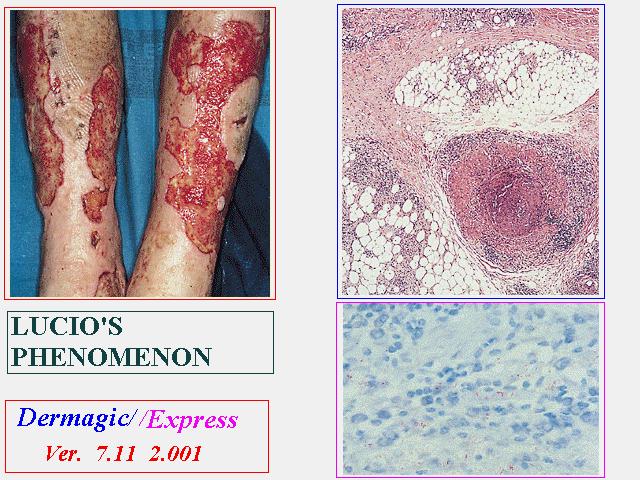
Numerous angular ulcerations were located over the extremities (Figure 1)
and surrounded by a livedoid pattern. The findings of the rest of his
examination were unremarkable except for a sensitive polyneuropathy.
Laboratory evaluation showed the following abnormal values: hemoglobin,
90
g/L; mean corpuscular volume, 67 pg; erythrocyte sedimentation
rate, 120
mm/h; and serum albumin, 16 g/L. The serum concentration of
-globulin was
increased in a polyclonal pattern. A skin biopsy
specimen was obtained
(Figure 2), and Ziehl-Neelsen staining was
performed (Figure 3). (see the
attach file)
Diagnosis: Lucio phenomenon.
HISTOPATHOLOGIC FINDINGS AND CLINICAL COURSE
A punch biopsy specimen
from the border of an ulcer revealed a patchy
infiltrate of foamy
histiocytes and scattered lymphocytes in the dermis
and
subcutaneous fat, tending to be clustered around blood vessels. Large
number of acid-fast bacilli were present in the Ziehl-Neelsen stain of
the
specimen. Foamy histiocytes and acid-fast bacilli were also noted in the
wall of the medium-sized arteries, with narrowing of the vessel lumen. No
nuclear dust was observed. Slit-skin smears showed single and clustered
acid-fast bacilli.
Multidrug therapy was initiated with 100 mg/d of oral
dapsone, 50 mg/d of
clofazimine, 600 mg/d of rifampin, and a single
300-mg dose of
clofazimine
per month, with good response to
date. Prednisone (40 mg) was also
prescribed at decreasing doses for
Lucio phenomenon and has been required
for months at low doses. Our
patient's ulcers healed with irregular
atrophic scars in 10 to 12
weeks.
DISCUSSION;
Our patient manifested the clinical and
histopathologic features of a
diffuse, lepromatous leprosy with skin
ulcerations characteristic of
Lucio
phenomenon, a severe,
necrotizing reaction described by Lucio and
Alvarado1
in 1852.
The reactional states in leprosy are characterized by acute
inflammatory changes, and they occur more commonly toward the borderline
and lepromatous end of the clinical spectrum. Lucio phenomenon is an
infrequent reaction in leprosy. It has usually been described in diffuse
lepromatous leprosy, so-called Lucio leprosy, which is unique because of
the absence of cutaneous nodules. This type of leprosy is almost
exclusively seen in Mexico and Central America. Lucio phenomenon is a
cutaneous necrotizing reaction that most commonly involves the
extremities
but may also affect the buttocks and trunk. The acute constitutional
symptoms of Lucio phenomenon are variable and, occasionally, may be
fatal.2, 3 It is believed to be an immune complex–mediated disease
like the
Arthus phenomenon and is included as a type 2 reaction in
leprosy.4, 5
Lucio phenomenon shows histopathologic findings of
leukocytoclastic
vasculitis along with a superficial and deep mixed
infiltrate of foamy
histiocytes in a perineural and perivascular
distribution. In some
reported
cases, the vascular damage may
have been the result of direct invasion of
Mycobacterium leprae, with
endothelial cell proliferation, thrombosis,
and
tissue
necrosis.6
The treatment of Lucio phenomenon is the same as that for
other type 2
reactions in leprosy. Local care and supportive therapy
are important to
prevent secondary infections and loss of proteins.
Prednisone therapy,
which is initially administered at dosages of 20
to 60 mg/d and then
tapered, may be required for weeks to months.
Thalidomide (400 mg/d with
reduction to maintenance doses of 100
mg/d) may be prescribed as an
alternative to prednisone. Clofazimine
administered at a dosage of 300
mg/d
has a useful
anti-inflammatory effect. It is not necessary to discontinue
multidrug therapy for leprosy.
REFERENCES
1. Lucio R, Alvarado Y, Latapi F, Cited by, Zamora AC, Cited
by. The
spotted leprosy of Lucio. Int J Lepr. 1948;16:421-430.
2. Pursley TV, Jacobson RR. Lucio's phenomenon. Arch
Dermatol. 1980;116:
201-204. MEDLINE
3. Bernadat JP, Faucher JF, Huerre M. Lèpre lépromateuse
diffuse
révélée
par une vasculite cutanée: le phenomene de
Lucio. Ann Dermatol
Venereol.
1996;123:21-23. MEDLINE
4. Touma DJ, Phillips TJ, Kurban AK, Goldberg L. Recurrent
rapidly
progressive infiltrated plaques and bullae. Arch Dermatol.
1996;132:1432-1434. MEDLINE
5. Murphy GF, Sánchez NP, Flynn TC, Sánchez JL, Mihm MC,
Soter
NA. Erythema
nodosum leprosum. J Am Acad Dermatol.
1986;14:59-69. MEDLINE
6. Rea TH, Levan NE. Lucio's phenomenon and diffuse
nonnodular
lepromatous
leprosy. Arch Dermatol.
1978;114:1023-1028. MEDLINE
=============================================================
3.)
[Lucio-Latapi leprosy and the Lucio phenomenon]
============================================================
ARTICLE
SOURCE: Acta Leprol (Switzerland), Jul-Sep 1983, 1(3) p115-32
AUTHOR(S): Saul A; Novales J
PUBLICATION TYPE:
JOURNAL ARTICLE; REVIEW (18 references)
ABSTRACT:
The
Lucio-Latapi's leprosy or diffuse lepromatous leprosy is a
clinical
variety of lepromatous leprosy first described by Lucio and
Alvarado
in 1852 and reidentified by Latapi in 1936. It is frequent in
Mexico
(23%) and in Costa Rica and very rare in other countries. It is
characterized by a diffuse infiltration of all the skin which never is
transformed into nodule, by a complete alopecia of eyebrows and eyelashes
and body hair, by anhydrotic and dysesthesic zones of the skin and by a
peculiar type of lepra reaction named Lucio's phenomenon or necrotic
erythema which is a vascularitis of vessels especially of the
dermohypodermic union and of the hypodermis. Clinically this vascularitis
is represented by well-shaped erythematous spots, later becoming necrotic
with scabs, ulcerations and scars. Three points of confusion are
stressed:
the differences between nodules and nudosities, Lucio's
leprosy and
Lucio's
phenomenon and necrotic erythema and
necrotic erythema nodosum leprosum.
The differences between the pure
and primitive form of Lucio's leprosy
and
the secondary one is
also discussed such as the laboratory findings,
histopathological
data, pronostic and treatment. Lucio's leprosy is
considered the most
anergic one of the all immunological spectrum
of leprosy.
=============================================================
4.) [Lucio's leprosy].
=============================================================
Med
Cutan Ibero Lat Am 1982;10(1):41-6 Related Articles, Books, LinkOut
Gibert E, Cubria JL, Gratacos R, Castro J, Monfort J, Castel
T, Lecha M
A case of diffuse lepromatous leprosy with lepra reaction
type II-Lucio's
phenomenon-in a 24 years old male patient is
reported. The histological
examination of the necrotic lesions and of
the apparently normal skin
showed the presence of dense perivascular
and perianexial
lymphohystiocitic
infiltrates with great
quantities of bacilli. The first biopsy did not
show
a picture a
leuccocytoclastic vasculitis but only areas of necrosis. The
immunofluorescence studies revealed on direct examination complement
deposits on vessel walls. The complement levels in blood were lowered and
circulating inmunecomplexes were also detected. These data confirm the
opinion that Lucio's phenomenon is caused by circulating inmunecomplexes
fixed on dermal vessel walls causing skin necrotic lesions.
=============================================================
5.) [22 years of leprosy: histopathology]
=============================================================
AU:
Dionisio-de-Cabalier-ME; Perez-HJ
AD: Ia. Catedra de Patologia,
Facultad de Ciencias Medicas, Hospital Nac,
de Clinicas, U.N.C.
SO: Rev-Fac-Cien-Med-Univ-Nac-Cordoba. 1995; 53(1): 17-21
AB: In
the present study, the frequency of histopathological reports of
leprosy carried out in the last 22 years at the Fst Chair of Pathology
(Medical School, U. N.C) was determined. Our findings on the frequency of
pure forms of leprosy agree with those reported by the O.M.S. On the
contrary, that was not the case with respect to reactive forms, since the
phenomenon of Lucio and Alvarado was more frequent in endemic zones.
=============================================================
6.) Lucio's phenomenon.
=============================================================
ARTICLE SOURCE: Arch Dermatol (United States), Feb 1980, 116(2)
p201-4
AUTHOR(S): Pursley TV; Jacobson RR
PUBLICATION TYPE: JOURNAL ARTICLE
ABSTRACT:
A
38-year-old woman had diffuse, nonnodular, lepromatous
leprosy
and Lucio's phenomenon. Most cases of Lucio's phenomenon have been
reported
to have a leukocytoclastic vasculitis as the underlying
pathologic
abnormality. In this patient, however, the histologic
picture of an early
lesion of Lucio's phenomenon showed a milk,
mononuclear cell
infiltration,
endothelial swelling, vascular
thrombosis, and ischemic necrosis. Lepra
bacilli were abundant around
nerves and blood vessels, and many were
noted
in vascular walls
and endothelium. Our findings raise the possibility
that
some
cases of Lucio's phenomenon may be caused by vascular damage due to
direct invasion of Mycobacterium leprae and not necessarily by
leukocytoclastic vasculitis.
=============================================================
7.) Lucio's phenomenon and diffuse nonnodular lepromatous leprosy.
=============================================================
ARTICLE SOURCE: Arch Dermatol (United States), Jul 1978, 114(7)
p1023-8
AUTHOR(S): Rea TH; Levan NE
PUBLICATION
TYPE: JOURNAL ARTICLE
ABSTRACT:
The records of ten
patients with Lucio's phenomenon showed
clinical and
histopathological changes similar to those described by
others.
Lucio's phenomenon is a syndrome distinct from erythema nodosum
leprosum as indicated by an absence of fever, leukocytosis and
tenderness,
a failure to respond to thalidomide, and a restriction to patients with
diffuse nonnodular lepromatous leprosy. Lymphopenia associated with
splenomegaly in three patients and glomerulonephritis in one patient were
unexpected findings of unknown relevance.
=============================================================
8.) Lucio's phenomenon: a comparative histological study.
=============================================================
ARTICLE SOURCE: Int J Lepr Other Mycobact Dis (United States), Jun
1979,
47(2) p161-6
AUTHOR(S): Rea TH; Ridley DS
PUBLICATION TYPE: JOURNAL ARTICLE
ABSTRACT:
To study
further the pathogenesis of Lucio's phenomenon, we
have
made a
comparative histological study of 11 patients with Lucio's
phenomenon
and 12 with ENL. Confirming the findings of others, Lucio's
reaction
could be distinguished from ENL by epidermal necrosis and by
necrotizing vasculitis manifesting necrosis in the walls of superficial
vessels and severe, focal endothelial proliferation of mid-dermal
vessels.
Furthermore, in Lucio's phenomenon large numbers of AFB
were found in
evidently normal and in swollen or proliferating
endothelial cells. We
hypothesize that patients with Lucio's
phenomenon have an exceptionally
deficient defense mechanism,
allowing unrestricted proliferation of AFB
in
endothelial cells,
facilitating contact between bacterial antigen and
circulating
antibody and leading to infarction; also, this nadir of
resistance
allows unimpeded dissemination of AFB, accounting for the
clinical
features of diffuse non-nodular leprosy. Thus, an explanation is
offered for the restriction of Lucio's phenomenon to patients with
diffuse
non-nodular lepromatous leprosy.
=============================================================
9.) [Diffuse lepromatous leprosy disclosed by cutaneous vasculitis. The Lucio phenomenon].
=============================================================
Ann
Dermatol Venereol 1996;123(1):21-3
Bernadat JP, Faucher JF, Huerre M
Clinique Paofai, Papeete, Tahiti, Polynesie francaise.
INTRODUCTION:
Lucio's phenomenon, also called necrotizing
erythema, is a
rare acute manifestation which sometimes introduces
diffuse lepromatous
leprosy, almost exclusively in Central American
populations.
CASE REPORT:
A
76-year-old polynesian man of
chinese ethnic origin had necrotizing
erythema for several months
before development of Lucio's leprosy. The
patient had necrotizing
lesions of the lower limbs with large polygonal
scars and poor
general health status. Diagnosis was based on the
discovery
of
acid-fast bacilli at the pathology examination of skin biopsies. The
necrotizing zones appeared as cutaneous vasculitis with angiogenesis of
the
superficial dermis and presence of Hansen bacilli within the
endothelium.
DISCUSSION:
This case of diffuse lepromatous leprosy,
the first reported
in
the South Pacific, emphasizes the
polymorphism of leprosy and the
importance of recognizing rare
clinical forms, especially in the tropics.
Anti-Hansen drugs are
effective.
=============================================================
10.) Immunologic aspects of leprosy as related to leucocytic
isoantibodies and platelet aggregating factors.
=============================================================
ARTICLE SOURCE: Int J Lepr Other Mycobact Dis (United States),
Jul-Sep 1975, 43(3) p239-48
AUTHOR(S): Saha K; Dutta
RN; Mittal MM
PUBLICATION TYPE:
JOURNAL ARTICLE
ABSTRACT:
The incidences of various iso- and autoantibodies in a random
population of 112 unselected leprosy patients is presented. Low titers of
leucocytic isoantibodies and platelet aggregating factor were detected in
the sera of a variable number of such patients. The leucoisoagglutinins
were found in 8% of the sera of tuberculoid as well as lepromatous
leprosy
patients, whereas the leucoisocytotoxins were detected in a
larger
percentage of the lepromatous (40%) as well as tuberculoid
(28%) cases.
The
platelet aggregating factors (PAF) were
positive in 51.2% and 45% of
lepromatous and tuberculoid cases
respectively. Of the 21 positive sera
for
PAF, the antiplatelet
factor by antihuman globulin consumption test could
be demonstrated
only in 66.6% and 50% of lepromatous and tuberculoid sera
respectively.
To study the frequencies of these newly detected antibodies
or antibody-like factor and to compare their occurrences with other
well-documented autoantibodies present in the sera of leprosy patients:
cryoglobulins, antinucleoprotein antibody and thyroglobulin
autoprecipitin
were also studied in the sera of the same population
of leprosy patients.
It has been observed that the simultaneous
occurrence of all these auto-
and isoantibodies in the serum of one
patient is a rare phenomenon.
Leucocytic and platelet counts of these
patients having antibodies
against
leucocytes and platelets were
found to be within normal limits.
Accordingly, it is suggested that
the low levels of antileucocyte
antibody
and antiplatelet factor
are probably harmless to the hosts. On the other
hand, it is
postulated that these antibodies may act as enhancing factors
by
being specifically adsorbed on the lymphoid cells, thus rendering them
unresponsive to mitogenic stimulus in vitro. From these studies it seems
that leprosy, especially the lepromatous type, is associated with some of
the serological features suggestive of an autoimmune aberration.
=============================================================
11.) The role of protein malnutrition in the pathogenesis of ulcerative "Lazarine" leprosy.
=============================================================
ARTICLE SOURCE: Int J Lepr Other Mycobact Dis (United States),
Jul-Sep
1976, 44(3) p346-58
AUTHOR(S): Skinsnes LK;
Higa LH
PUBLICATION TYPE: JOURNAL ARTICLE
ABSTRACT:
1. Clinical and necropsy observations in lepromatous leprosy
associated with severe emaciation and accompanying hypoproteinemia
suggest
that protein deprivation may be of pathogenic significance in the
ulcerative phenomenon that is designated "Lazarine leprosy".
2. An
experimental utilizing Wiersung rats infected with Mycobacterium
lepraemurium and maintained on a protein-free diet was developed for the
purpose of studying the effect of protein starvation on the course of
chronic mycobacterial disease similar to lepromatous leprosy with respect
to pathogen and host inflammatory response.
3. It was possible to
maintain
the experimental animals on a protein-free diet for up to
18 weeks of
concomitant M. lepraemurium infection. This was long
enough for the
infection to disseminate to a degree that was evident
in control animals
only several weeks later.
4. The protein-deprived
animals showed
decreased
inflammatory response to the pathogen,
presented more rapid dissemination
of the infection and harbored more
bacilli per macrophage than did
animals
similarly infected but
maintained on a protein adequate diet. This
indicates impairment of
native cellular immunity by protein deprivation
through decrease in
ability of macrophages to inhibit bacillary
multiplication.
5. There
was no evidence of impairment of macrophage
ability to phagocytose
the pathogens.
6. Morphologically the increased
dissemination of
pathogens and decrease in inflammatory response was
similar to the
increase in number and extent of visceral lesions seen in
Lazarine
leprosy. Decreased ability to dispose of the infecting bacilli
was
similar in the two models, human and animal. The animal model does not,
as
does lepromatous leprosy, involve the skin in the infection.
Hence
comparable ulcerative phenomena were not replicated in the
animals.
7. It
is suggested that Lazarine leprosy may result from
enhanced lepromatous
leprous infection occurring as a result of
protein malnutrition. The
pathogenic mechanism appears to be
impairment of cellular immunity
probably
enhanced by concomitant
impairment of humoral antibody immunity resulting
also in decreased
resistance to pyogenic and other secondary pathogens.
The
tissue
edema attendant on decreased serum osmotic pressure due to
lowering
of the serum protein fractions enhances the probability of ulceration.
=============================================================
12.) Dermal ultrastructure in leprosy.
=============================================================
ARTICLE SOURCE: Arch Pathol Lab Med (United States), May 1984,
108(5)
p383-6
AUTHOR(S): Van Hale HM; Turkel SB; Rea
TH
PUBLICATION TYPE: JOURNAL ARTICLE
ABSTRACT:
We studied the ultrastructure of the dermal inflammatory
response in
18 patients with leprosy. Biopsy specimens from 14
lepromatous
patients, including four with Lucio's phenomenon and four with erythema
nodosum leprosum, were compared with biopsy specimens from one borderline
lepromatous and three borderline tuberculoid patients. In all, the dermal
infiltrate consisted of macrophages, lymphocytes, and mast cells.
This
infiltrate was predominantly perivascular, and chronic reactive changes
were found in the small dermal vessels. The macrophages contained
phagocytized organisms within membrane-bound vacuoles and a wide variety
of
lysosomal residual dense bodies. Intraendothelial organisms were
occasionally seen, especially in biopsy specimens from the patients with
Lucio's phenomenon. The greatest number of mast cells were also seen in
the
infiltrate in those cases. The frequent close association of
macrophages
with lymphocytes and mast cells suggests an
interrelationship between
these
cells that appears typical of
the host response to leprosy.
=============================================================
13.) Lepromatous and tuberculoid leprosy: clinical presentation and
cytokine responses.
=============================================================
Ochoa
MT; Valderrama L; Ochoa A; Zea A; Escobar CE; Moreno LH; Falabella
Dermatology Service, Universidad del Valle, Cali, Colombia.
Int J
Dermatol (UNITED STATES) Nov 1996 35 (11) p786-90
OBJECTIVE:
This study analyzes the major clinical characteristics of
patients with active leprosy in relation to the in vitro immune response
to the T-lymphocyte activator anti-CD3.
METHODS:
Thirty-eight
patients
with an established diagnosis of leprosy were classified
according to the
Ridley and Jopling table. Peripheral blood
mononuclear cells from both
lepromatous leprosy (LL) and tuberculoid
leprosy (TL) patients and
healthy
controls were used to evaluate
lymphocyte proliferation; immunoenzymatic
assays were used to
evaluate cytokine production (IL-1, IL-2, IL-4, IL-6,
IL-10,
IFN-gamma).
RESULTS:
Peripheral blood mononuclear cells from both
LL and TL patients displayed blastogenic responses to anti-CD3. The
cytokines IL-1 beta, IL-6, IL-10, and IFN-gamma were detected in culture
supernatants. Endogenous production of IL-1 beta was significantly
higher
in cell cultures from patients with the lepromatous form
of the disease
compared to those with tuberculoid leprosy.
Production of IL-6 in
response to anti-CD3 was observed in a
significantly higher proportion of
LL than TL patients (P = 0.0025).
Gamma-interferon production did not
differ between TL and LL, but a
direct correlation was observed between
time of multidrug treatment
and IFN production in vitro (P = 0.016).
Interleukin-10 was detected
in culture supernatants of lymphocytes
activated by anti-CD3 from
both patient groups, but not from healthy
controls.
CONCLUSIONS:
The findings of this study suggest that patients
with
the two distinct forms of leprosy are capable of responding to a
polyclonal T-lymphocyte stimulus such as anti-CD3 and provide evidence
suggestive of alterations in the immune responses mediated by cytokines
that may contribute to the spectrum of disease and response to treatment.
=============================================================
14.) Leprosy (Hansen's disease) in South Dakota.
=============================================================
S D J
Med 1996 Jun;49(6):185-7 Related Articles, Books, LinkOut
Burrish G, Hartmann A, Lockwood W
Department of Dermatology, Central Plains Clinic, Sioux
Falls, SD, USA.
Worldwide Hansen's disease is an important and relatively
common disease,
but is still very rare in South Dakota. Two patients
are described to
help
demonstrate the wide variety of clinical
manifestations associated with
Hansen's disease. Since the clinical
appearance of Hansen's disease is
highly variable, the following six
forms of Hansen's disease are
described:
Indeterminate,
tuberculoid (TT), borderline tuberculoid (BT), borderline
(BB),
borderline lepromatous (BL), and lepromatous leprosy (LL). In
addition, three well-recognized reactional forms of leprosy are also
described: Type 1 (lepra reaction), type 2 (erythema nodosum leprosum),
and
type 3 (Lucio's phenomenon). While the disease affects primarily
the skin
and nerves, health care providers of all disciplines should
remain alert
for this disease which can present with a high degree of
clinical
variability.
=============================================================
15.) [Virchowian Hansen's disease, Lucio's phenomenon, cryptococcosis].
=============================================================
Hansenol Int 1988 Dec;13(2):47-56 Related Articles, Books, LinkOut
[Article in Portugese]
A 75 years old white male, for 3 years on treatment for
virchowian
hanseniasis, was admitted with active HD lesions,
infiltration on the
base
of right lung, leg ulcer and malaise.
After two days he developed purpura
and hemorrhagic blisters in the
limbs. The biopsy of these lesions
revealed
Lucio phenomenon.
The patient worsened with mental confusion, psychomotor
agitation and
anisocoric pupils. In the 18th day of internation the
patient
died. Necropsy revealed virchowian infiltration plenty of bacilli in the
skin and viscera as well as tuberculoid granuloma with acid-fast bacilli
in
the liver, spleen and bone marrow. These findings lead us to
review the
patient's classification from virchowian to borderline. In
the lungs,
leptomeninge, renal papile, prostate and thyroid it was
found loose
tuberculoid granuloma with a great amount of fungi
surrounded by a gelly
halo resembling Criptococcus neoformans. These
findings and the onset of
Lucio phenomenon are discussed in a patient
that has been treated for 3
years and still having several virchowian
lesions and a great amount of
acid-fast bacilli.
=============================================================
16.) Erythema nodosum leprosum in Singapore.
=============================================================
Ann
Acad Med Singapore 1987 Oct;16(4):658-62
Giam YC, Ong BH, Tan T
Middle Road Hospital, Singapore.
Erythema Nodosum Leprosum (ENL) or Type II reaction is an
immune complex
syndrome seen in multibacillary leprosy. 20 patients
with histological
confirmation of ENL in leprosy were studied from
1982 to 1986. These
patients had a range of clinical signs, from
fever, tender dusky nodules,
bullae, ulcers to lymphadenopathy,
arthralgia and neuritis. The four
major
histological patterns
are: a) classical pattern showing heavy
infiltrations
of
neutrophils in three cases, b) sub-epidermal bulla pattern with marked
oedema of the upper dermis, and collections of neutrophils in five cases,
c) vasculitis pattern, affecting superficial and mid-dermal vessels,
leading to epidermal necrosis, bulla formation and ulceration. Dilated
vessels, congestion, lumenal fibrin clots and fibrinoid necrosis of
vessels
were seen, d) non-specific picture in nine cases with mild
oedema,
infiltration with neutrophils, and two cases with minimal
reaction had
chronic ENL with clinical vasculitis. All the five cases
with vasculitis
showed C1q, C3 and fibrinogen in the vessels.
Comparing ENL reactions
reported in Asia, our pattern is similar to
that of Malaysians with the
majority showing sub-epidermal oedema.
Vasculitis is more common in
India.
Oedema with collagen
necrosis as seen in acute ENL with iritis in New
Guinea. The Lucio's
phenomenon was not seen in any of the countries in
Asia.
=============================================================
17.) Epidermal keratinocyte Ia expression, Langerhans cell hyperplasia
and lymphocytic infiltration in skin lesions of leprosy.
=============================================================
Clin
Exp Immunol 1986 Aug;65(2):253-9 Related Articles, Books, LinkOut
Rea TH, Shen JY, Modlin RL
Epidermal changes, Ia expression on keratinocytes, Langerhans
cell
hyperplasia and lymphocyte infiltration were sought in skin
lesions of
leprosy: 15 borderline tuberculoid (BT), six borderline
lepromatous (BL),
17 lepromatous (LL), 13 erythema nodosum leprosum
(ENL), six Lucio
reactions and nine reversal reactions. All three
changes were well
developed in BT and reversal reactions. ENL showed
well developed
keratinocyte Ia and Langerhans cell hyperplasia, but
little lymphocytic
infiltration. LL and Lucio tissues had some
Langerhans cell hyperplasia
but
little or no keratinocyte Ia or
lymphocytic infiltration. BL tissues were
so diverse as to suggest
two distinct subgroups. These findings are
consistent with the
hypothesis that keratinocyte Ia expression is an
immunohistological
sign of a cell-mediated immune (CMI) response.
However,
the Ia
keratinocyte expression found in BL and ENL tissues appears
contrary
to the undifferentiated macrophages and numerous bacilli found in the
lesions. Thus, if a sign of CMI, keratinocyte Ia expression is not a
measure of the effectiveness of the response.
=============================================================
18.) Specific antigen and antibody to Mycobacterium leprae in the
cryoprecipitate of a patient with Lucio phenomenon.
=============================================================
Rheumatol Int 1986;6(2):93-4 Related Articles, Books, LinkOut
Drosos AA, Brennan PJ, Elisaf MS, Stefanou SG, Papadimitriou
CS,
Moutsopoulos HM
Using a sensitive and specific enzyme-linked immunosorbent
assay (ELISA)
assay we showed that the cryoglobulins of a patient
with Lucio phenomenon
contain phenolic glycolipid I antigen and a
specific antibody.
=============================================================
19.) In situ characterization of T lymphocyte subsets in the reactional
states of leprosy.
=============================================================
Clin
Exp Immunol 1983 Jul;53(1):17-24 Related Articles, Books, LinkOut
Modlin RL, Gebhard JF, Taylor CR, Rea TH
Using monoclonal antibodies and the immunoperoxidase
technique, the
numbers
and distribution of T lymphocyte subsets
in the tissues of reactional
states of leprosy (six reversal
reaction, nine erythema nodosum leprosum
(ENL) and two Lucio's
reaction) were determined and compared with those
found in stable,
non-reactional patients (six tuberculoid, two borderline
lepromatous
and seven lepromatous).
The pattern of segregation of the
suppressor/cytotoxic phenotype at the periphery of the granuloma was
found
in both non-reactional tuberculoid lesions and reversal reactions, but
was
better developed in the former. In ENL and Lucio's reaction, as
well as
in
non-reactional lepromatous tissue, the helper/inducer
and
suppressor/cytotoxic phenotypes were both admixed with the
aggregated
histiocytes. However, the helper/suppressor ratio in ENL
(2.1 +/- 0.4)
was
significantly larger than that in
non-reactional lepromatous tissue (0.7
+/- 0.4, P less than 0.001).
The immature thymocyte antigen OKT6 was
found
on scattered large
non-lymphoid cells, most commonly in tuberculoid and
reversal
reaction tissues, less commonly in ENL, but only irregularly in
non-reactional lepromatous tissue.
The peripheral pattern of the
suppressor/cytotoxic phenotype may be an immunohistological reflection of
a
cell-mediated immune response common to both non-reactional
tuberculoid
and
reversal reaction patients. The reversal of the
helper/suppressor ratio
in
ENL as compared to non-reactional
lepromatous disease suggests some role
for cell-mediated immunity in
the pathogenesis of ENL. The OKT6 positive
cell is of unknown origin
and function.
=============================================================
20.) Ultrastructure of the dermal microvasculature in leprosy.
=============================================================
Int J
Lepr Other Mycobact Dis 1982 Jun;50(2):164-71
Turkel SB, Van Hale HM, Rea TH
Infection with M. leprae may lead to the presence of the
organism within
the dermal vascular endothelium, a phenomenon most
pronounced in
lepromatous leprosy. In order to study the
ultrastructural features of
the
dermal microvasculature in
leprosy, biopsies from 18 patients with
lepromatous (14), borderline
lepromatous (1) and borderline tuberculoid
(3)
leprosy were
examined. Four patients with Lucio's phenomenon and four
with
erythema nodosum leprosum were included.
The ultrastructural changes in
the
dermal microvasculature included endothelial swelling and
hypertrophy,
increased endothelial and pericytic cytoplasmic
processes, and pronounced
basal lamina reduplication. Occasional
large, pale, endothelial cells
with
widely dispersed organelles
were encountered. Phagocytized,
membrane-bound
intraendothelial
organisms were found, similar in appearance to those
within dermal
macrophages.
The predominantly perivascular dermal
inflammatory
infiltrate consisted of lymphocytes, macrophages and mast
cells. The
observed ultrastructural changes in the dermal
microvasculature
are similar to those previously described in the endoneurial vessels.
While
reflecting nonspecific responses of the dermal
microvasculature in
chronic
inflammation, the findings support a
possible role of the small dermal
vessels in the chronic nature of
the host's response to infection with M.
leprae.
=============================================================
21.) Lucio's phenomenon: a comparative histological study.
=============================================================
Int J
Lepr Other Mycobact Dis 1979 Jun;47(2):161-6
Rea TH, Ridley DS
To study further the pathogenesis of Lucio's phenomenon, we
have made a
comparative histological study of 11 patients with
Lucio's phenomenon and
12 with ENL. Confirming the findings of
others, Lucio's reaction could be
distinguished from ENL by epidermal
necrosis and by necrotizing
vasculitis
manifesting necrosis in
the walls of superficial vessels and severe,
focal
endothelial
proliferation of mid-dermal vessels.
Furthermore, in Lucio's
phenomenon large numbers of AFB were found in evidently normal and in
swollen or proliferating endothelial cells. We hypothesize that patients
with Lucio's phenomenon have an exceptionally deficient defense
mechanism,
allowing unrestricted proliferation of AFB in endothelial
cells,
facilitating contact between bacterial antigen and circulating
antibody
and
leading to infarction; also, this nadir of
resistance allows unimpeded
dissemination of AFB, accounting for the
clinical features of diffuse
non-nodular leprosy. Thus, an
explanation is offered for the restriction
of
Lucio's phenomenon
to patients with diffuse non-nodular lepromatous
leprosy.
=============================================================
22.) Serum macrophage migration inhibition activity in patients with
leprosy.
=============================================================
J
Invest Dermatol 1982 Nov;79(5):336-9
Rea TH, Yoshida T
We have found that 26 of 54 (48%) untreated patients with
leprosy had
serum
migration inhibitory activity, and that this
was present in tuberculoid,
borderline, and lepromatous forms of the
disease. Patients with active
recreational states; i.e., reversal
reactions, Lucio's reaction, or
erythema nodosum leprosum, were
particularly apt to have this inhibitory
activity. The prevalence of
inhibitory activity did not vary
significantly
with treatment,
dinitrochlorobenzene responsiveness, tuberculin
responsiveness, or
serum lysozyme levels.
=============================================================
23.) [Leprosy tests: diagnostic problems].
=============================================================
Acta
Leprol 1981 Apr-Jun;(83):11-9 Related Articles, Books, LinkOut
[Article in French]
Strobel M, Ndiaye B, Marchand JP, Stach JL, Foumoux F
Two cases of reactional leprosy leading to wrong diagnosis
are reported.
The first one concerns a reversal reaction
predominantly neuritic,
initially taken for polyarthritis. The second
one concerns an erythema
nodosum leprosum with extensive cutaneous
necrosis (Lucio's phenomenon or
ulcerative lazarine leprosy). Main
aspects and mechanisms of leprosy
reactional states are reviewed. It
is emphasized that errors or delays in
diagnosis are often caused by
failing to recognize cutaneous or neuritic
symptoms.
=============================================================
24.) Serum and tissue lysozyme in leprosy.
=============================================================
Infect
Immun 1977 Dec;18(3):847-56 Related Articles, Books, LinkOut
Rea TH, Taylor CR
Mean serum lysozyme values were found to be elevated in
untreated leprosy
patients. Statistically significant elevations were
present in each of
the
three major categories of leprosy,
tuberculoid, borderline, and
lepromatous. Values were particularly
high in patients with severe
reversal
reactions or Lucio's
phenomenon. Prolonged sulfone therapy was associated
with a fall in
serum lysozyme values. With an immunoperoxidase method to
localize
lysozyme in leprous tissues, two distinct staining patterns were
found,
granular and saccular.
The grandular pattern of lysozymal staining
was
found in epithelioid cells and in giant cells, and the intensity of
staining
showed a positive correlation with serum lysozyme levels.
Conversely,
a saccular pattern of lysozymal staining was found in
lepromatous
histiocytes, buth the intensity of staining was unrelated to
serum
lysozyme levels; the saccular structures contained dense aggregates
of Mycobacterium leprae.
These two patterns of staining probably
represent
different functional responses of monocyte-derived granuloma cells,
whereas
the serum levels reflect, to a varying degree, both the absolute number
of
such cells and the rate of secretory activity of this cell
population as
a
whole.
=============================================================
25.) [Reactional status of leprosy].
=============================================================
Med
Cutan Ibero Lat Am 1975;3(3):199-208 Related Articles, Books
Alonso AM
Reactional leprosy is studied according to its clinical forms
A)
Lepromatous a) Acute lepromatization: encroaching and invasive
nature;
the
patient becomes more and more lepromatous ; bad
prognosis. b) Erythema
nodosum: "contusiform dermatitis"; variable
prognosis not so bad as it is
in the preceding case; allergic nature
and its evolution is usually
detained and therapeutics efficient. c)
Erythema multiform. d) Lucio's
phenomenon: vascular lesions and
consequently necrosis as a complication
of
the "erythema
necrotisans" (beautiful leprosy).
B) Tuberculoid Reactional
tuberculoid
is the only one in this benign type, the Mitsuda's test must
always
be positive and prognosis consequently good.
C) Dimorphous or
"Borderline"
whose Mitsuda's test is mostly negative, sometimes positive,
but not
stable. The lesions may stimulate the tuberculoid leprids but
they
invade mucous membranes, are impregnated by pigmentation, may present the
Unna's band, and other characteristics of the Lepromatous type. Are
associated (fever, asthenia and emaciation). Prognosis not very good,
because of the possibility of lepromatization, according to its tendency.
Evolution slower and frequent relapses. Besides there are nodular
lesions.
Pathogeny
1) Perifocal allergic reaction (Jadassohn). Similar to
epituberculosis and Herxheimer reaction.
2) Septicemia. Sensitized
tissues
inside or outside the lesions, are invaded by the bacilli and so the
allergic reaction takes place. Even without culture resources,
Mycobacterium
leprae has been found in the blood by direct examination.
3)
Autoimmunization
(Waldenstrom, Matthews and Trantman, 1965).
Based upon
the
similarity
between both humoral syndromes, in leprosy reactions and
collagenous,
diseases, as to: hypergammaglobulins, hypercryoproteins,
antigammaglobulins,
serological reactions (Wassermann, Kahn, Kline, VDRL)
positives,
Antistreptolysin O, protein C reactive, antinuclear factors,
latex
and Wadler-Rose test positives (rheumatoid tests) lowering of
complement.
If leprosy reaction is like this, it should be the less
agressive of
the autoimmune diseases. a) Its eruptions are cyclic not of
long
standing duration, as a general rule. b) Its prognosis has been
recognized
as good, except lately, because of the use of corticoid
therapy
which
has been fatal, in many cases. After some years the leprosy
reaction
cures spontaneously. Treatment (see article)
=============================================================
26.) Auricular chondritis as a rheumatologic manifestation of Lucio's phenomenon: clinical improvement after plasmapheresis.
=============================================================
Ann
Intern Med 1983 Jan;98(1):49-51
Piepkorn M, Brown C, Zone J
=============================================================
=============================================================
27.) Contemplative immune mechanism of Lucio phenomenon and its global status.
=============================================================
J
Dermatol 1987 Dec;14(6):580-5
Sehgal VN, Srivastava G, Sharma VK
=============================================================
=============================================================
28.)
Plasma exchange therapy in Lucio's phenomenon.
=============================================================
Arch
Dermatol 1980 Oct;116(10):1101 Related Articles, Books, LinkOut
Wallach D, Cottenot F, Bussel A, Palangie A, Pennec J
Publication Types:
Letter
=============================================================
=============================================================
29.)
[Lepromatous leprosy with extensive ulcerations and cachexia. The
Lucio phenomenon? Lazarine leprosy]?
=============================================================
Acta
Leprol 1979 Sep-Dec;(76-77):331-3
[Article in French]
Strobel M, Ndiaye B, Carayon A
=============================================================
30. [2
cases of Lucio phenomenon in Paraguay].
=============================================================
Repura
1973 Jan-Mar;42(1):12-5
Innami S, Legiuzamon OR, Alvarenga AE
=============================================================
=============================================================
31.)
An unusual case of leprosy with pathological features common to
Lucio's phenomenon.
=============================================================
Cent
Afr J Med 1971 Jun;17(6):119-22
Taube E, Ellis BP
=============================================================
=============================================================
32.)
Primary diffuse lepromatous leprosy with erythema necrotisans
(lucio
phenomenon).
=============================================================
Arch
Dermatol 1968 May;97(5):593-4
Moschella SL
=============================================================
=============================================================
33.)
The "Lucio phenomenon" in diffuse leprosy.
=============================================================
Ann
Intern Med 1967 Oct;67(4):831-6
Donner RS, Shively JA
=============================================================
=============================================================
34.)
[Macular leprosy of Lucio--antimalarials in leprotic reaction].
=============================================================
Dermatol Int 1965 Jul-Sep;4(3):147-50
Padilla HC
=============================================================
=============================================================
35.)
[Dermatology in the Central American tropics. I. Lucio's spotted
leprosy. Antimalarials in the leprous reaction].
=============================================================
Rev
Med Hondur 1965 Jul-Sep;33(3):129-35
Corrales Padilla H
=============================================================
=============================================================
36.)
[Lucio's leprosy].
=============================================================
Division de Estudios de Posgrado e Investigacion, Facultad de Medicina,
UNAM, Mexico, D.F.
Gac Med Mex 1996 May-Jun;132(3):333-4
Quijano-Pitman F
Publication Types:
Biography
Historical
article
=============================================================
=============================================================
37.) [Lucio phenomenon in leprosy reactions].
=============================================================
Nippon
Rai Gakkai Zasshi 1980 Apr-Jun;49(2):113-6
Mayama A
=============================================================
=============================================================
38.)
Lucio's phenomenon: an overview.
=============================================================
Lepr
Rev 1979 Jun;50(2):107-12
Rea TH
=============================================================
=============================================================
39.)
Lucio's phenomenon: an immune complex deposition syndrome in
lepromatous
leprosy.
=============================================================
Clin
Immunol Immunopathol 1978 Feb;9(2):184-93
Quismorio FP Jr, Rea T, Chandor S, Levan N, Friou GJ
=============================================================
=============================================================
40.) [Lucio's
leprosy].
=============================================================
Actas
Dermosifiliogr 1976 Jan-Feb;67(1-2):31-6
Nunez Moreno A, Sotillo Gago I, Castro Romero A, Lopez Molina
M
=============================================================
===========================================================
41.)
Antiphospholipid antibodies thrombotic syndrome misdiagnosed as Lucio's
phenomenon.
=============================================================
Int J
Lepr Other Mycobact Dis 1996 Sep;64(3):320-3
Bakos L, Correa CC, Bergmann L, Bonamigo RR, Muller LF
Department of Internal Medicine, Hospital de Clinicas de
Porto Alegre, Federal University of Rio Grande do Sul, Porto Alegre,
Brazil.
===================================================================
DATA-MÉDICOS/DERMAGIC-EXPRESS No 2-(94) 03/05/2.000 DR. JOSÉ LAPENTA R.
===================================================================
|


