The Larva
Migrans Syndrome.
El Síndrome de Larva Migrans.
Data-Médicos
Dermagic/Express No. 2-(89)
23 Febrero 2.000 23 February 2.000
EDITORIAL ESPAÑOL
=================
Hola
amigos de al red, DERMAGIC de nuevo con ustedes. El tema de hoy
EL
SÍNDROME DE LARVA MIGRANS
Nos encantan las mascotas, sobre todo los
perros y gatos. Pero en la mierda
de estos bellos animales hay unos
parásitos que pueden pasar a la
piel cuando la tocamos o ingerimos, Mas
aun algunos de estos parásitos
pueden MIGRAR hacia órganos internos
como cavidad visceral, ojo, cerebro
y otros.
El sitio favorito para
contraerla es la PLAYA donde nuestras
lindas mascotas hacen su
mierda. Luego venimos nosotros e ingenuamente
la pisamos.
También en
los hogares donde hay perros no controlados por
el veterinario. En fin
una enfermedad mas, donde el hombre es
accidentalmente contaminado por
el animal.
En el caso de la LARVA MIGRANS CUTÁNEA (SUPERFICIAL), quizá no represente grandes problemas,
pero en el caso de LA LARVA
MIGRANS VISCERAL (PROFUNDA) la historia es
OTRA. De modo pues que
cuiden las lindas mascotas.
Espero que disfruten
estas 67
referencias.
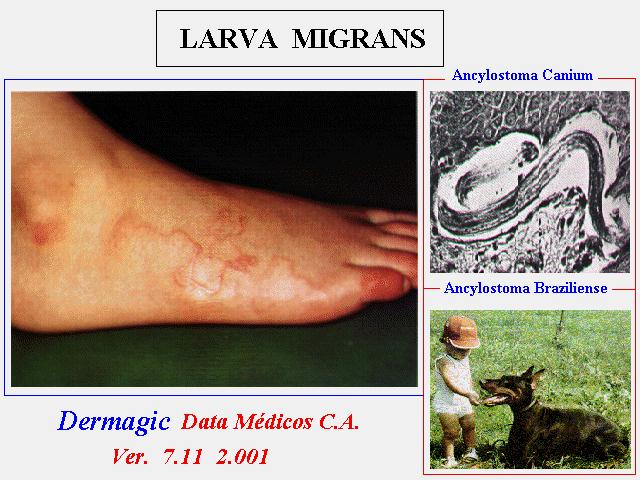
En el attach: la larva, el niño y la mascota.
Saludos a todos !!!
Dr. José Lapenta R.,,,
E DITORIAL ENGLISH
=================
Hello
friends of to the net, DERMAGIC again with you. Today's topic THE
LARVA MIGRANS SYNDROME.
We love pets, mainly the dogs and cats. But in
the fecal grounds of these beautiful animals there are some parasites
that can pass to the skin when we touch or eat it, But some of these
parasites even can GO toward internal organs as visceral cavity, eye,
brain and others.
The favorite place to contract it is the BEACH where
our pretty pets make its fecal grounds (shit). Then we come and frankly
we put our foot above them.
Also in the homes where there are dogs not
controlled by the veterinarian. In short an illness but where the man is
accidentally polluted for the animal.
In the case of the CUTANEOUS LARVA
MIGRANS (SUPERFICIAL) doesn't maybe represent big problems, but in the
case of THE VISCERAL LARVA MIGRANS (PROFUNDUS) the history is ANOTHER.
So that you have to take care of the pretty pets.
I hope enjoy these 67
references.
In the attach: the larva, child and the pet
Greetings to ALL, !!
Dr. José Lapenta R.,,,
===================================================================
REFERENCIAS BIBLIOGRÁFICAS /
BIBLIOGRAPHICAL REFERENCES
===================================================================
============================================================
0.)
CUTANEOS, VISCERAL and OCULAR LARVA MIGRANS
============================================================
1.)
Souvenir from the Hamptons - a case of cutaneous larva migrans of six months' duration.
2.) Effectiveness of a new therapeutic regimen
with albendazole in cutaneous larva migrans.
3.) [Migrant
erythema as clinical presentation of cutaneous larva migrans
in Mexico City]
4.) Larva migrans within scalp sebaceous gland.
5.) Cutaneous larva migrans, sacroileitis, and optic neuritis caused by an unidentified organism acquired in Thailand.
6.)
Perianal cutaneous larva migrans in a child.
7.) [Infections with
Baylisascaris procyonis in humans and raccoons]
8.) Cutaneous larva
migrans complicated by erythema multiforme [see comments]
9.) Cutaneous larva migrans associated with water shoe use.
10.)
Cutaneous larva migrans infection in the pediatric foot. A review and
two case reports.
11.) Creeping eruption of larva migrans--a case
report in a beach volley
athlete.
12.) Albendazole: a new therapeutic regimen
in cutaneous larva migrans.
13.) A primary health care approach to an
outbreak of cutaneous larva migrans.
14.) Autochthonous
cutaneous larva migrans in Germany.
15.) High prevalence of
Ancylostoma spp. infection in dogs, associated with endemic
focus of human cutaneous larva migrans, in Tacuarembo, Uruguay.
16.)
Persistent cutaneous larva migrans due to Ancylostoma species.
17.) [A
case of Dirofilaria repens migration in man]
18.) [Cutaneous larva
migrans, autochthonous in France. Apropos of a case]
19.)
Cutaneous larva migrans in travelers: synopsis of histories, symptoms, and treatment of 98 patients.
20.) [Nematode larva migrans. On two
cases of filarial infection]
21.) Larva migrans that affect the mouth.
22.) Immunological studies on human larval toxocarosis.
23.)
[Larva migrans]
24.) Effect of albendazole on Ancylostoma caninum
larvae migrating in the muscles of mice.
25.)
[Ocular manifestations of toxocariasis]
26.) Toxocara infestations in
humans: symptomatic course of toxocarosis correlates significantly
with levels of IgE/anti-IgE immune complexes.
27.) [Long-term
observations of ocular toxocariasis in children and youth]
28.) [A case of uveitis due to gnathostoma migration into the vitreous
cavity]
29.) [The ocular form of toxocariasis]
30.)
[Visceral larval migrans (Human toxocariasis) cause of
hypereosinophilia and visceral granulomas in adults]
31.) Visceral
larva migrans syndrome complicated by liver abscess.
32.) Visceral
larva migrans and tropical pyomyositis: a case report.
33.) [2 cases
of toxocariasis (visceral larva migrans)]
34.) [Visceral larva
migrans. A rare cause of eosinophilia in adults]
35.) [Visceral larva
migrans: a mixed form of presentation in an adult. The
clinical and laboratory aspects]
36.) Visceral larva migrans induced
eosinophilic cardiac pseudotumor: a cause of sudden death in a child.
37.) [Toxocariasis. A cosmopolitan parasitic zoonosis]
38.)
Visceral larva migrans mimicking rheumatic diseases.
39.) Hepatic
granulomas due to visceral larva migrans in adults: appearance on US and MRI.
40.) [Ascaridiasis zoonoses: visceral larva migrans
syndromes]
41.) Hepatic visceral larva migrans: evolution of the
lesion, diagnosis,
and role of high-dose albendazole therapy.
42.) Neuroimaging studies of cerebral "visceral larva migrans" syndrome.
43.)[Acute eosinophilic pneumonia and the larva migrans
syndrome: apropos of a case in an adult]
44.)Toxocariasis simulating hepatic recurrence in a patient with Wilms' tumor.
45.) Hepatic imaging studies on patients with visceral
larva migrans due to probable Ascaris suum infection.
46.) Encephalopathy caused by visceral larva migrans due to Ascaris suum.
47.) [Imported skin diseases (see comments)]
48.)
[Incidence of Toxocara ova--especially ova of visceral larva migrans
in beach sand of Warnemunde in 1997]
49.) Pets and Parasites.
50.) Cutaneous larva migrans in travelers: synopsis of histories, symptoms, and treatment of 98 patients.
51.) Cutaneous larva
migrans.
52.)[Current therapeutic possibilities in cutaneous larva
migrans]
53.) Cutaneous larva migrans due to Pelodera strongyloides.
54.) Oral albendazole for the treatment of cutaneous larva migrans.
55.) Cutaneous larva migrans in northern climates. A souvenir of your dream vacation.
56.) Creeping eruption. A review of
clinical presentation and management of
60 cases presenting
to a tropical disease unit.
57.) Dermatoses associated with travel to
tropical countries: a prospective study of the diagnosis and
management of 269 patients presenting to a tropical disease unit.
58.) Larva currens and systemic disease.
59.) Hookworm
folliculitis.
60.) [Prurigo and further diagnostically significant
skin symptoms in strongyloidosis]
61.) Gnathostomiasis, or
larva migrans profundus.
62.) Visceral larva migrans caused by
Trichuris vulpis.
63.) Creeping disease due to larva of spiruroid
nematoda.
64.) Creeping eruption due to larvae of the suborder
Spirurina--a newly
recognized causative parasite.
65.)
Linear lichen planus mimicking creeping eruption.
66.) Diagnosis and
management of Baylisascaris procyonis infection in an
infant with nonfatal meningoencephalitis.
67.)
[Human gnathostomiasis. The first evidence of the parasite in South
America]
68.) Efficacy of ivermectin in the therapy
of cutaneous larva migrans
[letter]
============================================================
============================================================
*
CUTANEOUS LARVAL MIGRANS (Creeping Eruption) *
============================================================
SOURCE:
Mandell, Douglas and Bennett's
Principles and
Practice of Infectious Diseases Fourth Edition
Cutaneous larval migrans is characterized as serpiginous,
reddened, elevated, pruritic skin lesions usually caused by
Ancylostoma braziliense,
the dog and cat hookworm. 1,20
Other animal hookworms including A.
caninum,
Uncinaria
stenocephala, Bunostomum phlebotomum, and others; the human
hookworms,
Strongyloides stercoralis and Gnathostoma spinigerum; and,
rarely,
insect larvae can cause similar findings. Like human hookworms,
A.
braziliense larvae infect dogs and cats by burrowing through the skin.
The
adults reside in the intestine and shed eggs, which undergo
development
into infectious larvae outside the body in places
protected from
desiccation and temperature extremes, such as sandy,
shady areas around
beaches or under houses. Infections are most common
in warmer climates
such
as the southeastern United States
and occur in children more commonly
than
in adults.
Larvae
penetrate the skin, causing tingling followed by
itching,
vesicle formation, and typically raised, reddened, serpiginous tracks
that
mark the prior route of the parasite. In severe infections,
persons may
have hundreds of tracks. Little further development of the
parasite
occurs.
Usually there are few, if any, systemic
symptoms, but some reports have
documented lung infiltrates and,
rarely, severe lung dysfunction and
recovery of parasites in the
sputum. Eosinophilia has been noted in some
infections.
The skin lesions are readily recognized, and
the diagnosis
is
made clinically. Biopsy specimens usually
show an eosinophilic
inflammatory
infiltrate, but the
migrating parasite is usually not identified. For
this
reason, biopsies are usually not indicated to establish the diagnosis.
Without treatment, skin lesions gradually disappear. Both topical (10%
aqueous suspension qid) thiabendazole and oral administration (25 mg/kg
bid for 2 days) are effective. In one study, most
patients treated with
thiabendazole responded within the first week compared to the
more than
4
weeks required for comparable improvement in the
placebo-treated group.
Successful treatment with albendazole or
ivermectin has been reported.
===========================================================
* VISCERAL LARVA MIGRANS (Toxocariasis) *
===========================================================
Visceral
larva migrans (VLM) is a syndrome characterized in its most
florid
state by eosinophilia, fever, and hepatomegaly. It is caused primarily
by
infection with Toxocara canis but also be T. cati and other
helminths
less
frequently.
---------------------- Life Cycle in the Dog
----------------------
Toxocara
canis infects dogs and related mammals by a number of
mechanisms.
1 Most commonly, ingested eggs hatch in the small intestine, and the
resulting larvae migrate to the liver, lung, and trachea. They are then
swallowed and mature in the lumen of the small intestine, where eggs are
shed. Other larvae migrate to and remain dormant in the
muscles but are
capable of development even years after the primary
infection,
particularly
in pregnant bitches. During
pregnancy, larvae again develop and infect
the
pups
transplacentally and transmammarily. Not uncommonly, infective
larvae
are found in the feces of the pups. Eggs are not infectious when passed
in
the feces and take 3–4 weeks to develop. They are hardy and
often remain
viable for months. Large numbers of viable eggs contaminate
the
environment
because of the high prevalence of infection
in dogs and the ability of
eggs
to survive relatively harsh
environmental conditions.
Infection in Humans
------------- Prevalence
------------
oxocariasis is prevalent
wherever dogs are found and Toxocara eggs are
able to survive. The
prevalence of infection or disease in humans is not
known, but seroepidemiology studies show wide differences in
prevalence
depending on the population tested. In the United States,
seropositivity
ranged from 2.8 percent in an unselected population to 23.1
percent in a
kindergarten population in the southern United States to 54
percent in a
selected rural community. None of the seropositive persons had
recognizable
disease.
------------------------ Clinical Manifestations
-----------------------
VLM occurs
most commonly in children less than 6 years of age. Disease
manifestations vary and range from asymptomatic infection to fulminant
disease and death, but it is increasingly appreciated that most
infections
are asymptomatic. Those who come to medical attention most
commonly
complain of cough, fever, wheezing, and other generalized
symptoms. The
liver is the organ most frequently involved, and
hepatomegaly is a
common
finding, although almost any organ
can be affected. Splenomegaly occurs
in
a minority, and
lymphadenopathy has been noted. Lung involvement with
radiologic
findings has been documented in 32–44 percent, but
respiratory
distress occurs rarely. Skin lesions such as urticaria and nodules have
also been described. Seizures have been noted to occur with increased
frequency in VLM, but severe neurologic involvement is infrequent. Eye
involvement in VLM is unusual but has been documented (see below under
"Ocular Larva Migrans"). Eosinophilia, usually accompanied by
leukocytosis,
is the hallmark of VLM. Other laboratory findings
include
hypergammaglobulinemia and elevated isohemagglutinin titers to
A and B
blood group antigens, which are due to the host's immune
response to
cross-reacting antigens on the surface of T. canis larvae.
------------
Diagnosis ------------
The
diagnosis of VLM is usually suggested clinically by the presence of
eosinophilia and/or leukocytosis in a young child accompanied by
hepatomegaly or signs and symptoms of other organ involvement. A history
of
pica and exposure to puppies is common. Patients are more
commonly black
and from rural areas. The diagnosis is definitively confirmed
by finding
larvae in the affected tissues by histologic examination or by
digestion
of
tissue; however, larvae are frequently not
found. The enzyme-linked
immunosorbent assay (ELISA) employing
extracts or excretory-secretory
products of T. canis larvae appears
specific and useful in confirming
the
clinical diagnosis. 8
However, toxocara antibody titers in populations
without clinically
apparent VLM vary dramatically, and elevated titers
cannot
definitively establish the diagnosis.
---------------------- Differential Diagnosis
----------------------
Eosinophilia,
fever, and hepatomegaly are caused by other parasitic
infections.
These include acute schistosomiasis, Fasciola hepatica
infections,
Ascaris lumbricoides abscess of the liver, acute liver fluke
infections (Clonorchis sinensis and Opisthorchis viverrini),
complications
from Echinococcus infection of the liver, Capillaria
hepatica, and other
invasive helminths. Diseases not caused by parasitic
infections should
also
be considered. Children with mild
disease may manifest only
eosinophilia.
------------------------- Treatment and Management
-------------------------
Most patients recover without specific
therapy. Treatment with
anti-inflammatory or anthelmintic drugs may be
considered with severe
complications that are usually due to
involvement of the brain, lungs,
or
heart. There is no
proven effective therapy, although thiabendazole,
mebendazole,
diethylcarbamazine, and other anthelmintics have been used.
Indeed, injury to the parasite may provoke a more intense
inflammatory
response leading to worsening of the clinical picture.
Corticosteroids
have
been used with and without specific
antilarval therapy, with some
reports
of improvement.
------------ Prevention
------------
VLM can
be easily prevented by a number of simple but effective measures
that prevent T. canis eggs from contaminating the environment
and
children
from ingesting eggs. Dogs, particularly
puppies, should be periodically
tested and treated for T. canis and
other worms. Pica should be
prevented.
===============================================
*
Ocular Larva Migrans *
================================================
Ocular larval migrans
(OLM) is caused by an infection of the eye with T.
canis larvae.
Although a present or past history of clinically
recognized
VLM has occasionally been noted, almost all patients
present with
unilateral eye involvement without a past history or
present systemic
symptoms or signs. Presumably, a larva by chance
becomes entrapped in
the
eye, resulting in an eosinophilic
inflammatory mass. Children are most
commonly affected and, on the
average, are older (mean, 8.6 years in one
study) than those diagnosed with VLM.
The findings are most
commonly
those
of a posterior or peripheral inflammatory
mass. In fact, this entity was
first recognized after examination of eyes enucleated for the
treatment
of
presumed retinoblastoma. Eosinophilia,
hepatomegaly, and other signs
and
sympoms of VLM are
lacking. The diagnosis is established clinically.
Although the serum
titers to toxocara larvae are higher than those of a
control
population, many patients with OLM have low or negative titers.
However, elevated vitreous 11 and aqueous fluid titers to toxocara
larvae
compared to serum levels have been documented and appear to be
useful in
establishing the diagnosis. There is no specific therapy.
============================================================
============================================================
1.)
Souvenir from the Hamptons - a case of cutaneous larva migrans of
six
months' duration.
============================================================
Mt Sinai
J Med 1999 Oct-Nov;66(5-6):334-5 (ISSN: 0027-2507)
Esser AC; Kantor I; Sapadin AN [Find other articles with these
Authors]
Department of Dermatology, Mount Sinai School of Medicine,
One East
100th
Street New York, NY, USA.
Cutaneous larva migrans is a distinctive serpiginous eruption
caused by
a
reaction to burrowing hookworms. The infection
is usually self-limited,
normally lasting 2-8 weeks, but may persist
for more than a year if
misdiagnosed. Biopsies of the creeping
eruption rarely reveal an
organism.
Thus, it is important
for the infection to be recognized clinically, so
that effective
treatment may begin. We found topical thiabendazole to be
fast and effective in treating this case of cutaneous larva
migrans of
six
months' duration.
============================================================
2.) Effectiveness of a new therapeutic regimen with albendazole in
cutaneous larva migrans.
============================================================
Eur J
Dermatol 1999 Jul-Aug;9(5):352-3 (ISSN: 1167-1122)
Veraldi S; Rizzitelli G [Find other articles with these
Authors]
Institute of Dermatological Sciences, IRCCS, University of
Milan, Via
Pace
9, 20122 Milan, Italy.
Twenty-four (13 males and 11 females) adult Caucasian patients
affected
by
cutaneous larva migrans, characterized by
extensive and/or multiple
lesions, were treated with oral albendazole
according to a new
therapeutic
regimen (400 mg/day for 7
days). No other topical or systemic drug was
used
nor any
physical treatment. All patients were cured at the end of the
therapy.
No recurrence was observed. No side effect was either
complained
of or observed, nor was any laboratory abnormality recorded. On the
basis
of this study, albendazole is effective in cutaneous larva
migrans
characterized by extensive and/or multiple lesions.
This new
therapeutic
regimen avoids no response and recurrence, which are not
uncommonly
observed following shorter (e.g.: 1-5 days) therapies with
albendazole.
The
longer duration of the therapy is not
accompanied by the appearance of
more
severe and/or new side
effects or laboratory abnormalities.
============================================================
r>3.3.) [Migrant erythema as clinical presentation of cutaneous larva
migrans
in Mexico City]
[Eritema migratorio como
presentacion clinica de larva migrans cutanea
en
la ciudad
de Mexico.]
============================================================
Gac Med
Mex 1999 May-Jun;135(3):235-8 (ISSN: 0016-3813)
Halabe-Cherem J; Nellen-Hummel H; Jaime-Gamiz I;
Lifshitz-Guinzberg A;
Morales-Cervantes R; Gallegos-Hernandez V;
Malagon-Rangel J [Find other articles with these Authors]
Cutaneous larva migrans (CLM) is a ubiquitous self-limited
skin
eruption,
most frequently caused by the larvae of dog
and cat hookworms. Although
CLM
is most frequent in tropical
climates, the infection is becoming more
common in urban areas. CLM
has been frequently misdiagnosed and/or
treated
inappropriately, and mimics rheumatic, infectious, vascular, or
dermatologic diseases. We here in report the clinical presentation and
management of 18 cases of CLM.
============================================================
r>4.4.) Larva migrans within scalp sebaceous gland.
============================================================
Rev Soc
Bras Med Trop 1999 Mar-Apr;32(2):187-9 (ISSN: 0037-8682)
Guimaraes LC; Silva JH; Saad K; Lopes ER; Meneses AC [Find
other articles with these Authors]
Faculdade de
Medicina do Triangulo Mineiro, Hospital Helio Angotti
(Associacao de
Combate ao Cancer do Brasil Central), Universidade de
Uberaba, MG.
A case of larva migrans or serpiginous linear dermatitis on
the scalp of
a
teenager is reported. An ancylostomid larva
was found within a sebaceous
gland acinus. The unusual skin site for larva migrans as well
as the
penetration through the sebaceous gland are highlighted. The
probable
mechanism by which the parasite reached the skin adnexa is
discussed.
============================================================
5.) Cutaneous larva migrans, sacroileitis, and optic neuritis caused by
an
unidentified organism acquired in Thailand.
============================================================
J Travel
Med 1998 Dec;5(4):223-5 (ISSN: 1195-1982)
Potasman I; Feiner M; Arad E; Friedman Z [Find other articles
with these
Authors] Infectious Diseases Unit, and Ophthalmology
Department, Bnai Zion Medical
Center, the Rappaport School
of Medicine, Technion, Haifa, Israel.
We report the case of a 32-year-old pregnant woman with an
unidentified
intraocular parasite. The parasite, which had been
acquired in Thailand,
caused cutaneous larva migrans, sacroileitis, and 2 years
later optic
neuritis and panuveitis.
The patient was successfully
treated with
ivermectin and albendazole. The diagnostic possibilities
of this
peculiar
presentation are discussed. Parasitic
infections are a leading cause of
medical problems in travelers to
tropical countries.
1 While most
parasites
cause
gastrointestinal problems, some may migrate throughout the body
and
lodge in critical organs. Ocular parasitic infections may occur by
direct
inoculation onto the eye,
2 or incidentally during systemic
migration.
Subconjunctival parasites are easily diagnosed by removal
and careful
microscopic examination.
3 Parasites, which lodge within
the eye, are
more
difficult to diagnose, especially if not
removed. In this report we
describe a patient who presented with an
intraocular parasite causing
optic
neuritis and panuveitis,
2 years after travel to Thailand.
============================================================
6.) Perianal cutaneous larva migrans in a child.
============================================================
Pediatr
Dermatol 1998 Sep-Oct;15(5):367-9 (ISSN: 0736-8046)
Grassi A; Angelo C; Grosso MG; Paradisi M [Find other articles
with these Authors]
Department of Pediatric
Dermatology, Istituto Dermopatico dell'Immacolata, Rome,
Italy.
Cutaneous larva migrans (CLM) is a dermatosis characterized by
the
presence
of parasites which migrate into the skin,
forming linear or serpiginous
lesions. We report a child with
cutaneous larva migrans of interest
because
of the
involvement of an unusual site and the patient's age. We confirm
the
efficacy of therapy consisting of administration of albendazole by
mouth.
============================================================
7.) [Infections with Baylisascaris procyonis in humans and raccoons]
[Infecties met Baylisascaris procyonis bij de mens en de wasbeer.]
============================================================
Tijdschr
Diergeneeskd 1998 Aug 15;123(16):471-3 (ISSN: 0040-7453)
Zagers JJ; Boersema JH [Find other articles with these
Authors]
Afdeling Parasitologie en Tropische Diergeneeskunde,
Hoofdafdeling
infectieziekten en Immunologie, Faculteit der
Diergeneeskunde,
Universiteit
Utrecht.
Baylisascaris procyonis is an ascarid which parasitizes the
small
intestine
of raccoons. The parasite is not very
pathogenic in the raccoon because
larvae do not migrate in this host.
In other animals the larvae migrate
through the body. They do not
develop into adult worms in the intestine
but
rather become
encysted in granulomas, showing a preference for the
brain.
In humans these larvae cause different larva migrans syndromes.
Patients
with neural larva migrans syndrome show severe brain symptoms
and the
disease is sometimes fatal. This article describes the life
cycle of the
worm and the incidence, symptoms, diagnosis, treatment, and
prevention
of
larva migrans syndromes, paying special
attention to the Dutch
situation.
============================================================
8.) Cutaneous larva migrans complicated by erythema multiforme [see comments]
============================================================
Cutis
1998 Jul;62(1):33-5 (ISSN: 0011-4162)
Vaughan TK; English JC 3rd [Find other articles with these
Authors]
Dermatology Service, Evans Army Community Hospital, Fort
Carson, Colorado, USA.
Cutaneous larva migrans is an intensely pruritic serpiginous
eruption
caused by the dog or cat hookworm. Often, the disease is
self-limiting
and
no other significant pathology develops;
however, a significant
localized
inflammatory response to
the nematode is extremely common. We present a
case of cutaneous larva
migrans in which a systemic inflammatory process
ensued that was characteristic of erythema multiforme. We
discuss
possible
mechanisms of this complication and review
the literature.
============================================================
9.) Cutaneous larva migrans associated with water shoe use.
============================================================
J Eur
Acad Dermatol Venereol 1998 May;10(3):271-3 (ISSN: 0926-9959)
Swanson JR; Melton JL [Find other articles with these Authors]
Division of Dermatology, Loyola University Medical Center, Maywood, IL 60153, USA.
It has been long suspected that footwear is protective against
cutaneous
larva migrans. This case report describes a woman who
developed
cutaneous
larva migrans despite wearing
'protective' footwear. We forward a
hypothesis by which recently
popular water shoes may actually be
conducive
to the
development of cutaneous larva migrans rather than having a
protective
function.
============================================================
10.) Cutaneous larva migrans infection in the pediatric foot. A review and two case reports.
============================================================
J Am
Podiatr Med Assoc 1998 May;88(5):228-31 (ISSN: 8750-7315)
Mattone-Volpe F [Find other articles with this Author]
Children's Hospital of Philadelphia, PA, USA.
Cutaneous larva migrans is the result of infestation of human
skin by
helminth larvae, which burrow through the epidermis. This
route of
infestation makes the foot a typical site for origination of
this
infection. Children, who frequently play barefoot in locations
where the
most common of the helminth larvae, the dog and cat hookworms,
are
endemic,
are at particular risk for this disorder. This
article reviews the
differential diagnosis of cutaneous larva migrans
and current concepts
in
management. Two cases of related
children who presented to their
pediatricians with this condition are
reported.
============================================================
11.) Creeping eruption of larva migrans--a case report in a beach volley
athlete.
============================================================
Int J
Sports Med 1997 Nov;18(8):612-3 (ISSN: 0172-4622)
Biolcati G; Alabiso A [Find other articles with these Authors]
S. Gallicano Institute, Institute of Sports Sciences, Rome, Italy.
The authors describe a case of cutaneous larva migrans in a
beach volley
athlete. This pathology is found more often in tropical zones
than in
European countries. There are no previous publications with
regard to
this
condition in athletes. The nematode
responsible for this affliction
often
is the Ancylostoma
braziliense.
Larval stage of the nematode migrates
through the skin;
within 72 hours after larval penetration, serpiginous,
elevated tunnels are observed. This affliction can be
complicated by
Loeffler's syndrome. In the case described only
dermatological
involvement
was observed. The patient was
treated with 400 mg albendazole tablets
twice
a day for five
days. Within two days of therapy the patient reported
less
itching; a medical control after ten days did not reveal any signs of
active infection.
============================================================
12.) Albendazole: a new therapeutic regimen in cutaneous larva migrans.
============================================================
Int J
Dermatol 1997 Sep;36(9):700-3 (ISSN: 0011-9059)
Rizzitelli G; Scarabelli G; Veraldi S [Find other articles
with these Authors]
Institute of Dermatological Sciences,
IRCCS, University of Milan, Italy.
BACKGROUND: Various therapeutic modalities have been used to
treat
cutaneous larva migrans, including physical treatments
(cryotherapy),
topical drugs (tiabendazole), and systemic drugs
(tiabendazole,
albendazole, and ivermectin). Physical treatments are
often ineffective
and
not devoid of side-effects. Topical
tiabendazole is difficult to find in
many countries; it is effective orally but frequently causes
side-effects.
Ivermectin has been used in a small number of
patients.
METHODS: Eleven
(six men and five women) adult patients with
cutaneous larva migrans
characterized by multiple and/or diffuse
lesions were treated with oral
albendazole (400 mg daily for 7 days).
No other topical or systemic
drugs
were used and no physical
treatment was given.
RESULTS: All patients
were
cured at the
end of treatment. No side-effects were complained of or
observed, and
no laboratory abnormalities were recorded. No recurrences
were
observed.
CONCLUSIONS: Albendazole is effective in the treatment of
cutaneous larva migrans characterized by multiple and/or
diffuse
lesions.
This new therapeutic regimen can reduce the
number of no responses and
recurrences, sometimes observed following
shorter (e.g. 3-5 days)
treatments with albendazole. The longer
duration of treatment is not
accompanied by the appearance of new
and/or more severe side-effects.
============================================================
13.) A primary health care approach to an outbreak of cutaneous larva migrans.
============================================================
J S Afr
Vet Assoc 1996 Sep;67(3):133-6 (ISSN: 0301-0732)
McCrindle CM; Hay IT; Kirkpatrick RD; Odendaal JS; Calitz EM
[Find other
articles with these Authors]
Department of
Production Animal Medicine, Faculty of Veterinary Science,
Medical University of Southern Africa, Medunsa, South Africa.
Primary health care (PHC) has been defined by the World Health
Organisation
as essential health care made universally accessible
to community
members,
with their full participation, at a
cost affordable to the community.
PHC
could therefore be
used in the prevention and treatment of zoonotic
diseases in humans,
as such diseases are more prevalent in disadvantaged
communities. The successful use of PHC principles in the
treatment and
control of cutaneous larva migrans in children in a
semi-rural,
low-income
community is discussed in this paper.
Constraints to implementation of
PHC
principles were
identified as resistance from health care professionals, lack of interdepartmental cooperation and bureaucratic delays.
It is
concluded that PHC principles can be used successfully for the
prevention
and treatment of specific zoonoses provided that an
aetiological
diagnosis
is made and the epidemiology of the
condition understood. The results
also
confirmed the
relevance of the veterinarian in the control of zoonotic
diseases as
part of the PHC team.
============================================================
14.) Autochthonous cutaneous larva migrans in Germany.
============================================================
Trop Med
Int Health 1996 Aug;1(4):503-4 (ISSN: 1360-2276)
Klose C; Mravak S; Geb M; Bienzle U; Meyer CG [Find other
articles with these Authors]
Institute for Tropical
Medicine, Berlin, Germany.
Cutaneous larva migrans syndrome is extremely rare in Germany.
However,
three cases of this syndrome were diagnosed in patients from
Berlin,
Germany, in the summer of 1994. Exposure to the infective
agent in
endemic
areas and close contact with animals were
excluded. It is assumed that
the
extreme temperatures in
summer 1994 favoured the conditions of
infection.
============================================================
15.) High prevalence of Ancylostoma spp. infection in dogs, associated
with
endemic focus of human cutaneous larva migrans, in
Tacuarembo, Uruguay.
============================================================
Parasite
1996 Jun;3(2):131-4 (ISSN: 1252-607X)
Malgor R; Oku Y; Gallardo R; Yarzabal I [Find other articles
with these Authors]
Unidad de Biologia Parasitaria,
Universidad de la Republica Oriental del
Uruguay, Montevideo, Uruguay.
A helminthological survey of the intestinal parasites in stray
dogs was
conducted in urban and suburban area of Tacuarembo, Uruguay,
during
winter
time. Eighty stray dogs captured in the city
were necropsied. Seventy
nine
dogs (98.8%) were positive for
helminth infection. Seventy seven (96.3%)
were parasitized by hookworms. Two species of hookworms were
found:
Ancylostoma caninum 96.3% and A. braziliense 49.4%.
This is the
first
report of the prevalence of A. braziliense in Uruguay.
Considering that
incidences of human cutaneous larva migrans caused by
the migration of
hookworms larvae were restricted mainly to the
northern part of Uruguay
and
that only A. caninum were
reported to be prevalent in the southern part,
it
is
supposed that A. braziliense is the primary causative agent of human
cutaneous larva migrans in Uruguay.
============================================================
16.) Persistent cutaneous larva migrans due to Ancylostoma species.
============================================================
South
Med J 1996 Jun;89(6):609-11 (ISSN: 0038-4348)
Richey TK; Gentry RH; Fitzpatrick JE; Morgan AM [Find other
articles with these Authors]
Dermatology Service,
Department of Medicine, Fitzsimons Army Medical Center, Aurora, CO
80045, USA.
Cutaneous larva migrans is considered to be a self-limited
parasitic
infection of about 2 to 8 weeks' duration, though it has
been reported
to
persist for as long as 55 weeks. In this
case, a healthy 47-year-old
white
man had multiple
serpiginous lesions typical of cutaneous larva migrans
for
18 months. A biopsy taken 2 months before presentation showed a parasite
consistent with Ancylostoma species deep in a hair follicle.
The patient
initially responded to topical thiabendazole, but relapse
occurred when
therapy was discontinued. Oral thiabendazole cured the
problem after 22
months of infestation. Cutaneous larva migrans may
sometimes be
long-standing, here almost 2 years, even in a healthy
patient. Organisms
may reside deep in the hair follicles. Topical thiabendazole
may not
penetrate to this depth, necessitating oral thiabendazole
therapy.
============================================================
17.) [A case of Dirofilaria repens migration in man]
[Sluchai
migratsii Dirofilaria repens u cheloveka.]
============================================================
Med
Parazitol (Mosk) 1996 Jan-Mar;(1):44 (ISSN: 0025-8326)
Artamonova AA; Nagornyi SA [Find other articles with these
Authors]
The paper reports a case of Dirofilaria repens subcutaneous
parasitism
with
the larva migrans phenomenon in the North
Causasus area where
epidemiological prerequisites are available for
spread of
dirofilariasis.
The clinical picture, surgical
intervention, and the diagnosis of the
infection are presented. The
parasite is defined by the authors as
Dirofilaria repens.
============================================================
18.) [Cutaneous larva migrans, autochthonous in France. Apropos of a
case]
[Larva migrans cutanee autochtone en France. A propos d'un
cas.]
============================================================
Ann Dermatol Venereol 1995;122(10):711-4 (ISSN: 0151-9638)
Zimmermann R; Combemale P; Piens MA; Dupin M; Le Coz C [Find
other articles with these Authors]
Clinique de
Dermatologie, Hopital d'Instruction des Armees Desgenettes, Lyon.
INTRODUCTION: Cutaneous larva migrans is rarely contracted in
temperate
countries.
CASE REPORT: When his house became flooded, he
had to stand
for
a long period of time with mud up to the
thigh. Some days later, he
developed multiple erythematous,
serpiginous pruritic tracts moving 1-2
cm
per day over
preexisting lesions of the right leg. Local and systemic
treatment
with thiabendazole led to rapid and definitive cure.
DISCUSSION:
Cutaneous larva migrans results from the migration of hookworm larvae in
the dead-end human host. It is mainly an imported disease and
native
cases
in Europe as reported here are rare. This case
demonstrates that the
conditions leading to the development of
cutaneous larva migrans are
rarely
found simultaneously in
temperate zones.
============================================================
19.) Cutaneous larva migrans in travelers: synopsis of histories,
symptoms,
and treatment of 98 patients.
============================================================
Clin
Infect Dis 1994 Dec;19(6):1062-6 (ISSN: 1058-4838)
Jelinek T; Maiwald H; Nothdurft HD; Loscher T [Find other
articles with these Authors]
Department of Infectious
Diseases and Tropical Medicine, University Hospital, University of
Munich, Germany.
The symptoms, medical history, and treatment of 98 patients
with
cutaneous
larva migrans (creeping eruption) who
attended a travel-related-disease
clinic during a period of 4 years
are reviewed. This condition is caused
by
skin-penetrating
larvae of nematodes, mainly of the hookworm Ancylostoma
braziliense and other nematodes of the family Ancylostomidae.
Despite
the
ubiquitous distribution of these nematodes, in
the investigated group
only
travelers to tropical and
subtropical countries were affected; 28.9% of
the
patients
had symptoms for > 1 month, and for 24.5% the probable
incubation
period was > 2 weeks. The efflorescences typically were on the lower
extremities (73.4% of all locations).
The buttocks and anogenital region
were affected in 12.6% of all locations, and the trunk and
upper
extremities each were affected in 7.1%. Only a minority of
patients
presented with eosinophilia or an elevated serum level of
IgE. No other
laboratory data appeared to be related to the disease.
Therapy with
topical
thiabendazole was successful for 98% of
the patients. Systemic
antihelmintic therapy was necessary in two
cases because of
disseminated,
extensive infection.
============================================================
20.) [Nematode larva migrans. On two cases of filarial infection]
[Wandernde Nematodenlarven. Uber zwei Falle von Filarienbefall.]
============================================================
Pathologe
1994 Jun;15(3):171-5 (ISSN: 0172-8113)
Bittinger A; Barth P; Kohler HH [Find other articles with
these Authors]
Medizinisches Zentrum fur Pathologie der Philipps-Universitat
Marburg.
With rapid air travel, so-called parasitic infections are
becoming more
important in northern hemisphere and temperate climates.
Parasitic
disease
is usually taken to imply infections
caused by protozoa and helminths.
The
most important
helminthic infections in man and with world-wide
incidence
are schistosomiasis, hookworm, and filariasis. We report the
clinico-pathological findings of two patients with filarial infection of
soft tissue and lymphatic nodes.
============================================================
21.) Larva migrans that affect the mouth.
============================================================
Oral Surg
Oral Med Oral Pathol 1994 Apr;77(4):362-7 (ISSN: 0030-4220)
Lopes MA; Zaia AA; de Almeida OP; Scully C [Find other
articles with these Authors]
Faculty of
Odontology, University of Campinas, Sao Paulo, Brazil.
As air travel expands, tropical diseases are increasingly
likely to be encountered. We report a case of a nematode infection
from dogs and cats
that appeared in the mouth as larva migrans, and we review the
literature.
============================================================
22.) Immunological studies on human larval toxocarosis.
============================================================
Cent Eur
J Public Health 1996 Dec;4(4):242-5 (ISSN: 1210-7778)
Uhlikova M; Hubner J; Kolarova L; Polackova M [Find other
articles with these Authors]
Postgraduate Medical School,
Prague, Czech Republic.
The aim of the study was to characterize the antiparasite
humoral
response
in patients with the syndrome of visceral
larval toxocarosis. Specific
IgG,
specific IgE and total IgE
immunoglobulins against Toxocara canis
excretory/secretory antigens
(TES) were detected by using ELISA
technique.
Antibody
response was studied in complete sera as well as in
immunoglobulin
fractions (IgG and IgE), isolation of which was performed on Protein A
Sepharose. It was observed that removal of IgG from the serum samples
resulted mostly in increasing levels of anti-Toxocara IgE antibodies
what
agrees with the theory of the blocking effect of IgG in the
immune
response. The results demonstrated a little correlation between
slgG and
slgE in the sera of symptomatic patients, examined in ELISA
reaction.
============================================================
23.) [Larva migrans] [Le larbish.]
============================================================
Sante
1995 Nov-Dec;5(6):341-5 (ISSN: 1157-5999)
Chabasse D; Le Clec'h C; de Gentile L; Verret JL [Find other
articles with these Authors]
Laboratoire de
parasitologie-mycologie, Consultations des maladies parasitaires et
tropicales, CHU, Angers, France.
Larbish, cutaneous larva migrans or creeping eruption, is a
serpiginous
cutaneous eruption caused by skin penetration of infective
larva from
various animal nematodes. Hookworms (Ancylostoma
brasiliense, A.
caninum)
are the most common causative
parasites.
They live in the intestines of
dogs and cats where their
ova are deposited in the animal feces. In
sandy
and shady
soil, when temperature and moisture are elevated, the ova
hatch
and mature into infective larva. Infection occurs when humans have
contact
with the infected soil. Infective larva penetrate the exposed
skin of
the
body, commonly around the feet, hands and
buttocks. In humans, the larva
are not able to complete their natural cycle and remain
trapped in the
upper dermis of the skin. The disease is widespread in
tropical or
subtropical regions, especially along the coast on sandy
beaches. The
diagnosis is easy for the patient who is returning from a
tropical or
subtropical climate and gives a history of beach exposure.
The
characteristic skin lesion is a fissure or erythematous cord which
is
displaced a few millimeters each day in a serpiginous track.
Scabies,
the
larva currens syndrome due to Strongyloides
stercoralis, must be
distinguished from other creeping eruptions and
subcutaneous swelling
lesions caused by other nematodes or myiasis.
Medical treatments are
justified because it shortens the duration of
the natural evolution of
the
disease.
Topical tiabendazole
is safe for localized invasions, but
prolonged treatment may be
necessary. Oral thiabendazole treatment for
three days is effective,
but sometimes is associated with adverse
effects.
Trials
using albendazole for one or four consecutive days appear more
efficacious. More recent trials using ivermectine showed that a single
oral
dose can cure 100% of the patients; thus, this drug looks very
promising
as
a new form of therapy. Individual prophylaxis
consists of avoiding skin
contact with soil which has been
contaminated with dog or cat feces.
Keeping dogs and cats off the
beaches is illusory in tropical countries.
============================================================
24.) Effect of albendazole on Ancylostoma caninum larvae migrating in
the
muscles of mice.
============================================================
Chung Kuo
Chi Sheng Chung Hsueh Yu Chi Sheng Chung Ping Tsa Chih
12;3(214-7Unknown Paragraph TypeS1000-7423Unknown Paragraph Type
Xiao S; Ren H; You J; Zhao L; Li B; Zhang C [Find other
articles with these Authors]
Institute of
Parasitic Diseases, Chinese Academy of Preventive Medicine
(WHO
Collaborating Centre for Malaria, Schistosomiasis and Filariasis),
Shanghai.
When mice inoculated with 1,000 third-stage larvae of
Ancylostoma
caninum
for 1 week were treated intragastrically
(ig) with albendazole (Alb) 75,
150 or 300 mg/kg.d for 3 days, the mean larva numbers
collected from the
muscles of each group were 2.7 +/- 1.7, 2.0 +/- 1.5 and 1.0
+/- 1.0,
respectively, being much less than that 205 +/- 68 of the
control group.
In
mice treated ig with Alb 150 mg/kg.d for 3
days, the concentrations of
Alb
and its effective
metabolite, albendazole sulfoxide (AlbSO), were
determined in plasma
and the muscles at different intervals after the
last
medication using high performance liquid chromatography.
The results
showed
that only low concentrations of Alb were detected in both
plasma and the
muscles. However, higher concentrations of AlbSO were found
not only in
the
plasma (5.4-10.5 micrograms/ml), but also in
the muscles (2.2-4.6
micrograms/g). The higher contents of AlbSO in
the muscles would be
helpful
for killing the Ancylostoma
larvae migrating in the muscles of mice.
============================================================
25.) [Ocular manifestations of toxocariasis]
============================================================
[Ocne
prejavy toxokarozy.]
Bratisl Lek Listy 1999 Mar;100(3):161-3
(ISSN: 0006-9248)
Gerinec A; Slivkova D [Find other articles with these Authors]
Pediatric Ophthalmology Dpt, Faculty of Medicine, Comenius University,
Bratislava, Slovakia.
The paper reports about the ocular symptomatology of
toxocariasis that
represents a severe parasitic disease especially in
children. Recently,
the
incidence of this disease is
increasing. Diagnostic process has improved
by
means of
newly developed laboratory methods. Ocular findings on retina
are
in toxocariasis identified very late. Despite many antihelmintics,
steroids
and surgical treatment, a poor treatment success has been
achieved, and
the
sight remains often permanently severely
affected. Because of the risk
of
blindness the most
efficient arrangement is prophylaxy from the side of
parents,
teachers, veterinarions and the society as a whole. (Fig. 3,
Ref.
6.).
============================================================
r>2626.) Toxocara infestations in humans: symptomatic course of toxocarosis
correlates significantly with levels of IgE/anti-IgE immune complexes.
============================================================
Parasite Immunol 1998 Jul;20(7):311-7 (ISSN: 0141-9838)
Obwaller A; Jensen-Jarolim E; Auer H; Huber A; Kraft D; Aspock
H [Find other articles with these Authors]
Department of
Medical Parasitology, University of Vienna, Austria.
Infestations of humans with the parasitic nematode T. canis
are common in
both developing and industrialized countries.
Most infestations induce a
clinically inapparent course of infection, however, severe
clinical
manifestations, i.e. visceral larva migrans (VLM) or ocular
larva
migrans
(OLM) syndromes are observed.
To find an
explanation for the different
courses of toxocarosis we examined
several serological parameters: the
expression of (i) specific IgE
(Immunoblot, IB), (ii) specific IgG
subclasses (IgG1-4, ELISA and the
formation of (iii) IgE/anti-IgE immune
complexes.
Serum samples were obtained from persons with
symptomatic
(VLM,
OLM) and asymptomatic course (AS) of the
infestation. As antigen, T.
canis
excretory/secretory (TES)
antigen from L3 larvae was used. Reactivity of
IgE against SDS-PAGE separated TES antigens was marginally
higher in
toxocarosis patients (35%) than in asymptomatics (24%), but
without
statistical significance. TES-specific IgG (1-4), predominant
subclass
in
all three groups was IgG1, followed by IgG2,
IgG4 and IgG3.
Subclass
IgG1,
2, 4 showed significant
differences between patients with VLM associated
symptoms and asymptomatic persons (P < 0.001) but not between
patients
with
OLM associated symptoms and asymptomatics.
Significantly elevated levels
of
IgE/anti-IgE immune
complexes were detected in sera of patients with
symptomatic course of
the disease, both VLM and OLM (P < 0.001).
Whereas
specific IgG may act via antibody dependent cell-mediated
cytotoxicity
mechanisms, IgE/anti-IgE immune complexes might possibly
participate in
VLM
and OLM by inducing type III
hypersensitivity.
============================================================
27.) [Long-term observations of ocular toxocariasis in children and
youth]
[Odlegle obserwacje toksokarozy ocznej u dzieci i
mlodziezy.]
============================================================
Klin
Oczna 1996;98(6):445-8 (ISSN: 0023-2157)
Krukar-Baster K; Zygulska-Mach H; Sajak-Hydzik K;
Kubicka-Trzaska A; Dymon M [Find other articles with these
Authors]
Katedry I Kliniki Okulistyki Collegium Medicum UJ w
Krakowie. font> <
PURPOSE: To evaluate the clinical status and ELISA test
changes in a
group
of children with ocular toxocariasis.
METHODS: We enrolled 37 patients
in
the studies. The
follow-up period lasted at least 3 years (3-15 years)
after the
diagnosis had been established. In all cases a complete
ophthalmological examination and actual ELISA test were performed. We
compared the clinical status in two groups of patients: one with
positive
and the other with negative ELISA test at the time of control
examination.
RESULTS: In a majority of initially positive
serological patients the
control ELISA test for Toxocara canis antigen
was negative. In these
cases
various post-inflammatory
lesions in the anterior and posterior pole of
the
eye were
present. In 8 cases the ELISA test was positive, despite the
absence
of active inflammatory process. In 5 serologically positive
patients
the active inflammation was observed. In more than 50% of cases
the visual acuity was decreased.
CONCLUSION: Ocular
toxocariasis is a
long-lasting, severe type of uveitis that requires
long treatment and
causes dramatic visual impairment. ELISA test is a
sensitive method
indicating the intensity of inflammation in ocular
toxocariasis.
============================================================
28.) [A case of uveitis due to gnathostoma migration into the vitreous
cavity]
============================================================
Nippon
Ganka Gakkai Zasshi 1994 Nov;98(11):1136-40 (ISSN: 0029-0203)
Sasano K; Ando F; Nagasaka T; Kidokoro T; Kawamoto F [Find
other articles with these Authors]
Department of
Ophthalmology, Nagoya National Hospital, Japan.
We report a 26 year-old male patient who had floaters and
hyperemia in
his
left eye following uveitis due to
gnathostoma that had migrated into the
vitreous cavity. Severe iridocyclitis and mild opacity of the
vitreous
body
were observed, together with whitish-yellow
subretinal tracks
accompanied
by dot and blot hemorrhages in
the fundus.
Slit lamp microscopic
examination revealed a worm which
writhed in the vitreous cavity. We
performed vitrectomy to remove the
worm from the anterior vitreous
uneventfully, followed by prompt
subsidence of the inflammatory signs.
The
worm was
identified as a third instar larva of Gnathostoma doloresi.
Eosinophilia and creeping eruption did not appear throughout the
follow-up
period. The patient was accustomed to eat live roaches and
whitebait, as
well as sliced raw beef liver.
============================================================
29.) [The ocular form of toxocariasis]
[Ocni forma larvalni
toxokarozy.]
============================================================
Cesk
Oftalmol 1994 Jun;50(3):186-90 (ISSN: 0009-059X)
Lobovska A; Zackova M [Find other articles with these Authors] III. klinika infekcnich a tropickych nemoci 1. LF UK, Praha.
Ocular toxocariasis (ocular form of larval toxocariasis)
arises mainly
unilaterally and represents no rare disease. On 3rd
Department of
Infectology, 1st Faculty of Medicine, Charles
University, Prague, 102
patients with proved larval toxocariasis were
treated from 1981 to 1990.
Ocular toxocariasis concerned only one third of this number.
Most
frequent
form was the retinal toxocaral granuloma (in
55.2%), positioned by two
thirds at the posterior pole of retina. In
one case, endophthalmitis led
to
amaurosis of the eye.
Clinical forms typical for ocular toxocariasis are
presented.
No statistically significant difference was
observed in
treatment effects using thiobendazole or
diethylcarbamazine. All
patients
with ocular toxocariasis
were treated with systematic steroids.
============================================================
30.) [Visceral larval migrans (Human toxocariasis) cause of
hypereosinophilia and visceral granulomas in adults]
[Larva migrante
visceral (toxocariasis humana) causa de hipereosinofilia
y
granulomas viscerales en el adulto.]
============================================================
Bol Chil
Parasitol 1999 Jan-Jun;54(1-2):21-4 (ISSN: 0365-9402)
Sapunar J; Fardella P [Find other articles with these Authors]
Departamento de Medicina, Hospital Clinico, Universidad de Chile.
A 24-year-old woman 2-3 months after a normal parturation
presented
geophagy. Due to hypermenorrhea she consulted a gynecologist
and in a
hemogram a 57% (6,893 x mm3) hypereosinophilia was detected.
A chest TAC
showed bilateral pulmonary nodules.
The following tests
resulted
positive:
ELISA IgG for toxocariasis 1:1000,
isohemagglutinins anti A 1:2048 and
anti
B 1:512. The
patient was treated with albendazole and prednisone during
10
days. One month after treatment eosinophilia decreased to 2.590 x mm3
and
ELISA IgG for toxocariasis descended to 1:128. Different
aspects of
human
toxocariasis are commented. When
hypereosinophia is observed in adult
patients, toxocariasis must be
checked.
============================================================
31.) Visceral larva migrans syndrome complicated by liver abscess.
============================================================
Scand J
Infect Dis 1999;31(3):324-5 (ISSN: 0036-5548)
Rayes A; Teixeira D; Nobre V; Serufo JC; Goncalves R;
Valadares L; Lambertucci JR [Find other articles with these Authors]
Department of Internal Medicine, Infectious Disease Branch, School of Medicine, Federal University of Minas Gerais, Belo Horizonte, Brazil.
We describe a case of visceral larva migrans syndrome
complicated by
liver
abscess, pericardial effusion and
ascites. To our knowledge, these
findings
have not been
reported previously. The structural and immunological
alterations
caused by visceral larva migrans are thought to lead to the
development of visceral abscesses.
============================================================
32.) Visceral larva migrans and tropical pyomyositis: a case report.
============================================================
Rev
Inst Med Trop Sao Paulo 1998 Nov-Dec;40(6):383-5 (ISSN: 0036-4665)
Lambertucci JR; Rayes A; Serufo JC; Teixeira DM;
Gerspacher-Lara R;
Nascimento E; Brasileiro Filho G; Silva AC [Find
other articles with
these
Authors]
Departamento de
Clinica Medica, Faculdade de Medicina da UFMG, Belo
Horizonte, MG,
Brazil. [email protected].
We report a case of tropical pyomyositis in a boy who
presented with a
severe febrile illness associated with diffuse
erythema, and swelling in
many areas of the body which revealed on operation extensive
necrotic
areas
of various muscles that required repeated
debridement. The patient gave
a
history of contact with
dogs, and an ELISA test for Toxocara canis was
positive. He also
presented eosinophilia and high serum IgE levels.
Staphylococcus
aureus was the sole bacteria isolated from the muscles
affected. We
suggest that tropical pyomyositis may be caused by the
presence of
migrating larvae of this or other parasites in the muscles.
The
immunologic and structural alterations caused by the larvae, in the
presence of concomitant bacteremia, would favour seeding of the bacteria
and the development of pyomyositis.
============================================================
33.) [2 cases of toxocariasis (visceral larva migrans)]
[Dos casos
de toxocarosis (larva migrans visceral).]
============================================================
Enferm
Infecc Microbiol Clin 1996 Nov;14(9):548-50 (ISSN: 0213-005X)
Lopez-Velez R; Turrientes MC; Malo Q; Fenoy MS; Guillen JL
[Find other articles with these Authors]
Unidad de Medicina
Tropical y Parasitologia Clinica, Hospital Ramon y Cajal, Madrid.
BACKGROUND: Different epidemiological studies have
demonstrated that
specific anti-Toxocara antibodies are detected in
the serum of a high
percentage of the Spanish population. But very few
clinical cases of
visceral larva migrans are being confirmed.
METHODS
AND RESULTS: Two
cases
of visceral toxocarosis, in two
sisters, are described. In the first,
the
prevailing clinic
was swelling of joints and upper respiratory tract
symptoms; and
asthma and cutaneous allergic manifestations in the second
patient. Both cases presented with an elevated blood
eosinophil count,
high
levels of total IgE and high titlers
of anti-Toxocara antibodies. All
symptoms disappeared after treatment
with diethylcarbamazine and they
remain asymptomatic several months
after.
CONCLUSIONS: In pediatric
population, toxocarosis should be
ruled out in every patient with
respiratory symptoms, allergic
cutaneous manifestations and elevated
blood
eosinophil
count. The anti-Toxocara antibodies assay is of great value
in
establishing the diagnosis of this parasitic disease.
============================================================
34.) [Visceral larva migrans. A rare cause of eosinophilia in adults]
[Visceral larva migrans. En sjelden arsak til eosinofili hos voksne.]
============================================================
Tidsskr Nor Laegeforen 1996 Sep 20;116(22):2660-1 (ISSN: 0029-2001)
Lund-Tonnesen S [Find other articles with this Author]
Infeksjonsseksjonen Medisinsk avdeling, Haukeland Sykehus 5021, Bergen.
Toxocariasis is a cosmopolitan infection of dogs and cats with
a
roundworm
resembling Ascaris. Man becomes infected by
ingesting eggs from the
environment. The infection occurs mainly in
children. There are two
distinct syndromes: visceral larva migrans and
ocular toxocariasis. The
author describes the case of a 70 year old
Norwegian female with
visceral
larva migrans. One month
after a visit to Spain she developed fever,
hepatomegaly and marked
eosinophilia. Liver biopsy revealed subacute
hepatitis with
eosinophilic leucocyte infiltration.
Toxocara ELISA was
strongly
positive. Treatment with albendazol 400 mg b.i.d. and
prednisone
10 mg daily for three weeks was successful. A clinical relapse after
three
months was treated in the same way for one month. Prolonged
treatment is
recommended. To our knowledge, this is the first reported case
of
visceral
larva migrans in an adult Norwegian.
Epidemiology, diagnosis and
treatment
are discussed.
============================================================
35.) [Visceral larva migrans: a mixed form of presentation in an adult.
The
clinical and laboratory aspects]
[Larva migrans
visceral: forma mista de apresentacao em adulto. Aspectos
clinicos e laboratoriais.]
============================================================
Rev Soc
Bras Med Trop 1996 Jul-Aug;29(4):373-6 (ISSN: 0037-8682)
Barra LA; dos Santos WF; Chieffi PP; Bedaque EA; Salles PS;
Capitao CG; Vianna S; Hanna R; Pedretti Junior L [Find other articles
with these Authors]
Instituto de Infectologia Emilio Ribas,
Instituto de Medicina Tropical de Sao Paulo, Brasil.
We relate a case of an 18-year-old man, resident of Xapuri
(state of
Acre,
Brazil), with a history of repeated episodes
of meningoencephalitis
(three
in one year), each one was
examined by a local doctor. In our service
(Emilio Ribas Institute of
Infectology) we observed a patient with
polyjoint aches, radiological
and bronchoscopic pulmonary alterations
(without clinical features),
meningeal and brain stem
manifestations--with
normal brain
computed tomography and cerebrospinal fluid. Blood
eosinophils
and serological Toxocara canis test (ELISA) were greatly increased.
With
the hypothesis of Toxocariasis (visceral larva migrans) we
administered
thiabendazole that brought complete clinical and
laboratory remission.
Inspite of a new episode of headache with
meningeal manifestation
approximately one month later (treated with
dexamethasone resulting in a
full remission after three days) we have not found other
manifestations
in
approximately three and a half years of
ambulatory care.
============================================================
36.) Visceral larva migrans induced eosinophilic cardiac pseudotumor: a
cause of sudden death in a child.
============================================================
J
Forensic Sci 1995 Nov;40(6):1097-9 (ISSN: 0022-1198)
Boschetti A; Kasznica J [Find other articles with these
Authors]
Medical Examiner for Suffolk County, Commonwealth of
Massachusetts, Boston, USA.
A case of fatal cardiac larva migrans in a 10-year-old boy is
described.
The autopsy findings were quite dramatic, with a bosselated,
sessile
polypoid mass involving the left ventricular myocardium and
protruding
into
the ventricular lumen. The precise
morphologic characterization of the
zoonotic ascarid larva was
impaired by advanced resorption of the larva
by
an
inflammatory infiltrate. Nonetheless, morphometry of the larval
remnants
strongly suggested the raccoon ascarid, Baylisascaris
procyonis, as the
causative agent.
============================================================
37.) [Toxocariasis. A cosmopolitan parasitic zoonosis]
[La
toxocarose une zoonose parasitaire cosmopolite.]
============================================================
Allerg
Immunol (Paris) 1995 Oct;27(8):284-91 (ISSN: 0397-9148)
Humbert P; Buchet S; Barde T [Find other articles with these
Authors]
Service Dermatologie, CHU Saint-Jacques, Besancon.
The infection by Toxocara canis transmitted by dogs (30% of
them are
infected in our countries) and less frequently by cats lead
to larva
migrans visceral syndrome with neurological manifestations,
ophtalmological
affection and various cutaneous manifestations
observed in 24% of the
extra-ocular infections: chronic urticaria
often associated with
asthmatic
manifestations and chronic
rhinitis, angio-oedema or local oedema
reaching
particularly
the eyclid, chronic pruritus associated with lesions due to
scratching or to nodular prurigo. An hypereosinophilia is an
argument in
favour of a progressive infection.
High total IgE is an
hallmark of
visceral infections by parasites and total IgE level is
well correlated
with the presence of intra-tissular larva. The
serological diagnosis is
based on the determination of specific IgG by
ELISA which appears also
to
be interesting for the patient's
follow up. The western blot method
seems
to be more specific
than the other methods and so is useful to confirm a
diagnosis. The treatment given as early as possible is based
on the use
of
diethylcarbamazine but also of thiabendazole,
albendazole and
mebendazole.
Prophylaxis of toxocara
infection includes the prohibition of dog access
to
children
games areas but also a frequent turn over of the sand in public
parks.
============================================================
38.) Visceral larva migrans mimicking rheumatic diseases.
============================================================
J
Rheumatol 1995 Mar;22(3):497-500 (ISSN: 0315-162X)
Kraus A; Valencia X; Cabral AR; de la Vega G [Find other
articles with these Authors]
Department of Immunology and
Rheumatology, Instituto Nacional de la Nutricion Salvador Zubiran,
Mexico City, Mexico.
OBJECTIVE. To report rheumatologic or rheumatologic-like
manifestations
of
the visceral larva migrans (VLM) syndrome.
METHODS. We carried out a
prospective study of patients with VLM seen
in a private practice
setting
in Mexico City between 1990
and 1993.
RESULTS. From a population of 600
patients we identified 6
patients (5 women) with VLM. Three patients
complained of arthralgia;
in 4 a history of migratory cutaneous lesions
was
elicited,
and in one monoarthritis of the right knee was found. One
patient
had deep edema that suggested thrombophlebitis of the right arm; the man
in
our series had right testicular swelling during followup. In 2
cases,
panniculitis was documented by biopsy and in one, small vessel
vasculitis.
Four patients had frequent contact with dogs and one
with cats; 4
patients
frequently ate raw fish. The diagnosis
of VLM was confirmed either by
the
clinical picture, biopsy,
or ELISA.
CONCLUSION. The spectrum of
rheumatological manifestations
in VLM may be wider than previously
thought.
============================================================
39.) Hepatic granulomas due to visceral larva migrans in adults:
appearance
on US and MRI.
============================================================
Abdom
Imaging 1994 May-Jun;19(3):253-6 (ISSN: 0942-8925)
Jain R; Sawhney S; Bhargava DK; Panda SK; Berry M [Find other
articles with these Authors]
Department of
Radio-diagnosis, All India Institute of Medical Sciences, Ansari
Nagar, New Delhi.
Visceral larva migrans is a syndrome characteristically
involving
children
with a history of pica, and usually
presents with fever, abdominal pain,
tender hepatomegaly, and hypereosinophilia. Hepatic granulomas
of
visceral
larva migrans are rare in adults.
We describe
three adult patients with
hepatic lesions which on histopathology
demonstrated characteristic
granulomas of visceral larva migrans. All
patients had abdominal
sonograms
and two had additional MR
scans of the liver. Both ultrasound and
magnetic
resonance
imaging demonstrated characteristic appearances which have not
been described previously (viz., ill-defined central necrotic
areas
surrounded by concentric thick walls and perifocal edema in the
liver
parenchyma).
============================================================
40.) [Ascaridiasis zoonoses: visceral larva migrans syndromes]
[Zoonoses d'origine ascaridienne: les syndromes de Larva migrans
visceral.]
============================================================
Bull Acad
Natl Med 1994 Apr;178(4):635-45; discussion 645-7 (ISSN:
0001-4079)
Petithory JC; Beddok A; Quedoc M [Find other articles with
these Authors]
Department de biologie medicale E. Brumpt
Centre Hospitalier, Gonesse.
The syndrome of Visceral Larva Migrans is a zoonotic disease
due to the
migration in human of nematodes larval, specially ascarid.
Since the
larvae
fail to complete their migrating cycle in
humans, the diagnosis of
Toxocariasis infection remains only
serologic. We have been able to
demonstrate by the technique of agar
diffusion and the Western-blotting
method that the etiology due to
Toxocara canis was twice as much
frequent
as the one due to
Toxocara cati in the syndrome of Visceral and Ocular
Larva Migrans.
The use of numerous antigens from adult nematodes, mainly Ascaris suum, has shown, than in France, in the syndrome of
VLM at least
12% of the cases were certainly due to other nematodes.
Nippostrongylus
brasiliensis (or another similar nematode) of the rat
might be
responsible.
The existence of numerous clinical and
biological cases found negative
in
serology, allow us to
suggest that some other larval nematodes, may be
from
wild
animals, might play an etiological role.
============================================================
41.) Hepatic visceral larva migrans: evolution of the lesion, diagnosis,
and role of high-dose albendazole therapy.
============================================================
Am J
Gastroenterol 1994 Apr;89(4):624-7 (ISSN: 0002-9270)
Bhatia V; Sarin SK [Find other articles with these Authors]
Department of Gastroenterology, G.B. Pant Hospital, New Delhi, India.
An unusual presentation of hepatic involvement of visceral
larva migrans
is
described. A 45-yr-old male presented with
fever, pain in the right
upper
quadrant, and persistent
eosinophilia. Ultrasound initially detected a
solitary hypoechoic area
in the right lobe of the liver which rapidly
progressed to multiple
lesions with peripheral hyperechoic lesions.
Aspiration from the
lesion revealed Charcot-Leyden crystals and sheets
of
eosinophils. Serology for Toxocara canis was strongly positive.
Prolonged
and high-dose albendazole therapy, in combination with
antibiotics, was
required to treat the patient effectively.
============================================================
42.) Neuroimaging studies of cerebral "visceral larva migrans" syndrome.
============================================================
J Neuroimaging 1994 Jan;4(1):39-40 (ISSN: 1051-2284)
Zachariah SB; Zachariah B; Varghese R [Find other articles
with these Authors]
Department of Neurology, University of
South Florida College of Medicine, H. Lee Moffitt Cancer
Center, Tampa, FL.
"Visceral larva migrans" syndrome is a zoonotic disease caused
by the migration or presence in human tissue of nematode larva from
lower-order
animals. This syndrome includes generalized illness,
eosinophilia, and symptoms arising from larval invasions of different
organs including the
liver, lungs, eyes, and central nervous system.
There has been
only one
case report of the computed tomographic (CT) and magnetic
resonance
imaging
(MRI) appearances of cerebral toxocaral
disease. Described here is a
patient with cerebral toxocaral disease
with a high eosinophil count and
toxocaral titer in the serum and abnormal CT and MRI findings
who had
spontaneous recovery of the clinical symptoms.
============================================================
43.)[Acute eosinophilic pneumonia and the larva migrans syndrome:
apropos
of a case in an adult]
[Pneumopathie eosinophilique
aigue et syndrome de Larva migrans. A
propos
d'un cas chez
un adulte.]
============================================================
Rev Mal
Respir 1994;11(6):593-5 (ISSN: 0761-8425)
Bouchard O; Arbib F; Paramelle B; Brambilla C [Find other
articles with these Authors]
Clinique de Pneumologie, CHU de
Grenoble.
Toxocariasis is a frequent disease in children, but the severe
clinical
manifestations are rare in the literature (diffuse
interstitial
pneumonia
with hypoxaemia and acute severe
asthma). The diagnosis is made thanks
to
the reliability of
serological techniques (the ELISA test and using
antigen
excretion-secretion tests of the larvae of Toxocara canis). The authors
report a case of acute severe eosinophilic pneumonia whose outcome was
rapidly favourable following steroid therapy; the existence of positive
Toxocara canis serology with a contamination risk of the patient in the
domestic environment leads us to integrate the clinical picture into the
larva migrans syndrome.
============================================================
44.)Toxocariasis simulating hepatic recurrence in a patient with Wilms'
tumor.
============================================================
Med
Pediatr Oncol 1994;22(3):211-5 (ISSN: 0098-1532)
Almeida MT; Ribeiro RC; Kauffman WM; Maluf Junior PT; Brito
JL;
Cristofani
LM; Jacob CA; Odone-Filho V [Find other
articles with these Authors]
Instituto da Crianca, Hospital das
Clinicas, Universidade Estadual de
Sao
Paulo, Brazil.
We report the case of a 3-year-old girl with stage I Wilms'
tumor of
favorable histology. During the course of chemotherapy 5
months
post-diagnosis, an abdominal ultrasonogram revealed hypoechoic
areas
consistent with hepatic tumor recurrence. A liver biopsy
performed to
rule
out recurrence of the malignancy was
suggestive of toxocariasis and the
diagnosis was confirmed by
serologic testing. Although the patient had
few
classic
signs of visceral larva migrans, her eosinophilia and family
social
history should have suggested this possibility.
This case demonstrates
that
hepatic toxocariasis should be considered in evaluating
hepatic
hypoechoic
lesions in a child, even when features
typical of the disease are
absent.
============================================================
45.) Hepatic imaging studies on patients with visceral larva migrans due
to
probable Ascaris suum infection.
============================================================
Abdom
Imaging 1999 Sep-Oct;24(5):465-9 (ISSN: 0942-8925)
Hayashi K; Tahara H; Yamashita K; Kuroki K; Matsushita R;
Yamamoto S; Hori T; Hirono S; Nawa Y; Tsubouchi H [Find
other articles with these Authors]
Department of Internal
Medicine II, Miyazaki Medical College, Kiyotake, Miyazaki 889-1692,
Japan.
Visceral larva migrans (VLM) is a disease usually observed in
children
in
which the larvae of animal parasites invade and
reside in human tissues
for
long periods. Although the
common causal species of VLM are Toxocara
canis
and T. cati,
we identified three adult patients with VLM, probably due
to
Ascaris suum, whose diagnosis was made by specific immunoserological
tests.
The patients complained of respiratory symptoms, and laboratory
tests
showed pronounced eosinophilia, but neither larvae nor eggs were
detected
in stool samples.
We present the findings of various
imaging studies of
the
patients. Multiple small hypoechoic
mass lesions were demonstrated by
ultrasound tomography, which
disappeared after anti-helminthic therapy.
Hepatic mass lesions were
detected as low-density areas on computed
tomography, as high signal
intensities on T2-weighted magnetic resonance
images, as space-occupying regions in liver scintigraphy, and
as
yellow-white nodules in laparoscopy. Although biopsied liver tissue
specimens showed marked infiltrations of eosinophiles in the portal
tracts
and hepatic sinusoids, neither larvae nor eggs could be
identified.
============================================================
46.) Encephalopathy caused by visceral larva migrans due to Ascaris
suum.
============================================================
J Neurol Sci 1999 Apr 1;164(2):195-9 (ISSN: 0022-510X)
Inatomi Y; Murakami T; Tokunaga M; Ishiwata K; Nawa Y; Uchino
M [Find other articles with these Authors]
Department of Neurology, Kumamoto University School of Medicine, Japan.
We described a patient with encephalopathy associated with
visceral
larva
migrans (VLM) caused by Ascaris suum. He
suffered from drowsiness,
quadriparesis, eosinophilia and elevated
serum IgE levels. Brain
magnetic
resonance (MR) imaging
revealed multiple cerebral cortical and white
matter
lesions. Serological tests indicated recent infection with A. suum.
Pulse
steroid therapy relieved the patient's central nervous system
symptoms
and
marked improvement of lesions on brain MR
images. We concluded that the
encephalopathy in this patient was
probably caused by VLM due to Ascaris
suum.
============================================================
47.) [Imported skin diseases (see comments)]
[Importhuidziekten.]
============================================================
Ned
Tijdschr Geneeskd 1998 Dec 12;142(50):2746-50 (ISSN: 0028-2162)
Cairo I; Faber WR [Find other articles with these Authors]
Afd. Huidziekten, Academisch Medisch Centrum/Universiteit van Amsterdam.
In two Dutch subjects who had been on holiday in the tropics,
a woman
aged
32 and a man of Surinam descent aged 52 years,
and in two men aged 21
and
38 years who had arrived from the
tropics in the Netherlands, one
recently
and one 15 years
previously, import skin diseases were diagnosed: larva
migrans
cutanea, cutaneous leishmaniasis, mycetoma and lobomycosis.
The
diagnosis was based on the anamnesis, the clinical picture and
histopathological findings. The patients were cured by administration of
antimicrobial agents and (or) excision. When travellers or
immigrants
from
the tropics present with skin lesions, an
imported skin disease should
be
considered.
============================================================
48.) [Incidence of Toxocara ova--especially ova of visceral larva
migrans
in beach sand of Warnemunde in 1997]
[Studie zum
Vorkommen von Wurmeiern--insbesondere von Eiern des
Hundespulwurmes
(Larva migrans visceralis-Syndrom) im Strandsand von
Warnemunde 1997.]
============================================================
Gesundheitswesen 1998 Dec;60(12):766-7 (ISSN: 0941-3790)
Schottler G [Find other articles with this Author]
Landeshygieneinstitut Rostock.
Beach sand was examined and analysed in 1997 at several
locations in
Warnemunde, a North-East German seaside resort,
especially for the
incidence of the nematode genuo Toxocara. Two of
126 samples contained
Toxocara. The author points out measures to
decrease the risk of
infection.
============================================================
49.) Pets and Parasites.
============================================================
AU:
Juckett-G
AD: West Virginia University School of Medicine, Morgantown,
USA.
SO: Am-Fam-Physician. 1997 Nov 1; 56(7): 1763-74, 1777-8
CP: UNITED-STATES
AB: Which parasites can be transmitted by
household cats and dogs?
Certainly a variety of potentially dangerous
helminths and protozoa can
be
transmitted to humans from
pets but, for the most part, very special
conditions must be present
before this occurs. Small children, pregnant
women and
immunocompromised persons are three groups at greater
potential
risk than the general population. Infants and toddlers may contract
visceral or cutaneous larva migrans, tapeworm infections and, rarely,
other
helminths or protozoa.
Pregnant women and their offspring
are at special
risk for toxoplasmosis. Immunocompromised persons (including
those with
acquired immunodeficiency syndrome) are susceptible to
multiple
infections
but especially to cryptosporidiosis, an
underdiagnosed zoonosis present
in
contaminated water
supplies. Other zoonotic infections (Echinococcosis,
Dirofilariasis)
rarely appear in the general population but, when they
do
occur, pose very real diagnostic challenges.
The risk of disease
transmission from pets can be minimized by taking a few simple
precautions
such as avoiding fecal-oral contact, not emptying the
cat's litterbox if
pregnant, washing hands carefully after handling pets, worming
pets
regularly and supervising toddler-pet interactions. In most
cases, the
psychologic benefits of pet ownership appear to outweigh
the reducible
risks of disease transmission.
============================================================
50.) Cutaneous larva migrans in travelers: synopsis of histories,
symptoms,
and treatment of 98 patients.
============================================================
SO
- Clin Infect Dis 1994 Dec;19(6):1062-6
AU - Jelinek T;
Maiwald H; Nothdurft HD; Loscher T
PT - JOURNAL ARTICLE
AB - The symptoms, medical history, and treatment of 98 patients with
cutaneous larva migrans (creeping eruption) who attended a
travel-related-disease clinic during a period of 4 years are reviewed.
This
condition is caused by skin-penetrating larvae of nematodes,
mainly of
the
hookworm Ancylostoma braziliense and other
nematodes of the family
Ancylostomidae. Despite the ubiquitous
distribution of these nematodes,
in
the investigated group
only travelers to tropical and subtropical
countries
were
affected; 28.9% of the patients had symptoms for 1 month, and for
24.5% the probable incubation period was 2 weeks.
The efflorescences
typically were on the lower extremities (73.4% of all locations). The
buttocks and anogenital region were affected in 12.6% of all locations,
and
the trunk and upper extremities each were affected in 7.1%.
Only a
minority
of patients presented with eosinophilia or
an elevated serum level of
IgE.
No other laboratory data
appeared to be related to the disease. Therapy
with topical
thiabendazole was successful for 98% of the patients.
Systemic
antihelmintic therapy was necessary in two cases because of
disseminated,
extensive infection.
============================================================
51.) Cutaneous larva migrans.
============================================================
SO
- South Med J 1993 Nov;86(11):1311-3
AU - Jones WB 2d
PT - JOURNAL ARTICLE
AB - The case of cutaneous larva
migrans presented here is typical for
its
mechanism and
geographic location of infection, evolution of lesions,
and
prompt response to treatment. Except for pinworms, helminth infections
are
rarely thought of in emergency departments away from the areas
where the
parasites are especially prevalent.
The several-day incubation
period
and
modern-day ease of travel should place this
illness on one's list of the
differential diagnoses of pruritic lesions regardless of the
location of
practice. This case serves as a reminder that in a mobile
society,
diseases, as well as patients, can travel.
============================================================
52.)[Current therapeutic possibilities in cutaneous larva migrans]
============================================================
SO
- Hautarzt 1993 Jul;44(7):462-5
AU - Wolf P; Ochsendorf
FR; Milbradt R
PT - JOURNAL ARTICLE; REVIEW (24 references);
REVIEW, TUTORIAL
AB - The recommendations for the treatment of
cutaneous larva migrans
are
not uniform, and the recommended
methods are neither always available
nor
always effective.
If only the skin is affected, primarily topical
therapy
is
indicated. Topical thiabendazole combines efficacy with missing
systemic
side-effects. In Germany the pure substance has to be used or
Mintezol
tablets must be purchased from abroad.
Topical mebendazole
and freezing
with liquid nitrogen are less effective and involve
side-effects. If
topical treatment fails, systemic therapy is
required. The recognized
treatment with oral thiabendazole (2 days) is
associated with numerous
side-effects. There are now two new, safer
drugs that should be
preferred:
albendazole (400 mg/day for
3 days), available in Germany as Eskazole,
or
ivermectin
(single dose of 200 micrograms/kg). The latter can be ordered
from the manufacturer under the trade name of Mectizan.
============================================================
53.) Cutaneous larva migrans due to Pelodera strongyloides.
============================================================
SO
- Cutis 1991 Aug;48(2):123-6
AU - Jones CC; Rosen T;
Greenberg C
PT - JOURNAL ARTICLE
AB - A twenty-year-old landscape worker was evaluated for a widespread
cutaneous eruption consisting of papules, pustules, and burrows.
Cutaneous
scrapings revealed live and dead larvae of a free-living
soil nematode,
Pelodera strongyloides. This is the third instance of
human dermatitis
due
to this organism, and the first
reported in an adult host.
============================================================
54.) Oral albendazole for the treatment of cutaneous larva migrans.
============================================================
SO
- Br J Dermatol 1990 Jan;122(1):99-101
AU - Jones SK;
Reynolds NJ; Oliwiecki S; Harman RR
PT - JOURNAL ARTICLE
AB - Cutaneous larva migrans is becoming more common in the U.K. with
the
popularity of tropical countries as holiday destinations. We
describe
the
increasing use of a new benzimidazole
derivative, albendazole, which is
very effective in the treatment of
cutaneous larva migrans. In contrast
to
thiabendazole, it is
virtually free from side-effects and should, we
feel,
become
the treatment of choice for this condition.
============================================================
55.) Cutaneous larva migrans in northern climates. A souvenir of your
dream
vacation.
============================================================
SO
- J Am Acad Dermatol 1982 Sep;7(3):353-8
AU - Edelglass
JW; Douglass MC; Stiefler R; Tessler M
PT - JOURNAL ARTICLE
AB - Three young women recently returned to the metropolitan Detroit area
with cutaneous larva migrans. All three had vacationed at a
popular club
resort on the Caribbean island of Martinique. Cutaneous larva
migrans is
frequently seen in the southern United States, Central and
South
America,
and other subtropical areas but rarely in
northern climates. Several
organisms can cause cutaneous larva
migrans, or creeping eruption.
The
larvae of the nematode Ancylostoma
braziliense are most often the
causative
organisms. Travel
habits of Americans make it necessary for
practitioners
in
northern climates to be familiar with diseases contracted primarily
in
warmer locations. The life cycle of causative organisms and current
therapy
are reviewed.
============================================================
56.) Creeping eruption. A review of clinical presentation and management
of
60 cases presenting to a tropical disease unit.
============================================================
SO
- Arch Dermatol 1993 May;129(5):588-91
AU - Davies HD;
Sakuls P; Keystone JS
PT - JOURNAL ARTICLE
AB - BACKGROUND AND DESIGN--Cutaneous larva migrans is an infection
with a
larval nematode, most frequently by dog or cat hookworms. It has a
characteristic presentation that is easily recognizable. We reviewed the
charts of 60 patients with cutaneous larva migrans who
presented to the
Tropical Disease Unit, Toronto (Ontario) Hospital,
during a 6-year
period.
RESULTS--Ninety-five percent of the
patients were Canadians who had
recently returned from the tropics or
subtropics, notably the Caribbean.
Almost all patients had a linear or serpiginous, very pruritic
larval
track. Topical thiabendazole was efficacious in 52 (98%) of 53
patients
treated. Albendazole cured six (88%) of seven patients
treated. Because
of
adverse effects, oral thiabendazole and
liquid nitrogen were not
utilized.
CONCLUSION--We conclude
that topical thiabendazole and oral albendazole
are
very
effective and safe modalities for the treatment of cutaneous larva
migrans.
============================================================
57.) Dermatoses associated with travel to tropical countries: a
prospective
study of the diagnosis and management of 269 patients
presenting to a
tropical disease unit.
============================================================
SO
- Clin Infect Dis 1995 Mar;20(3):542-8
AU - Caumes E;
Carriere J; Guermonprez G; Bricaire F; Danis M; Gentilini M
PT - JOURNAL ARTICLE
AB - The full spectrum of skin
diseases related to travel in tropical
areas is unknown. We
prospectively studied 269 consecutive patients with
travel-associated dermatosis who presented to our tropical
disease unit
in
Paris during a 2-year period.
The median age
of these patients was 30
years; 137 patients were male; 76% of the
patients were tourists; 38%
had
visited sub-Saharan Africa;
and 85% had been appropriately vaccinated
against tetanus. Cutaneous
lesions appeared while the patient was still
abroad in 61% of cases
and after the patient's return to France in 39%.
The
diagnosis was definite in 260 cases; 137 of these cases (53%) involved
an
imported tropical disease. The most common diagnoses were cutaneous
larva
migrans (25%); pyodermas (18%); pruritic arthropod-reactive
dermatitis
(10%); myiasis (9%); tungiasis (6%); urticaria (5%); fever
and rash
(4%);
and cutaneous leishmaniasis (3%).
Hospitalization was necessary in 27
cases
(10%), with a
median duration of 5 days (range, 2-21 days).
Travelers
should be
advised on how to avoid exposure to the agents and vectors of
infectious dermatoses. Travel first-aid kits should include insect
repellents and antibiotics effective against bacterial skin infections.
============================================================
58.) Larva currens and systemic disease.
============================================================
SO
- Int J Dermatol 1984 Jul-Aug;23(6):402-3
AU - Amer M;
Attia M; Ramadan AS; Matout K
PT - JOURNAL ARTICLE
AB
- Of 26 patients infested with Strongyloides stercoralis 10 (38.5%)
were asymptomatic without systemic or cutaneous signs. Nine patients
(34.6%) presented with systemic complaints only and seven patients
(26.9%)
had systemic and cutaneous manifestations. Further
observations of the
skin
lesions on four of those with
systemic and cutaneous manifestations
revealed linear urticarial
bands, extending to several centimeters
within 1
hour and
persisting up to many days, waiting and waning. Blood
examination
showed eosinophilia in all patients. These findings confirm the concept
that larva currens even alone should be considered a cutaneous sign of
systemic disease.
============================================================
59.) Hookworm folliculitis.
============================================================
SO
- Arch Dermatol 1991 Apr;127(4):547-9
AU - Miller AC;
Walker J; Jaworski R; de Launey W; Paver R
PT - JOURNAL ARTICLE
AB - A case of persistent folliculitis in a 21-year-old man was
demonstrated to be due to Ancylostoma caninum larvae. Treatment with
oral
thiabendazole was curative. Cutaneous larva migrans may be
due to A
caninum, but this presentation appears to be unique. The
literature
concerning etiology and pathogenesis of larva migrans is
discussed with
reference to this case.
============================================================
60.) [Prurigo and further diagnostically significant skin symptoms in
strongyloidosis]
============================================================
SO
- Hautarzt 1988 Jan;39(1):34-7
AU - Bockers M; Bork K
PT - JOURNAL ARTICLE
AB - An increasing incidence of
strongyloidosis must be expected in
European countries as a result of
the increasing numbers of immigrants,
as
well as
holiday-makers returning from tropical regions. In addition to
gastrointestinal symptoms, dermatological complaints are predominant.
Only
rarely are cutaneous symptoms the only clinical manifestation of
disease.
The penetration of filariform larvae may cause "ground
itch." In cases
of
chronic disease, larva currens is the
most obvious sign and consists of
linear urticarial wheals evoked by
larva migration. The most common
non-specific symptoms are rashes,
pruritus and urticaria. A further
symptom
of
strongyloidosis, intensely itching prurigo, is described in a
20-year-old female Thai. Remission was achieved following tiabendazole
therapy.
============================================================
61.) Gnathostomiasis, or larva migrans profundus.
============================================================
SO
- J Am Acad Dermatol 1984 Oct;11(4 Pt 2):738-40
AU -
Feinstein RJ; Rodriguez-Valdes J
PT - JOURNAL ARTICLE
AB - Gnathostomiasis, or larva migrans profundus, is a significant
cause
of morbidity in many parts of the world, especially the Far
East. Over
forty cases have recently been reported from South America,
and some of
those patients are seeking diagnostic evaluation and
treatment in the
United States. A clinical course of painless
migratory recurrent
urticarial
skin lesions in a patient who
has eaten raw or poorly cooked freshwater
fish should alert a
physician to the diagnosis of gnathostomiasis.
============================================================
62.) Visceral larva migrans caused by Trichuris vulpis.
============================================================
SO
- Arch Dis Child 1980 Aug;55(8):631-3
AU - Sakano T;
Hamamoto K; Kobayashi Y; Sakata Y; Tsuji M; Usui T
PT - JOURNAL
ARTICLE
AB - Two brothers with visceral larva migrans caused by
Trichuris
vulpis
were diagnosed after they had been
investigated for an eosinophilia.
Both
patients were almost
asymptomatic. The diagnosis of visceral larva
migrans
was
based on the results of immunoelectrophoretic studies and no liver
biopsy was performed. After administration of thiabendazole, the number
of
eosinophils and serum total IgE levels gradually decreased, and
the
patients have remained well.
============================================================
63.) Creeping disease due to larva of spiruroid nematoda.
============================================================
SO
- Int J Dermatol 1993 Nov;32(11):813-4
AU - Okazaki A; Ida
T; Muramatsu T; Shirai T; Nishiyama T; Araki T
PT - JOURNAL
ARTICLE
============================================================
============================================================
64.)
Creeping eruption due to larvae of the suborder Spirurina--a newly
recognized causative parasite.
============================================================
SO
- Int J Dermatol 1994 Apr;33(4):279-81
AU - Taniguchi Y;
Ando K; Shimizu M; Nakamura Y; Yamazaki S
PT - JOURNAL ARTICLE;
REVIEW (13 references); REVIEW OF REPORTED CASES
============================================================ font> <
============================================================
65.) Linear lichen planus mimicking creeping eruption.
============================================================
SO
- J Dermatol 1993 Feb;20(2):118-21
AU - Taniguchi Y;
Minamikawa M; Shimizu M; Ando K; Yamazaki S
PT - JOURNAL
ARTICLE; REVIEW (25 references); REVIEW OF REPORTED CASES
AB - A
42-year-old woman was referred to our hospital with a linear
eruption
on her right flank of two months duration. Because she had
eaten
loach-fish a month before she noticed the eruption, a creeping eruption
due
to Gnathostoma spp. was initially suspected, but the
histological
findings
of the biopsy specimens showed typical
features of lichen planus. Linear
lichen planus is discussed based on the cases accumulated in
the
literature
regarding the distribution of Blaschko
lines.
============================================================
66.) Diagnosis and management of Baylisascaris procyonis infection in an
infant with nonfatal meningoencephalitis.
============================================================
SO
- Clin Infect Dis 1994 Jun;18(6):868-72
AU - Cunningham
CK; Kazacos KR; McMillan JA; Lucas JA; McAuley JB; Wozniak
EJ; Weiner LB
PT - JOURNAL ARTICLE
AB -
Baylisacaris procyonis, the common raccoon ascarid, is known to
cause
life-threatening visceral, neural, and ocular larva migrans in mammals
and
birds. Two human fatalities have been previously described;
however,
little
is known about the spectrum of human disease
caused by B. procyonis. In
this report, the case of a 13-month-old
child who had nonfatal
meningoencephalitis secondary to B. procyonis
infection is presented.
The
suspected diagnosis was
confirmed with use of newly developed enzyme
immunoassay and
immunoblot techniques.
The diagnosis, management, and
prevention of B.
procyonis infection in humans is discussed. Clinical,
serological, and
epidemiological evaluations established B. procyonis as
the etiologic agent. The child survived his infection but
continued to
have
severe neurological sequelae. The
potential for human contact and
infection
with B. procyonis
is great. There is no effective therapy; therefore,
prevention is
paramount.
============================================================
67.) [Human gnathostomiasis. The first evidence of the parasite in South
America]
============================================================
SO
- Ann Dermatol Venereol 1983;110(4):311-5
AU - Ollague W;
Ollague J; Guevara de Veliz A; Penaherrera S
PT - JOURNAL
ARTICLE
AB - Reporting 4 cases of gnathostomiasis, a clinical
review of this
disease is given by the authors. In one of these cases
the diagnosis
could
be established by evidencing the
parasite. The name: nodular migratory
eosinophilic panniculitis is
suggested for this disease.
============================================================
68.) Efficacy of ivermectin in the therapy of cutaneous larva migrans
[letter]
============================================================
MLID92328556
Author(s) Caumes E; Datry A; Paris L; Danis M;
Gentilini M; Gaxotte P
Source Arch Dermatol
1992;128:994.
Major MeSH Ivermectin ; Larva Migrans
Minor
MeSH Administration [Oral]; Adolescence; Middle Age; Prospective
Studies
Check Tag(s) Female; Human; Male
Language English
Pub. Year 1992
Pub. Type Letter
==================================================================
DATA-MÉDICOS/DERMAGIC-EXPRESS No 2-(89) 23/02/2.000 DR. JOSÉ LAPENTA R.
===================================================================
|