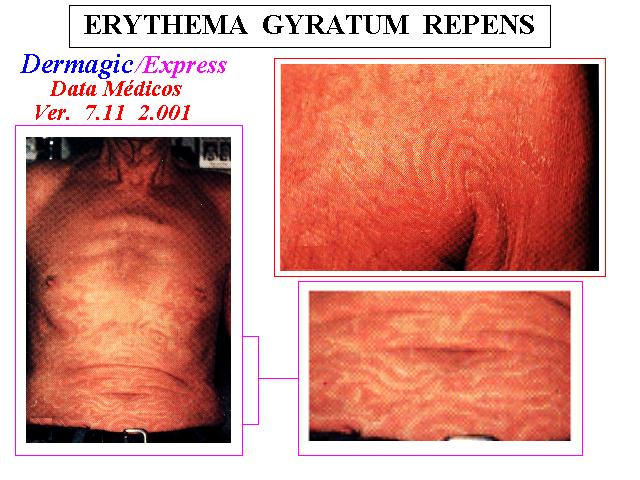
The skin may be the first organ to heraLd {he presence
of a visceral
malignancy. Paraneoplastic eruptions seen with
cancer include acanthosis
nigricans, acquired ichthyosis,
pancreatic fat necrosis, migratory
thrombophlebitis, Sweet's
syndrome, hypertrichosis lanuginosa acquisita,
and others, but
one of the most specific dermatoses associated with
underlying
neoplasia is that of erythema gyratum repens (EGR). We discuss
this dermatosis and review the literature.
HISTORY
=======
Gammel1 described
the first case of EGR in 1953. His patient, a
55-year-old
woman, developed a scaling, pruritic eruption on her trunk and
extremities reminiscent of "knotty cypress wood grain." The eruptions
was
noted to extend about 1 cm per day. A palpable axillary
lymph node revealed
metastatic adenocarcinoma of the breast. A
radical mastectomy was
performed that led to fading of the
eruption within 48 hours and complete
clearing by 6 weeks.
Neither the eruption nor the tumor recurred. The
author
believed this distinctive eruption had been caused by a carcinotoxin
to which the host was allergic. He named it "erythema gyratum
repens"
(repens from the Latin meaning to crawl or creep).2
Since this initial description, at least 48 additional patients have
been
reported.3-46 With a few exceptions,28, 31,35,36,40,42,46
all have been afflicted with an underlying malignancy, most commonly of
the lung. Figurate erythemas have been known to occur With neoplasia,47
but EGR is the most specific and may be the most distinctive.
CLINICAL FINDINGS
=================
EGR displays concentric erythematous bands48
predominantly on the trunk and
extremities. The hands, feet,
and face are usually spared.2'49
The pattern of EGR has been
described as wood-grained,17' 25, 28, 35, 43
serpiginous,25
zebralike,2' 20 cypress rings,22 gyrate,43 whorled,43 and
swirls of rope25 (Fig. 1, B). The expanding borders are usually macular
but may occasionally be palpable.20 Scale is usually present14,20
and
trails the leading edge of the eruption42. The eruption of
EGR
moves rapidly across the surface of the skin, usually
about 1 cm per day.14
EGR may involve the entire
body.12'20'25'26'40 Saika et al.23 reported a
patient in whom
solely right-sided truncal lesions developed with
underlying
intrahepatic metastases from an adenocarcinoma of the colon. An
overlying solitary flank lesion in a patient with ipsilateral
hypernephroma has also been observed by one of us (A. M.).
Table 1 lists the associated skin findings in these
patients. Most patients
experienced some degree of pruritus.20
Ichthyosis and palmar/plantar
hyperkeratosis were also noted
in 16% (8 of 49) and 10% (5 of 49) of the
patients,
respectively. Three patients also had bullous pemphigoid,23,35,44
one had pemphigus vulgaris,30 and three had unspecified vesicles and
bullae7, 13, 14 during the course of the disorder.
An approximately 2:1 male-to-female ratio was
observed. The average age was
63 years and thus far alL
patients have been white. Most patients (25) had
the onset of
their eruption an average of 9 months before their malignancy
was diagnosed (range 1 to 72 months). Four patients developed EGR an
average of 9 months after their tumor was detected and in two
cases16,41
the eruption and neoplasm occurred simultaneously.
Table II outlines the underlying malignancies (if any)
in these patients.
Lung cancer was the most common (16
patients [32%]), followed distantly by
esophagus (4 patients
[8%]) and breast (3 patients
[6%]). In three patients a
metastatic malignancy was detected but the
primary site could
not be identified.14,22,25 Lymphoreticular cancers
were rare.19,37 Six patients did not have an underlying
malignancy,31,35,40,42,46 and in two other cases tuberculosis28 and the
CREST syndrome36 were believed to be the cause.
Laboratory evaluations were performed in some cases.
Many patients had
peripheral eosinophilia as high as 59%.29
Eosinophilia of the bone marrow
has also been described.7,46
Decreased T-ce1126'30 and increased
B-ce1126 populations have
been reported, as have normal percentages for
both.31
Stankler31 demonstrated normal T-cell function in a patient with EGR but
no underlying malignancy. Decreased serum levels of C3 and increased
luteinizing hormone and follicle-stimulating hormone were reported in
one patient.26
=============================================================
Table 1. Skin findings in 49 patients with erythema gyratum repens
=============================================================
% of | Affected | disordes patients |
-------------------------------------------------------------
50 Pruritus*
16 Ichthyosis 22' 26, 29,
40,41,43,45,46
lo
Palmar/plantar hyperkeratosis 6,42,45,46
8
Pityriasis rubra pilaris 20, 40
6
Psoriasiform lesions10, 39,40
6
Vesicles/bullae7' 13, 14
6
Bulbus pemphigoid 23,35'44
2
Pemphigus vulgaris 30
2
Discoid lupus erythematosus 40
*References 1,3-7, 10, 12, 14, 17,21,22,25,27-29,37,
38,40,41,43, 45, 46, 48.
-------------------------------------------------------------
=============================================================
Table II. Underlying malignancies associated with erythema
gyratum repens*
=============================================================
% | Patients | TyPe
-------------------------------------------------------------
32 Lung4, 9, 10, 15-18,
21,26,37,39,41,43,44,45
12 None31,35,40,42,46
8
Esophagus27, 29,32, 33
6
Breast,1, 3, 30 unknown metastatic neoplasm 4, 22, 25
4
Cervix,5,7 pharynx,8,34 stomach11,13
2 Anus,24 bladder,20 bowel,23 Hodgkins disease,38 myeloma,19
pancreas,41, prostate,20 tongue,6 uterus 12
--------------------------------------------------------------
*One patient each also had tuberculosis28 and CREST syndrome.36
--------------------------------------------------------------
HISTOPATHOLOGY
EGR is classified among the superficial erythemas50
and as such tends to demonstrate generally nonspecific
histopathologic features. Mild to moderate hyperkeratosis,
parakeratosis, and spongiosis are seen.43,49, 50 Acanthosis,
follicular plugging, liquefactive epidermal celLs, and
epidermopoiesis of neutrophils and eosinophils have been described.7
The dermal vessels are surrounded by a lympho-histiocytic
infiltrate with occasional eosinophils.28, 37, 40,
43, 50 Mast cells may also be seen.28 The capillary
endothelium may appear swollen7 and vascular proliferation has
been described.14,28 Frank vasculitis is absent. Pigmentary
incontinence45 and papillary dermal edema49 may also be seen.
Subepidermal bullae with a sparse eosinophil infiltrate was
described in a patient with EGR and bulbus pemphigoid.35
Holt and Davies26 described a patient with bronchogenic carcinoma
who had IgG and C3 deposits at the basement membrane zone
detected by direct immunofluorescence of both lesional and
uninvolved skin. Indirect immunofluorescence and
immunofluorescence of metastatic nodal deposits were negative.
Other investigators have found negative direct and indirect
immunofiuorescence in biopsy specimens of EGR.39,46 Levine et al.43
described a patient Erythema gyratum repens with no immune
deposits at the basement membrane zone but IgM deposition on epidermal
nuclei. Phenotyping of the infiammatory infiltrate in EGR demonstrated B
celís and macrophages; no T celís were found.26
DISCUSSION
===========
Differential diagnosis of the figurate erythemas
------------------------------------------------
Erythema
annulare centrifugum (EAC) is morphologically similar to EGR and
some authors believe a close relation exists between the two
disorders.7 EAC usually is manifested by arcuate, polycyclic
erythematous lesions that expand slowly48 and clear centrally;
it may be pruritic.49 EAC differs from EGR in that the former
is slightly palpable and "moves" much more slowly.20
Histopathologic examination shows that EAC is a deep and superficial
erythema50,51 with a lymphohistiocytic "coat-sleeve" arrangement
around blood vessels,50 mild spongiosis, and parakeratosis.49
EAC may 2,48 or may not2,52 be related to an underlying disease. It
has been reported in association with malignancies48 but also
with infections and drug intake.2,48,53 Lesions may persist
indefinitely or resolve within a few days. Erythema
chronicum migrans (ECM) is an annular eruption precipitated by
the bite of an Ixodes tick and caused by infection with Borrelia
burgdorferi.2,48,49 The lesions begin as erythematous papules that
enlarge in a circular, expansile pattern to form a red,
raised, scaleless eruption several centimeters in width.48
This usually begins several days to weeks after the tick bite.
Serum antibodies directed against Borrelia antigens may be
found. Erythema marginatum rheumaticum is usually associated
with rheumatic fever in children and is rarely seen today.2 This
eruption shows swift spread-irng, erythema, and minimal induration.
However, it displays no scaling, has no symptoms, is evanescent, and
demonstrates a neutrophilic infiltrate on histologic examination 49,51
Patients with glucagon-producing islet cell tu-mors of the pancreas may
have necrolytic migratory erythema. Lesions usually begin on dependant
parts of the body, periorally and perigenitally. Arcuate and circinate
red plaques with erosions, vesicles, necrosis, and desquamation are
present.48 Additional diseases that may occasionally enter the
differential diagnosis include subacute cutaneous discoid lupus
erythematosus, tinea corporis (especially tinea imbricata), psoriasis,
pityriasis rubra pilaris, familial annular erythema, and keratolytic
winter erythema.
Etiology
========
The cause of EGR is unclear. Gammel1 believed that the
underlying tumor altered organ proteins, thereby producing
endogenous allergens and creating a state of hypersensitivity
to specific tumor antigens. Church10 injected suspensions of
his patient's tumor (lung), unaffected pulmonary tissue, and
skin intradermally into a recovered patient. In a similar experiment Leavelí et al.14 performed an Ouchter-lony gel ditfusion with their patient's serum and a homogenate of his tumor (undifferentiated
adenocarcinoma-type unknown).
Both produced negative results. Holt
and Davies,26 the only investigators to demonstrate positive
immunofiuorescence of the basement membrane in skin biopsy
specimens of EGR, proposed three possibilities: tumor
neoantigens may invoke antibody production that cross-react
with endogenous skin antigens, the tumor products may alter
certain skin antigens rendering it susceptible to immunologic attack,
and tumor antigen-antibody complexes may form with subsequent
cutaneous deposition. Barber et al.28 agreed that immune
complex deposition may be operative but not neeessarily
involve tumor antigens exclusively.
Evaluations of the
cellular arm of the immune system in EGR have been sparse.
Investigators do not believe these lymphocyte subsets play a
significant etiologic role in the eruption.26 Jacobs et al.30 noted a peripheral T-cell deficiency in their patient and postulated that a compensatory B-cell hyperactivity existed. Peripheral blood
lymphocytes in one patient were not stimulated by
phytohemagglutimn, tumor extract (lung), or involved skin extract.26 It seems clear that whatever factors are involved in the production
of this eruption emanate from the underlying tumor. These
factors may be produced from solid as well as hematopoietic
tumors. Inherent in patients who develop EGR is a
predisposition to react in such a manner when affiicted with
cancer. Such a susceptibility could involve the human
lymphocyte antigen (HLA) system, tumoral antigen production, and/or
ground substance alterations.
Specific HLA antigens have been
reported to occur to a significantly greater extent in patients with
malignancies of the cervix,54 testis,55 and thyroid,56 as well as in
non-Hodgkin's lymphoma,57 Burkitt's lymphoma,58 and multiple myeloma.59
An interesting feature of the HLA antigens is their close relation to
tumor antigens.60 These two groups of polypeptides are believed to be
structurally similar with an association existiing between the
genes expressing both. Specific alleles among patients with
cancer may render them more susceptible to the development of
EGR. Second, the pathogenesis of EGR may involve a localized ground
substance adaptive phenomenon. In this model granulocytes release
connective tissue active peptides, which, in turn, stimulate
fibroblast proliferation to produce ground substance with
increased viscosity. 61 Thus inflammatory mediators are
impeded from tissue spread and "walled off."
EGR might result
from a similar phenomenon involving spread of the erythematous rings through stroma, which is unable to "wall off,' the attendant
inflammation. Clearing of the eruption results from a
subsequent halt of this process and clearance of the
inflammatory mediators.61 Moore62 noted that the morphologic
features of EGR were similar to the patterns of aggregating
slime mould and the Belousez-Zhabotinskii chemical reaction, processes
in which reaction or diffusion systems are also operative.
Additional findings
--------------------
Five patients with EGR (10%) also had palmo-plantar
keratoderma. In three, no underlying malignancy was
detected,42,46 one had lung cancer,45 and one patient had a
tongue carcinoma.6 Keratotic involvement of the palms and
soles has been described previously in association with esophageal
cancer63 and Bazex syndrome.64 Therefore it is not surprising that
hyperkeratotic activity should appear in a subset of patients with a
paraneoplastic eruption. These findings may be purely coincidental, but
the high prevalence of palmoplantar thickening would make an association
seem plausible.
Three patients had associated bullous
pemphigoid,23,35,44 one had pemphigus vulgaris,30 and three
had vesiculobulbus eruptions not otherwise specified.7,13, 14
All but one of these had an underlying malignancy,35 and no
specific cancer was represented more than once. The association
between cancer and pemphigoid/pemphigus has been speculated on for
many years, however, it is currently believed that a link
probably does not exist.65,66 Because virtually all patients
with EGR have had an underlying malignancy, the question arises, what of
those who do not? Barber et al.28 published the first case of a patient
with this eruption and pulmonary tuberculosis. Although their photograph
fails to show the classic "knotty cypress" pattern, the patient's course
appears consistent with EGR. Shortly thereafter,
Stankler31
described a healthy man with a 17-month history of a gyrate
erythema believed to be consistent with EGR that subsequently
resolved. Examination did not reveal a malignant process. No photographs
were provided. Ingber et al.36 and Juhlin et al.46 described
patients with the CREST syndrome and palmoplantar
hyperkeratosis, respectively; however, their photographic
documentation is questionable for EGR. In 1985 Langlois et al.
42 reported a patient with the classic eruption of EGR with a
negative evaluation and lack of malignancy at autopsy. The patient had
had an unexplained 30-pound weight loss.
Risk factors for
neoplasia in this patient were not discussed. Finally,
Cheesbrough and Williamson40 present the best evidence for EGR
unassociated with a malignancy. Their two patients had a
characteristic eruption, exhaustive work-ups, lengthy
follow-up (12 and 60 months), and, importantly, no signs or symptoms
referable to an underlying cancer. Therefore it seems clear that a
few patients with EGR and no underlying malignancy do exist.
However, patients who develop the typical eruption of this
disorder should be assumed to have an underlying cancer until
proven otherwise.
TREATMENT
=========
The most effective therapy for EGR is an exhaustive
search for an underlying malignancy with treatment of the
primary cause. Resolution of the Erythema gyratum repens
eruption has been noted after surgery, chemother-apy, or radiotherapy.1,
3,4,9, 10'25'38 After treatment of the cancer, additional therapy for
the eruption includes topical20, 46 and systemic steroids,25,
37,42 radiotherapy,24 and azathioprine.24 Failure of topical
steroids 22,24 and vitamin A administration42 has been
reported.
REFERENCES
==========
1. Gammel
JA. Erythema gyratum repens. AMA Arch Derm Syph
1953;66:494-505.
2. Harrison PM. The annular erythemas.
Int J Dermatol 1979;18:282-90.
3. Purdy MJ. Erythema
gyratum repens. Arch Dermatol 1 959;80:590- 1.
4. Schneeweiss J, Goid SC. Erythema gyratum repens. Proc Roy Soc
Med 1959;52:367-8.
5. Duperrat B, Guilaine J, Demay C.
Erythema gvratum: en rapport avec un carcinome cervical
métastatique. Bulí Soc Franc Derm Syph 1961;68:20-1.
6. Duperrat B, Pringuet R, David V. Erythema gyratum repens. Bulí
Soc Franc Derm Syph 1961;68:578-82.
7. Van Dijk E. Erythema
gvratum repens. Dermatologica 1961;123:301-10.
8. Storck H, Schnyder UW, Schwarz K. Erythema gyratum repens bei
hypopharynxcarcinom. Dermatologica 1962;124:289-93.
9. Caldwell 1W. In discussion of Church RE. Bronchiolar carcinoma
presenfing as erythema gvratum perstans. Proc Roy Soc Med 1963;56:905.
10. urch RE. Bronchiolar carcinoma presenting as erythema gyratum
perstans. Proc Roy Soc Med 1963;56:904-5.
11. Woerdeman
MJ. Erythema gyratum repens. Dermatolog-ica 1964;128:391-2.
12. Le Coulant P, Texier L, Maleville J, et al. Erythema gyratum
repens. Buil Soc Franc Derm Syph 1966;73:235-6.
13. Pevny 1. Erythema gyratum repens. Z Raut Geschlecbtslcr 1
966;40:26~70.
14. Leavelí UW, Winternitz WW, Black JR.
Erytbema gyratum repens and undifferentiated carcinoma. Arch
Derma-tol 1967;95:69-72.
15. Miguérés J, Jover A, Layssol M,
et al. Un syndrome para-néoplasique rare: l'érythéme gyratum
repens: Ses rapports avec le cancer bronchique. J Franc Med
Chir Thor 1967;212:313-24.
16. Pokorny' M, Hilla M. Erythema
gvratum repens. Cesk Dermatol 1969;44:200-3.
17.
Solomon R. Erytbema gyratum repens [Letter]. Arch Dermatol
1969;lO0:639.
18. Hochleitner H, Bartsch G, Zelger J. Erythema
gyratum repens bei Bronchuscarcinom. Rautarzt 1970;21:1 16-9.
19. Thivolet J, Gallois P, Perrot R. Une dermatose paranéc> plasique
m6connue: l'érythema giratum repens. Rev Lyon Med 1970;19:789-95.
20. Thomson J, Stankler L. Erythema gyratum repens. Br J
Dermatol 1970;82:406-1 1.
21. Connor BL. Erythema gyratum
repens: case presentafion. Trans St Johns Hosp Dermatol Soc
1972;58:323-4. 2
2. Touraine R, Revaz J, Lepine J, et al.
Syndrome paraneo-plasique associant ichtyose généralisé et
érythéme annu-laire. Bulí Soc Fr Derm Syph 1972;79:623-6.
23. Saika NK, MacKie RM, McQueen A. A case of bulbus pemphigoid and
figurate erythema in association with met-astatic spread ofcarcinoma.
Br J Dermatol 1973;88:33 1-4.
24. Lukowska 1, Silny W.
Erythema gyratum repens jako schorzenie paranowotworowe.
Przegl Dermatol 1974; 61:785-9.
25. Skolnick M, Mainman BR.
Erythema gyratum repens with metastatic adenocarcinoma. Arch
Dermatol 1975; 111:227-9.
26. Holt PJA, Davies MG.
Erythema gyratum repens an ímmunologically mediated
dermatosis? Br J Dermatol 1 977;96:343-7.
27. Verret JL,
Pierrin B, Bertrand G, et al. Erythema gyratum repens: 011
syndrome paranéoplasique de Gammel. Ann Dermatol Venereol 1
977;104:403-6.
28. Barber PV, Doyle L, Vickers DM, et al.
Erythema gyratum repens with pulmonary tuberculosis. Br J
Dermatol 1978; 98:465-8.
29. Barriére H, Litoux P, Bureau B,
et al. Erythema gyratum repens de Gammel et ichtyose acquise
associés a un cancer de l'oesophage. Ann Dermatol Venereol
1978;105:3 19-21.
30. Jacobs R, Eng AM, Solomon LM. Carcinoma
of the breast, pemphigus vulgaris and gyrate erythema. mt J
Dermatol 1978;17:221-4.
31. Stankler L. Erythema gyratum
repens: spontaneous reso-lution in a healthy man (Lerter]. Br
J Dermatol 1978;99: 461.
32. Tenailleau JP. Erythema gyratum
repens [Lerter]. Ann Dermatol Vénéreol 1978;105:765.
33. ChristensenjD. Erythemagyratumrepens [Letter] . Ugeskr
Laeger 1979;141:3532.
34. Ressa PG, Colombo R. Erythema
gyratum repens. G Ital Dermatol Venereol 1980;115:301-2.
35. Breathnach SM, Wilkinson JD, Black MM. Erythema gy-ratum
repens-like figurate eruption in bulbus pemphigoid. Clin Exp
Dermatol 1982;7:401-6.
36. Ingber A, Pullmann H, Nowel C.
CRSET Syndrom: assoziation mit erythema figuratum. Z Hautkr
1983;58:1298-306.
37. Larrouy JC, Apter J, Baréty M, et al.
Erythema gyratum repens et cancer bronchique primitif: disparition de la
dermatose sous corticothérapie gégérale. Ann Dermatol V~
néréol 1983;l 10:329-34.
38. Yebra SI, Garciá BB, Camacho MF.
Eritema gyratum re-pens de Gammel y enfirmedad de Hodgkin. Med
Cutan Ibero Lat Am 1983;11:281-6.
39. Olsen TG, Milroy SK,
Jones-Olsen 5. Erythema gyratum repens with associated
squamous celí carcinoma of the lung. Cutis 1 984;34:35 1-5.
40. Cheesbrough MJ, Williamson DM. Erythema gyratum repens, a stage in
the res~ution of pityriasis rubra pilaris? Clin Exp Dermatol
1985;l0:466-71.
41. Karalitski EM. Erythema gyratum
repen~paraneoplas-ticheski dermatoz. Vestn Dermatol Venereol
1985;8:49-51.
42. Langlois JC, Shaw JM, Odland GF. Erythema
gyratum repens unassociated with internal malignancy. J AM
ACAD DERMATOL 1985;12:911-3.
43. Levine LE, Morgan NF, Fretzin
D, et al. Erythema gyratum repens. Arch Dermatol
1985;121:170-1.
44. Graham-Brown RAC. Bullous pemphigoid with
figurate erythema associated with carcinoma of the bronchus.
Br J Dermatol 1987;l 17:385-8.
45. Appell ML, Ward WQ, Tyring
SK. Erythema gyratum repens: a cutaneous marker of malignancy.
Cancer 1988; 62:548-50.
46. Juhlin L, Lacour LP, Larrouy JC,
et al. Episodic erythema gyratum repens witll ichthyosis and
palmoplantar hyocrk-eratosis without sigus of internal
malignancy. Clin Exp Dermatol 1 989;14:223-6.
47. Summerly R.
The figurate erythemas and neoplasia. Br J Dermatol
1964;76:370-3.
48. Burgdorf WRC, Goltz RW. Figurate erythemas.
In: Fita-patnck TB, Bisen AZ, Wolff K, et al, eds. Dermatology
in general medicine. New York: McGraw-Hrn, 1987:1010-8.
49. White JW. Gyrate erythema. Dermatol Clin
1985;3:l29-39.
50. Lever WF, Schaumburg-Lever G.
Histopathology of the skin. Philadelphia: JB Lippincott, 1983:137-8.
51. White JW. Hypersensitivity and miscellaneous inflammatory
disorders. In: Moschella SL, Hurley HJ, eds. Dermatology.
Philadelphia: WB Saunders, l985:46-98.
52. White JW,
Perry HO. Erythema perstans. Br J Dermatol 1969;81:641-5l.
53. Sheliey WB. Erythema annulare centrifugum. Arch
Der-matol 1 964;90:54-8.
54. Sniecinski 1, Haley J,
Morgan-Byrne J, et al.Histocom-patibility-antigen distribution in
patients with cervical and endometrial carcinomas. Gynecol Onool 1981;
11:68-74.
55. DeWolf WC, Lange PH, Binarson ME, et al. HLA and
testicular cancer. Nature 1 979;277:21 6-7.
56.
Panza N, Del Veechio L, Maio M, et al. Strong association between an
HLA-DR anfigen and thyroid carcinoma. Tissue Antigens 1982.20:155-8.
57. van den Tweel JG, Dugas DJ, Loon J, et al. HLA typing in
non-Hodgkin's lymphomas. Comparative study in caucasoids,
Mexican-Americans and negroids. Tissue Anti-gens 1 982;20:364-7 1.
58. Jones EH, Biggar RJ, Nkrumah FK, et al. Study of the HLA system
in Burkitt's lymphoma. Hum Immunol 1980;3:207-l0.
59. Ludwig H, Mayr W. Genetic aspects of susceptibility to multiple
myeloma. Blood 1982;59:1286-91.
60. Gupta RK, Morton DL.
Tumor antigeos. In: Ray PK, ed. Immunobiology of
transpíantation, cancer and pregnancy. New York: Pergamon
Press, 1983:113-47.
61. Stone OJ. A mechanism of peripheral
spread or localization of inflammatory reactions-role of the
localized ground substance adaptive phenomenon. Med Hypotheses
1989; 29:167-9.
62. Moore HJ. Does the pattern of erythema
gyratum repens depend on a reaction-dilfusion system? [Lerter]
Br J Der-matol 1982;107:723.
63. Howel-Evans W, McConnell RB,
Clarke DA, et al. Carci-noma of the esophagus with keratosis
palmaris et plantaris (tylosis). Q J Med 1958;27:413-29.
64. Richard M, Giroux J-M. Acrokeratosis paraneoplastic (Bazex
syndrome). JAM ACAD DERMATOL 1987;16:178-83.
65. Stone SP,
Schrocter AL. Bulbus pemphigoid and associ-ated malignant
neoplasms. Arch Dermatol 1 975;1 11:991-4. 66. Kaplan RP,
Callen JP. Pemphigus-associated diseases and induced
pemphigus. Clin Dermatol 1983; 1:42-71.
=============================================================
=============================================================
2.) Cutaneous manifestations of cancer.
=============================================================
Curr Opin Oncol 1999 Mar;11(2):139-44 Related Articles, Books
Sabir S, James WD, Schuchter LM
Hematology-Oncology Division, Hospital of the
University of Pennsylvania, Philadelphia 19104, USA.
The appearance of skin lesions in patients with occult
or obvious malignancy may be of extreme value in the detection
and management of cancer because the skin is readily
accessible to examination and biopsy. Examination of the skin
of our patients can provide important insights into underlying
malignant processes or possible complications from cancer
treatment. The range of cutaneous abnormalities is wide, and include
cutaneous paraneoplastic syndromes such as xanthomas, acanthosis
nigricans, carcinoid syndrome, unusual erythematous eruptions
such as erythema gyratum repens, and a number of genetic
syndromes associated with malignancies and inherited
dermatoses.
=============================================================
3.) Erythema gyratum repens in association with renal cell carcinoma.
=============================================================
J Urol 1998 Jun;159(6):2077 Related Articles, Books, LinkOut
Kwatra A, McDonald RE, Corriere JN Jr
Department of Surgery, University of Texas Medical
School, Houston, USA.
=============================================================
=============================================================
4.) Erythema gyratum repens: another case of a rare disorder but no new
insight into pathogenesis.
=============================================================
Dermatology 1996;193(4):336-7 Related Articles, Books
Rojo Sanchez S, Suarez Fernandez R, de Eusebio Murillo
E, Lopez Bran E, Sanchez de Paz F, Robledo Aguilar A
Department of Dermatology, Hospital Universitario San
Carlos, Madrid, Spain.
Erythema gyratum repens (EGR) is an uncommon but
distinctive dermatosis characterized by marble-like swirls of
erythema and a thin covering scale over the trunk, axillae and
groins which has been associated with malignancy. Bronchial
carcinoma has been the most frequent neoplasm associated. A
case of EGR in a 50-year-old man with carcinoma of the lung is
reported. The onset of dermatosis preceded the discovery of the neoplasm
by 9 months. Oral corticosteroids induced the disappearance of the
skin lesions. No recurrence was observed after discontinuation
of the treatment. The patient died 1 year after the onset of
dermatosis.
=============================================================
5.) Cutaneous paraneoplastic syndromes in solid tumors.
=============================================================
Am J Med 1995 Dec;99(6):662-71 Related Articles, Books
Kurzrock R, Cohen PR
Department of Clinical Investigation, University of
Texas M.D. Anderson
Cancer Center, Houston 77030, USA.
OBJECTIVE: To provide an overview of the clinical
manifestations, pathophysiology, and oncologic implications of
the cutaneous paraneoplastic syndromes that occur
predominantly in patients with solid tumors. METHODS: A review
was performed of the literature identified by a comprehensive
MEDLINE search. RESULTS: Diverse cutaneous paraneoplastic syndromes may
be associated with underlying tumors. They include
musculoskeletal disorders (clubbing, hypertrophic
osteoarthropathy, dermatomyositis, and multicentric
reticulohistiocytosis), reactive erythemas (erythema gyratum repens and
necrolytic migratory erythema), vascular dermatoses (Trousseau's
syndrome), papulosquamous disorders (acanthosis nigricans,
tripe palms, palmar hyperkeratosis, acquired ichthyosis,
pityriasis rotunda, Bazex's syndrome, florid cutaneous
papillomatosis, the sign of Leser-Trelat, and extramammary
Paget's disease), and disorders of hair growth (hypertrichosis
lanuginosa acquisita). The clinical manifestations of these
dermatoses may precede, coincide with, or follow the diagnosis
of cancer. The presence of a cutaneous paraneoplastic syndrome
is often associated with a poor prognosis. CONCLUSIONS:
Cutaneous paraneoplastic syndromes are specific constellations
of mucous membrane and/or skin abnormalities that are caused
by an underlying tumor. Since they may be the presenting sign of an
occult cancer, cognizance of their features and clinical
implications are of considerable importance. Individuals with
these syndromes should have a thorough workup for an
associated malignancy.
=============================================================
6.) Erythema gyratum repens unassociated with underlying malignancy.
=============================================================
J Dermatol 1995 Aug;22(8):587-9 Related Articles, Books
Kawakami T, Saito R
Second Department of Dermatology, Toho University
School of Medicine,
Tokyo, Japan.
A case of erythema gyratum repens occurring in a
62-year-old woman is presented together with a review of the
literature. Evaluation and follow-up for the development of
malignancy over a 32-month period failed to reveal any
evidence of malignancy. Formerly, all cases of erythema
gyratum repens were evaluated in terms of an association with an
underlying malignant disorder. To date, only sixty cases have
been reported in the literature; 14 (23%) were not found to be
associated with any neoplasm. Therefore, this term is now also
used for cases unassociated with malignancy. Erythema gyratum
repens is a cutaneous eruption with a characteristic
diagnostic morphology resembling a wood grain pattern.
=============================================================
7.) Erythema gyratum repens-like eruption in a patient with Sjogren
syndrome.
=============================================================
Acta Derm Venereol 1995 Jul;75(4):327 Related Articles, Books
Matsumura T, Kumakiri M, Sato-Matsumura KC, Ohkawara
A
Publication Types:
Letter
=============================================================
=============================================================
8.) Paraneoplastic bullous pemphigoid resembling erythema gyratum
repens.
Br J Dermatol 1999 Mar;140(3):550-2 Related Articles,
Books, LinkOut
=============================================================
Hauschild A, Swensson O, Christophers E
Publication Types:
Letter
=============================================================
=============================================================
9.) Eruption resembling erythema gyratum repens in linear IgA
dermatosis.
=============================================================
Dermatology 1995;190(3):235-7 Related Articles, Books
Caputo R, Bencini PL, Vigo GP, Berti E, Veraldi S
Istituto di Scienze Dermatologiche, Universita di
Milano, Ospedale
Policlinico IRCCS, Italia.
We report a case of linear IgA dermatosis associated
with eruptions resembling erythema gyratum repens in a
62-year-old man. The patient
revealed no clinical and
laboratory evidence of an underlying malignancy.
The presence
of eruptions similar to erythema gyratum repens during the
course of bullous dermatoses has been described in only eight reports.
=============================================================
10.) Erythema gyratum repens associated with hypereosinophilic syndrome.
=============================================================
J Dermatol 1994 Aug;21(8):612-4 Related Articles, Books
Morita A, Sakakibara N, Tsuji T
Department of Dermatology, Nagoya City University
Medical School, Japan.
We report a case of typical erythema gyratum repens
lesions observed as a manifestation of idiopathic
hypereosinophilic syndrome in a 63-year-old man. While
erythema gyratum repens is usually associated with malignancy,
an intensive search over a 30-month period failed to reveal any evidence
of neoplasm. With administration of dapsone, the typical
gyrate lesions disappeared as the subject's hypereosinophilia
improved.
=============================================================
11.) Erythema gyratum repens. A case studied with immunofluorescence,
immunoelectron microscopy and immunohistochemistry.
=============================================================
Br J Dermatol 1994 Jul;131(1):102-7 Related Articles, Books
Caux F, Lebbe C, Thomine E, Benyahia B, Flageul B,
Joly P, Rybojad M, Morel P
Service de Dermatologie, Hopital Saint-Louis, Paris,
France.
We report a patient with erythema gyratum repens
(EGR), in whom a bronchial carcinoma was found. Direct
immunofluorescence revealed granular deposits of
immunoglobulins at the basement membrane zone (BMZ) in the skin, and in
the lung tumour. Direct immunoelectron microscopy showed that the
immune deposits were localized just beneath the lamina densa.
Indirect immunofluorescence revealed circulating anti-BMZ
antibodies. Immunohistochemical staining, using
anti-transforming growth factor-beta, anti-epidermal growth
factor receptor, anti-vimentin and anti-alpha-actin, was found
to be more intense in the lesional skin and the lung tumour than
in normal tissues. Possible mechanisms in the pathogenesis of EGR
are discussed.
=============================================================
12.) Erythema gyratum repens: direct immunofluorescence microscopic
findings.
=============================================================
J Am Acad Dermatol 1993 Sep;29(3):493-4 Related Articles, Books,
LinkOut
Albers SE, Fenske NA, Glass LF
Department of Internal Medicine, University of South
Florida, College of
Medicine.
=============================================================
=============================================================
13.) Erythema gyratum repens without underlying disease.
=============================================================
J Am Acad Dermatol 1993 Jan;28(1):132 Related Articles, Books, LinkOut
Boyd AS, Neldner KH
Publication Types:
Comment
Letter
=============================================================
=============================================================
14.)Reactive erythemas: erythema annulare centrifugum and erythema
gyratum
repens.
=============================================================
Clin Dermatol 1993 Jan-Mar;11(1):135-9 Related Articles, Books
Tyring SK
Department of Dermatology, University of Texas Medical
Branch, Galveston.
Publication Types:
Review
Review,
tutorial
=============================================================
=============================================================
15.) Subcorneal accumulation of Langerhans cells in erythema gyratum
repens.
=============================================================
Br J Dermatol 1992 Feb;126(2):189-92 Related Articles, Books
Wakeel RA, Ormerod AD, Sewell HF, White MI
Department of Dermatology, Aberdeen Royal Infirmary,
U.K.
Erythema gyratum repens (EGR) is a cutaneous
manifestation of malignant
disease. We report an unusual
accumulation of activated epidermal Langerhans cells in the
upper layer of the epidermis and propose that these cells play
an important immunopathological role.
=============================================================
16.) Erythema gyratum repens in a healthy woman.
=============================================================
J Am Acad Dermatol 1992 Jan;26(1):121-2 Related Articles, Books
Garrett SJ, Roenigk HH Jr
Department of Dermatology, Northwestern University
Medical School, Chicago,
IL 60611.
Comments:
Comment in: J Am Acad Dermatol
1993 Jan;28(1):132
=============================================================
=============================================================
17.) [Gammel's non-paraneoplastic erythema gyratum repens].
=============================================================
Ann Dermatol Venereol 1991;118(6-7):469 Related Articles, Books
[Article in French]
Bazex J, Marguery MC
Service de Dermatologie, Allergologie et Venereologie,
Hopital Purpan,
Toulouse.
Publication Types:
Review
Review
of reported cases
=============================================================
=============================================================
18.) [Erythema gyratum repens type eruption].
=============================================================
Ann Dermatol Venereol 1991;118(11):897-9 Related Articles, Books
Goettmann S, Lazareth I, Crickx B, Lemaire V, Belaich
S
Service de Dermatologie, Hopital Bichat, Paris.
=============================================================
=============================================================
19.) A mechanism of peripheral spread or localization of
inflammatory
reactions--role of the localized ground substance
adaptive phenomenon.
=============================================================
Med Hypotheses 1989 Jul;29(3):167-9 Related Articles, Books
Stone OJ
It is known that connective tissue-active peptides
(CTAP) are released at sites of inflammation. Some of this
material diffuses to immediately adjacent tissue and increases
ground substance viscosity and fibroblast proliferation. This
contributes to host protection against spread of infections
and tumors. In a person with normal inflammatory reactivity, it
should prevent spread of mediators and products of local
inflammation. However, the host with an increased reactivity
in sites of increased ground substance viscosity or who is
highly reactive to dilution of tissue fluid would respond with
more inflammation. A non-infectious, non-malignant process in
a host with a highly reactive inflammatory or immune response
could end up with peripheral spread. This could occur in any tissue but
it occurs with great vigor in the skin. It could present as a
peripheral extension of a local disease process, such as
psoriasis, or the migration of cyclic lesions with clearing of
the central area. There are over a dozen variants of
peripherally spreading, ringed lesions described in the
dermatologic literature. This includes erythema marginatum of rheumatic
fever, erythema gyratum repens associated with cancer, and erythema
annulare centrificum associated with allergic reactions to fungi.
Many of the ringed dermatologic lesions have an immunologic
component. They tend to be associated with inflammatory immune
reactions at distant sites. Dermatologists have been gathering
information on the ringed phenomenon at least since Hebra in
1854. The acute localized ground substance adaptive phenomenon
is a broadly beneficial biologic response.
=============================================================
20.) Episodic erythema gyratum repens with ichthyosis and palmoplantar
hyperkeratosis without signs of internal malignancy.
=============================================================
Clin Exp Dermatol 1989 May;14(3):223-6 Related Articles, Books
Juhlin L, Lacour JP, Larrouy JC, Baze PE, Ortonne JP
Two patients with typical lesions of erythema gyratum
repens, peripheral ichthyosis, palmoplantar hyperkeratosis and
nail changes are described. A non-specific erythrodermic
eruption of several weeks' duration had preceded the typical
lesions. No signs of internal malignancy were found and the
typical gyrate lesions disappeared within some weeks with full
restitution of all skin lesions within 6-8 months.
=============================================================
21.) Erythema gyratum repens. A cutaneous marker of malignancy.
=============================================================
Cancer 1988 Aug 1;62(3):548-50 Related Articles, Books
Appell ML, Ward WQ, Tyring SK
Department of Dermatology, University of Alabama,
Birmingham.
A patient with erythema gyratum repens in whom a
bronchogenic carcinoma was found is described. Erythema
gyratum repens is a cutaneous eruption with a unique
morphology resembling a wood grain pattern. Its presence is almost
always associated with serious systemic pathology, usually
neoplastic, and thus should be considered a cutaneous marker
of internal malignancy.
=============================================================
22.) Bullous pemphigoid with figurate erythema associated with carcinoma
of the bronchus.
=============================================================
Br J Dermatol 1987 Sep;117(3):385-8 Related Articles, Books
Graham-Brown RA
Department of Dermatology,
Leicester Royal Infirmary, Infirmary Square, U.K.
A patient with bullous pemphigoid (BP), a figurate
erythema resembling erythema gyratum repens and a bronchial
carcinoma is reported. It is suggested that this is a genuine
association and that when a figurate erythema occurs with BP,
an underlying carcinoma should be excluded.
=============================================================
23.) Erythema figuratum versus erythema gyratum repens.
=============================================================
J Am Acad Dermatol 1986 Jul;15(1):111-2 Related Articles, Books
Ingber A, Sandbank M
Publication Types:
Letter
=============================================================
=============================================================
24.) Erythema gyratum repens, a stage in the resolution of pityriasis
rubra
pilaris?
=============================================================
Clin Exp Dermatol 1985 Sep;10(5):466-71 Related Articles, Books
Cheesbrough MJ, Williamson DM
=============================================================
=============================================================
25.)[Erythema gyratum repens--a paraneoplastic dermatosis].
=============================================================
Vestn Dermatol Venerol 1985 Aug;(8):49-51 Related Articles, Books
[Article in Russian]
Karalitskii EM
=============================================================
=============================================================
26.)Erythema gyratum repens unassociated with internal malignancy.
=============================================================
J Am Acad Dermatol 1985 May;12(5 Pt 2):911-3 Related Articles,
Books
Langlois JC, Shaw JM, Odland GF
A case report of erythema gyratum repens occurring in
a 68-year-old man is presented. Evaluation and follow-up for
development of malignancy over a 39-month period failed to
reveal evidence of malignancy. The patient died of an
unrelated cause. Autopsy did not demonstrate any evidence of
malignancy.
=============================================================
27.) Erythema gyratum repens.
=============================================================
Arch Dermatol 1985 Feb;121(2):170-1 Related Articles, Books
Levine LE, Morgan NE, Fretzin D, Rubenstein D
Publication Types:
Letter
=============================================================
=============================================================
28.) Gyrate erythema.
=============================================================
Dermatol Clin 1985 Jan;3(1):129-39 Related Articles, Books
White JW Jr
The gyrate erythemas consist of a nonspecific group
(often called erythema annulare centrifugum) for which the
cause is usually unknown, and three specific types (erythema
marginatum rheumaticum, erythema chronicum migrans [Lyme
disease], and erythema gyratum repens). The first specific type,
erythema marginatum rheumaticum, has become extremely rare with the
decline of its associated disease, rheumatic fever. The second
specific type, erythema chronicum migrans, is caused by a
spirochete transmitted by the I. ricinus complex of ticks. The
third specific type, erythema gyratum repens, is uncommon,
morphologically distinctive, and an indicator of serious
disease, usually internal malignancy, in almost every instance.
=============================================================
29.) Infantile epidermodysplastic erythema gyratum responsive to
imidazoles. A new entity?
=============================================================
Arch Dermatol 1984 Dec;120(12):1601-3 Related Articles, Books
Saurat JH, Janin-Mercier A
A 3 1/2-year-old girl had a three-year history of
chronic annular erythema that more closely mimicked erythema
gyratum repens of adults than other annular erythemas of
infancy. Histopathologic study revealed bowenoid
characteristics in the epidermis. No fungi were ever demonstrated in
this patient's skin lesions, but they consistently responded
to treatment with ketoconazole and flared immediately after
cessation of treatment with that drug.
=============================================================
30.) Erythema gyratum repens with associated squamous cell carcinoma of
the lung.
=============================================================
Cutis 1984 Oct;34(4):351-3, 355 Related Articles, Books
Olsen TG, Milroy SK, Jones-Olsen S
A 63-year-old man with erythema gyratum repens (EGR)
was found to have an underlying squamous cell carcinoma of the
lung. Neither radiation nor chemotherapy had any effect on the
extensive eruption. EGR is the most distinctive of the
figurate erythemas, and continues to be one of the most
consistent cutaneous signs of an associated visceral malignancy.
=============================================================
31.) [Cutaneous paraneoplastic syndromes].
=============================================================
Ann Med Interne (Paris) 1984;135(8):662-8 Related Articles, Books
Barriere H
The authors list the really significant paraneoplastic
cutaneous syndromes: acanthosis nigricans, paraneoplastic
acrokeratosis, acquired ichthyosis (and eventually the
"explosive" onset of seborrheic warts) and a special type of
desquamative circinate erythema (erythema gyratum repens). The
possible paraneoplastic character of other conditions is also discussed:
dermatomyositis, necrosing vasculitis, autoimmune bullous conditions
and pruritus "sine materia".
=============================================================
32.) [Erythema gyratum repens and primary bronchial cancer.
Disappearance of the dermatosis under general corticoid therapy].
=============================================================
Ann Dermatol Venereol 1983;110(4):329-34 Related Articles, Books
[Article in French]
Larrouy JC, Apter J, Barety M, Ortonne JP
A case of Erythema Gyratum Repens in a 76 year old man
with bronchiolar carcinoma is reported. The onset of the
dermatosis preceded the discovery of the neoplasm. Oral
corticosteroids induced the disappearance of the skin lesions.
No recurrence was observed after discontinuation of the treatment.
The patient died 7 months after the onset of the dermatosis.
=============================================================
33.) [Erythema gyratum repens of Gammel and Hodgkin's disease].
=============================================================
Med Cutan Ibero Lat Am 1983;11(4):281-6 Related Articles, Books
[Article in Spanish]
Yebra Sotillo I, Garcia Bravo B, Camacho Martinez F
A 65 year old male with Hodgkins disease, and
generalised figurate Erythema, which during his period of
hospitalisation migrated and became much more evident,
disappearing after initial therapy. Diagnosed as "Erythema
gyratum repens" reported by Gammel, an uncommon form of
paraneoplasic migrant figurate Erythema, we review the 33 previous cases
of this process, and find that, although 30 were related to
other processes.
=============================================================
34.) Erythema gyratum repens-like figurate eruption in bullous
pemphigoid.
=============================================================
Clin Exp Dermatol 1982 Jul;7(4):401-6 Related Articles, Books
Breathnach SM, Wilkinson JD, Black MM
=============================================================
=============================================================
35.) [Erythema gyratum repens].
=============================================================
Ugeskr Laeger 1979 Dec 17;141(51):3532 Related Articles, Books
[Article in Danish]
Christensen JD
=============================================================
=============================================================
36.) [Erythema gyratum repens].
=============================================================
Hautarzt 1979 Apr;30(4):213-5 Related Articles, Books
[Article in German]
Verret JL, Schnitzler L, Schubert B, Alain YM,
Bertrand G
A case of erythema gyratum repens is reported in 78
year old woman. The particularly typical eruption, mainly
affecting the trunk, was associated with a squamous cell
carcinoma of the esophagus. The paraneoplastic dermatosis
cleared after radiotherapy of the cancer.
=============================================================
37.) Erythema gyratum repens: spontaneous resolution in a healthy man.
=============================================================
Br J Dermatol 1978 Oct;99(4):461 Related Articles, Books
Stankler L
Publication Types:
Letter
=============================================================
=============================================================
38.) Erythema gyratum repens with pulmonary tuberculosis.
=============================================================
Br J Dermatol 1978 Apr;98(4):465-8 Related Articles, Books
Barber PV, Doyle L, Vickers DM, Hubbard H
A 63-year-old man presented with erythema gyratum
repens of 7 months' duration. A cavitating mass at the right
lung apex was resected and proved to be tuberculous. Following
the resection, the skin lesions cleared within a few days.
Erythema gyratum repens has not previously been described in
association with non-malignant visceral pathology. The pathogenesis
remains obscure but cannot be related specifically to a
response to tumour cells or their products in view of the
association reported here. The condition bears no resemblance
to any known tuberculide.
=============================================================
39.) [Gammel's erythema gyratum repens and acquired ichthyosis
associated with esophageal carcinoma].
=============================================================
Ann Dermatol Venereol 1978 Mar;105(3):319-21 Related Articles, Books
Barriere H, Litoux P, Bureau B, Preel JL, Thebaud Y
=============================================================
=============================================================
40.) [Erythema gyratum repens or Gammel paraneoplastic syndrome. A case
with
epidermoid carcinoma developed on a megaesophagus].
=============================================================
Ann Dermatol Venereol 1977 May;104(5):403-6 Related Articles,
Books
[Article in French]
Verret JL, Pierrin B, Bertrand G, Dubin J, Allain YM,
Schnitzler L
=============================================================
=============================================================
41.) Erythema gyratum repens--an immunologically mediated dermatosis?
=============================================================
Br J Dermatol 1977 Apr;96(4):343-7 Related Articles, Books
Holt PJ, Davies MG
=============================================================
=============================================================
42.) Erythema gyratum repens with metastatic adenocarcinoma.
=============================================================
Arch Dermatol 1975 Feb;111(2):227-9 Related Articles, Books
Skolnick M, Mainman ER
A patient with Erythema Gyratum Repens (EGR) had a
marked increase of his eruption, with uncontrollable pruritus
that was unresponsive to steriod therapy. This culminated in
an exfoliative dermatitis. A metastatic, undifferentiated
adenocarcinoma was removed following a right-sided craniotomy.
The patient then had complete cessation of his pruritus, with
moderate improvement of his eruption. All the reported cases of EGR were
reviewed in terms of the source of the malignant disorder. The
relationship between the time of onset of the EGR and the
discovery of the malignant disorder, as well as the effect of
treatment of the malignant condition on the course of the EGR,
was studied. The data suggest a highly probable relationship
between the two.
=============================================================
43.) [Erythema gyratum repens (Gammel's syndrome)]
=============================================================
SO - Hautarzt 1979 Apr;30(4):213-5
AU -
Verret JL; Schnitzler L; Schubert B; Alain YM; Bertrand G
PT
- JOURNAL ARTICLE
AB - A case of erythema gyratum repens
is reported in 78 year old woman. The particularly typical
eruption, mainly affecting the trunk, was associated with a
squamous cell carcinoma of the esophagus. The paraneoplastic
dermatosis cleared after radiotherapy of the cancer.
=============================================================
44.) Figurate and bullous eruption in association with breast carcinoma.
=============================================================
SO - Arch Dermatol 1990 May;126(5):649-52
AU - Watsky KL; Orlow SJ; Bolognia JL PT -
JOURNAL ARTICLE; REVIEW (16 references);
REVIEW OF REPORTED CASES
AB -
We describe a patient with two coexistent cutaneous
eruptions: (1) trauma-induced bullae of the distal extremities
and elbows and (2) multiple concentric gyrate lesions on the
trunk and extremities, some of which became bullous. The
gyrate lesions were stationary and nonpruritic. Biopsy of both
types of lesions showed a subepidermal blister and a minimal
inflammatory infiltrate. Direct immunofluorescence revealed linear
deposition of IgG and C3 at the dermoepidermal junction and indirect
immunofluorescence was negative. By immunoelectron microscopy, these
immune deposits were localized to the lower lamina lucida. The
eruption was not controlled despite high-dose (80 mg/d) oral
administration of prednisone and required the addition of an
oral administration of methotrexate (20 mg weekly). On further
evaluation, an intraductal mammary carcinoma was detected.
Following radiation therapy, the methotrexate and prednisone
therapy were tapered without recurrence of the eruption during a
follow-up period of 18 months.
=============================================================
45.) [Erythema gyratum repens associated with bronchial carcinoma]
=============================================================
SO - Hautarzt 1970 Mar;21(3):116-9
AU -
Hochleitner H; Bartsch G; Zelger J
PT - JOURNAL ARTICLE
=============================================================
=============================================================
46.) Erythema gyratum repens. Reports of two further cases
associated with
carcinoma.
=============================================================
SO - Br J Dermatol 1970 Apr;82(4):406-11
AU
- Thomson J; Stankler L
PT - JOURNAL ARTICLE
=============================================================
=============================================================
47.) Carcinoma of the breast, pemphigus vulgaris and gyrate erythema.
=============================================================
SO - Int J Dermatol 1978 Apr;17(3):221-4
AU
- Jacobs R; Eng AM; Solomon LM
PT - JOURNAL ARTICLE
=============================================================
=============================================================
48.) [Premycotic erythema simulating erythema gyratum repens].
=============================================================
Bull Soc Fr Dermatol Syphiligr 1969;76(1):12 Related Articles, Books
[Article in French]
Duperrat B, Puissant A, Cherif-Cheikh JL, Pringuet R,
David V, Blanchet P
=============================================================
=============================================================
=============================================================
49.) An unusual paraneoplastic syndrome: erythema "gyratum repens" or
Gammel's syndrome].
=============================================================
Presse Med 1967 May 20;75(24):1239-42 Related Articles, Books
[Article in French]
Migueres J, Jover A, Layssol M, Ranfaing J
=============================================================
=============================================================
50.) [An unusual paraneoplastic syndrome: erythema gyratum repens. Its
relation with bronchial cancer].
=============================================================
J Fr Med Chir Thorac 1967 Apr;21(3):313-24 Related Articles, Books
[Article in French]
Migueres J, Jover A, Layssol M, Ranfaing J
============================================================
DERMAGIC/EXPRESS 2-(93) 19 Abril 2.000 19 April 2.000 DR. JOSÉ LAPENTA
R.
============================================================