 |
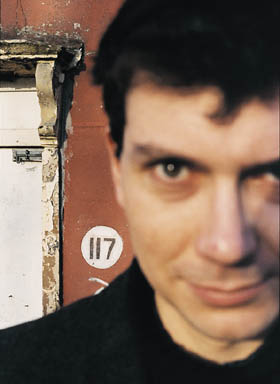
| Magnet Magazine Interview - Magnet 44 Final Draft Fred Mills England's Flying Saucer Attack was the bande du jour among underground hipsters, sonic alchemists and droney space-rockers around the globe. A high-profile appearance at the first Terrastock Festival, along with the release of the long-awaited third FSA studio album, appeared to set the stage for the FSA world takeover. Then -- silence. What happened? "I cracked up for a little while, basically." Flying Saucer Attack pilot, commodore and auteur Dave Pearce is exaggerating, as the laugh accompanying his declaration clearly indicates, but the slightly nervous tone to the laugh additionally says that the man's candor isn't a ruse. Pearce is not hiding anything from us tonight, this frigid, late December evening in Bristol, England, where he's nursing the remnants of a holiday-season cold, slurping hot tea and, for the better portion of a two-hour trans-Atlantic phone chat, laying his thoughts open. Pearce's lengthy exile from the music business proved beneficial. His new album, Mirror (Drag City), is an impressive step forward in the FSA canon that finds him tinkering with his trademark lo-fi, drumless drone formula -- some numbers clank and crunch with am ominous rock-techno flair -- and additionally replacing, on the album's most haunting tunes, his usual intangible vocal mumbling with gently forthcoming, folk-styled singing. "I think this new one has something," agrees Pearce, in a friendly -- if slightly congested -- voice. "And it's a blessed relief, because all these years down the line you worry that you may have completely blown it." Questioning himself and second-guessing his musical choices has always been part of Dave Pearce's essential nature, a trait that seems to run in artists and has the paradoxical ability both to stimulate their artistry and to stop it dead in its tracks. The latter scenario is partly responsible for the wheels coming off the FSA wagon towards the end of '97. Pearce had spent months fussing over the New Lands album, experimenting with new sounds, textures and recording techniques. "Then I got the test pressing of it back," recalls Pearce. "Big or small person -- and I'm definitely a small person! -- you always think, when a new album comes out, 'Maybe someone's gonna like this!' And so I put the test pressing on, listened to it, and thought, 'Oh dear. This just doesn't cut it at all.'' It was a shame; it seemed disjointed rather than focused. But you know, it wasn't only a feeling of, 'Oh, my music's all wrong.' It was also more... 'stuff.' About that time, things just weren't working upstairs in the attic, either, ha-ha-ha!" This 'stuff,' it turns out, was a deep bout with clinical depression. Pearce, by his own account, didn't even pick up a guitar or switch on a tape recorder for a full twelve months, and the remainder of his "vacation" was marked by quick bursts of recording followed by long stints of just listening to the tapes. "It's like I didn't have an 'approach' anymore. My sort of sense of purpose and even my musical purpose just... I dunno, the last two years have disappeared completely -- Prozac probably explains why I'm still here -- because it's something that runs in my family, you see." "Back in 1970, '71, I went through the same thing, and I wanted Dave to know that," says Tom Rapp, the legendary Pearls Before Swine raconteur currently enjoying a revived musical career. Rapp became aware of Flying Saucer Attack through his musician son and from the Pearls tribute album For The Dead In Space, which featured a Flying Saucer Attack contribution. Rapp would later meet Pearce at Terrastock I; hitting it off, they've corresponded ever since. Continues Rapp, "So I called Dave up a few months ago. I wanted to tell him that, hey, you will survive this. And even if you feel good, you can still write songs! That they're not exclusive provinces of, ah, when there's no calm in your life and you're feeling really screwed up. You think, 'If I get better, I won't be able to write these songs anymore.' So we just had a talk about how you can still do that and move forward and still be able to be happy... In a way, I guess writer's block can happen when you start second-guessing. Because I did that too, and it can paralyze you after awhile. I always thought that the key to writing was to just get out of your own way, which is sometimes very difficult. You have to forget to second-guess and just do it!" Backtracking for a moment, cast your gaze to Bristol, England, circa 1990, and to a nexus of musically-inclined friends and students. Rachel Brook (bass) and Dave Pearce (everything else) teamed up as Flying Saucer Attack, eventually issuing a pair of singles and a full-length whose blurry-dreamy, self-styled "rural psychedelia" -- far removed from the UK's soon-to-be-overhyped Brit-pop scene -- quickly caught the imagination of drone-rock mavens on both sides of the Atlantic. And even as FSA was increasing its discography exponentially, other FSA associates were beginning to make their marks in the indie world. Reminiscing, Pearce says, "In many ways it was a nice time! It was different with those early records. A, it was a 'we': Rachel was 19, 20, and I was in my mid '20s. And I was still working in a record shop, a shop not many people came into but most of the people who did knew each other. Movietone [Brook's other band] was getting together at the same time; Crescent was too; Third Eye Foundation was starting and was involved in everyone's bands. And, okay, we might have been playing gigs to 30 people in a back room in Bristol, but there was always something going on. There would be the odd trek up to London to play a gig, and there were all these little records coming out. The point is, everyone was seeming to do something. So all those early FSA records were fueled by that." Kiwi guitar wizard Roy Montgomery recalls being smitten long distance by the first FSA album and subsequently writing Pearce, whom he perceived to be a kindred spirit, suggesting they share a few pints as his '95 travel plans included the UK. Says Montgomery, "He promptly wrote back, rather cautiously agreeing, pointing out that he was not the most gregarious of individuals. 'Fine', I thought, 'I know plenty of folk like this back home in New Zealand', so when I got to the UK I called him up and said 'What are you doing in a couple of weekends' time?'. 'Supposed to be playing an FSA show here in Bristol. Don't expect much, we've never really played properly... do you play drums by any chance?' 'Not really,' I said, 'but I'll bring my guitar just in case...' As it turned out, I found Dave to be very affable, if rather reticent, and after one very low volume rehearsal we hit the stage to play FSA's greatest hits in a small but packed venue in Bristol." Bits of the Montgomery-FSA collaboration would eventually surface on a '97 EP, Goodbye. Meanwhile, the personal relationship between Pearce and Brook was unraveling. That, plus an increasing aversion to playing live on Pearce's part and Brook's involvement with Movietone, signaled the conclusion of FSA Mk. I: "About the time of Chorus ['95 collection of radio and singles tracks] we tried to do some gigs in Germany, and it was a complete disaster. I'd always assumed music was a recording thing anyway, not a sit-in-the-back-of-the-van thing. So that reached an end." Despite claiming to have "no musical ideas at all, not even tapes or half-finished songs," Pearce soldiered on as a one-man FSA, with occasional assistance from friends, churning out recordings. In April of 1997, at the behest/badgering of Ptolemaic Terrascope editor Phil McMullen, Pearce agreed to make his American performing debut in Providence at the first Terrastock gathering. Pearce's showing was initially conceived as a low-key guitar jam with Jim O'Rourke and Bill Kellum (Doldrums, also of VHF Records, home of several FSA releases). But as Kellum relates, "Dave's performance there kind of took on a magnitude for a lot of people beyond what it he intended it to be. It somehow became one of the "headline" events of the festival. I guess quite a few people went up there specifically for that reason. Dave had kind of a grueling trip from the UK to Rhode Island and wasn't feeling well, so we really didn't get a chance to practice at all - we just went over the chords for a few minutes and went up there and did it. A couple of things were really nice and a couple were a little shaky. I think Dave feels like he's not a good live performer and would rather not do it than have people be perpetually disappointed. Personally, I don't think he's giving himself enough credit." Adds McMullen, "Dave was incredibly nervous, but the ad-hoc assemblage of FSA-USA took the stage to one of the largest and most attentive audiences of the weekend, fans hanging on to every word of the hesitant songs, eagerly grasping at every nuance of the music as if it contained a rare gem. It wasn't perfect, but then it's the imperfections which make a gemstone sparkle, and within the context of the festival -- and given Dave's reticence to play live at all -- it was a triumph." As we already know, after Terrastock Pearce returned home to tackle -- and be thwarted by -- New Lands. Cue "vacation"; cut to 1999. Dave Pearce took his friend Tom Rapp's advice to heart and worked through his artistic blockage. The resulting Mirror would be disorientingly beautiful, but it wouldn't come overnight, and it would involve a lot of painstaking experimentation. One new stratagem Pearce adopted was to avail himself of the digital recorders, samplers and computers at the studio of his friend Rocker (who had worked on parts of previous FSA records). Explains Pearce, "When I was round at Rocker's we might knock out something that'd be completely and utterly digital -- for example, the Chemical Brothers pastiche, 'Chemicals,' there's no guitar on that; it's all synthesizers, and the mix was done at his place. Or we'd have some tracks that we'd half-finished, so he'd mix it on DAT, I'd take it home, tape it onto my cassette 8-track, listen to it, think, 'Hold on, I hear something in this!', get a bassline, get an acoustic part, improvise lead guitar, add a vocal... admittedly, at separate times. Then mix it, and bingo! So it's part analog and part digital. You might have some of the clear, digital sounding stuff recorded at Rocker's, then another four tracks of analogue-ness lumbering in atop it." Perhaps even more significant is Mirror's emphasis on distinct vocals, making it a far more intimate album than its predecessors. Pearce, to his credit, has a wonderful voice, clearly influenced by Nick Drake, with just the right measure of emotional warmth to counterbalance the sometimes austere moods his guitars and effects conjure. "On those early records I just found the singing too difficult to do. Fortunately, with the first few records, you mix the singing down and it can be a sort of statement. But you can't carry on that way. You've got to sing out a bit. I wanted a special kind of content, a 'content content' -- if I said 'magic' it would sound corny. Something extra." Tom Rapp: Dave has actually had an influence on my work now. I've been working with putting the acoustic guitar through a vocal modifier and other guitar modifiers as well, and getting all kinds of odd and strange things. I never would have thought to do it that way, but I know it can be done because Dave's done it! At Terrastock we were discussing his idea that all sound is music. That's what I've always thought of Dave's work -- that all sound is music. His new one has some really unusual things, that are just beautiful guitar and voice songs. He seems to be adding a whole new element of words, a whole new form of content. It's courageous to make that kind of leap. Bill Kellum: "There's something about the quality of Dave's music and voice and the weird way it's all put together that gives some people that special, indescribable feeling. Explaining and theorizing and analyzing kind of lessens the magic of the visceral impact of music. In his case I think he has the elusive combination of being able to write a good tune and put it in an interesting setting - a lot of 'drone rock' just sounds like guys fiddling with delay pedals. I guess there's always going to be people who imitate rather than take the initiative to find their own voice and a setting for it the way Dave has." Roy Montgomery: "In essence, I regard him a fellow amateur explorer of musical forms, a genuinely talented but fragile individual who has already made a significant mark upon the 'tuneful noise' tradition of the past few decades. He has a great sense of humor, and I hope he continues to chase his muse." If, as the cliche goes, a man's fortune is measured in terms of the lives he's touched, then Dave Pearce is wealthy indeed. And he's been generous with his gifts. "Sharing your creativity is communicating something, and being able to do that is a good thing," says Pearce. "It's that odd sort of how-do-you-justify-your-existence problem. Long before I ever released anything I wanted to do a record. I don't think my just walking through the streets of life is justification. You have to have some physical thing." If, as another cliche goes, music has the capacity to soothe and heal, then perhaps Pearce, through his travails, learned to trust its therapeutic powers. He's already looking at the future, contemplating an all-acoustic record, and doesn't completely rule out performing live, either. ("Probably just sit there with my new acoustic guitar -- I've just bought an expensive one that I can't play!") At the moment, however, he's pretty pleased with the new FSA record. "It's like when I got the test pressing for Mirror. I listened to it then thought, 'There's something I really like here!' I dunno what happened this time. What I think I was trying to do before, I've done a bit 'better.' I mean 'nearer' to what I've been trying to do all along. I'm not turning my back on distortion, or the ragged-arse approach of before. I'm not going to say it was all wrong before. But there were always things I found a bit cringeworthy -- the singing or the lyrics, or the tape hiss. So this one, whether it was a culmination or a fluke, the end result is that I'm proud of the record. "You're talking 11 songs and nothing else, no outtakes, that represent two calendar years. Yet it seems more complete than ever, in a way. This whole period has been very, very good for the music. "You know, the reason that you make music is because you can't express certain things verbally. I was watching a documentary about Kurosawa, and people were interviewing him, saying, 'So tell us what it means, this film.' He said, 'If I could tell you what it meant, I could have written it on a piece of paper, held it above my head, and stood on the side of the street. I wouldn't have made the film!' And that's a terrible answer in an interview, but... that's the thing, exactly." --end-- |
 |