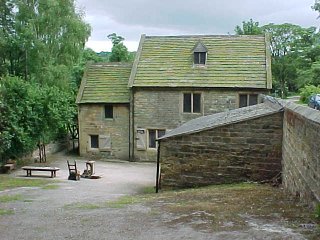
| For over 600 years there has been a water-mill at the
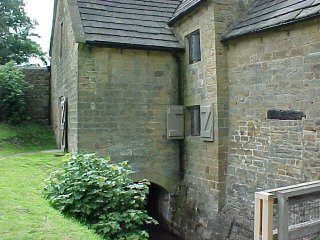
foot of Hodmire Hill where the Stainsby Brook joins the River Doe Lea.
Until 1593 it was owned by the Savage family, Lords of the Manor of Stainsby, but was then bought by Bess of Hardwick. Grain grown by the tenants was converted into flour and fodder for the Hardwick Hall estate. |
 |
|
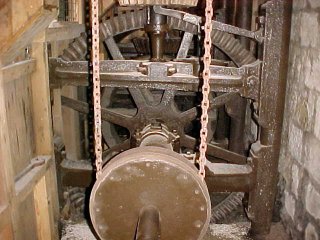
The water-wheel is seventeen feet in diameter and five
feet wide.
Water powers all of the machinery and because of the design and layout the mill could be operated by one person. In the seventeenth century a kiln was built and a drying floor installed above it. Grain and other crops could now be dried on the premises. |
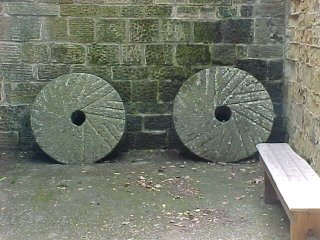
| Three pairs of millstones are in situ; a pair of French
burrstones installed in 1850 and two pairs of local gritstones from
Hathersage.
Two stones were brought to the mill in 1890 at a cost of ten guineas (over £1000 at today's value), and weighing 1.5 tons each. |
 |
 |
By 1900 new developments had overtaken the mill. Imported
American wheat produced a better quality white flour but Stainsby's stones
were unsuitable for grinding this harder grain.
Water turbines and roller mills superseded its more primitive technology and there was less and less need for its produce In 1952 the long tradition of milling at Stainsby came to an end. |
Stainsby Mill passed to the National Trust in 1976 and after substantial restoration was opened to the public in 1992. |
|