
Judas Iscariot
· The name Judas is the Greek form of Judah (Hebrew for “praised”). Among the twelve, two had the name and for that reason, Judas who betrays Christ, is associated with the surname Iscariot (Hebrew for “a man of Kerioth”).
· Unlike the other Apostles who were from Galilee, Judas was from the city Kerioth in Judah. There is no mention in the Bible concerning his joining of the Apostles or his part in the ministry and miracles.
· He is never mentioned without some reference to his betrayal of Jesus. Judas is referred to as the devil or having Satan enter into him when the betrayal is mentioned.
· Went to the Sanhedrin, the supreme national tribunal of the Jews, to offer up Jesus in exchange for money.
· Jesus knew about the betrayal before it happened. When John the Evangelist asked Jesus which one of them was going to betray him, Jesus answered that it would be the one to whom he passed dipped bread. After Jesus dipped his bread, He gave it to Judas Iscariot.
· Judas left and came back with soldiers to the place where Jesus and the disciples were. The first three gospels describe how Judas gave Jesus a kiss to signal to the soldiers which one they were after. Mark claims that Judas said “Hail, Rabbi” before kissing Jesus, who does not give a reply. Matthew claims that after Judas greets him as stated by Mark, Jesus replies “Friend, whereto art thou come. Luke adds that after the kiss, Jesus asks, “Judas, dost thou betray the Son of man with a kiss?” However, these accounts are not described in John’s recounting of the story. According to John, the soldiers arrived and asked which one was Jesus and then fell over backwards to the ground when Jesus said, “I am He.”
· Matthew is the only one to mention the sum paid to Judas by the chief priests, and makes note that an Old Testament prophecy has been fulfilled because of it. He also tells of Judas’s repentance and suicide, neither of which is mentioned in the other Gospels. There is another account of these events in a speech by Peter in the book of Acts although there are some discrepancies between the two accounts. Peter’s account seems to imply that Judas bought a field with the money he received from betraying Jesus, and it was subsequently called “field of blood” because of his death. However, Matthew, on the other hand, claims that Judas took the thirty pieces of silver back to the high priests and threw it back at them as an act of repentance. Judas then went and hung himself. Matthew recounts how the priests, in an act of contrition, used the thirty pieces of silver to buy the field to use for the burial of strangers, which for this cause was called the "field of blood." All of this, according to the Matthew, was the fulfillment of the prophesy foretold by the prophet Zechariah in 520 - 518 BC.
· There is a view held by an early Gnostic sect known as the Cainites that maintains that Judas was actually enlightened, and acted as he did in order that mankind might be redeemed by the death of Christ. Because of this, they consider him worthy of esteem and gratitude. A more modern version of this theory suggests that Judas, like the other apostles, did believe that Jesus was the Messiah. They believe that he went to the priests to turn Jesus in, not because he thought that they would kill Christ but because he thought that the arrest would provoke an uprising from the people who would then set Jesus free and place Him on the throne. To support this belief, they point out that when Judas found out that Jesus was condemned and given to the Romans, he immediately repented.
Images
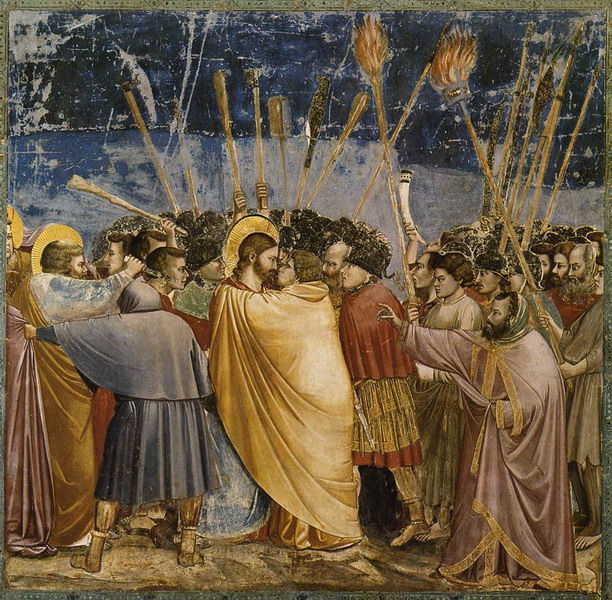
The Kiss of Judas by Giotto
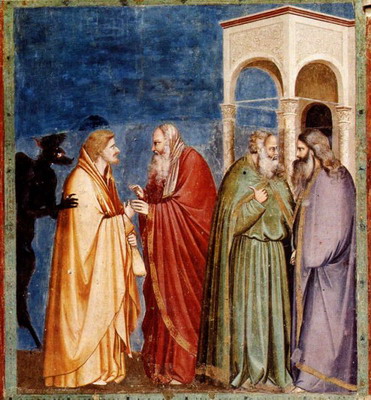
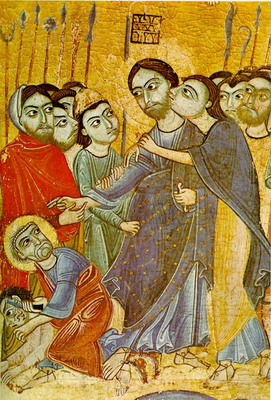
LEFT: The Betrayal by Judas by Giotto; RIGHT: The Kiss of Judas by Anonymous (XII Century)
Links