 Poland and WWII


Bucharest, 19th March 1940. Left. Clockwise from top left: Julian Knot [still alive as of 1998 and living in Canada], Michal Zawisza [died 1981], Stanislaw Jesinski [died 1997], Wladyslaw Topko [died 12th February 1945 of wounds, buried at Goirle War Cemetery, Holland], unknown, Mieczyslaw Zawisza [returned to Poland after the war]. Right. Stanislaw Jesinski.
Background This page is a dedication, both to my grandfather,
Stanislaw Jesinski (later known as Stanley Kean), and to the hundreds of thousands of
Poles like him, who, despite being victors in the war against Germany and its allies,
lost their homes, families and previous lives. My grandfather was born in Przemys'l
in south-east Poland on 27th September 1911, he was almost 29 years old when the war
began. He was never to see his mother, father or youngest sister again, despite the
fact that they survived the war. He was not to see his other sister, Wanda, until
the 1970's, when she visited London and he travelled from Scotland to see her. Although many did
return home permanently, or did so for short visits
after Stalin's death in 1956, my grandfather's story is by no means anomolous, and,
given Churchill's role in this betrayal, is one that should be weighed against his
wartime achievements.
Blitzkrieg
I think this is the document
that allowed my grandfather to leave Poland in 1939. Note the somewhat deceptive
date - it's Polish for 30th August. A postcard my grandfather received from a girlfriend,
whilst staying in a YMCA in the Rumanian town of Tirgu Jui. She is telling him of
the terrible bombings and food shortages in L'wow. Note the Russian stamps.
left: Split, Yugoslavia 1940 On 1st September 1939
the German army entered Polish territory in the north, south and west. Within four days
they had penetrated fifty miles into Polish territory, and the devastation was so great that by September 10th
Polish forces and able-bodied men were being ordered to the south-east of the country. Two
weeks later the Russians, who had signed a non-aggression treaty with the Germans,
attacked in the east. The Polish government called on all able-bodied
Poles to head south into Rumania, and then on to France. Hundreds of thousands,
mainly from eastern Poland, made their way through the Carpathian mountains. Many
failed to avoid the guards, but many more made it to their destination.
My grandfather was interned in Bucharest, but 'escaped' to Yugoslavia.
Many others made it to Italy. It was from Rumania that many Poles heard of the fall
of Warsaw to German forces on 28th September. From here they made their
way westward to France in boats and ships, most arriving at
Marseilles in the south of France. In addition to these fragmented many, there
was also a vast group led by General Wladyslaw Anders who marched from Russia to
Syria. The Polish Army in France
left: Coetquidan, France, 1939/40 The arrival
of the Poles in France caused their hosts a major headache. Where to put them? What would
they wear? How would they be armed? The first answer came in the form of three D�partements
known as Coetquidan,
the second in twenty year old blue uniforms, and last in the form of Great War rifles. As
Pruszynski has argued, however, they did not lack "enthusiasm and fighting spirit". Three
brigades were formed - the 'Podhale Brigade' and the '1st' and '2nd' Divisions. The Podhale Division
was sent to fight in the mountains of Norway. The 1st and 2nd Divisions defended the
Maginot Line, and eventually covered the retreat of the French army at Raon L'Etap. Heavy Polish losses
were inflicted. It was at this point that Petain contacted Hitler requesting an armistice. Sikorski
persevered, defending the French retreat, with the aim of reaching the ports in the
south of France, in order that they could escape to Britain. Pruszynski puts this retreat
eloquently: "they scattered through the Vosges. Polish guerillas went on fighting ...
for two weeks after the armistice. They found food in the villages at night. Sometimes the peasants helped them;
many fell into ambushes and were never heard of again. But several thousand men emerged
from the forest at the other end". The 2nd Division made it to Switzerland where
they were interred for the rest of the war. The 1st Division was eventually evacuated from La Rochelle.
The Polish Army in Scotland
The first Poles sent to Scotland in 1940 arrived in Glasgow,
camping in football grounds and parks. From here they were transferred out to
surrounding areas such as Biggar, Douglas and Crawford. In most cases (even given
the distinct religious differences) relations were remarkably good, with Biggar,
for example, holding an Open Day in their honour. Relationships were formed with
many local women, but, perhaps due to the immaculate manners of the Poles, there
was to arise little of the animosity that was to greet American soldiers on their
arrival. The following years were spent 'defending' the Fife coast, from
Burntisland to Montrose. It was here they would remain until June 1944.
The Polish Air Force
left: Flight Lieutenant Jan Zumbach of 303 Squadron
of the Polish Air Force, 1943
Perhaps the greatest attention given to the Poles regarding their
place in World War Two comes from their exploits during the Battle of Britain. Did
the introduction of the Poles, after the usual xenophobic deliberation, on 30th
August 1940 (see the movie 'Battle of Britain' or check out the website dedicated to Miroslaw Ignacy Wojciechowski)
turn the Battle of Britain the way of the Allies? Certainly most British pilots have
nothing but praise for their Polish counterparts, who were well-trained and battle
experienced. Additionally, the statistics speak
for themselves. On what is widely regarded as the turning point of the battle (15th
September), Polish flyers claimed 27 of the 56 German aircraft downed. Polish
303 Squadron ended the Battle of Britain as the most successful of the Allied squadrons.
Normandy: The 1st Polish Armoured Division
far left: Emblem of the 1st Polish Armoured Division left: Badge of the 1st Polish Armoured Division The events of 1943 at Tehran [as will be mentioned]
left relations strained between Poland and Britain. Indeed, the role of the Polish
Parachute Brigade was to aid the eventual Polish uprising, but they were never to reach Warsaw.
The 1st Armoured Division, on its arrival in Normandy, joined up with the 1st Canadian
Army. Progress, unlike that of the Americans, was slow. On 17th August they were ordered to
close the Falaise Gap, thus surrounding a vast part of the German army. The Gap
was finally closed on 21st August. The war was not over, but the closing of the
Falaise Gap can perhaps be viewed as the beginning of the end. The division then pushed
on into the Low Countries, liberating towns such as Baarle Nassau, Vlijmen and,
most importantly, Breda. Along the way thousands of Poles (forcefully enlisted into the
German army) joined their countrymen, on the march to Wilhelmshaven. They reached the
town just as the Germans surrendered.
Normandy: The Polish Parachute Division
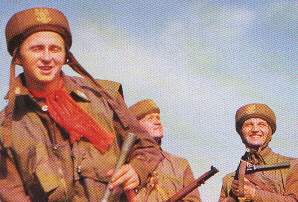
Polish paratroopers in Scotland, 1943
The original remit of the Polish Parachute Division was to aid those
Poles who rose against the Germans in their home country. This objective never came
to fruition, and they then came under the command of the 1st British Airborne Division which was to attempt
to take Arnhem bridge. On the opposite side of the bridge from the British, Major General Sosabowski
was ordered to relieve them. They failed, under heavy fire, to reach the other side, and
much criticism was endured by the Poles for this failure. This less than aggressive Polish advance
can, perhaps understandably so, be attributed to the lack of commitment to Polish
freedom shown by Churchill.
The Aftermath
The aftermath of the war for Poland was
actually decided in 1943
when the allied leaders (not including representatives from Poland) met at Tehran.
Stalin was handed the eastern section of Poland, up to and including L'wow, whilst
Russia would control elections within the remainder of the country. Churchill had
decided Poland's future, with little or no thought for the part they had played in
securing his. In his defence he probably had little other choice than to start a war
with Russia, but one should ask how important was the part played by the Polish pilots
during the Battle of Britain. Had it not been for them would Britain have fallen?
Given this situation, then, Britain was all but forced to
give permanent shelter to those Poles who do not wish to return to a Soviet-controlled
homeland. The monetary problems faced by Britain in the post-war years led to the
'Polish Question' - what to do with them? Initially many undertook the post-war occupation of Germany. The 1st
Polish Armoured Division, for example, was based at Oldenburg, Hanover, and Munster,
whilst the 2nd Corps were based mainly in Italy and the Middle East.
In 1946, the Polish Resettlement Corps (PRC) was
formed to help integrate into Scottish society those who were unwilling to be repariated to
Communist controlled Poland. More than two-thirds of the Polish soldiers chose to
stay in Britain (around 36,000 in Scotland) and anti-Polish sentiment was reduced by the post-war labour shortage.
In the Polish elections of 1947 the outcome was decidedly in favour of the pro-Communist parties.
Poland had been denied its democratic right. By April 1948 almost all the quarter million
Poles had been brought to Britain. Of these only 105,000 returned to Poland.The remainder enlisted in the PRC,
and by 1951 only around 10,500 remained in Scotland.
The death of Stalin less to a
somewhat less autocratic Soviet rule in Poland, the result of which was that letters began to be sent home and, occasionally,
trips were organised. Nevertheless, the loss of the Poles should never be underestimated. Two stories portray this.
The first is of my grandfather. After leaving his country in 1939 he was never to see his mother and youngest sister again.
In the late-1950s his father organised a trip to Scotland. He died two weeks before he was due to fly.
He did not see his sister Wanda until the 1970s. The second story is that told to me
by the wife of a soldier who knew my grandfather, called Ryszard Pach. They had visited
Poland in 1973 to find his mother, only to discover that she had died a mere six months before.
One can only guess at the level of bitterness directed by many Poles at Germany, Russia and,
perhaps more obviously, against Churchill. The creation of a free Poland in 1990 has had little
effect on the majority of Poles in Britain. They certainly understood the significance of
the occasion, but many were almost fully acculturalised into Scottish society.
Their children were, in virtually every respect, wholly Scottish. With every passing Pole
their struggle, both during and after the war, becomes less
visible, but it never becomes less relevant. They fought the war from its very first day
to its very last, and all continue to pay the price of that conflict.


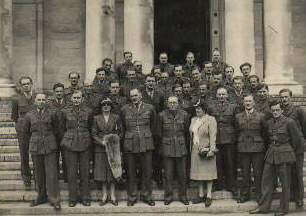
right: Polish War Choir 1940's


Check out my chat page regarding the Polish forces
For the Official Website of Poland click here
For a similar overview of Poland's contribution to the allied victory in WWII click here
For an in-depth look at Polish war graves and all things Polonica click here
For an in-depth look at Polish militaria check out The Polish Collector
All are written in English
I am always happy to speak to others regarding the Polish story.
I'm particularly interested in the 1st Armoured Division, and especially the 9th
Flanders Rifle Brigade. If you have (or had) relatives who were in this unit please
contact me. I am in contact with two people whose fathers (one of whom is still alive)
were in this unit. All
three of us have numerous photographs and stories which we are more than happy
to pass on. Contact me
