Rival southern California Hispanic street gangs had one thing in common: they were enemies with anyone from northern California.
This rivalry united them in jail and in state prisons. The same was true for northern Hispanic gang members, except their common enemy was any gang member from the south. Somewhere, while the dust was settling between these two groups, they began to visualize an imaginary line which divided the northern gangs from the southern gangs.
This line turned out to be a gray area, rather than a clear line, in central California. However, gang members usually agreed that the division was located somewhere between the cities of Bakersfield and Delano.
Street and prison gang members from Northern California began to use the number 14 as an identifier. It represented the 14th letter of the alphabet, the letter "N." The letter stood for Norteño, the Spanish word for Northerner. The term Norte was used to show that a person was from the north. Individuals from southern California were automatically considered rivals, both inside the prison system and on the streets.
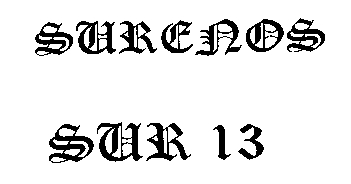
Southern California gang members began using the number 13 as an identifier. The 13th letter of the alphabet is the letter "M," and the word for this letter in Spanish is "Eme." Southern California gang members started using words like Sureno, which means "southerner." Often, this term was abbreviated as sur/SUR. Gang members also started to tattoo themselves with the number 13 and with the terms Sureno or Sur along with the name of their gang, to signify their origin in southern California. Within prison walls La EME “shot callers” direct Southern Hispanics, also referred to as Surenos, to assault other inmate groups and staff.
Prison records indicate the Surenos are involved in many of the prison melees or mini-riots.
Inmates in the state prison system were given bandannas in a railroad print, and could select from two colors: red or blue.
Hispanic street and prison gangs from northern California claimed the color red to identify themselves. They used this color because most of the southern California Hispanics in state prison had chosen to wear a blue-colored railroad handkerchief. The Crips and Bloods were not the first gangs to use red or blue to identify.
According to the information provided by the Arizona Department of Corrections Web Site on http://www.adc.state.az.us/STG/Surenos.htm
Membership - Approximately 160 members in prison
Tattoos/Symbolism - Sureno, Sur, Sur 13, 13, X3,
Racial make up - Mexican Americans and Mexican Nationals from Southern California Criminal Street Gangs
Prison Criminal Activity- Aggravated Assaults, Assaults, Narcotics The Group has a very close allegiance to the California Mexican Mafia and Arizona's Old Mexican Mafia. The Group is currently has extreme conflicts with the New Mexican Mafia. Membership is on the increase. Extremely disruptive to safe, secure and orderly Prison Operations.