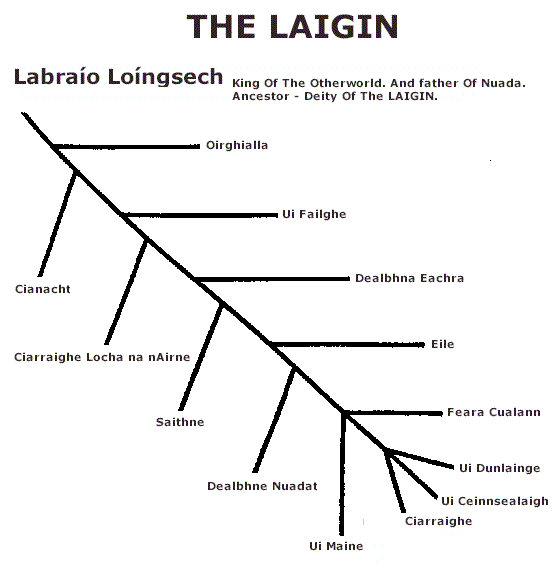
Cianacht -Eile Seperate Tribes?
|
In Review of Source Materials The following information seems to break from the opinions of the members of
the Clan Cian group of California. Our question is or should be what is the authentic history of Ireland, does it matter? If our desire to
know where we come from and what events in time have formed who we are; isn't it important to understand those events and the actions
our ancestors took to resolve them?
In historical times (i.e., the historical cycle), the need to manipulate a social standing, may have been important to provide social growth,
or further political and or military ambitions. However, the current times, in order to understand our past, histories, lore and culture; the need
to research objectively is paramount. To romanticize or manipulate the histories of our cultures- dwarfs our understanding of who we are,
where we come from and what made us the people we have become. A review of these references, may help to further our understanding.
The following information is excerpted from the book- "The Anglo-Norman Advance
into the South-West Midlands of Ireland 1185-1221" Chapter Two: Ely O'Carroll, The Ele; By: George Cunningham, ISBN: 0 9505368 4 9
"Between the fifth and twelth centuries the Ele, a tribe possibly of Laginian origin, were
forced southwards by the Ui Neill expansion into south Midhe..... The following information is excerpted from the book- "Clans and Families of Ireland
and Scotland: An Ethnography of the Gael A.D. 500-1750." By C. Thomas Cairney, Ph.D. ISBN: 978-1-58549-070-9
(used with permission from the author). Note that the author identifys 12 different tribes of the Laigin. Those tribes are: VIII. The Laigin The Laigin, or Dumnonii, were the third
ethno-tribal group to come to Ireland, coming from Gaul shortly before the Gaels
themselves, sometime during the first century B.C. Branches of the Dumnonii settled first
in the Devon-Cornwall area before others moved on to Ireland (Chapter III). In southern Britain their kingdom gave its name to Devon (Dumnonia). In
the time of King Arthur (ca. A.D. 500), as the tribe most closely associated with that
great Pendragon, these Devon Domnonii established a dual kingdom which included the north
coast of Brittany (Domnonie), from whose royal house eventually sprang the House of
Stewart (which house inherited the crown of the Scots in 1371 and that of England in
1603). The Stewarts are covered under the chapter on the Normans, having come to Scotland
in the wake of Norman conquest of England, in which they served as allies of the dukes of
Normandy. In Ireland the Dumnonii were generally known as the Laigin, and
originally became overlords in the southeastern and central regions, and in Connacht. From
there they later spread to other parts of Gaeldom, as we shall see. Tribes of the Laigin The Cianacht The Luighne or "race of Lugh," included the families of
O’Hara (O hEaghra) and O’Gara (O Gadhra). The O’Haras descend from Eaghra,
Lord of Luighne (now the Barony of Leyney) in South Sligo, who died in 926. In the
fourteenth century the O’Haras divided into two branches, the heads of which were known as O’Hara Boy (Buidhe), the
Yellow O’Hara, and O’Hara Reagh (Riabhach), the Speckled or Brindled
O’Hara. A branch of the family settled early in County Antrim, and became very
important there. The O’Garas were once one clan with the O’Haras, and together
their territory, Luighne, included the modern baronies of Corran and Leyney in South
Sligo, and Gallen and North Costello (Sliabh Lugha) in Mayo. About the end of the tenth
century the two families separated, and divided the territory between them, the
O’Garas taking the Mayo portion. They were driven from their territory by the
Jordans, Costellos and other Anglo-Norman settlers, and resettled in Greagraidhe, in Sligo, now
the Barony of Coolavin, and were later known as lords of Coolavin. They built their
stronghold, Moygara, at the northeastern extremity of Lough Gara. Branches went to Munster
before the end of the sixteenth century, and are known as Geary or Guiry. The
O’Duanys or Devanys of Sligo are a branch of the O’Garas. The Eile The O’Carrolls (O Cearbhaill) descend
from Cearbhaill, Lord of Ely, who was one of the leaders at the famous battle of Clontarf
in 1014. The head of the O’Carrolls was originally lord of all Ely, but after the
Anglo-Norman invasion their power was restricted to South Offaly, which was subsequently called Ely O’Carroll. The Ui Cairin or O’Mahers (O Meachair) are of the same stock as
the O’Carrolls, and were lords of Ui Cairin, now the Barony of Ikerrin, in the old
Ely territory in Tipperary. After the Anglo-Norman invasion, Ikerrin was added to Ormond,
but The O’Maher (chief of the sept) was left in control of the territory as tributary
to the Butlers, the Anglo-Norman earls of Ormond, under whom they flourished. The O’Riordans (O Rioghbhardain) are a branch of the
O’Carrolls of Ely, and probably descend from Rioghbhardan, son of Cucoirne O
Cearbhaill, Lord of Ely, who fell at the battle of Sliabh gCrot in 1058. As late as 1576 a
"Gaven O Rewrdane" was a "freeholder" in Ely O’Carroll, and one
of the most important followers of Sir William O’Carroll. By this time branches had
spread into Leix and Kilkenny, but even earlier the greater portion of the sept had
removed to Cork and Limerick. In 1597 Maurice O’Riordan of Croome was attainted by
the English, his lands being given to a George Sherlocke. The O’Flanagans (O Flannachain) are of the same stock as the
O’Carrolls of Ely, and were chiefs of a territory known as Cineal Arga, now the
barony of Ballybrit, in southeast Offaly. **NOTE** We request that if anyone has information contrary to that posted , or has information that refutes
that posted to this site....Please, forward title, author, publisher(date) and ISBN if known; that the source materials might be compared, referenced and or cross
referenced to attempt to varify said information. ( [email protected] )
|